Posted on Leave a comment

Winter Mornings in West River

Highland Ridge Road in Wind Cave National Park is one of my favorite places to experience the breaking of a new day. Flanked by prairie dog towns and grazing buffalo, an early riser is sure to hear a coyote chorus across the rolling landscape. If you are really lucky, grazing elk, pronghorn and even a glimpse of one of the coyote choristers is possible when the morning light breaks above the distant Boland Ridge to the east.

I spent two mornings in early January getting my fill of morning’s glory in this special place. The first morning was mostly clear and the rising sun revealed pronghorn grazing on the edge of a prairie dog town with a small herd of bison in the distance. Coyotes sang all around me, unseen but close enough to count five distinct voices. Elk grazed on the northern ridge just opposite Custer State Park’s southern fences. It’s no wonder that folks liken this part of South Dakota to the Serengeti in East Africa. I have visited both places in the morning, and the experience does have similarities when it comes to wildlife and natural beauty.

As the morning progressed, I noticed slight hoarfrost in the lower draws of the park. Hoarfrost forms when water vapor in the air condenses on cold surfaces on clear, windless nights. Crystals freeze directly from the vapor state and do not turn into liquid water in the process. This is different than rime ice that is seen accumulating during fog events. Hoarfrost is typically finer and more delicate, but it is just as fun to photograph. With my trusty macro lens and some bright sunlight to help light the minutiae of grass, chokecherry branches and slender yucca blades adorned with ice structures, I spent nearly an hour bent close to the earth trying to record the beauty in detail. During the process, I came across a young buck overseeing a small group of mule deer. The does did not seem concerned, but they moved after the buck decided I was too close.

On the second magical morning, the sky was gray and colorless. There was fog in eastern parts of the park, which left rime ice on the grass and pine trees. Three bull elk weren’t far from the road and allowed me to photograph them before moving on. It was my last day of my West River winter vacation, and it did not disappoint. As is my usual habit, I detoured through Badlands National Park. Strong flurries added snowy drama to the scenery. My favorite sites were a few lone bison moving slowly through the weather and the colorful Yellow Mounds portion of the park framed by white snow. Winter in South Dakota may not get raving reviews, but in this case, my camera says otherwise.

Christian Begeman grew up in Isabel and now lives in Sioux Falls. When he’s not working at Midco he is often on the road photographing South Dakota’s prettiest spots. Follow Begeman on his blog.

Posted on Leave a comment

Postcards from December

As another year comes to an end, I find myself watching the weather closely like most of us in the Upper Midwest. When there is fog and overnight lows below freezing, I really pay attention. I know those conditions mean there is a good chance of frost appearing, which means great opportunities to find and photograph ordinary scenes that become transformed into extraordinary winter works of art.

This year what little snow we had in early December melted on a few relatively warm days, but the cold nights caused the moisture to return again in the form of fog and rime ice. Rime ice is the scientific term for it, but folks around here know the phenomena simply as frost. I particularly enjoy when frost appears like it did this season, with little to no snow to hinder traveling. I have family in the northeastern and north central part of the state, and this winter I’ve found myself on the road more than usual with holiday travel and attending basketball games. For two of those trips Jack Frost was hard at work, so I left early to see what I could find.

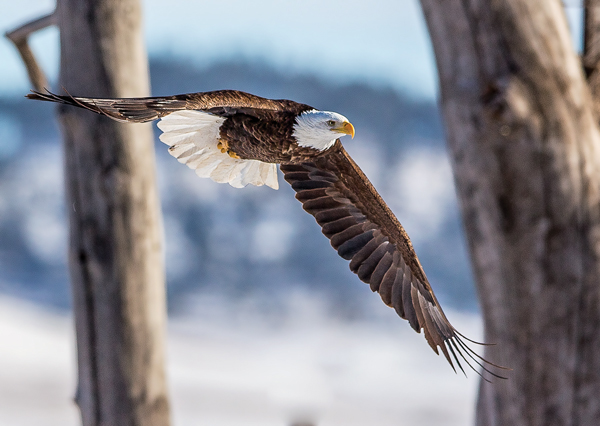
On Christmas Eve I was due in Mobridge for supper. That gave me all day to search out frosty art on my way. I started at Terrace Park in Sioux Falls. Ornamental cherry trees still had red fruit attached and few leaves had yet to drop. These provided excellent bases for frost to accumulate. After about an hour, I drove up to the Dells of the Big Sioux, stopping to shoot a favorite red barn and the railroad tracks that go through downtown Baltic. At the Dells, a pair of bald eagles were patrolling the river, and I was lucky enough to watch them fly below me as I was checking out the scenery.

From the Dells, I drove west to Highway 81 and then turned north after detouring through Lake Herman State Park near Madison. I stopped in the city park at Arlington where the rime ice was particularly thick. An old red hydrant that reminded me of watering calves back home on the farm was particularly striking adorned in frost. Later on, I spotted what looked like an elevator building on a ranch in rural Faulk County. By the time I was driving through Potter and Walworth counties, the snow was gone, but the fog still covered the taller grass and trees white with frost. It was hard not to be in good holiday spirits after a trip like that.

December seems to be the time when winter is most beautiful on the Northern Plains. Maybe it’s the holiday season, or because we simply aren’t tired of the cold yet. Either way, I hope you enjoy my collection of December postcards as much as I enjoyed capturing them. Happy New Year and good luck with the camera work the whole year long!

Christian Begeman grew up in Isabel and now lives in Sioux Falls. When he’s not working at Midco he is often on the road photographing South Dakota’s prettiest spots. Follow Begeman on his blog.

Posted on Leave a comment

Going Vertical

Ever since smartphones put a handy camera in everyone’s pocket, I’ve been known to complain about vertical video and photos. As one who learned to capture media prior to the digital age, the horizontal format was never challenged. The dimensions varied from film to television, but we were all used to creating and consuming photos and video in roughly a rectangular space. Now there were exceptions. Magazine covers, for example, had to fit in a vertical space. Portraits, whether school ping pongs or 8×10 glossies from your favorite Hollywood stars were also mostly vertical. Even so, the vast majority of video and photography was shot in a horizontal space.

That has all changed. To me it’s more jarring on video than photography. I’m not the only one that hasn’t adapted easily to the changes. I’ve seen multiple t-shirt designs stating a common theme:”Just say no to vertical video.” I prefer horizontal photography due to my penchant for landscapes and skies. That said, there is a time and place for vertical photos. I guess. So, I faced up to the challenge of vertical imagery and explored it in this month’s column.

The most common time I find the urge to turn my camera sideways is under the night sky, particularly when the Northern lights are strong and high overhead. We are in the midst of the solar maximum, an 11-year cycle in which there are more sunspots than usual. These sunspots tend to produce more solar flares. The solar flares, when sent in our planet’s direction, are the main cause of Northern lights. The energized plasma interacts with our magnetic field to produce the Aurora, and if you can catch a stronger geomagnetic storm, it is quite a sight. These nocturnal events are also really fun to photograph. Our modern camera sensors pick up on the color of the lights better than our eyes, which flip rods and cones around in the dark. This means colors that appear dull to the naked eye really pop in a photograph. I like to frame these displays with country church steeples. Adding a strong foreground element makes a more interesting image.

Other times I’ve turned the camera vertically include rainbows after a strong storm, waterfalls and close-up detail like a backlit leaf in the autumn sunlight. In September and October, you can still see the Milky Way as long as you are away from strong light sources. As soon as it gets fully dark, the starry pathway shows nearly vertical in the south, southwest sky. This year I found myself at the Needles formation in Custer State Park for one such evening. I have long envisioned a shot of the Milky Way alongside the Needle’s Eye and found the best way to capture it was to indeed turn that camera sideways and go for the vertical shot. It seems old dogs really can learn new tricks.

Christian Begeman grew up in Isabel and now lives in Sioux Falls. When he’s not working at Midco he is often on the road photographing South Dakota’s prettiest spots. Follow Begeman on his blog.

Posted on Leave a comment

West River Autumn

September usually signals the end of hot summer weather in South Dakota, but this year things have been warmer than usual. The dry and dusty days of late September reminded me of the hot and dry summers of my youth growing up along the Ziebach and Dewey County line. The only difference was a lot more grasshoppers back then and these days I pack a camera any time I’m back in West River country. Such was the case when I took a much-needed vacation to the Badlands and Black Hills the last week of September.

Over the years, I’ve discovered that as amazing as these locations are, it is in the golden and blue hours when magic happens. For those of you wondering, the golden hour is the hour before sunset and after sunrise. The blue hour is the time after the sun sets or before it rises when the sky is not fully dark. These are the times that wildlife is most active, particularly when the day is going to be baked with a side of gritty wind.

Since daylight shortens in late September, there is also more night. In the Badlands and more remote parts of the Black Hills, added darkness is a boon to stargazers and amateur astrophotographers. The Milky Way can be observed as a near vertical shaft of distant starlight in the southern sky about an hour and a half after dark in late September. As the night wanes, the Milky Way slides westward and slowly sets. This year, I finally attempted a Milky Way composition I’ve been wanting to do for about a decade. I wanted to align the Milky Way with the Needles Eye in Custer State Park. With clear weather, this was the year to give it a try. At elevation, the hot air of the day cooled as the evening deepened. The wind died except for an occasional vehicle passing by and I soon became alone with the stones and stars. It’s hard to explain that feeling, and photos can’t do it justice.

Late September also brings out the first blush of autumn’s color, particularly in the high draws and high country. Spearfish Canyon is a national scenic byway, and early fall is among the best times to take the drive. Further up and into rural Lawrence County, even more beauty can be found with stands of aspen and birch glowing in the sunlight. And there are fewer tourists and dust clouds along the county roads to boot.

I spent my last few days in Custer State Park just after the big annual buffalo roundup. Call me anti-social if you want, but I prefer the quiet parts of that park and adjacent Wind Cave National Park. I did stumble on quite a scene, thanks to the roundup. While traveling the Wildlife Loop Road, a scene that could have been taken from centuries ago revealed itself as I approached the bison corrals. The trees of Lame Johnny Creek were showing off their autumn color and scattered beyond on the receding hills was a portion of the big bison herd grazing peacefully. Moments like this are what keep me coming back to this part of the world when the seasons change.

Christian Begeman grew up in Isabel and now lives in Sioux Falls. When he’s not working at Midco he is often on the road photographing South Dakota’s prettiest spots. Follow Begeman on his blog.

Posted on Leave a comment

Small in Frame

Earlier this year, I received a call to submit to a photo contest online with a theme called”small in frame.” The example photo was of a scarlet tanager on a branch surrounded by greenery. The tanager’s brilliant red was”small” in the frame of green-on-green foliage, but in spite of this, the vibrancy and beauty of the bird was accentuated because of how it was framed. This made me think about what else I have photographed, or could photograph, with this technique in mind.

In this column, I’ve found a few bird photos from this spring where I was forced to use a”small in frame” approach. The reason? I couldn’t get any closer to the birds. Shooting small songbirds during migration is difficult when not using feeders or blinds. While birding Palisades State Park in May, I found a good perch above Split Rock Creek looking over a few trees above the canyon. After an hour or more of soaking in the spring sunshine and birdsong, an Indigo bunting landed on one of the farther branches and the resulting photo is one of my favorites from that day.

Photographing country churches also provides a great opportunity to shoot”small in frame,” especially when showcasing our beautiful South Dakota sky and landscapes. Wildlife both large and small can make good subjects as well. Photographs of a lone elk on a ridge in Wind Cave National Park and a Monarch butterfly on a wild blazing star flower showcase the power of the technique.

In late summer, I’m often in northeast South Dakota on weekends seeking late summer wildflowers in the remnant tall grass and fen preserves. This year, I shot with”small in frame” in mind. I particularly like how this theme shows off not only the whole plant but the habitat and other grass species in which it thrives. I’ve always been a fan of macro photography and wildflowers naturally make great subjects. I found that pairing a photo of a wildflower species in its habitat with a macro close-up of its delicate beauty tells a powerful visual story.

I didn’t submit any photos to the”small in frame” contest, but if it ever comes around again, I will now be a little more prepared. Ironically, my strongest instinct as a photographer is still to get as close as possible to whatever I’m shooting, but this little exercise proves it is not always necessary to capture a unique image of the beauty found here on the Northern Plains.

Christian Begeman grew up in Isabel and now lives in Sioux Falls. When he’s not working at Midco he is often on the road photographing South Dakota’s prettiest spots. Follow Begeman on his blog.

Posted on Leave a comment

Summer Safari

Late June and early July in South Dakota never cease to surprise. A drive on the last Sunday in June and a three-day trip to see family over the Fourth of July provided more photos than I can share here. That’s largely because of my habit of only traveling the back roads, which sometimes causes consternation for those waiting on my arrival. I’ve learned to keep schedules loose and a cell phone handy. The only predictable thing about me is my unpredictable route and drive time. The interstate serves its purposes, but it’s not the way to go if you’re looking for scenery.

The word”safari” is a Swahili word meaning”journey.” It has evolved over time to describe a trip to hunt or see the African”big five,” but I like the broader idea of”taking a trip” much better. Taking a trip to find wildflowers is not something my teenager self would have bet on, but now that I’m a wandering photographer in my spare time, finding and photographing wildflowers is high on my list. These trips often branch out into great adventures that are totally unpredicted, which is precisely what happened on my trip from Mobridge to Sioux Falls on July 6.

I purposely took Highway 10 from Mound City to the Sica Hollow turn just west of Sisseton. The road goes through amazing prairie pothole country between Eureka and Leola and Sand Lake National Wildlife Refuge west of Hecla. Wildlife and birds are abundant. I’ve seen breathtaking pasqueflower patches in the hills of McPherson County and often take a side trip on the gravel roads near the Ordway Prairie Reserve just to take in the wide-open prairie experience. This year, I’ve seen foxes along that route: an adult near a den around Easter and two kits playing in the tall grass in early July.

Before going through Sisseton, I turned north of Highway 10 toward Sica Hollow State Park. Pop-up thunderstorms had begun to do their thing, and I got there in between showers. Deer flies and mosquitos quickly reminded me that I was out of insect repellent. From there I headed toward Summit and the backroads south of town to look for wildflowers in the prairie hills of Grant County. Another rain shower gave me a free car wash for nearly 10 minutes straight. Normally this would dampen my mood, but the radar showed clearing skies behind the last line of showers. Since it was late afternoon, that meant the possibility of rainbows.

By the time I made it to central Deuel County, a vivid rainbow began to form in the east as the low sunlight broke through the cloud cover and shone into the last of the rainfall. I chased that rainbow from Deuel County through Brookings and into Moody County, stopping now and again when a foreground scene lent itself to accentuating the beauty. Rainbows are one of the more ephemeral things to photograph. All the factors that make one seem to change as you set up to shoot. Clouds moving and rain starting and stopping make a rainbow chase one of the more fun yet frustrating things I do with my camera. Maybe that is why I like it so much. If there are rainbows, it’s a good bet I’ll be chasing them.

Christian Begeman grew up in Isabel and now lives in Sioux Falls. When he’s not working at Midco he is often on the road photographing South Dakota’s prettiest spots. Follow Begeman on his blog.

Posted on Leave a comment

Surprising West River

The flower that smiles to-day

To-morrow dies;

All that we wish to stay

Tempts and then flies.

What is this world’s delight?

Lightning that mocks the night,

Brief even as bright.

— Percy Shelley (excerpt from poem entitled”The Flower That Smiles Today”)

Seasons are distinct in this part of the world. A rhythm that is both seen and felt. The older I get, it seems that the timing picks up. Wasn’t it just a few days ago I saw the first pasqueflower of early spring? How are we past Independence Day already?

Percy Shelley’s poem snippet above reflects the ephemeral nature of well … nature. The lines focus on the heart-quickening beauty of a wildflower bloom while reminding us of the ever-present and underlying sadness of knowing that same flower will quickly fade. Lately I’ve really noticed how much I follow the seasons. I always have, but looking back over my photos and columns posted here, it becomes quite evident I’m a creature of habit shaped by the wind and weather of South Dakota. Nothing proves it more than my annual pilgrimage West River in the days surrounding Memorial Day weekend and my subsequent posting about the trip right here in this column. It is quite amazing, however, how each post brings new discoveries and new ways to enjoy the countryside. We truly do live in a land of infinite variety.

This year was a bit different in terms of what I did and where I went, but it was not different in the recharge I felt when spending time out under the open sky. That sky makes a big difference in what I tend to point my lens at. This year is green, which means moisture. Storm clouds lumbered overhead while I was in the Badlands and dropped slushy hail before finally moving out. It was so heavy that the ravines and rivulets looked like thousands of snow cones. The good news was there was just enough sunlight left as the clouds left to produce a rainbow. Also, many birds were out on fence posts and other perches attempting to dry out after the moisture. This makes for great opportunities to get their portraits.

I spent some time west of Belle Fourche on a family friend’s small ranch taking photos of both the landscape coming to life as well as their small herd of cows and calves. This took me back to my youth chasing cows along the Ziebach and Dewey County line between Isabel and Dupree. Meadowlark song accompanied me as I slowly discovered and documented the landscape. Better than any song on the radio in my opinion.

On my last day on the prairie, a friend from Perkins County released a herd of bison onto his pasture in the South Grand River breaks just outside the town of Bison. The prairie hills were green and welcoming. Pincushion cactus, wallflowers and beardtongue were all in bloom to greet the new residents. Just 150 years or so ago, they all would have been common sights on those hills. And so the world turns. The rhythm of life on the great Northern Plains just added back in a long-lost beat. I’m glad to have been a small part of it all.

Christian Begeman grew up in Isabel and now lives in Sioux Falls. When he’s not working at Midco he is often on the road photographing South Dakota’s prettiest spots. Follow Begeman on his blog.

Posted on Leave a comment

Starts and Stops

Spring is once again in full swing. The season arrived a bit differently this year. The winter of 2023-24 was very mild with only about two weeks of extreme cold. February was mild and the unseasonably warm temperatures lasted until late March, when the wind and cold slowed things down a bit. Many early bloomers were just getting started when that cold blast returned. It wasn’t until nearly the end of April until things felt”on-time” again. As I write this, the lilacs are in bloom and the spring warbler migration is about to hit full speed. Even with the starts and stops, I’ve noticed the vivid colors more than ever this spring as life is renewed. My goal with this version of my annual spring photo journal is to highlight the beautiful hues of new life returning to our part of the world.

February 13

Unseasonably warm temperatures had melted most of our snow, and warm hued sunsets, like this one over Trinity Lutheran a few miles west of Sioux Falls, ignited spring fever.


February 21

With evening temps in the 50s, I experimented with long exposures on Phillips Avenue in downtown Sioux Falls.


March 15

I found my first wildflowers of spring (snow trillium and pasqueflower) at Newton Hills State Park and Hanson County, respectively.


March 30

Easter weekend was cold and blustery. While traveling to see family in rural McPherson County, I got a nice portrait of a red fox near its den entrance.


April 14

Bloodroot flowers were in bloom at Union Grove State Park, as was the very first plum brush. A large bumblebee was busy taking advantage.


April 21

I took a Sunday afternoon trip that started at Palisades State Park and then up to the prairie hills of Deuel County. A mother raccoon nursing her young, a pheasant, pasqueflowers and the song of the meadowlark were pleasant discoveries along the way.


April 28

The next Sunday was cold and blustery with periods of rain. The pasqueflowers of Deuel County were leaning and covered with raindrops. Prairie smoke was just beginning to emerge.


April 30

A dashing palm warbler stopped at Palisades State Park during its migration journey to Canada.


May 4

A yellow-rumped warbler at Palisades State Park posed nicely among new leaf growth.


May 5

I discovered a wild violet and new leaves along the Trail of Giants at Big Sioux Recreation Area near Brandon.


May 7

I went birding at Palisades State Park and had good luck finding and photographing the colorful yellow warbler and male and female Baltimore orioles. To top off the day, an exquisite sunset sky graced Falls Park in Sioux Falls.


May 10

A major geomagnetic storm caused bright and colorful Northern lights across most of North America. I traveled to one of my favorite structures in the state — the remains of Concordia Pioneer Lutheran Church northeast of Sisseton — to capture the event.

Christian Begeman grew up in Isabel and now lives in Sioux Falls. When he’s not working at Midco he is often on the road photographing South Dakota’s prettiest spots. Follow Begeman on his blog.

Posted on Leave a comment

A Photographer’s Playground

I’ve never outgrown my fascination for toys. A few years back a friend asked me to lead a workshop photographing toys. My first reaction was,”Who’s going to sign up for that?” He suggested I do a Google search and it opened a whole new creative doorway and reason for collecting toys. I discovered there are thousands of people around the world creating very fun photographs with toys.

Toys now accompany my camera on just about every trip. These images are some of my favorites from around South Dakota.

Chad Coppess is the photo editor for South Dakota Magazine

Posted on Leave a comment

Winter Dreams

When winter descends upon the Northern Plains, slumber seems to come easy. The busy-ness of life that abounded in the warmer seasons has either fled south or is hibernating under a blanket of frost and snow. Likewise, for me the temptation to rest under the warmth of a blanket while old man winter toils out of doors is strong. The short daylight and frigid temperatures don’t really offer much incentive for activity, either. Even so, we hardy Dakotans trudge on. Farmers and ranchers continue to care for livestock. Town folks keep the business doors open, the mail going and schools running. Not to mention attending the basketball games and wrestling matches as best we can.

Occasionally, with the right weather conditions, the season of sleep and slumber can provide dreamlike scenes of immense beauty. These winter dreams are something a part-time photographer like me pursues as much as possible. A foggy night can produce frosted landscapes straight from a fairy tale. Frigid cold and wind coupled with an open sky conjure sun dogs that are as breathtaking as the wind biting into your bones.

In this column, I have collected photos from three such days this winter. They are photos of frost and light, or winter dreams, if you will. Starting on December 23, as I began my journey to north central South Dakota for the holidays, I strayed from the main highways after a heavy fog to capture Jack Frost’s handiwork. New Year’s Day dawned frosty and since I had the day off, I took advantage. Finally, January 3 was foggy west of town, so I took another trip to see what I could find.

I won’t try to convince anyone that winter in these parts is always beautiful. Nor is it a particularly easy time of year. But there is beauty to be found and experienced. Seeking out these winter dreams does more than just get off the couch. They are a reminder that even though this season of slumber is strong, it won’t be long until the winter breaks and all will awaken once again. The perfect June evening is made that much more perfect because we have experienced these winter days and nights. And I haven’t seen a fly or mosquito for months. Which is kind of nice.

Christian Begeman grew up in Isabel and now lives in Sioux Falls. When he’s not working at Midco he is often on the road photographing South Dakota’s prettiest spots. Follow Begeman on his blog.