Posted on Leave a comment

Gator Shows

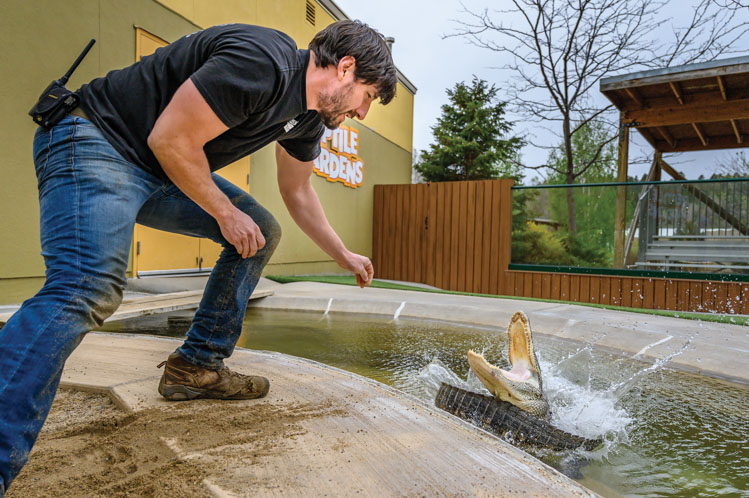
Ryan Comer deals with an ornery gator in the show arena at Reptile Gardens.

Rapid City is a thousand miles from the natural habitats of giant lizards, but Matt Plank’s boyhood dream was to work with alligators and snakes. Fortunately, one of the world’s largest collections was right down the highway.

Reptiles were”always a passion,” Plank says.”I always watched Animal Planet, was always catching garter snakes, frogs and toads. It seems to be luck that I grew up next to this,” he said as he walked through the Sky Dome of Reptile Gardens.

Plank got a job in the cafe at the expansive attraction in 2002, worked there seasonally while earning a biology degree in 2010 from Arizona State University and joined the permanent staff in 2013. He is now assistant curator and show coordinator, overseeing the educational performances for summer visitors.

Now he works alongside Head Curator Terry Phillip, who found his way to Reptile Gardens after managing a pet store in Colorado and focusing on”reptiles, dinosaurs, girls and business, not necessarily in that order,” he says with a smile.”I was not so successful at most of them.”

Phillip moved to the Black Hills, where he had relatives, and started doing alligator shows at Reptile Gardens in 1997. Today he is among the country’s top authorities on crocs, venomous snakes and other reptiles.

American alligators are one of the great success stories of conservation. Once endangered, they could have easily been hunted to extinction when people moved into their habitats. But alligators adapted and responded to preservation efforts; today they are thriving in the southern United States. Most of the gators at Reptile Gardens are captured in places like eastern Texas and South Carolina where they have become a nuisance in populated areas.

Rapid City native Matt Plank found a calling among the large reptiles that live just outside his hometown.

“Gator wrestling” has been a staple at reptile zoos for decades, however the shows at Reptile Gardens do not actually include grappling. At Rapid City, the entertainers seek to demonstrate the agility and strength of their alligators and crocodiles.

The shows took a two-year break due to the COVID-19 pandemic but returned in 2022. Phillip said the revived shows brought together an inexperienced staff and animals that weren’t used to the handling, a hazardous combination. Even though the staff and the animals grow accustomed to each other, there’s reason for caution around them.”We aim for the art of perfection,” Phillip says.”You can’t make mistakes. The biggest problem is complacency. You don’t want that with dangerous animals.”

“You get hit by one of these gators you’ll feel it,” he said. Right on cue, an alligator that was being moved to a different enclosure swung his head and smashed the taillight on a pickup.

Accidents and injuries do occur.”I made it my first year without getting bit,” Plank says, but admitted he has been injured several times.”Now I do everything I can not to get on a gator,” he chuckled.”When it’s exciting it means something’s not going well.”

Showing scars along his arm and fingers, Plank recalled a bite that required 17 stitches.”I remember his mouth right here,” he says, clamping one hand onto the scarred one. Reptile Gardens Public Relations Director Johnny Brockelsby — son of Earl Brockelsby, who founded the popular Black Hills attraction in 1937 — recalls hearing on the staff walkie-talkie that a manager was needed at the alligator arena immediately.

“‘Immediately’ means there is something serious,” Brockelsby says, pointing out that he’s not at his best in emergency situations.”When I got there, Matt was just sitting on the gator like normal and I asked what was wrong.”

“Johnny, my hand is in his mouth,” Plank replied.

Terry Phillip has trained numerous animal wranglers and emergency personnel on handling dangerous reptiles.

“Matt had sweat streaming down the side of his face, so I gave the gator a light tap on the nose, but nothing happened,” Brockelsby says. After another smack on the nose, with Plank pushing down as hard as he could, he got the animal to open his jaws.

“Then he says, ‘Johnny, should I finish the show?'” Brockelsby laughs.”I said, ‘No, I’m taking you to the emergency room.’ Luckily his fingers were between the teeth, or it could have been a lot worse.”

Phillip calls the incident the”most significant in my time here,” and Plank agrees.”It’s the close calls that scare you the most,” he adds.

Recognized as one of the largest collections of reptiles in the world, Reptile Gardens is also a place where other people seek advice.”We get questions from all over the planet,” Plank says. The staff also keep one of the largest and most diverse supplies of antivenom in the world.

Phillip is proud of the training he’s helped provide for area medical technicians, law enforcement officers, EMTs and first responders. He has offered staff training for other zoos and animal parks. He recognizes that his expertise is unique and helpful in certain situations.”Anytime, anywhere, for any reason for law enforcement and emergency personnel,” he says. He has also been part of several confiscations of illegal reptile collections around the country, some of which were added to the displays at Reptile Gardens.

Plank loves his job and wouldn’t want to be anywhere else.”Sometimes I’m jealous of the Florida parks because of the weather,” he says.”But there’s something about this place.”

Not even a gator bite will change his mind.

Editor’s Note: This story is revised from the March/April 2023 issue of South Dakota Magazine. To order a copy or to subscribe, call (800) 456-5117.

Posted on Leave a comment

South Dakota Road Adventures

We have a feature in our current South Dakota Magazine (July/August) on traveling Old Highway 16. At first I wanted to title it “Highway 16: The Perfect S.D. Road Trip” but my fellow editors talked me out of that. It sounds like the perfect road trip to me, but probably isn’t for those who don’t want to go off-roading for a few miles here or there. Our photographer nearly collided with a longhorn cow in Haakon County.

Luckily, we have several other summer travel recommendations for those who like their roads more civilized. Here are some basic recommendations for road-tripping 16, and a few other highlights from our summer travel issue.

Highway 16 covers a 400-mile stretch between our east and west borders, connecting Sioux Falls with Rapid City and several smaller communities along the way. It was part of a 1,600-mile passage between Detroit and Yellowstone National Park that was linked nearly a century ago. A group formed in 1919 to promote the journey in South Dakota, which intersected at times with Highways 14 and 20.

Take time to travel the back roads that are now Highway 16 and you’ll find many remnants of its heyday, including places that made the transition to Interstate 90 such as Wall Drug, the Pioneer Auto Show in Murdo and Reptile Gardens. There are also some great restaurants, like Al’s Oasis, Hutch’s in Presho and the Back 40 near Kimball, a renovated Highway 16 gas station.

For a complete guide to 16, see our July/August issue. Or, like the article’s author, you can play it by ear and see if you can piece together the old roadway on your own. Old 16 enters South Dakota from Minnesota as 262nd Street at Valley Springs, just east of Sioux Falls. The highway is easier to find on the other side of the state because it is still known as U.S. Highway 16.

Our current issue also highlights our state’s 13 National Natural Landmarks, any of which would make a great summer road trip. The U.S. Interior Department began the program in 1962 to highlight our country’s biological and geological diversity. “The sites help tell the story of our nation’s natural heritage through representations of different features,” says Heather Eggleston, a regional National Natural Landmark coordinator. “Those included in the program are the best examples of those features still in existence.”

South Dakotas 13 designations include glacial lakes and sloughs, timeworn buttes and prehistoric rock. Some of the 13 landmarks are well known, such as Bear Butte, and others were a surprise even to our staff, such as Red Lake (Brule County), Buffalo Slough (Lake County) and Snake Butte (Jackson County).

Snake Butte is 23 miles south of Interior on the Pine Ridge Reservation. It features one of the world’s best collections of sand calcite crystals. In fact, South Dakota is one of only a few places on the globe where the crystals are found. They form when water containing dissolved calcite seeps through sand beds. Over time, the calcite forms crystals that surround the sand, between 15 to 20 inches in length. The butte is located in a beautiful sloping and wide-open area of the Pine Ridge, which is worth the drive itself.

South Dakota sweeping landscapes, amazing geological diversity and friendly communities make it an ideal place to get on the road and see what adventures you’ll find. We hope our summer road recommendations inspire you to hit the road — but if it’s Highway 16, be sure to yield to the longhorn cattle.

Posted on Leave a comment

Scales and Tails

Alysha Whitaker shared these photos of Reptile Gardens in Rapid City. “I take my kids there to have fun, but I also venture out on my own for picture taking outings,” Whitaker says. “I often get down on the ground with the lizards to get just the right shot. I know I get funny looks from people wondering why. It’s a lot of fun!”
Whitaker is a stay at home mom of Riley, age 6, and Bentley, age 3. See more of her work at www.facebook.com/icsphoto2.
Posted on Leave a comment

Rapid City Reptiles

From the moment you crest the hill on Highway 16 six miles south of Rapid City and glimpse the 60-foot high, black plexiglass dome encased by an aluminum grid in the valley below, you sense the exotic.

It may be the unusual reptiles, birds and plants inside the futuristic dome that entice people off the prairie and into the tropics, but it is excellent customer service, plain and simple, that keeps visitors to Reptile Gardens satisfied.

Earl Brockelsby, the man who built one of South Dakota ‘s best-known businesses, never met Walt Disney, but the two entrepreneurs shared the same philosophy on how to run a successful tourist attraction, according to Earl’s son, John Brockelsby.

Being greeted with a genuine smile from each employee they encounter, finding the spotless restrooms cleaned each and every hour like clockwork, or getting every question answered, no matter how far afield from the subject of reptiles, is not exotic, but it helps explain the success of Reptile Gardens, said Brockelsby, public relations director. He and his cousin, Joe Maierhauser, president and CEO of Reptile Gardens, are two of the second-generation family members active in the business.

“Our whole philosophy parallels what the Disney company uses,” Brockelsby said. “We emphasize, again and again, that the most important asset we have is our employees and how they treat our visitors. We don’t just give good customer service, we want to exceed our customers’ expectations at every turn along the way.” Next to friendliness in the Reptile Gardens bible is cleanliness. “We try to keep the place immaculate,” Brockelsby said. Of course, it is people’s fascination with reptiles, not clean restrooms, which created Reptile Gardens.

That love-hate relationship, an attraction coupled with revulsion, is something Earl Brockelsby always understood, his son said. The elder Brockelsby, who passed away in 1993, knew from the very beginning that people would pay money to see things that terrified them. “People want to see the biggest and the baddest,” Brockelsby said. “And that’s true of reptiles, too.”

In 1935, Kadoka-born Earl Brockelsby was 19 and working at a Rapid City attraction called “Hidden City.” It no longer exists, but it may have been some sort of naturally occurring geological formation that just happened to resemble a man-made brick wall. Whether or not tourists were thrilled with Hidden City, they were invariably impressed when Earl ended the tour by removing his cowboy hat to reveal a rattlesnake coiled on top of his head.

The next year, Earl attracted customers to his rock and mineral souvenir stand by pretending to have his partner photograph him handling a rattlesnake. By 1937, he decided to concentrate on snakes and opened Black Hills Reptile Gardens in an 18-foot by 24-foot building on Skyline Drive.

On opening day, May 19, 1937, Reptile Gardens took in $3.85. Admission was 10 cents for adults and 5 cents for children. In 1938 he grossed $26 during opening week. That’s a far cry from today’s revenues. For the 2013 summer season, adult tickets are $16.00; $14.50 for seniors; children 5-12 are $11.00; four and under are free. The admission fee comes with a free season pass, good April through October. “There are days now when we take in more in one day than we did in a full year back then,” John Brockelsby said. Of those who visit, 50 percent are either repeat customers or came because it was highly recommended by someone they know. “We’re very fortunate that local people are big supporters of Reptile Gardens,” Brockelsby said.

“He did some very, very bizarre things. He did stuff with snakes that one of our employees today would be fired on the spot for doing.”

Success is also based on uniqueness. While Florida is known for several reptile attractions, Reptile Gardens is the only attraction of its kind in the Midwest. “One of the things we have to keep in mind is that we have to be different than zoos. We have to offer things they can’t, which is where our animal shows come in,” he said.

Earl Brockelsby was self-taught on the subject of reptiles, but the staff he assembled has impressive credentials. Reptile Gardens curators are some of the nation’s foremost experts in reptiles, respected within the zoological community, John Brockelsby said. “We’ve been around so long and our reputation is such that we regularly have animals of ours on loan to zoos like Brookfield Zoo in Chicago, maybe the Bronx Zoo, maybe the San Diego Zoo,” he said.

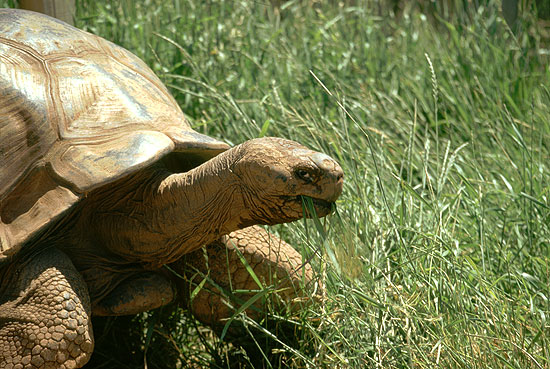
Reptile Gardens has found a unique niche in the tourist industry, falling somewhere between family entertainment and science education. Kids can experience the concept of extinction first-hand by petting Quazi and Tank, a pair of giant Aldabra tortoises, and by a visit to Methuselah’s Playground, an area which honors the Gardens’ most famous denizen with a bronze sculpture of the giant Galapagos tortoise. Bewitched Village, originally a trained animal show, is now a Wild West-style ghost town, with gemstone and arrowhead sluicing, blacklight 3D safari and goofy photo opportunities. An underground viewing bubble gives visitors a close look at the social, playful world of Prairie Dog Town.

Hundreds of orchids, bromeliads, caladiums and other exotic plants adorn the Sky Dome, initially constructed in 1964. Tropical rainforest exhibits are commonplace in zoos today, but back then it was the first of its kind in America. This is also where you’ll find the snakes, amphibians, crocs and bugs. Tortuga Falls is another lush and tranquil spot, graced in summertime by the call of Darwin the kookaburra, an Australian bird.

Then, of course, there are the animal shows, which originated with Earl Brockelsby. An early promotional postcard, entitled “Man Bites Rattlesnake,” pictures Brockelsby holding a rattlesnake next to his open mouth. “He did some very, very bizarre things. He did stuff with snakes that one of our employees today would be fired on the spot for doing,” his son said, shaking his head. “What he always told me is ‘I just always knew that they weren’t going to bite me.’ He felt he had a ‘simpatico’ with them. Whether he did or not I don’t know, but he never did get bitten. He never had a poisonous snake bite.”

In another bit of early-day hucksterism, Brockelsby dipped a common prairie rattlesnake in red dye, billing it as an exotic “Red Rattler.” His son laughs at the memory but is quick to point out that none of the species on display today is anything but genuine — as genuine as the fond memories of 76 years’ worth of visitors, many of whom rank their trip to Reptile Gardens as a highlight of their Black Hills summer vacation.

Editor’s Note: This story is revised from the July/August 1993 issue of South Dakota Magazine. To order a copy or to subscribe, call 800-456-5117.


Posted on Leave a comment

Eat Local…Bananas?


Eating locally grown food in South Dakota just makes sense. This is a rich and fertile land, where backyard gardens, local farms and Community Supported Agriculture programs produce a vast array of delicious fruits, vegetables and grains. Why not take advantage of that bounty?

When we think about local and seasonal foods, tomatoes and sweet corn often pop to mind, but eating locally can be much more exotic. A Spearfish farm offered corn smut (yes, it’s edible!) to its CSA members last summer. One local gardener successfully raised peanuts in her community garden plot in Yankton a few years ago. Perhaps oddest of all, there’s an elegant restaurant in Rapid City that serves South Dakota-grown bananas.

A tropical fruit in South Dakota? Yes indeed — and they’re organic to boot. Pamela Light, executive chef and owner of the Wine Cellar Restaurant in Rapid City, spotted the bright yellow edibles on a stroll through Reptile Gardens‘ Sky Dome. After a chat with good friend and Reptile Gardens CEO Joe Maierhauser, Light secured the fruit for use in her restaurant. Once or twice a year, when the bananas are ripe, her staff incorporates them into dishes like banana cake, banana cheesecake, curried bananas, banana ice cream, banana pie, and more.

Bananas aren’t the only South Dakota-grown food on the Wine Cellar’s menu.”We always use Wild Idea Buffalo — it is local and grazed organically. Seasonally, all herbs and some tomatoes come from my backyard Wine Cellar Restaurant gardens. Chef Chris, my head chef, gathers wild morel and chanterelle mushrooms from the Black Hills. We also purchase produce at the various farmers’ markets in season,” Light said.

The restaurant’s ingredients list extends beyond South Dakota’s borders, of course. Light also shares the best fresh foods from other states she visits: Copper River salmon and halibut from Alaska, Minnesota wild rice, and black truffles, marble potatoes and artisan cheeses from Washington. Light said,”I always give credit to the state these fresh items come from, as it is exciting to me to be able to share these things that you just cannot find locally. Bringing them in to share in our little city is wonderful! Everyone should have the opportunity to enjoy the freshest roadside produce there is as well as fresh seafood.”

The restaurant serves European & California-style cuisine, with elegant-sounding dishes like veal tortellacci alfredo, Calvados smoked duck sausage and porcini sacchette with porchini cream. As one might guess from the name, the Wine Cellar Restaurant has another specialty, offering over 50 wines available by the glass, plus an extensive selection of bottles.”I change [our wine list] about 50% twice a year so I can share all the different wines that are available to me with Rapid City,” Light said.

Like some of her ingredients, Light is an import herself. She was raised in Minneapolis, but her family moved to the west coast when in high school. In the mid 1990s, she decided to look for a smaller community to raise her two children.”Rapid City and the Black Hills seemed like a great place to come since we are active in outdoor activities.”

The move was a success. The Wine Cellar Restaurant just celebrated its 12th anniversary in Rapid City’s historic downtown, about a half a block away from Main Street Square. The restaurant is located in a building over one hundred years old, with hardwood floors and tin ceilings. Linen tablecloths, candles and fresh flowers create a inviting atmosphere.

But thinking about that atmosphere raised one question. In their intimate, historic surroundings, amongst all the fresh and fancy food, had Light, Chef Chris and the rest of the Wine Cellar staff ever discovered any stowaways in the Reptile Gardens banana supply?

“Thank God, no,” Light said.


The Wine Cellar Restaurant is located at 513 Sixth Street, Rapid City, SD. Call 605-718-CORK (2675) or visit www.winecellarrestaurant.com for reservations.

Pamela Light shared this “simple but really great” recipe for curried bananas. She suggests serving it with jasmine or basmati rice and Mediterranean spiced and grilled chicken, pork tenderloin or pork chops.


Curried Bananas

2 tablespoons unsalted butter
1 teaspoon curry powder, or more to taste
1/4 teaspoon garam masala
4 large bananas sliced in half lengthwise, then in half again

Heat butter in a large saute pan over medium high heat. Add the spices and stir until well blended and butter is bubbly. Add all the bananas and saute, carefully turning often to coat with the spiced butter. Gently cook until hot but NOT mushy (just a few minutes). Remove to individual plates and drizzle the pan sauce over the bananas and rice. Serves 4.

Posted on Leave a comment

Goodbye to South Dakota’s Favorite Tortoise

Reptile Gardens near Rapid City houses some of the world’s deadliest snakes, most exotic birds and even a modern-day dragon. Still, old Methuselah, the 600-pound Galapagos tortoise, was a favorite amongst visitors. Methuselah died this week at the ripe old age of 130. Folks at Reptile Gardens are planning a tribute in the near future for their old friend. Photos by Joe Maierhauser, Earl Brockelsby and Chad Coppess from S.D. Tourism.