Posted on — Leave a comment

Dipping into Spring

The calendar says it’s spring in South Dakota, and I’m seeing signs that it might even be true. Baby goats are cavorting on my brother’s farm, there’s been a distinct increase in birdsong and I recently ate the first nibble of something fresh and green from my garden — a snippet of chives.

I love growing herbs, but other than sprinkling chopped chives into scrambled eggs and the unholy amount of pesto I consume once the basil gets going, I’m more apt to eat leaves straight off the plant than use them in dishes. Then I remembered my conversation with Rapid City cheesemaker Spencer Crawford for the March/April 2021 story”Our Goat Renaissance.” Crawford makes aged, washed-rind goat cheeses with milk from his small herd of Alpine dairy goats. He reminded me of a quick method for making a very basic cheese at home — one that pairs well with the bright flavors of herbs.

Take a jug of whole or 2 percent milk that’s nearing its expiration date, pour it into a heavy pan and heat to a simmer. Remove the pan from the heat, throw in something acidic (lemon juice, buttermilk or a glug of white vinegar) and let it sit for about 10 minutes. The milk should separate into small, fluffy curds and yellowish whey. If you’re Miss Muffet, you can enjoy that as is, but I empty the pot into a colander lined with coffee filters to let the whey drain out. Sometimes I weigh it down to expel more whey and create a firmer cheese that works well in curry. Unweighed, the cheese is similar to ricotta. It makes a great addition to pizza or pasta or you can whirl it into a smooth, herb-rich dip.


A simple homemade cheese and a snip of the garden’s first greens make a wonderfully fresh dip.

Green Goddess Dip

Adapted from Abra’s Kitchen

1–1 1/2 cups fresh cheese
1 clove of garlic, minced
2 tablespoons olive oil
1/4 teaspoon black pepper
1/4 teaspoon salt
1/4 cup fresh herbs (chives, parsley, dill, tarragon and/or basil) or more, to taste

Roughly chop herbs. Use a hand blender or food processor to mix ingredients together until the dip is smooth and creamy, adding more olive oil if needed. Serve with crackers, fresh vegetables or whatever sounds good.

Posted on — Leave a comment

Pudding Pi

2021 seems like the best year to celebrate the little things, to recognize happiness wherever we find it. Most of us have been through a lot and need joy.

Nobody is better at finding the best silly ways to celebrate than the food obsessed. Every day of the year represents some kind of made-up food holiday. Just in the last few months alone, we have had National Ranch Dressing Day, National Spaghetti Day, National Margarita Day and World Nutella Day. Not to mention entire months dedicated to Oatmeal, Potato Lovers and Celery. The message is clear: food should be fun and appreciated.

Of course, those of us grasping for any reason to celebrate have embraced March 14. 3-14 is recognized worldwide as Pi Day in honor of the mathematical constant and has been lovingly hijacked with its homonym pie. Who doesn’t want to eat pie on Pi Day?

This year, as I look to Pi Day, I am also acknowledging my husband’s love of pudding pies. While I may think of pie as vehicle to highlight amazing seasonal fruit, pudding pies are always his first request. Homemade butterscotch may be tops for him, and when I saw that Martha Stewart paired this luscious amber dessert with a pecan shortbread crust, I was sold. Garnished with candied pecans, this Butterscotch Pie with Pecan Shortbread Crust brings joy to any Pi Day celebration.


Butterscotch Pie with Pecan Shortbread Crust

(adapted from Martha Stewart)

March 14 (3-14) is known as Pi Day in honor of the mathematical constant. Pie lovers celebrate too. A favorite of Fran Hill’s is Butterscotch Pie with Pecan Shortbread Crust.

Crust:

1 cup pecan halves

1 cup plus 2 tablespoons flour

1/2 teaspoon kosher salt

6 tablespoons unsalted butter, room temperature

1/3 cup granulated sugar

1 large egg yolk

Filling:

1 cup firmly packed dark-brown sugar

2 tablespoons plus 1 teaspoon cornstarch

1/4 teaspoon kosher salt

4 large egg yolks

1 2/3 cups whole milk

3 tablespoons unsalted butter

Sugared Pecan Garnish:

48 pecan halves (This is roughly how many you will need to ring the tart pan, but the egg white mixture can easily coat a few more. Do it for snacks and salads.)

2 tablespoons sugar

1/4 teaspoon kosher salt

1 egg white

Crust: Preheat oven to 375 degrees F. Toast pecans on a rimmed baking sheet until fragrant and golden, 8 to 10 minutes. Let cool 15 minutes, then finely grind in a food processor. Add flour and salt to food processor and pulse just to combine. Add the softened butter and sugar to the food processor and pulse a few more times. Add the egg yolk and process to thoroughly incorporate. Mixture will have a fine crumb texture and hold together when pressed between fingers. Press evenly into bottom and up sides of a round 11-inch fluted tart pan with a removable bottom.

Freeze pan 15 minutes, then transfer to oven and bake until set and deep golden brown, about 20-25 minutes. (Watch the crust near the end of baking. Mine was probably done at 20 minutes, but I failed to check on it and have a more toasted result … still tasty but would probably have been better with a few less minutes in the oven.) Transfer pan to a wire rack; let cool 15 minutes.

Filling: (Don’t be me. Don’t get ahead of yourself and make the pudding while the crust is chilling. Wait until the crust is baked and cooling. Otherwise, you will be constantly whisking the pudding until the crust is ready to keep it from setting up. Learn from my mistakes.) While the crust is cooling, in a saucepan, whisk together brown sugar, cornstarch and salt. Whisk egg yolks into the milk and whisk this mixture into the dry ingredients. Bring to a boil, then reduce heat and simmer 1 minute. Remove from heat and whisk in butter. Pour filling into crust and let cool.

Sugared Pecans: Reduce oven temperature to 350 degrees F. Whisk sugar, salt and egg white together. Stir in pecans. Spread nuts in an even layer on a rimmed baking sheet lined with parchment. Bake, stirring once (being careful to keep nuts separate and not clump together), until golden brown and crunchy, about 15 minutes. Let cool completely. Garnish pie with sugared pecans. (Extra pecans can be stored in an airtight container at room temperature up to 1 week.) Refrigerate pie until pudding is set, at least 4 hours, but up to 2 days.

To serve pie, remove sides of pan, transfer pie to a platter. Slice and serve. May offer whipped cream with each portion, if desired. It is delicious without, though. (Serves 10-12)

Fran Hill has been blogging about food at On My Plate since October of 2006. She, her husband and their three dogs ranch near Colome.

Posted on — Leave a comment

Sunrise, Sunset’

I’m not much on musicals. I find it hard to stay with a story when folks sort of just burst into song and dance. Nothing against music or dancing, it is just a personal preference. That said, there are a few musicals of which I am quite fond. The Sound of Music was a movie that my family watched together on more than one occasion when I was younger. Our school performed The Music Man when I was in eighth grade and our cast pulled from elementary kids to seniors.

One musical, however, rises above all others in my esteem. I first saw Fiddler on the Roof in grade school. It was late in the school year and I think our music teacher just sort of ran out of things to try to teach us, or maybe he lost his patience. Either way, after our spring concert, we spent our music class time watching the 1971 movie version of the musical. Nearly every song is memorable, and the story was fun, funny, melancholy and downright tragic.

One of those memorable songs is also the theme of this month’s column.”Sunrise, Sunset,” composed by Jerry Bock with lyrics by Sheldon Harnick, is performed as the oldest daughter in the family is married to the young man she fell in love with (not the butcher that the matchmaker chose for her). Even as a grade schooler I could sense the weight of bittersweet time passing in the song. Now that I’m older the song is even more laden with meaning:

Sunrise, sunset
Sunrise, sunset
Swiftly flow the days
Seedlings turn overnight to sunflowers
Blossoming even as we gaze

Sunrise, sunset
Sunrise, sunset
Swiftly fly the years
One season following another
Laden with happiness and tears

Sunrises and sunsets happen to be a favorite thing for just about anyone with a camera to photograph, so much so that they far too often fall into the realm of photographic clichÈ. I’m not so quick to discard sunset photos. Every day the sun rises and every day it sets — sometimes with more flare than usual — and our South Dakota sunsets rarely disappoint.

In mid-February, I was doing my best to capture the last of the day’s light on freshly fallen snow north of Dell Rapids. It was a very pleasant sunset, but the magic wasn’t over after the sun went down. About 15 minutes into the blue hour, a low fog began to rise above the snow in the Big Sioux River valley. I stopped just southeast of Baltic, got my tripod and did my best to capture the ethereal scenes. All the while, in the back of my mind, a familiar chorus began to play. In the dying of the day, I was reminded once again of the gift of time I’ve been given and the promise of another day, another season, another year following another, laden with happiness and tears.

Christian Begeman grew up in Isabel and now lives in Sioux Falls. When he’s not working at Midco he is often on the road photographing South Dakota’s prettiest spots. Follow Begeman on his blog.

Posted on — Leave a comment

Peninsula Paradise

Growing up in Chicago, my youthful idea of a pastoral Shangri-la was straight out of the old children’s book Heidi, and maybe Lassie flicks on WGN.

Heidi was a German Swiss girl who spent her days skipping though the emerald valleys of the Swiss Alps in a dirndl, herding goats, reading Bible stories and warming the heart of her disgruntled adoptive grandfather, Alm-Uncle. Eventually she teaches a disabled girl to walk again through a kind of miraculous ecotherapy (Heidi was ahead of her time for a country girl).

Heidi the healer closes the chasms between human and God/Nature that debilitate us mentally (Alm-Uncle) or physically (Clara). When you feel like”the mountains are calling” you, Heidi is that iPhone.

Now as a South Dakotan, I field those calls. I go hiking through the Black Hills, Badlands and northwestern butte country, or paddling down the Missouri or Cheyenne.

Each of those places is curative. The South Dakota country that rekindles my city boy concept of the Dorfli foothills where Heidi skips be-dirndled through a sea of green is on the peninsula that lurches out like a velvet mullein stalk into the Little Bend of the Missouri River.

True, it’s a pricklier, snakier green sea. Skipping barefoot might be a bad idea. Instead of snowy peaks, the meadows are enveloped in azure water and sky. The river bluffs bubble through beneath your feet. Each billowy detour off the main appendage is a fuzzy green caterpillar bulging in segments as it munches the Missouri. To stand on a hill and trace each bulbous ramble into the blue, or the flower parades through the folds that empty into shallow pools at water’s edge, may be as medicinal a psychic skip in the shadow of the Swiss mountain Stanserhorn.

You can access this peninsular Xanadu at the Little Bend Recreation Area. At a point where the road curves southwest down to a boat/fishing pier, there’s a small parking area with a sign that indicates walk-in only. From here you’ll leave the state recreation area, though the entire peninsula is a public land, state and federal (Army Corps of Engineers). My guess is that very few non-hunters ever hike here.

I set out to explore the fingerlings and make it to the V-shaped inlet at the center of the terminus. With an evening start, I hiked along the trail that cuts a straight-ish line along the northeast edge until it faded away about a mile and a half in. From there I spotted a picturesque sub-isthmus — snaking out to a cliff surrounded by a narrow strip of beach — enclosing a cottonwood leaf bay.

In about 4 1/2 miles, I reached the river side and pitched tent on a narrow strip of beach. Bullfrogs and great-horned owls sang a dirge for the day. A garter snake slithered along the edge of the water, mirroring the rippling moonlight.

At dawn, I packed up and kept my eyes on the big water to reach the V. Throngs of grasshoppers hurdled ahead of me, many caught in the webs of ferocious-looking yellow garden spiders. Wildflowers hewed close to the coulees. A velvety-antlered buck Heidi-ed his way through the verdure. As the land tapered in the final descent there were swan-feather fields of foxtail and other hairy grasses.

Then it was there — the pool that softens the point of the V. Jade swells surround, here and there sheered down to Pierre shale, cobalt above and below. Gulls perched on a narrow sand bar. I lingered a bit and began the way back, up the spine of the main stalk where you can see every caterpillary appendage burrow into the blue.

Michael Zimny is a content producer for South Dakota Public Broadcasting and is based in Rapid City. He blogs for SDPB and contributes columns to the South Dakota Magazine website.

Posted on — Leave a comment

Bridges to History

John Timm as Governor Arthur Mellette.

No South Dakotan alive today shook the hand of our first governor, Arthur Mellette, or stood with Valentine McGillycuddy atop Black Elk Peak. But we can still gain insight into the men and women who helped shape our state through the people who study and portray them today as historical re-enactors.

About five years ago, I asked several re-enactors for their favorite stories about the characters they have come to know so well. Here are two anecdotes that have stayed with me since the story appeared in our January/February 2017 issue, mostly because of the implications they may have had on our state’s history.

John Timm began performing as Arthur Mellette in 2005 after a historian at the Mellette House in Watertown suggested his facial features closely resembled those of the former governor, who served from 1889 to 1893.

One day, Mellette received a letter from a young man who had just graduated from law school in Mellette’s home state of Indiana. The new lawyer was inquiring about business prospects in Dakota Territory. Mellette said he could do well here and invited him to stay at the Mellette home in Watertown.

That Fourth of July, Mellette was invited to give a speech in Clark, about 30 miles west. He was unable to attend, so he asked the young lawyer to go make a speech in his place.”There was a big demand for lawyers at the time with all the homesteading and claim jumping, so the people in Clark asked him to stay,” Timm told us.”One night a terrible storm came through, probably a tornado, and the town’s sewage got mixed with the fresh water supply, setting off this great plague of cholera. As they cleaned up the town, no one remembered seeing their new attorney for quite some time. They went to his law office and sure enough, there he was — and more dead than alive.

“They sent a telegram to Mellette in Watertown that it looked like he wasn’t going to survive. Mellette took the train to Clark and brought him back in a boxcar, and he notified the young man’s family in Indiana. His dad came out by train, and between him and Mellette they nursed him back to health until he was well enough to go back to Indiana to finish his recovery.

“After he recuperated, he came back to Clark to practice law. Eventually he sent for the girl who would become his wife. Of course, we know that Mellette later became South Dakota’s first governor, and the young man he helped to save, Sam Elrod, became South Dakota’s fifth governor.”

In Rapid City, Wayne Gilbert portrayed Valentine McGillycuddy for several years through a partnership with Historic Rapid City, a preservation organization currently restoring the McGillycuddy House. McGillycuddy was the physician who tended Crazy Horse’s mortal wounds at Fort Robinson in 1877. He was among the first white men to climb Black Elk Peak in 1875 (his ashes are interred atop the mountain), was president of the South Dakota School of Mines and Technology and later mayor of Rapid City.

McGillycuddy also served as Indian agent on the Pine Ridge Reservation in the 1880s, the decade before the Wounded Knee Massacre in 1890.”He quarreled frequently with Red Cloud because McGillycuddy was trying — for good or ill — to enforce the government’s policy that the Lakota needed to be turned into farmers,” Gilbert said.”But despite that, he really was quite sympathetic to, if not aligned with, Native practices, cultures and beliefs, and at the very least tolerant of them and not willing to discourage them.

“McGillycuddy was ultimately relieved of his duties, and his replacement was new to Native culture. So when the Ghost Dance movement began he was terrified, and asked that the Army be brought to Pine Ridge. McGillycuddy was strongly against that. He said, ‘When the Seventh Day Adventists put on ascension robes and went into the mountains to await the second coming of Jesus, we didn’t call out the Army. So we shouldn’t call out the Army because these Native people are putting on ghost shirts and practicing their religion.’

“He met with Red Cloud and others and they asked him to intervene, but he told them his words didn’t have the power they once did. He did what he could, but it wasn’t enough. And it was at that point that Red Cloud said, ‘You and I never got along, but I can see now that you may have been right. You are wasicu wakan,’ loosely translated as the Holy White Man.

“Later, state historian Doane Robinson said that had McGillycuddy been the agent, or had his advice been followed, the Wounded Knee Massacre would not have occurred.”

A different governor? No Wounded Knee? We’ll never know what South Dakota might look like had either of those scenarios played out, but thanks to the re-enactors who preserve stories like these we’ll always have food for historical thought.

Posted on — Leave a comment

Brunch on the Farm

It’s been a minute since I shared a recipe here with South Dakota Magazine. Allow me to reintroduce myself. I am Fran, and I like brunch. No, let’s revise that. I LOVE brunch. I am not an early riser, if I can help it, and savoring a slow multi-course meal mid-morning while sipping coffee with a splash of a little something-something is heaven for me.

The reality is that my husband’s farm responsibilities don’t allow for us to dip into this brunch fantasy on a daily basis. The sheep get fed before the humans around here and are waiting at the feed bunks for their breakfast every morning in rain, snow, sleet or shine. My husband is a sport, though, and does try to indulge my brunch desires one day a week. Sundays, he returns home after morning farm chores, and finds me elbow deep in eggs, bacon, sausage and fruit.

Sometimes, I get elaborate with my brunch spread and bake quiches layered with vegetables, cheese and even salmon. Sometimes, I just boil eggs. We are lucky enough to have a freezer full of locally raised pork which allows bacon and sausage to rotate through my menus. I try to include some vegetables, even going as far as finely chopping kale or spinach and adding to my rich homemade sausage gravy that we ladle over fluffy biscuits. Trust me. It IS still delicious. And fruit is a mainstay for a Sunday brunch. I love that citrus is such a bright seasonal spot in the winter.

A good brunch needs something sweet as a finish. What would a decadent meal be without some kind of dessert? Baking muffins seems to be a no-brainer, and I try to search out small batch recipes that don’t leave the two of us with extra baked goods for days and days.

I have a Small Batch Blueberry Muffin recipe that I make so frequently, the cookbook falls open directly to the page. I have slightly altered the original to suit ingredients that I usually have on hand, and the large, bakery-style paper baking cups I long ago ordered in bulk and may never run out of only make five muffins instead of the intended six. No matter how they are baked, I always love that first bite of tenderly caked muffin dotted with tart berries. THIS is what Sunday brunch should be.


This small batch recipe for blueberry muffins is perfect for “brunch for two.”

Small Batch Blueberry Muffins

(adapted from Dessert for Two)

4 tablespoons unsalted butter, melted

1/2 cup sugar

1 large egg

3/4 cup Greek yogurt (I use plain or vanilla)

1 tablespoon milk

1/2 teaspoon vanilla

1 cup flour

1 1/2 teaspoon baking powder

1/4 teaspoon baking soda

1/2 cup fresh blueberries

For the streusel:

2 tablespoons brown sugar

1 tablespoon flour

1 tablespoon unsalted butter, cold

Preheat oven to 400 degrees F. Line a muffin tin with 6 paper liners (if you have the larger bakery-style liners, there will only be enough batter for 5).

Combine melted butter, sugar, egg, yogurt, milk and vanilla. Stir in flour, baking powder and baking soda until incorporated. Gently fold in blueberries.

Fill each paper muffin liner with batter.

For the streusel:

Combine the brown sugar, flour and cold butter using your fingertips to slightly warm the butter and create a crumble. Sprinkle liberally over each muffin.

Bake for 16 to 18 minutes, or until a toothpick tests clean. (Larger muffins may take longer to bake through.) Allow muffins to rest in tin for a couple of minutes before transferring to wire rack to cool. (Yields 6 muffins)

Fran Hill has been blogging about food at On My Plate since October of 2006. She, her husband and their three dogs ranch near Colome.

Posted on — Leave a comment

Wise and Wonderful

Late last year I was asked to edit a video for Perkins County author and musician Eliza Blue to celebrate the new PBS Masterpiece series”All Creatures Great and Small.” I remember the original series played often on our TV back in the day. SDPB was the only channel we could tune in clearly, so whether I found it interesting or not my only option was such programming. I’m not complaining. My love for nature, history and geography owes a great deal to public broadcasting. This particular television show (and book from which it is based) derives its name from an Anglican hymn called”All Things Bright and Beautiful.” This hymn wasn’t one that was sung frequently in my home church, but even so, when I heard Eliza’s meditative version, I was more than happy to help with the video.

A small problem emerged. What would I use to cover the lyric,”All things wise and wonderful?” I remember joking with Eliza that video of an owl, which I didn’t have, would work perfectly. Fast forward to a winter’s walk in a heavy snowfall at Big Sioux Recreation Area on the edge of Brandon. Out of the corner of my eye I caught a glimpse of something I’d never seen before: a barred owl, relaxed as it sat out the weather. I took a few photos and then remembered my video assignment. I switched the camera to video mode, propped myself against the nearest tree trunk for steadiness and got my”wise” owl footage.

Why are owls portrayed as wise? Their rounded face is probably the most compelling reason. With a shortened beak and large eyes, an owl’s face seems more humanlike than other birds. Not all cultures see owls as wise and benevolent, however. The Lakota sometimes interpret them as bad omens, messengers between the world of life and death. Since the owl is a skilled hunter of the night, silent on the wing but sometimes quite spooky when making sounds, I can understand.

Throughout the year, up to nine owl species can be found in South Dakota. I have seen and photographed all but one. The Eastern screech owl has avoided me quite successfully over the years. I find this ironic as screechers often live closer to humans than other owls and are quite abundant, according to the experts. This year, I noticed a large number of short-eared owls in the spring and summer West River. This winter the numbers seem to be quite high East River; a troop has entertained birders in the Big Sioux River flats southwest of Brookings since Christmas.

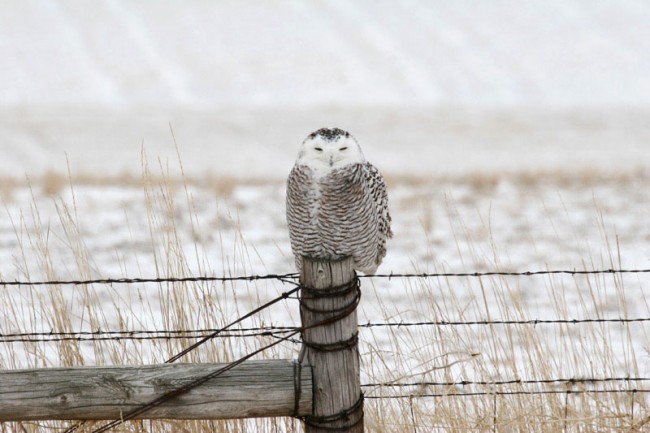
One of the most unique owl species that sometimes graces us is the snowy owl. This large white owl lives and breeds in the arctic tundra, but every few years large numbers of them descend southward in what is called an irruption. I first saw a snowy in 2011 near Okobojo, north of Pierre. In 2018, northwest Sioux Falls had three snowy owls that hung around for at least two weeks. One crisp Saturday, I watched nearly all morning as a snowy sat preening, stretching and snoozing atop a light pole just outside of work. This winter, I heard there were four in Spink County near Redfield. Last Saturday I set out to find them. I wasn’t disappointed. I located three of the four, including one very white and regal male. I’ve gathered those new photos for this column and have included some other favorites from over the years. Owls species not pictured here but found in other columns of mine in the past include the Northern saw-whet owl, long-eared owl and barn owl.

Posted on — Leave a comment

Forever Close to Home

You could always hear his voice above the crowd.

Every Fourth of July, hundreds of people come to Memorial Park in Lake Norden to cap off the city’s Independence Day celebration with an amateur baseball game and fireworks. It’s a popular time for school and family reunions, so people who grew up in Lake Norden often find their way back. The ball game is a good time to catch up if you missed the pork barbecue the night before, so there’s a constant buzz of conversation humming throughout the park as the game is played.

Mel Antonen

Mel Antonen’s voice always stood out. He’d grown up in a house right across the street from the ballpark and did every job imaginable as his father, Ray, managed the Lake Norden Lakers: groundskeeping, announcing, scorekeeping and, eventually, playing. It was small town baseball that launched him on his career as a journalist covering Major League Baseball for USA Today, Sports Illustrated and, most recently, Sirius Radio and Mid-Atlantic Sports Network in Washington, D.C. But no matter what major league city he found himself in, or what superstar he was interviewing, his thoughts were never far from Lake Norden. He came back on the Fourth of July as often as he could; it pained him to miss even a single year. He sometimes regaled friends with stories from his reporting, but more often than not they relived their own days on the diamond or reminisced about the colorful characters they all remembered. He stayed connected to Lake Norden, and in doing so became a mentor to many of us who grew up there.

Antonen died on January 30 at age 64. For 383 days, he battled a rare autoimmune disease called hemophagocytic lymphohistiocytosis (HLH) that became compounded by COVID-19 and lymphoma, a combination so unlikely that doctors told him he was probably the only person in world battling all three at once.

Antonen on the mound in Lake Norden.

As a kid growing up in Lake Norden, I loved it when Mel came home because I felt like it gave me an inside connection to the world of professional baseball. I’d ask about my perennially hapless Chicago Cubs, and he’d share some nugget he’d gotten at the winter meetings or through interviews. We’d talk about new ideas for exhibits inside the South Dakota Amateur Baseball Hall of Fame, which Ray was instrumental in bringing to Lake Norden and which remained a passion project for Mel.

Our relationship changed in the summer of 2007. I had finished school and was trying to figure out if more education was in my future or if I needed to find a job. With a wife and two kids, my sensibilities pulled me toward employment, so I brought my resume and a few writing samples to the South Dakota Magazine office.

Bernie Hunhoff told me they didn’t have a need for a writer, but there was a marketing position open and that he’d review my materials and get back to me. About a week later he called and offered me the job.

I knew that I probably wasn’t cut out for marketing, but this was South Dakota Magazine. I honestly didn’t know what to do. I needed advice. So I called Mel, who told me as politely as he possibly could that I would be an idiot if I didn’t take it. The marketing thing fizzled out, as I had suspected, but nearly 14 years later I’m still here, and I have Mel to thank, at least in part. I know he was there for others, too.

Suddenly I was working with Mel, which never felt quite right. Me, editing the guy who’d spent two decades at USA Today? I wasn’t sure about that.

He was always emailing me with story ideas. Even though his job took him to major league baseball parks around the country and interviews with the sport’s leading stars, he never stopped thinking about the next South Dakota baseball story he wanted to write.

The first major feature of his that I edited was about six longtime amateur baseball managers in South Dakota, and the dedication that it takes from them to keep a team going. We headlined it”Love for the Game” because it really seemed to capture the passion they all had for small-town baseball, but looking back I think it clearly reflected the passion of the writer just as much.

Brothers Rusty (left) and Mel Antonen as Lake Norden Lakers.

He worked through his illness, not only for his regular job on the East Coast but on pieces for South Dakota Magazine. Just last fall he finished a story that had long been discussed around Lake Norden but never written down. I’d grown up hearing about the time the great pitcher Satchel Paige came to Lake Norden on a barnstorming tour. The whole town was abuzz for the game, but it quickly turned to anxiousness when the time for the first pitch arrived and Satchel was nowhere to be found. Turns out that Satchel ran into two boys (one of whom happens to be my cousin) and they all went fishing together south of town. The rest of the story is in our September/October 2020 issue.

Sometimes Mel would email just to reminisce about playing baseball in Lake Norden. One day we got on the subject of the state amateur tournament. He told me he hit a double in his first state tournament at-bat in Madison.”I could hear Danny Olson’s play-by-play voice when I got to the plate. My knees were shaking,” he said. “I also remember striking out three or four times versus Dave Gassman of Canova in the quarterfinal game.”

Then there was the year the hometown Lakers lost to Eureka 6-5 in the semifinal game.”The game ended when manager Dale Jacobsen had our best base stealer, Mike Murphy, try to steal second with two outs in the ninth inning. He was out on a close call, and Jake argued and argued, following the umpire all the way to his car. Jake was still arguing as the umpire was taking off his equipment and putting it into the trunk.

“Chad Lavin, Steve Brown and I were pick-up players from Bryant’s Legion team. I didn’t play, but I’ll never forget the sinking feeling that goes with a season that ended like that.”

One day, he wrote to tell me about an amazing South Dakota connection he’d experienced in Washington, D.C.”I have been going to breakfast at a dive bar on the Hill for a long time,” he said.”The other day, I was there meeting a friend. The friend was late, and I ended up talking to one of the waitresses about baseball. She started talking about how her dad played ‘amateur baseball,’ but didn’t tell me where.

“‘You wouldn’t know where,’ she said.

Antonen and his son Emmett at the South Dakota Amateur Baseball Hall of Fame in Lake Norden.

“But we continued to talk. I found out she was from Arlington, and her dad was Hall of Fame pitcher Chuck Petersen. She’s donated money to the Hall. Her dad and my dad were close friends, teammates, rivals.

“I would have never continued the conversation had she not said, ‘amateur baseball,’ which is, in my mind, is a phrase that you only hear in South Dakota.”

And, for much of the last year, there were health updates.”Survived one near death disease and COVID-19 is next to be knocked out,” he wrote last April 23 with the hashtag #finntough, ever proud of his Finnish heritage.

“I am in hospital, but I am feeling fixed and should be able to go home today,” he wrote a month later, while double checking details of the Satchel Paige story.

“Still battling HLH, but we hope to have it in remission by the end of November,” he said in the last message I ever received from him three months ago. But in the end the diseases proved too much for even a tough old Finlander from Lake Norden.

One of my favorite stories about Mel came from an interview he did with Cal Ripken, Jr., the longtime shortstop of the Baltimore Orioles and the holder of baseball’s longest consecutive games played record at 2,632. Mel asked Ripken about playing in Baltimore and what made it different from other major markets like New York and Boston. Did he ever think about playing somewhere else?”Mel,” Ripken said,”you just don’t understand what it’s like to play baseball in a small town.”

Mel knew it better than the Iron Man ever would have realized. It’s what brought him back every Fourth of July. He stayed connected to Lake Norden and to South Dakota, the people and the stories, and we’re all richer for it.

Posted on — Leave a comment

Badlands Fast

Lance Smith attempts a Fastest Known Time in the Badlands’ Sage Creek Wilderness.

You won’t find the”Sage Creek Wilderness Loop” on any map of Badlands National Park. There is no official trail or signage. Lance Smith of Sioux Falls had hiked the area numerous times with his son, and thought that others might enjoy the scenery, if they knew about it.

“So I went on my own and decided to see how fast I could do it,” Smith says.”And the FKT (Fastest Known Time) website put it up as a route.”

He put up a time to beat, and somebody did.

“I did a great time, I thought. But then a guy named John Haak went out and beat the time I put up by 56 minutes or so.”

Haak beat Smith’s time just two weeks later, in an area of the park that sees very little foot traffic, beyond a small area around the Conata Picnic Area.

“The first time I did it, I wanted to spend some time trying to get some good pictures, video, just to try to entice some other people potentially to do it,” says Smith.”Because the Badlands can be a place that a lot of people don’t think of doing this type of thing.”

Smith returned recently and reclaimed his Fastest Known Time (FKT), clocking 3 hours, 27 minutes, 8 seconds on the 22-ish mile loop. Still, his record may not last for long, and that’s fine by him.”It’s really fostering this competition like, ‘Hey, I did this. Now you go beat me.’ When that person beats you, you congratulate them. Then if you want, you can go back and try to beat that person again.”

There are currently five routes listed on the latest iteration of fastestknowntime.com: the Centennial Trail, a Black Elk Peak out-and-back, the Run Across South Dakota, the Sage Creek Wilderness Loop and the Mickelson Trail (for which no winning time is listed as yet). Other than the initial FKT for the Black Elk Peak route, set by Jeff Valliere in 2017, all listed times were logged in 2020.

FKT’s have been gaining in popularity, nationally and around the world, since the early 2000s — especially on well-known, signed trail systems like the Appalachian Trail. The FKT world witnessed a tsunami of new fastest time submissions in 2020.”It blew up so much because of COVID,” says Smith, who also holds the FKT for the Centennial Trail.”All the races that people like to participate in got canceled, postponed. People are looking to get out to kind of push themselves, experience something.”

Smith says he’s interested in pioneering more off-trail routes.”There’s some really cool landscapes that we have in South Dakota. We just don’t have very many routes submitted to the website, which I’m hoping to maybe create.”

Finding a good route is about more than just picking a place to run, says Smith.”It has to have good aesthetics, be fun, challenging. Anybody can go out and run from point A to point B. I’m kind of looking in the Black Hills for some stuff to do. There are the Slim Buttes and the North and South Cave Hills. I’ve kind of been looking at how to link those two distinct areas together with a run.

“I would hope that maybe some other people see this as an avenue of sharing some cool adventure running or hiking that they’ve done with others.”

Michael Zimny is a content producer for South Dakota Public Broadcasting and is based in Rapid City. He blogs for SDPB and contributes columns to the South Dakota Magazine website.

Posted on — Leave a comment

South Dakota Resolutions

Editor Katie Hunhoff and other South Dakota Magazine staffers share resolutions to explore the state in 2021.

We have a New Year’s tradition at South Dakota Magazine to make resolutions on traveling South Dakota. As you can imagine, our staff knows the state pretty well. The resolutions are a fun way to challenge ourselves to try new places and activities.

This year the resolutions are different because of the pandemic; we are all looking for travel opportunities that can be accomplished with safety and health in mind. Maybe our resolutions will give you some ideas.

Hannah Schaefer, our photography and editorial assistant, plans on reading books she collected at the South Dakota Book Festival. On her list is Unfollow by Megan Phelps-Roper (the South Dakota Humanities Council’s One Book South Dakota for 2020), Murder on the Red River and Girl Gone Missing by Marcie Rendon and According to Kate by Chris Enss. (On a side note, our managing editor put together a collection of South Dakota books that are must reads. You’ll find his suggestions in our Nov/Dec 2020).

Departments Editor Laura Johnson Andrews has a couple of day trips planned.”I have been holed up for most of 2020 due to COVID concerns, so at this point, a trip to Toby’s Lounge in Meckling would be a nearly unbearable thrill,” she says. Toby’s is about a 10-minute drive east of Yankton and is known for delicious broasted chicken. Laura also wants to venture a little further to the town of Colome.”I’d love a tour of the Colome area with our food columnist, Fran Hill. I haven’t been there since the South Dakota Outhouse Museum moved to town, so I feel like I’m overdue.”

John Andrews, our managing editor, is planning a trip around some magazine stories he wants to write.”I’m writing a story on Peter Norbeck to coincide with the holiday in his honor, which I don’t think many South Dakotans know about. I think the story of how his house ended up in Geddes and that small town’s own resolve to save it is pretty inspiring.”

Bernie Hunhoff, our editor at large, also wants to visit an historic place.”In all my travels of South Dakota, I have never visited the site of Sitting Bull’s death along the Grand River in Corson County. I hope to get there in 2021. By about any standard, he must rank as the greatest and most influential person to have lived in our region over the last 200 years.”

My resolution is to hike a new peak every time I visit the Black Hills, starting with Black Elk Peak, which I am ashamed to say I have never climbed. But I think all of us probably have a similar destination that we never took the time to experience. That’s part of why we love printing the magazine — to remind people what we have in our own backyard and spark the desire to start exploring.