Posted on — Leave a comment

Highway to Zell

I hadn’t planned on going anywhere. It was supposed to be a quiet Saturday. I had traveled the weekend before and was scheduled to travel the next two weekends to Wyoming and Nebraska. A quiet Saturday with nothing much to do seemed like a good idea. So how did I find myself under a stormy sky in Zell just after sunset on August 12? It’s complicated.

About mid-morning, I had my errands done. I suppose I could have vacuumed or dusted or even read a book. But the call of the great outdoors had other plans. It was the weekend, for goodness sake. I have a perfectly good camera in my bag and a truck full of gas … wasn’t it a bit of a waste not to take a short drive out of town and see what was out there? That line of thinking was all it took. Soon afterwards, I was following this most recent case of wanderlust and heading north. My destination wasn’t far, just up to southern Deuel County to check a known spot for Monarch butterflies and wildflowers. Then if the clouds were doing anything interesting, maybe a little storm chasing.

After I’d spent some time chasing a few butterflies the clouds starting building as predicted. I checked the maps and it looked like maybe I could get behind the storm system if I headed west. Soon I was just outside of Waverly in Codington County. Rays of sunlight broke through heavy clouds to shine golden on a recently baled wheat field.

The clouds kept building. I kept driving west. Next was Clark County, then northeastern Spink, where somewhere south of Turton I spotted a pair of Great Horned Owls in a couple of dead trees. The miles were adding up, and I still couldn’t get to edge of the storm system.

On the edge of Spink and Faulk County, along Highway 212 is the tiny community of Zell. St. Mary’s Catholic Church is right along the highway and I had wanted to get a photo of it for quite a while. With the ominous sky, I figured I might as well zip to Zell to get that photo.

It was now early evening. The skies seemed to be parting westward, so I headed out to Rockham. One of my co-workers is from Rockham, and I thought she might get a kick out of me standing in front of the town sign. After that, I took a gravel road north of town and headed farther west. A beautifully taken care of country school soon appeared on the horizon … another photo opportunity. Later the sun broke through the heavy clouds above a pasture full of grazing cattle. Then the clouds to the east began doing mysterious things. The storm was back building to the west. I headed back to Zell, to frame up the little town under the amazing sky, stopping at a sunflower field along the way.

I found myself standing in the middle of Highway 212 with no traffic, taking photos of massive clouds slowly revolving above the little town. The moment was so South Dakota. Where else can you do that kind of thing? What a great place to be a wandering photographer! On my way home, just north of Wolsey, my truck’s odometer turned over to 100,000. So I stopped at the C-store and filled it with the highest quality and most expensive gas available. Seemed like the right thing to do, sort of a little thank you to the trusty wheels that kept me going on this picturesque and totally unexpected road trip.

Christian Begeman grew up in Isabel and now lives in Sioux Falls. When he’s not working at Midcontinent Communications he is often on the road photographing South Dakota’s prettiest spots. Follow Begeman on his blog.

Posted on — Leave a comment

Catching Rainbows

Our neighbor state to the northwest may be known as big sky country, but South Dakota ranks right up there in terms of amazing things to witness in the great blue yonder. On a clear night, it isn’t hard to get lost in the numberless stars blinking back at you. Who hasn’t been soothed by the nearly unobstructed blue sky accented with white, fluffy clouds sailing overhead? As much as I enjoy those kinds of sky gazing, there is nothing quite like watching a summer storm burst from the horizon and relentlessly fill the sky with terrible beauty, only to soften its show with a breathtaking rainbow dancing away into the evening.

Unfortunately, this year, the raindrops have been few and far between across the whole state. The season started promising enough. On May 3, I chased a rainbow. It was after work when I looked up to see a potential rainbow situation brewing. It was a pretty strong spring shower with a few lightning bolts and very few clouds behind it to the northwest. Once I got behind the showers and the sunlight came streaking through, one of the most brilliant full rainbows I have ever witnessed began to form. I chased it as it moved southeast for about 20 miles, stopping at churches, silos and over grass fields for various photo ops.

It’s not always that easy. Many times, only a slender, faint rainbow drops from a distant cloud. Sunlight, amount of water falling, size of the raindrops and angle of view all have role to play in forming the phenomena. Trying to get all those factors to work together takes some work and a lot of luck.

In mid-June, a large line of severe thunderstorms marched across eastern South Dakota. I drove through the rain and wind to the back end of the storm just as the sun set in rural McCook County. I’ve seen a lot of beauty in the sky in my day, but watching the evening sunlight emerge under the clouds and light up that storm was like watching an artist unveil a masterpiece. The mammatus clouds caught the setting sunlight and created shadows and patterns across the whole eastern half of the sky. I had two cameras and the beautiful church steeple of Immanuel Lutheran south of Canova in front of me, as well as an old barn nearby. I did my best to capture what I saw, but even so, I feel like I didn’t come close.

A double rainbow near Ben Clare, along the South Dakota/Iowa border.

In July, I was in Perkins County working on a video project when a summer storm rolled up from Wyoming. I saw light under the clouds towards the Slim Buttes, so I drove that way in case I could recreate the visual magic I had seen in McCook County. When I got to Slim Buttes Lutheran in northeastern Harding County, the sunlight broke free, but there was still a light rain falling with very large drops. The conditions were perfect for a rainbow. I looked out my rear window and sure enough, a full and richly colored rainbow began to appear. Later I drove a few miles farther east to capture the last of the setting sunlight as it played off the falling rain. It created a colorful scene that you really had to see to believe.

It’s only the end of July, and as I write this there are storms north of town, which is good for farmers, ranchers and sky watchers. Even so, I’m hoping for more than a few more opportunities to catch a rainbow.

Christian Begeman grew up in Isabel and now lives in Sioux Falls. When he’s not working at Midcontinent Communications he is often on the road photographing South Dakota’s prettiest spots. Follow Begeman on his blog.

Posted on — Leave a comment

Farewell to Spring

Summer is upon us once again. It really wasn’t that long ago that I saw the last of the snow on the ground. May 3 to be exact. It was up in the ditch near West Nidaros Lutheran as a spring rainbow formed over the steeple after an early evening rainshower. Meteorologic summer spans June, July and August, but my calendar tells me the astronomical first day of summer was June 21. The difference is the former goes by temperature and the latter by the position of the earth in relation to the sun, but that’s all a little too technical for what I wanted to share this month. Let’s get back to photography.

Spring and autumn have always been my favorite seasons. Nothing against summer and winter (except for mosquitos and frostbite, I guess). This particular spring was special. I was able to spend more time than any previous year following the annual warbler migration in a handful of southeastern South Dakota parks. I saw three species I’d never seen before, as well as a couple of old favorites. It is no easy feat to capture a decent image of those little bundles of energy as they cruise the canopies looking for insects, so getting a good photo always feels like a big win.

While out and about in the woodlands, hilltops and creek bottoms, I was constantly surprised by wonders beyond the world of birding. The return of butterflies and spring blossoms are a great opportunity to break out the macro lens. Getting close to butterflies in the trees or blossoms in the breeze requires patience and a stick-to-it attitude — traits I don’t normally exhibit in the world outside of photography, unfortunately. Many times, I’d get lost in the moment only to realize I’d just spent a half hour waiting for a Monarch butterfly to land on just the right flower bud in just the right light. Even so, I’ve always felt that it was time well spent. Focusing on the beauty of nature has a way of melting away daily cares and concerns. I’m not the first to say this, nor will I be the last, but drinking in the wonders of nature is truly good medicine both for the mind and the soul … and the photographer.

This column is sort of a long look back at the spring of 2017 for me. Here are 24 images of my favorite moments and memories, from having a blue-winged warbler close enough (and long enough) for me to take his portrait at Newton Hills State Park to finding a new (to me) wildflower while hiking the Dells of the Big Sioux, the season. The season did not disappoint. So, farewell spring in South Dakota. I’m happy I was able spend such quality time with you this time. Can’t wait to see you again!

Christian Begeman grew up in Isabel and now lives in Sioux Falls. When he’s not working at Midcontinent Communications he is often on the road photographing South Dakota’s prettiest spots. Follow Begeman on his blog.

Posted on — Leave a comment

West River Paradise

I spent the 2017 Memorial Day weekend immersed some of our state’s most iconic scenery. Buffalo Gap National Grasslands, Badlands National Park, Custer State Park and Wind Cave National Park are inspiring any time of the year, however there is something even more special about these places in spring. The grass is greener, the sky is bluer and the clouds seem to move faster. The heartbeat of renewed life on the high plains is simply more intense.

That said, I wasn’t so sure about my decision on Friday when I arrived in the Badlands. It was cloudy and overcast. The only interesting scene I found was a lone bull bison grazing along the Sage Creek Wilderness Area rim road. Saturday morning was chilly, cloudy and didn’t seem a whole lot better for photo opportunities, so I slept in. By the time I got back out into the Badlands, rays of sunshine starting poking through the clouds as they raced east. I saw six burrowing owls in the Badlands and grasslands that day. The closest was a bit sulky. He was stooped over and voicing his mating call. It had rained overnight, which left the early wildflowers bejeweled with small raindrops. Things were looking up. The sky soon turned deep blue with happy white clouds sailing across from the northwest.

That evening, just as the crescent moon was setting, the Northern lights began to flare. It was clearing to the southeast and the Milky Way rising above the pinnacles of the Badlands provided amazing views one way, while the pale arc of Aurora in the north added an eerie, but beautiful view to the north. I was on the leeward side of the pinnacles for most of the time, and I can’t remember the last time I’ve ever heard such silence. It was almost a revelation to hear nothing whatsoever under the starry sky.

I slept in again the next morning. Chasing the stars will make a guy sleepy. I arrived at Custer State Park about mid-morning and wandered around the new visitor center. The sound of the creek running and birds singing made the sunny morning one of those times where you just want to sit down and watch the butterflies go by. Later, I looked for pincushion cactus blooming along the Red Valley Road in Wind Cave National Park. I’ve checked for the last six years and always seem to miss the bloom by a week or so. This time, I found three or four just starting to bud. My grandmother loved these plants, and would sometimes take my brothers and me on expeditions along the Moreau River breaks looking for them. When we found some, she would delicately transplant them into her garden.

As I was down amongst the flowers a spring thundershower arrived with thunderclaps that echoed along the valley. The smell of rain on the breeze signaled that it was time to get in the truck and find a nice spot to sit out the shower. I can’t decide if I prefer the smell of rain before or after in West River country. If anybody can figure out how to bottle that smell, I’d be the first in line to buy.

That evening, I began the trip home chasing more rain showers. I took a side trip north of Oacoma at sunset to capture the last sunset of my quick trip to paradise … I mean West River.

Christian Begeman grew up in Isabel and now lives in Sioux Falls. When he’s not working at Midcontinent Communications he is often on the road photographing South Dakota’s prettiest spots. Follow Begeman on his blog.

Posted on — Leave a comment

Signs of Life

Spring’s arrival can be fickle in these parts. I suppose I should consider the starts and stops of warm weather in March and April as a lesson in patience. It’s not easy, but once the long arm of winter finally exits for good, it makes the heady days of late spring all the better. For the last five years, I’ve compiled a”spring journal,” as the land awakens with life in South Dakota. It’s a true testament to our state’s varied weather that as I write this, it is raining here in northeast Sioux Falls, while most of the prairie west of the Missouri has seen snow all day. The good news is that snow means moisture and April snow always melts quickly. Here’s to another spring awakening in South Dakota!

February 20

A week and a half of unseasonably warm temperatures melted all the snow and brought my first sighting of snow geese in McCook County.


March 16

While driving the backroads of Clay County, I stopped to shoot a weathered, white barn against the soft sunset colors. The air was warm with a touch of humidity and I smelled”spring” for the first time in 2017.


March 20

I was in Lake County near Lake Madison Lutheran in a quest to photograph sunset on the first day of spring.


April 1

An epic dawn. I started in the darkness of a blind about 4 miles west of Highway 83 waiting to observe sharp-tailed grouse and greater prairie chickens perform their early spring dance. While waiting, a jaw-dropping sunrise sky filled the eastern horizon. I took a couple wide shots, then put on my long telephoto with hopes of getting a semi on the road to silhouette against the sky. Just as I got set, two cattle trucks topped the distant hill.


April 1

Grouse dance. As the morning brightened, the lek came alive with the sights and sounds of the grouse doing their thing. To my left were the sharp-tailed grouse, and to my right the prairie chickens held court. I couldn’t have asked for a better location to watch the events unfold.


April 1

Evening pasque. After taking a brief nap in Pierre, I headed back to Sioux Falls along the backroads. In Hanson County, I saw several stands of pasqueflowers in bloom. I spent an hour or two shooting their portraits in the last light of a rare day with no wind on the prairie hills.


April 8

Bloodroot were blooming at Union Grove on a 60-plus-degree afternoon. Since I was close, I drove to Spirit Mound Historic Prairie and came across a long ditch full of chorus frogs belting out their song. These little guys are barely bigger than my thumb, but sitting just 3 or 4 feet away from them, they made my ears ring.


April 13

I took a hike at Big Sioux Recreation area near Brandon after work. I found some plum brush in bloom and a handful of Ruby-crowned Kinglets foraging in the younger trees. It was the first time I actually saw and photographed the ruby crown for which they are named.


April 15

I drove back to my hometown of Isabel for Easter weekend. I left Sioux Falls while it was still dark in a thunderstorm and drove through rain all the way to the Missouri River. This is a view of Highway 212 in Faulk County with a rain shower in the distance and a unique rainbow over the Missouri River Hills in Potter County (near Whitlock Bay).


April 16

Easter sunset in northern Brule County saw the sun emerge on the horizon under low hanging rain clouds, which added unique and beautiful coloring to the western horizon.


April 17

70 degrees and sunshine inspired me to take a hike at Newton Hills State Park south of Canton. I spotted my first Blue-gray Gnatcatcher (I love that name) and a strikingly colored green dragonfly amonsgt the buds along Sergeant Creek.


April 21

Just before midnight, an outburst of northern lights illuminated the sky above a calm Scotts Slough northwest of Hartford. I enjoyed the late night show in a light jacket instead of a winter coat.


April 23

Blue sky, wispy clouds and blooming, fragrant plum brush highlight my hike at Good Earth State Park.


April 25

A rainy day in Sioux Falls and snow in much of the rest of the state. Hopefully this is truly the last gasp of Old Man Winter. Only time will tell.

Christian Begeman grew up in Isabel and now lives in Sioux Falls. When he’s not working at Midcontinent Communications he is often on the road photographing South Dakota’s prettiest spots. Follow Begeman on his blog.

Posted on — Leave a comment

Night in Black and White

I have an affinity for black and white photography. I learned how to develop and print black and white photos in my college days at the University of Sioux Falls. Monochrome is simple, yet evocative. It can convey a sense of timelessness and elegance. It can also be poetic. Ansel Adams, an American master at photography, has both inspired and taught countless photo enthusiasts like me. I’m especially a fan of his use of color filters in the field to get his photos to look a certain way when printed. For example, on a blue sky, sunny day, he would often use a red filter. The result turned the azure sky into nearly black when printing. This technique allows for clouds as well as flora and fauna, with their contrasting lighter tones, to stand out.

The digital age has dramatically changed photography since the days of Adams. One of the beautiful things about modern editing programs is that many of them allow an editor to dial into the individual color channels of a photo and manipulate the image by sliders and dials instead of filters and chemicals. Photoshop even has presets to mimic the red, orange and yellow filters that Adams so often used. I try to post a black and white country church photo every Wednesday on the Prairie Sanctuaries Facebook page. Many of them are shot on blue sky days with white clouds. I use the red filter technique as a starting point in editing to give the darker skies a more eye-catching contrast against the often-white churches.

Last summer, it dawned on me to actually shoot a church at night to get a naturally dark sky instead of using the red filter. I actually stumbled upon the idea. I was chasing some Northern lights in Butte and Harding County and by the time I got to South Cave Hills Church, northwest of Buffalo, clouds had begun to roll in from the north and the aurora was quickly fading. Since I was already there, I took a photo. Once I had it back in editing mode, I couldn’t get the green cast from nearby yard lights out of the image. On a whim, I converted it to black and white. It was a revelation. The stars and clouds above the church suddenly grabbed my attention in a whole new way.

On my way home to Isabel over Christmas, I drove through Trail City on Highway 20 and noticed that all the lights were on in the Holy Rosary Catholic Church. I stopped to shoot the image and, once again, the black and white version seemed to pop more than the color image. Because of these two instances, I made it my mission to try more black and white night photography this winter. I even re-edited a few of last summer’s photos of a lightnting storm and the Milky Way with a prairie windmill to see how they would look in monochrome.

So here are 16 black and white night images for your viewing pleasure. Most were made within the last month as I tried new scenes like the city lights of Sioux Falls and dark sky areas like Palasades State Park or abandoned farmsteads. I realize others may not be as enthusiastic about black and white, but I had a lot of fun. I always learn something when I try something new. And with our unusually mild February, what better way to spend those long winter nights than outside under the stars?

Christian Begeman grew up in Isabel and now lives in Sioux Falls. When he’s not working at Midcontinent Communications he is often on the road photographing South Dakota’s prettiest spots. Follow Begeman on his blog.

Posted on — Leave a comment

For the Birds

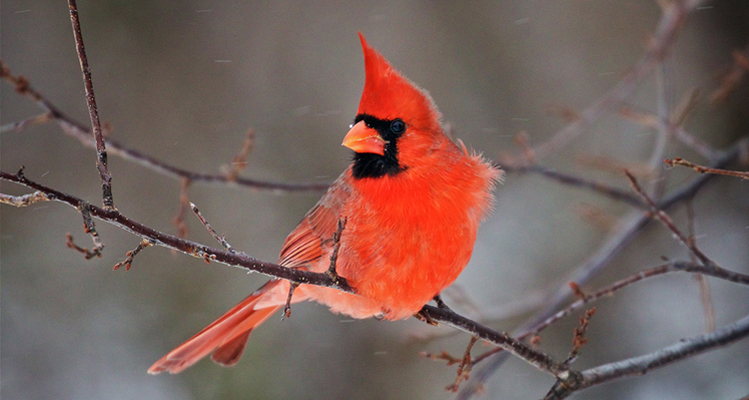
You might think that freezing temperatures and wind-driven snow pelting your face would make for poor photography. Normally I’d agree. However, there are certain places I like to go on a snowy day. One of them is the Sioux Falls Outdoor Campus near the feeders. If you are patient, there is a very good chance of spotting one of a few resident cardinals coming in for lunch or hanging around the nearby branches. The brilliant red of the male is always a joy to see, but seems to stand out even more beautifully amidst the snowflakes.

Friends and co-workers often tease me about how I’m becoming a birder, as if there’s something bad about that. I’m not a true birder, but I’ve taken more steps in that direction the last few years. True birders are interested in every bird they see or hear. I’m partial to the ones I think look cool in a photograph. True birders can tell you where migrating birds come from and about how long they’ll stay. I have to go to the internet for that kind of knowledge. True birders do this thing called”pishing” to get birds to show themselves and take good long looks at you. I try it sometimes, but I think the birds that show up are doing it more out of humorous curiosity than anything else.

Something that has really interested and awed me about birds is how much most of them travel. In the spring, we can get birds from as far away as South America. There is a similar story in the winter. Birds like Lapland longspurs from the arctic come down and hang out in open fields with flocks of horned larks. Bohemian waxwings, the northern cousin of our resident cedar waxwings, are a treat to see. But the most popular and exciting traveller from the north is the snowy owl. I’ve been lucky to see one in almost every winter over the last five years except this one, though it’s not for a lack of trying. I headed northwest of Aberdeen in mid-January, where one had been reported. I didn’t see it, but did I found flocks of snowy buntings, thousands of pheasants and a lone meadowlark, which is interesting because the closest they usually winter is Nebraska

A few Februarys ago, a local birder spent a lot of time looking for the little Northern Saw-whet owl in parks around southeast South Dakota. He reported three of them at Newton Hills State Park. Although these owls can be found along the Missouri River, particularly in the Pierre area at Farm Island and a few other hot spots, I did not know they would come this far south and east. So I went looking too. I failed miserably. On the third visit, I found dead field mice hanging on branches, which is good owl sign, but could not for the life of me spot the owl itself. Finally on my fourth or fifth try, I nearly walked headlong into the owl resting on a young cedar branch in the midst of a tangled thicket. I froze. Usually wild birds flush when discovered at close range. The owl looked at me for about 30 seconds then slowly closed its eyes and went back to sleep. It was an amazing, breathtaking encounter with a winter bird that I’ll never forget. Do seeking out and enjoying thrills like that make me a true birder? Not yet, but I’m getting there.

Christian Begeman grew up in Isabel and now lives in Sioux Falls. When he’s not working at Midcontinent Communications he is often on the road photographing South Dakota’s prettiest spots. Follow Begeman on his blog.

This slideshow requires JavaScript.

Posted on — Leave a comment

Light Through the Storm

This winter has started ugly. There have been snow storms all across the state, record wind chills and to top it off, a major ice storm and blizzard over Christmas. This column is about finding beauty in the midst of that raging holiday storm. I tread lightly because I know the storms we have experienced are deadly at worst and stressful in the least. With that in mind, I first want to say thank you to the electric cooperative linemen, snowplow drivers and friendly neighbors who quickly lend a hand to help those who are suffering.

Our winter weather the weekend before Christmas was coupled with dangerously cold temperatures. I had planned on driving to Mobridge to watch my nephews play basketball, but the wind chills changed my mind. I stayed inside most of Saturday, and by the middle of the afternoon I had a major case of cabin fever. So I went to my dresser to find long johns, down to the garage closet to knock the dust off my coveralls and out the door. The snow drifting right outside my living room window was the first subject followed by Jack Frost’s handiwork on my storm door window. I ended that cold day with a -7 degree sunset in northern Minnehaha County.

My Christmas break started Dec. 22 with an afternoon drive to Day County to look for birds. Pickerel Lake Recreation Area is said to be a good place to find winter birds. I was unlucky in that I only found a flock of black-capped chickadees and heard a bluejay. I did see a nice group of white-tail deer trying their best to avoid me in the campground. They were quite successful, since their skill in managing shin-deep snow is far superior to mine.

I made it to Isabel on Dec. 23. Dad and I took a drive south to Red Earth Creek the next morning in foggy, frosty conditions and found grouse, turkey, pheasant, a hairy woodpecker and a large flock of goldfinches among the trees. On Christmas Day the mist, rain and sleet started. I went out mid-morning and found around an inch of ice built up on anything stationary like fences, highwires and even crested wheat grass. Right before Christmas dinner the rain turned to snow and the wind picked up. It howled all night and well into the next day. About an hour before sunset on Dec. 26, my mom and I ventured out to try to capture a few images of the winter wonderland. Luckily, a neighbor had cleared our driveway. Otherwise I’d still be shoveling.

We drove about 2 miles south of town, noting the drifts and the horned larks who seemed unaffected by the cold. I stopped to shoot the ice buildup on a woven-wire fence with the setting sun. To do this I had to cross a ditch that was completely filled with snow. My mom had a great laugh inside the warm pickup cab watching me get high-centered in nearly waist-deep snow. It took a few minutes but I negotiated my way back to the road as my dear mother wiped tears of laughter from her eyes.

We headed back in time to see a herd of 30-plus deer emerge from a tree lot on the edge of town. When I got out to shoot a photo, they bounded off into the snowswept prairie like the nature footage you see of reindeer in Lapland. It was all quite an adventure, and as ugly as the weather turned, if you looked hard enough there was always beauty to be found. We thankfully had power throughout the holidays, but I know many didn’t. It isn’t always easy living in God’s Country, but I truly do think the beauty that surrounds us makes it worthwhile.

Christian Begeman grew up in Isabel and now lives in Sioux Falls. When he’s not working at Midcontinent Communications he is often on the road photographing South Dakota’s prettiest spots. Follow Begeman on his blog.

Posted on — Leave a comment

Seeking Simplicity

The simplicity of a single leaf yet to fall, blazing orange in the early evening light. A long, straight road heading into the heart of evening. A lone bison against fiery clouds. Winter’s first blast against the straight walls of a country church. Visual eloquence. Nature being itself. Time churning, seasons turning. Each vision an echo of the reminder we all see this time of year. The seasons of growing, of life, have come to an end and winter has begun to reign on the high plains.

What if a photograph, or a series of photographs could capture that mood of transition? Recently a co-worker loaned me a DVD of longtime National Geographic photographer DeWitt Jones talking about his experience. One of his tips was simple, yet profound. Ask yourself,”What in the scene in front of you is good?” Once you’ve pinpointed that, then work to eliminate all the things that would distract from that one good thing you want to capture.

This isn’t easy to accomplish. Our world tends to be very complicated and full of things to see and do, and we are tempted to capture it all in one fell swoop. I’m as guilty as the next person. That is one of the reasons I wanted to try the simplicity idea. My tool of choice became the telephoto lens. Most photographers tend to think of the long lens as a sport or wildlife lens. However, it can also work wonders in isolating the detail of a leaf against an abstract background. Keeping your aperture low also helps the blur, or”bokah,” of the background stay pleasantly out of focus and less distracting.

I use a 100-400mm lens whenever I can. Sometimes I’ll even add a 1.4 extender, which gets me even closer to the subject. This set-up is also great for capturing birds. By November, most of the summer species have fled for warmer weather, but colorful and lively birds can still be found. While walking the trails of the Sioux Falls Outdoor Campus the day after our first snow, I was intrigued to watch a flock of finches, field sparrows and dark-eyed juncos expertly pick and eat the seeds out of the tall grass and dried out sunflower heads. A small, downy woodpecker flew out to a nearby tree while I stood there trying capture the simple beauty of these busy little bursts of life liven up a cold November day. Simple beauty sometimes happens where you least expect it. That’s the fun of trying new techniques and attempting to take images in a new way.

On Thanksgiving Day, after our feast, Dad and I went for a drive to catch the sunset. It had been cloudy and generally dreary for a few days, and the break on the western horizon gave evidence that the sun might make an appearance. The day was as still as you can get in the vast expanse of rural Dewey County. We drove to an abandoned church north and east of Firesteel and waited. When the sun burst out and the colors came alive, coyotes howled to the north and the sky began to make magic. The sun proceeded to paint the clouds various shades for 20 minutes until the light was gone. That simple beauty may have been brief but it will remain with me for a long time to come.

Christian Begeman grew up in Isabel and now lives in Sioux Falls. When he’s not working at Midcontinent Communications he is often on the road photographing South Dakota’s prettiest spots. Follow Begeman on his blog.

Posted on — Leave a comment

The Early Bird Finds the Beauty

I was up before the sun on October 1. That in itself is a rare occurrence. I just can’t seem to get excited about super early mornings. I blame my younger years on the farm and countless pre-dawn milking sessions for that. I learned the luxury of sleeping in at an early age. But I digress. I was up early on October 1 to find and photograph fall colors along the eastern edge of the Coteau des Prairie, and I was not disappointed. Squinting into the rising sun while driving east along a winding road through the Big Coulee area north of Summit, I was greeted with a classic South Dakota scene complete with fall colors and a small white church in the distance. Later, I spent a few hours at Sica Hollow, one of South Dakota’s most colorful fall destinations. It was a good day searching for and finding autumn color.

About mid-month I found myself in Pierre late on a Saturday afternoon. I was pleasantly surprised that most of the cottonwoods below Oahe Dam were blazing yellow and orange, and the day was calm enough to attempt reflection photos in the marina at Oahe Downstream Recreation Area. And Capital Lake was almost still enough to be a mirror. You couldn’t have asked for a more perfect fall day. The next day I got up early again to check out Palisades State Park. Although the trees weren’t quite as far along, I found colorful leaf detail near King and Queen Rock.

When photographing fall foliage, I usually recommend using a telephoto lens and shooting from a distance to pull as much color into frame as possible. This year, I tried the same technique but with leaf detail. If I found a leaf I liked, I tried to put a colorful background of other foilage behind it and then shot it with a long lens. It made for a different way to enjoy and record autumn. Another trick when shooting in the woods is to include a sunburst with a wide angle lens. Find a scene you like and position your camera relative to the sun so it is just past a distant branch or leaf. It helps to have your aperture set high (f16 or so) to get more rays from the burst.

Just last weekend, I helped some old college friends take family photos at Union Grove State Park. I don’t usually photograph people, but in all honesty, the best fall photos usually include humans. Whether it is kids jumping in a leaf pile or a couple walking hand in hand under a canopy of colorful leaves, human interaction simply adds so much more to a happy autumn scene. Even though October is almost over, there are still leaves on the trees or piles on the ground, so it’s not too late to get out there and get some memorable photos. Another good thing about this time of year is that beautiful, early morning light doesn’t happen quite so early, so getting out of bed to get those photos is definetely doable. At least that’s what I tell myself when setting the alarm the night before.

Christian Begeman grew up in Isabel and now lives in Sioux Falls. When he’s not working at Midcontinent Communications he is often on the road photographing South Dakota’s prettiest spots. Follow Begeman on his blog.