Posted on Leave a comment

The Birdwatcher’s Wings

Willis Hall used a trip wire to photograph himself with a trio of red-tailed hawk fledglings.

I sat in the hospital room, watching my friend breathe. He was 86. I felt a little guilty watching him, because he was the most private person I ever knew, and I’m not sure he would have approved; yet it is hard to look away when you love someone. Sometimes we think if we do just a little more, it will be all right. Of course it is not our decision. Willis would have us know that.

I knew Willis Hall for 25 years. He was my mentor and my friend. That he and Rosamond let me be with them was a gift.

I met Willis for the first time when they came to our house to show a group of Yankton College teachers some bird slides. It was love at first sight. He, his Rosamond, and their incredible photographs are the things on which I imprinted as fast as a gosling on the goose. I was cooked. At 7 the very next morning, the three of us began our first of hundreds of birding trips. We three, and sometimes my husband too, eventually would cross what seemed like every prairie pothole and dusty back road in the six-state region. We never took the main road except to get to another dirt road. My gift to Willis was to find a back road he hadn’t traveled before.

By canoe in the summer, he introduced me to least terns and piping plovers on Missouri River sandbars. Above the river, in the low oak hills and on grass-covered bentonite clay cliffs, we found Dutchman’s breeches and the pasqueflower in the spring and buffaloberries and LeConte’s sparrows in the fall. We hiked the hills, checking wild plum bushes for Bell’s vireo and spotted towhee nests and scouting for deer, turkeys, prairie ring-necked snakes and his favorite, great horned owls.

In the winter, we kicked the soccer ball over the park trails or skied the woods in search of red-bellied woodpeckers and bluebirds.

And in the last two years, I played my first tennis ever, with a man who had played for 70 years. Ever patient, he never gave up on me; he just kept putting the ball over the net. If we were distracted by nighthawks and nuthatches at his favorite park counter, so much the better.

In the early days we spotted and counted birds, and he photographed. Rosamond judiciously jotted their numbers and exact locations on the back of recycled envelopes in writing so small a magnifying glass was required to read it. From him I first heard very patient answers to my questions about bird identification, photography and all things having to do with the natural world. If I spotted a bird, impulsively calling it out, Rosamond would always say,”Willis?” and only when he confirmed a sighting, would she add it to the list. I think it was five years before they accepted my birds.

His friend Phil Hall from North Dakota, who explores and writes on the natural history of the Badlands, also writes of Willis’ patience. “One spring, I believe it was in 1982, I noticed that a golden eagle had reclaimed its nest high up in the wall that defines the east side of Red Canyon. I phoned Willis, and 36 hours later he and Rosamond appeared in the pasture by my cabin. After the obligatory tea for an Englishman, we set out for the eagle’s nest, which was about 10 miles down the canyon. While the nest looked close to the road, it was a deceivingly long hike, and just short of vertical. Willis led the way, hauling a camera, a big lens, binoculars, and a heavy camera bag. At the time, I was 39 and he was 69. I struggled to keep up with him.

“We advanced as far up the canyon wall as possible. There, we ducked behind a scrubby cedar tree. Out of his bag, Willis produced a small piece of camouflage cloth, which he draped around us. We sat like rocks for two hours. However, I twice shifted my weight and once had to scratch an itchy nose. We waited without breathing.

“The eagle never came, and Willis finally announced that we should hike back to the pickup. I was chagrined at not being able to show him the eagle. As we gathered up the equipment, I asked, ‘Willis, why do you think the eagle never came to its nest?’

“‘We moved too much,’ he replied.”

At home he was constantly on the move. If Rosamond was his ears, he was her legs. She might say, “Willis, get me the bird notes from the kitchen.”

He would respond, “Where are they?”

“In the pea bag on the counter.” He would go, and return empty handed and baffled. She would carefully repeat, “Pea bag!”

“Oh!” he said, “I thought you said tea bag.”

And they both would exchange glances that said, “Pay attention, dear. Speak more clearly, dear.” But they were smiling at each other.

Their relationship was a curious delight to the college students. She regarded her students highly and held extra classes at their home. One of her former French students wrote, “I remember one time Miss Burgi called to Willis to please bring that cereal box to her. When she had it she reached in and pulled out my homework. Of course! Homework in a cereal box. He was dear and I knew there was some serious devotion going on in that house. “

Theirs was indeed the language of serious devotion. They chose their cadences carefully. She may have been the professor of Latin, but he was the poet. He spoke plain English.

From her I first heard exotic bird terms. “Is that a bird or an excrescence?”

I asked for translation, and Willis, in all seriousness, answered, “Excrescence — a bump on a log — excrescence.” And looked at her. And she smiled.

Rosamond once told me she would rather be struck from a mountain than linger aimlessly. In 1992 she suffered a stroke and passed from her mountain. He believed he would be with her again. In 1998 he wrote the poem Almighty God.

A few leaves flutter in the breeze.

These too shall all be gone.

Almighty God shall bring them

back again.

Each one, its perfect self, shall be

A part of me, as it has been.

She too, My Rosamond,

shall be again.

Willis never wanted to impose. Waiting at the doctor’ s office, he had a sniffle. I told him I had taken a zinc lozenge for my sniffles. He seemed absolutely mystified. He looked at me, and rather than have me repeat, an imposition, he tried to further the conversation by eliciting more information. He questioned, “Where does one get such a substance?”

“Oh, probably from chewing rocks,” I replied.

Somewhat alarmed, Willis said, “From chewing rats?”

Now this was a man who rescued bats and carried indoor insects outside so they’d have a fighting chance. “No,” I said, “from chewing rocks, r-o-c-k-s.” Concerned that I had confused rather than amused him I said, ”I’m only kidding, Willis. It’s a joke.” He, waiting for me to breathe as I watched his face, looked me straight in the eye and said the only zinc he knew was the kitchen zinc.

With deep relief for the moment and for so much else, I laughed. I detected a sly smile on his face. I knew that once again — I’d been cooked.

We moved Willis from the protected environment of his hospital room to an adjoining nursing home where we hoped he could convalesce from the pneumonia for which he’d been hospitalized. His beloved brother, Winston, had died six weeks before, and he was greatly saddened.

Several times over those weeks in the hospital, health care workers asked me if he was my father. One day, through deafened ears, he responded , “Daughter … and mother.”

I combed his gray hair and said he looked like a tufted puffin, the longhaired seabird whose wings are better suited for diving for fish than for flying. He said he had never had a higher compliment. Two weeks later he said he felt he had come to the end of a long race. The next week he said he wished he could start over. When I asked if he wanted anything he replied, “What I want is unobtainable.” Three days later he had a small stroke. He did not recognize the oak bough I brought. For another day he said nothing.

And then he revived.

A long time ago, trying to keep up with him, I had asked Willis if he could live without walking. He said he guessed on his deathbed he’d get up and take a walk. And he did. At sunset, we went outside and walked the half block to the edge of the bluff. In silence we looked down at ducks silhouetted on a silver bend in the river.

I told him I had spoken with his oldest friend, Wes Cook, who now lives in New Mexico. His eyes widened. “Is he well?” Willis asked. Those were his last words.

I had brought him a gift, a large photo I’d taken in Alaska, a single tufted puffin facing the sea. He looked at the bird. He smiled at me and nodded. This time he would have to fly.

Editorís Note: This story is revised from the May/June 2000 issue of South Dakota Magazine. To order a copy or to subscribe, call (800) 456-5117.

Posted on Leave a comment

For the Birds

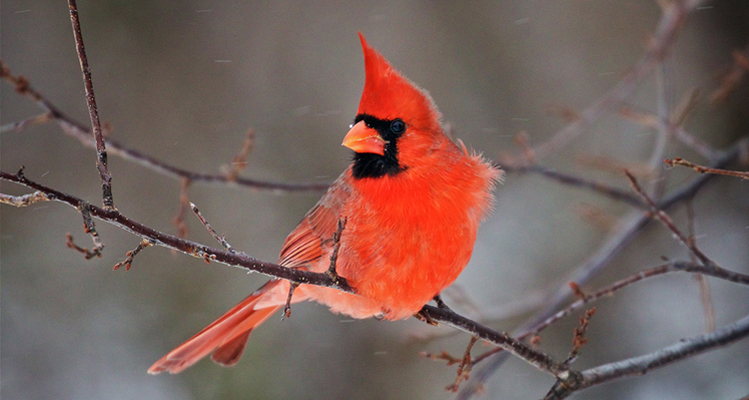
You might think that freezing temperatures and wind-driven snow pelting your face would make for poor photography. Normally I’d agree. However, there are certain places I like to go on a snowy day. One of them is the Sioux Falls Outdoor Campus near the feeders. If you are patient, there is a very good chance of spotting one of a few resident cardinals coming in for lunch or hanging around the nearby branches. The brilliant red of the male is always a joy to see, but seems to stand out even more beautifully amidst the snowflakes.

Friends and co-workers often tease me about how I’m becoming a birder, as if there’s something bad about that. I’m not a true birder, but I’ve taken more steps in that direction the last few years. True birders are interested in every bird they see or hear. I’m partial to the ones I think look cool in a photograph. True birders can tell you where migrating birds come from and about how long they’ll stay. I have to go to the internet for that kind of knowledge. True birders do this thing called”pishing” to get birds to show themselves and take good long looks at you. I try it sometimes, but I think the birds that show up are doing it more out of humorous curiosity than anything else.

Something that has really interested and awed me about birds is how much most of them travel. In the spring, we can get birds from as far away as South America. There is a similar story in the winter. Birds like Lapland longspurs from the arctic come down and hang out in open fields with flocks of horned larks. Bohemian waxwings, the northern cousin of our resident cedar waxwings, are a treat to see. But the most popular and exciting traveller from the north is the snowy owl. I’ve been lucky to see one in almost every winter over the last five years except this one, though it’s not for a lack of trying. I headed northwest of Aberdeen in mid-January, where one had been reported. I didn’t see it, but did I found flocks of snowy buntings, thousands of pheasants and a lone meadowlark, which is interesting because the closest they usually winter is Nebraska

A few Februarys ago, a local birder spent a lot of time looking for the little Northern Saw-whet owl in parks around southeast South Dakota. He reported three of them at Newton Hills State Park. Although these owls can be found along the Missouri River, particularly in the Pierre area at Farm Island and a few other hot spots, I did not know they would come this far south and east. So I went looking too. I failed miserably. On the third visit, I found dead field mice hanging on branches, which is good owl sign, but could not for the life of me spot the owl itself. Finally on my fourth or fifth try, I nearly walked headlong into the owl resting on a young cedar branch in the midst of a tangled thicket. I froze. Usually wild birds flush when discovered at close range. The owl looked at me for about 30 seconds then slowly closed its eyes and went back to sleep. It was an amazing, breathtaking encounter with a winter bird that I’ll never forget. Do seeking out and enjoying thrills like that make me a true birder? Not yet, but I’m getting there.

Christian Begeman grew up in Isabel and now lives in Sioux Falls. When he’s not working at Midcontinent Communications he is often on the road photographing South Dakota’s prettiest spots. Follow Begeman on his blog.

This slideshow requires JavaScript.

Posted on Leave a comment

Snow Birds

The first major snowstorm of the season hit the midwest on Friday. Only a few inches were initially expected in Sioux Falls, but the city saw record snowfall by the end of the day. The previous record for November 20 was 3.8 inches in 1975. A whopping 14 inches were reported on the south side of town while northern Sioux Falls received about half as much. Christian Begeman spent a few hours at the Outdoor Campus that afternoon, observing birds stocking up at the feeders. See more of his work at cbegeman.blogspot.com.

Posted on Leave a comment

Why We Go Birding

I have noticed that people may not understand what I’m doing when I go birding. They sometimes think that I’m going just to look at pretty birds. That’s true, but there is more to it for birders like me.

Searching for Different Species

When migration begins, I want to see the different birds that pass through because they’re only in our area during part of the spring and fall. A bird that’s new to our area or an early arrival would be nice to see. A rare bird would be great. If a birder sees an interesting or rare bird, it is reported to an email listserv so that other birders may go see it, too. If it is indeed a rare bird, I record what I observe and try to get a photo and/or video. My detailed report goes to a committee of the state ornithological union. If they decide I was correct in my identification, it will be entered into the state birding records. It is very gratifying for a birder to find a rare bird and have the report accepted.

Adding to My List

Birders like me keep many different lists: yard, patch, town, state, year, counties and life lists. I am very list-motivated, so I enjoy searching for different birds to add. It’s like a game for birders. The South Dakota Ornithologists’ Union website lists the top birders in the state, which is another fun goal to try to achieve.

Citizen Science

I keep a list of the birds I see and note certain details: date, place, time of day, duration, species and quantity. I also note breeding codes, such as whether a bird is nest-building, on the nest, carrying food or nesting material, feeding young, etc. It is work to get this information collected and put onto the database, but it is a great feeling to help with citizen science and know that you are contributing to conservation.

Later I put all of this information onto eBird. Launched in 2002 by the Cornell Lab of Ornithology and National Audubon Society, eBird shares these observations with a global community of educators, land managers, ornithologists and conservation biologists. Also, eBird keeps track of birders’ lists, so that is very handy for us. At the end of each reporting season, we can have our eBird information sent directly to the state database, so it will be part of our state’s birding records as well. In this way, birders are helping science by collecting data for state and global databases.

Birding is Fun

Birding is fun whether you keep lists or just observe birds. When I go birding I get exercise while hiking, yet it is very relaxing. I see wonderful places, wild animals and beautiful wildflowers, as well as birds. I enjoy seeing the variety birds, watching their behavior and listening to them sing. Birding with other birders is also enjoyable, and it is nice to spend time with like-minded people.

While concentrating on bird songs and bird identification, my troubles and worries melt away. My husband often tells people how happy I am when I return from birding. He is right. I am so thankful that I went to my first birding festival four years ago and that I was turned on to birding. This year’s South Dakota Birding Festival at Fort Randall will be May 1-3 at Pickstown. A new gathering, the Prairie Birding Festival, will be in Mitchell on May 8-10. More information is available online. You may want to come and check out these festivals for yourself.

Birding is a fulfilling activity and is enjoyed in varying degrees by different birders. I wish everyone could get outdoors more often to experience all that nature has to offer. Until then I will do my best to get people interested, so that they can feel the same joy that I have felt.

Kelly Preheim is a South Dakota Ornithologists’ Union board member. She teaches kindergarten at Armour Elementary, where she incorporates lessons on birding into the classroom. Her students have been recognized nationally for their knowledge of birds. Visit Preheim’s Flickr site to see photos from her birding adventures.

Posted on Leave a comment

Eagle Season

A bald eagle built a nest near the old Meridian Bridge in Yankton two years ago, and then perched on a nearby cottonwood branch and posed for pedestrians, who were at eye level to the big bird when they were on the bridge’s upper deck.

The eagle eventually abandoned that nest. Maybe it was a tad too close to civilization for her comfort. But more eagles than ever are wintering on the open water of the Missouri River in Yankton, and they often glide slowly over the walking bridge that extends into the city’s old downtown.

Eagles were following the Dodo bird to extinction a scant 50 years ago. Illegal hunting, habitat destruction and a poison known as DDT were killing the species. In 1963, only 487 nesting pairs could be found in the United States.

But the Endangered Species Act banned DDT in 1972, and the eagles gradually adapted to a changing prairie landscape. Today, the state Game, Fish & Parks Department estimates that there may be as many as 300 nesting pairs just in South Dakota.

Most South Dakota eagles can be found wintering below the Missouri River dams, where massive old cottonwood trees provide a barky foundation for their large, heavy nests. Open water below the river’s dams provides easy fishing. Eagles also nest in the Black Hills near the Deerfield Reservoir, and it’s not surprising to find them in any part of the state.

Eagles build their nests by mid-February and begin laying eggs in late February. The birds mate for life, and use the same nests from year to year, adding twigs each year. Their nests are among the largest of any North American bird. One big nest measured 13 feet deep by 8 feet wide.

The majestic bald eagle was chosen as our national emblem in 1787, partly because it was native to North America. The fierce appearance of its curved beak, regal white head and piercing eyes were also factors. In the emblem, drawn in 1782, a bald eagle is displayed with an olive branch in one claw and 12 arrows clutched in the other, representing both peace and war.

Benjamin Franklin famously opposed putting the bald eagle on the nation’s emblem. He favored the wild turkey, which he claimed was, “A much more respectable bird and a true native of America.” He said the turkey was a bird of courage that “would not hesitate to attack a grenadier of the British guards who should presume to invade his farm yard with a red coat on.”

It seems Franklin was also put off with the bald eagle’s habit of eating carrion. They often steal food from smaller birds by intimidating them into dropping their prey. They also feed on dead fish and crippled birds. “He is a bird of bad moral character,” wrote Franklin. “He does not get his living honestly. You may have seen him perched in some dead tree where, too lazy to fish for himself, he watches the labor of the fishing hawk and, when that diligent bird has at length taken a fish and is bearing it to his nest for his young ones, the bald eagle pursues him and takes the fish.”

It seems unpatriotic to dredge up Franklin’s comments. After all, the eagle is just doing what comes naturally. Go eagle watching this spring and you will instantly be reminded of why our founding fathers chose this regal bird to represent our nation. Your best chance to see some soaring is to visit the Missouri below the dams at Yankton, Pickstown, Fort Thompson and Pierre. In Yankton, a few eagles can often be found in the big trees that lie south of Riverside ballpark.

Posted on Leave a comment

Feeding Feathered Friends

February is National Bird Feeding month, and with this year’s extremely cold temperatures it’s a great month to supplement bird food supplies.”During winter months it is really important that birds have enough food to keep their fires burning,” says K.C. Jensen, associate professor in the Natural Resource Management department at South Dakota State University.”Bird metabolism is extremely high, average body temp is 105 to 107 degrees, so they need lots of fuel.”

Seeds are one of the best sources of carbohydrates, and the more fat the better.”I like black-oil sunflower seeds because they’re readily available, relatively inexpensive and the birds really go for it,” Jensen says. They’ll attract most winter birds like black-capped chickadees, white and red-breasted nuthatches, and downy, hairy and red-bellied woodpeckers. Other backyard favorites like blue jays, American gold finches, purple finches, common redpolls and pine siskins also like mixed seeds. And many winter birds enjoy suet.

Ricky Olson, South Dakota Ornithologists Union president, says he’s often asked if we really need to feed birds in winter.”A lot of people say, ‘birds were here before we were and they would survive without us,’ but I don’t believe that’s so true in many areas anymore,” Olson says.”I live in Pierre and there are very few wooded areas left as habitat has been changed for development and housing. I don’t know if there’s enough natural stuff to sustain much of the population, especially in hard winters.”

Inspired by this info and the national Great Backyard Bird Count set for February 14-17, I decided to make birdseed ornaments for my backyard trees. In honor of Valentine’s Day I made them heart-shaped. This recipe uses coconut oil in place of the usual suet, so it only works for wintertime use. Coconut oil melts at temperatures above 76 degrees.


Bird Seed Ornaments

Adapted from Wikihow.com

Heavy-duty aluminum foil
Non-stick cooking spray
About 6 metal cookie cutters
1 cup coconut oil
1 — 1 Ω cups birdseed
Small saucepot
Twine or string

Coat cookie cutters with non-stick spray. Lay each cookie cutter on two squares of foil, then wrap foil up around the cutter’s sides. Thread a 10-inch piece of twine through the cutter. Melt 1 cup coconut oil on medium heat then mix in at least 1 cup bird seed. Let cool so mixture begins to thicken, but is still pourable. (This took a long time, so I set the pot outside for a little while.) Pour the mixture into the cutters until it almost reaches the top. Let harden at room temperature, then place in the freezer, or set outside, for 1 hour. Finally pop the ornaments out of the cutters and tie to your tree. Make sure to tie near other branches so birds have somewhere to perch while they eat.

Posted on Leave a comment

Winter is for the Birds

A friend of mine recently shared a link to a bird photographer’s exquisite work capturing small songbirds in flight. The message was accompanied by a good-natured challenge to start producing similar images of my own. I’m always up for a challenge. The problem, I soon discovered, is that getting a good photo of wild birds in nature is extremely hard … not to mention predicting where and when said bird will take flight. What I’m trying to say is that I’ve failed miserably in this particular challenge … so far.

With that confession on the table, I figured I’d share some tips (and photos, both good and bad) that I picked up along the way. Now I’m not much more than a greenhorn birder myself, but I do have a starting suggestion. Find the nearest winter bird feeder and camp out nearby. Last year I had good luck at the Sioux Falls Outdoor Campus during a steady morning snowfall. This year I tried the bird feeders at Farm Island State Park near Pierre and at the entrance to Good Earth State Park southeast of Sioux Falls. These feeders allow you to get fairly close as long as you stay still and are willing to wait for the birds to return after initially disturbing them. This wait can take anywhere from five to 15 minutes. At Good Earth, I chose to sit cross-legged on the ground next to an evergreen as I waited. Soon I had juncos hopping a few feet away and a downy woodpecker nearly ran into my head. I sat so still for so long that my leg fell asleep. Good thing no one was around. Standing up was accompanied by numerous mutterings and murmurs.

I read that Farm Island is home to northern saw-whet owls, so after spending some time at the feeder missing shots of flying finches (those things can move!), I searched for a couple of known saw-whet roosts reported on a birding website. I failed to find them as well. My guess is that the high water a few years back may have re-arranged a lot of things on the island (but in reality, being a rookie birder didn’t help much either). I did, however, have a fun game of hide and seek with a noisy northern cardinal male for about a half hour along the trail. I must have been near its nest when I saw a flash of red and heard the telltale metallic chirp. Long story short, he let me get the closest I’ve ever been to a cardinal, with one stipulation: he put as many branches and twigs of his favorite tree between the two of us at all times.

I really like owls, and earlier in the month I accidentally scared a great horned out of an abandoned church. He flew to the tree windbreak nearby and, like the cardinal, kept the densest part of the tree between him and me. I saw a long-eared owl for the first time in my life while checking out the swans of LaCreek National Wildlife Refuge in Bennett County. He was sunning himself in the early morning light and I happened to notice his outline from at least a quarter mile away. I didn’t get a great shot of him from that distance, but it made the day worthwhile.

The last tip I have is to use your ears. The best tool for locating a bird while out and about is hearing them. I’ve still got work to do on this one. Just last weekend, as I sat quietly along Sergeant Creek at Newton Hills State Park, I could pick out cardinal, chickadee and at least two other unknown songs amongst the steady drumming of woodpeckers and the brazen calls of blue jays. The only birds I could actually see were two bald eagles soaring high above the distant Big Sioux River. Experiences like this make birding addicting. I know they are out there, I know they make great photos, and I know it is a challenge to put it all together and get the unique shot. I wouldn’t have it any other way.

Christian Begeman grew up in Isabel and now lives in Sioux Falls. When he’s not working at Midcontinent Communications he is often on the road photographing our prettiest spots around the state. Follow Begeman on his blog.

Posted on Leave a comment

West River Photo Hunt


I’m not a normal hunter. Not like my older brother, anyway. He’s a true hunter. Growing up in West River country, I rode along with him from time to time as a spotter. I suppose I provided companionship and moral support but almost always left the shooting to him, mostly because he was pretty good with a gun. He once spotted and shot a deer from our back sidewalk without the taking the time to put shoes on. I believe he still has the antlers, mounted with the title”In Stocking Feet” printed below.

It wasn’t like I was a bad shot. I spent countless hours honing my skills with my .22 caliber rifle in the prairie dog town a few miles west of our house. That said, I never was much good with a shotgun. I’d rather hunt grouse with my .22. One fall afternoon I did just that with my hunter brother. He made fun of me, like any good older brother would. I silenced him as I took a grouse of the haystack on the hill with my first shot. One shot, one grouse. Of course I didn’t hit anything else all day, but my point had been made.

Nowadays I shoot wildlife with different gear. A 100-400mm lens is my weapon of choice and instead of antlers on the wall I hope to get photos that might be wall-worthy. This means I don’t get to enjoy deer jerky or mom’s wonderful pheasant gravy over mashed potatoes, but I get to enjoy all the other fun of hunting in South Dakota, and maybe more. Many of the animals that are off limits to hunters are not off limits to me. I also get to shoot after the sun goes down and in our national and state parks. Our park systems offer some of the best wildlife viewing opportunities this side of Yellowstone.

I took some time off before Thanksgiving to do a little hunting my way before seeing the folks for the holiday. I started off in the Badlands. That first morning I was up and out before the sun and on my way. Most wildlife is active early in the morning or in the last hours of the day, so I knew if I was going to be able to see anything interesting I needed to be out early. A nice bonus to doing this is being able to witness the beauty of daybreak. Let me tell you, dawn over the Badlands is truly a sight to behold. The following morning as I was driving through Custer State Park in search of early morning elk, I was treated to another colorful sunrise. I eventually found elk in Wind Cave National Park, but they were quite shy and I didn’t get as close as I wanted. No matter, the thrill of just seeing them on the horizon line while hearing the coyotes howl across the canyons made the day a winner anyway.

I’ve been thinking about how many animals I saw on this two and a half day excursion and it really is quite a list. From a fleeting glimpse of a bobcat to a bald eagle in the middle of a prairie dog town as well as bighorns at sunset and a lone coyote howling in the late afternoon, it was a thrill for both the eyes and camera lens. I didn’t get to photograph all I saw, but thrill of being out there and hunting for the”shot” was enough. In fact, it’s enough to keep me going back year after year. Now if I can just get some deer jerky from my brother…

Christian Begeman grew up in Isabel and now lives in Sioux Falls. When he’s not working at Midcontinent Communications he is often on the road photographing our prettiest spots around the state. Follow Begeman on his blog.


Posted on Leave a comment

Dakota’s Other Dunes

Every year as I travel South Dakota’s roads something new surprises me. The latest example was discovering the north edge of the Nebraska Sand Hills is actually located in South Dakota. South of Martin, in Bennett County, the Sand Hills march at least seven miles across the border. When I discovered this, I looked at a topographic map and noticed the lack of roads in this region, which intrigued me. Doing more research, I stumbled across an article online that lamented the fact that hardly any photos can be found of the region in state publications or South Dakota Tourism material. Sounded like a challenge to me.

The Sand Hills eco-region is fascinating. Most of the area has never been under the farmer’s plow, mostly because no decent crops can be grown. It is just over 20,000 square miles of land that is 85% intact natural habitat. Geologists say the area used to be active sand dunes as recent as eleven hundred years ago. It is hard to imagine Sahara-like dunes in South Dakota but once you take a hike out into the hills, it is actually pretty easy to see it. The ground is soft and easy to move. The grasses and plants are not as dense as in other South Dakota grasslands, but the variety of species are surprisingly vast. It is good cattle country and many large, sprawling ranches still thrive.

Sitting on top of the vast Ogallala Aquifer, the Sand Hills boast many wetlands and small lakes throughout the rugged country. Because of this, the area has become a hugely important corridor for migrating birds. Right up against the northern edge of the Sand Hills, pretty little Lake Creek sends a healthy stream out into the picturesque valley of LaCreek National Wildlife Refuge. The US Fish and Wildlife Services maintain this important wetland area of over 5,000 acres. I spent a good amount of time traveling the refuge’s roads, hiking a few trails looking for wildlife and being surprised by brilliant wildflowers at almost every stop.

LaCreek is full of wildlife in the summer, but if birding is your thing, then the refuge is actually better visited in the spring or fall during the migratory seasons. I saw an owl, a couple eagles and a few pelicans, but these sightings are nothing compared to the numbers of birds the place hosts at migration’s high tide. Trumpeter swans are the biggest attraction — LaCreek was a key place that helped the bird’s population rebound in the United States in the early to mid-1900s. A group of cygnets (young swans) was transplanted from Montana and a new colony grew and soon thrived at LaCreek.

Although I missed the swans, I thoroughly enjoyed my two-day stay in Bennett County. The weather was hazy and humid. In the evening the setting sun resembled a molten ball of rock settling into the west. As I looked out over the wide valley and into the Sand Hills on the horizon, it struck me that this place reminded me of my visit to East Africa’s Serengeti in December 2009. I mean, there are no lions or zebras at LaCreek, but I could easily imagine a hippo or two popping out of one of the trout pools. It is funny how the mind plays tricks on you out alone under a vast South Dakota sky. Then again, there used to be real sand dunes and a desert on the southern horizon. So who am I to question South Dakota’s variety and ability to continue to surprise?

Christian Begeman grew up in Isabel and now lives in Sioux Falls. When he’s not working at Midcontinent Communications he is often on the road photographing our prettiest spots around the state. Follow Begeman on his blog. To view Christian’s columns featuring other unique spots in South Dakota’s landscape, visit his landmarks page.


Posted on Leave a comment

Sioux Quartzite’s Ancient Beauty

Last December I turned 40. I guess I’m supposed to be”old” now (at least to anyone under 40, that is). Other than some achy knees and various aches and pains I don’t feel old — especially now that I’ve done a little research on the landmark that helped shape Sioux Falls and the surrounding area. Sioux quartzite, the hard stone that the Big Sioux tumbles over at Falls Park in Sioux Falls, is ancient. I mean really, really ancient. Those that study rocks say it was formed around 1.5 billion years ago. That is older than old — I mean it is really hard to fathom. The last dinosaurs are supposed to have been around 60 million years ago. That’s a drop in the bucket compared to our Sioux quartzite. This rock formation has been fairly stable and in existence for roughly a quarter of the time Earth has been a planet.

I first visited the falls of the Big Sioux when I was a young teenager. For a West River kid, it was like a whole new world. Back then, the park hadn’t been cleaned up nor was there much for walkways, but nonetheless, I still remember being surprised that such a thing existed in South Dakota. I later learned that Sioux Falls is not the only place to see outcroppings of Sioux quartzite. Palisades State Park just south of Garretson may be small in terms of size, but it packs a large punch in terms of unique and stunning scenery. There, Split Rock Creek cuts through a section of Sioux quartzite, leaving dramatic cliffs and standing stones seemingly in the middle of rolling farm hills.

Just upstream, on the other side of Garretson, is Split Rock Park and Devil’s Gulch. Legend holds that this is where outlaw Jesse James escaped a posse of armed men after fleeing from a botched robbery attempt in Minnesota in 1876. James and his horse supposedly leaped the narrow gorge leaving his pursuers behind. A small walking bridge marks the spot today. Whether the legend is true or not, the area is a great place to hike and see the quartzite formations.

Another place that shows off the beauty of the quartzite is just south of Dell Rapids. Here the Big Sioux divides into two streams with the smaller channel cutting straight through cliffs of Sioux quartzite called the Dells of the Big Sioux. There is a small park and overlook to check out, or if you have a more adventurous spirit, there is a sort of natural staircase to the north of the picnic area to climb down into the gorge. In visiting the area earlier this spring, I also found it to be a great place to bird watch. Insect catchers swoop through the canyon picking off their prey and the cliffs allow for nests for all sorts of swallows as well. The abundance of trees provide nesting and resting areas for many species too.

This summer I was introduced to a couple of Sioux quartzite areas that were brand new to me and very worth visiting. Arrowhead Park on the east side of Sioux Falls is a great place to take a short hike with family members in around some quarry pools. The waterfowl are used to people and many folks like to take some bread along to feed them on the edges of the pools. Along the South Dakota-Iowa border is another pool in the Gitchie Manitou preserve that is a little more off the beaten track but well worth the visit as well. I went there on a hot July afternoon and basically had the place to myself. My task was to take a portrait or two of ancient beauty over a billion years in the making. Makes me feel young and spry just telling you about it.

Christian Begeman grew up in Isabel and now lives in Sioux Falls. When he’s not working at Midcontinent Communications he is often on the road photographing our prettiest spots around the state. Follow Begeman on his blog. To view Christian’s columns featuring other unique spots in South Dakota’s landscape, visit his landmarks page.