Posted on Leave a comment

The Birds Are Back

Unknowns. Social Distancing. Stay at home. Worry. Concern. We are experiencing it all these days. And with the”new normal” comes so many voices. So many storylines. Some real and earnest. Some biased, but still quite earnest. Arguments on whether things are worse than we think or maybe not nearly as bad as we think. Politicizing in an election year to boot. There is so much noise even when we stay at home and try to shut it all out.

Even before the Covid-19 pandemic cast its shadow over the world, I found a solution to all the noise. Starting this time of year and extending into early summer, I take any and every opportunity I can get to shut off the TV, the chirping smart phone and whatever else is vying for my attention to go outside and find birds. The spring migration is a wonder in this part of the world. With the Missouri River dividing our state and the mighty Mississippi just a state to the east, we are in prime flyway country.

In March, I took a day trip to Sand Lake National Wildlife Refuge in Brown County, where I saw thousands of snow geese and other waterfall congregating on their way to the Arctic. The day I was there, it was estimated that 500,000 birds were in the area. Seeing that much life in one spot is something, but then to witness portions of it take flight en masse is another wonder entirely. Small tornadoes of wings, feathers and goose honks filled the sky and slowly moved away. This is a kind of noise I’m OK with … once a year. The arrival and subsequent passing through of snow geese is noisy, let’s be honest, but it also means spring is on its way!

Of course, this is South Dakota, so just because spring is near does not mean winter is over. On Easter weekend, a near blizzard was pummeling Sioux Falls. Ironically, snowy days are some of my favorite times to get out and shoot photos of birds. They tend to flock closer to the ground, stay put longer and the bad weather makes for great backgrounds. This year’s Easter snowstorm provided all that and more. Plus, I was completely surprised to find the first little warblers of the year out browsing for insects in the midst of the wind and weather. Yellow-rumpled warblers, which incidentally have one of the greatest bird names of all time, were seen both at Terrace Park and the Outdoor Campus. This means real spring is even closer. In fact, I’m hoping by next weekend it will be here for good.

Here are 16 photos of my bird hunts this year and eight from last year to show examples of what is yet to come. The great thing about birding this time of year is that most of us can do it from our back porch if we need to stay isolated. Just so you know, on all my birding trips so far this year, I easily encountered far more birds than people, although the birds seem to maintain much more than the recommended 6 feet of social distancing. Even so, witnessing the spring migration this or any year is a hopeful thing. The good book reminds us that no sparrow falls to the ground outside of the Creator’s care. If that, then how much more for us? This is a comforting thought in my book. Happy spring! Stay safe and be well.

Christian Begeman grew up in Isabel and now lives in Sioux Falls. When he’s not working at Midco he is often on the road photographing South Dakota’s prettiest spots. Follow Begeman on his blog.

Posted on Leave a comment

In Full Swing

For the last seven years, I’ve tried to visually document the first signs of new life in “spring journals.” From the first wildflowers to the arrival of songbirds, rambling nature walks through parks in southeastern South Dakota have become increasingly fun. In years past, I usually started documenting signs of spring in March — and sometimes as early as February — but the last two winters have been long and trying. This time, I started my journal entries on the day after a major blizzard struck on April 12. It is amazing how much changes on the Great Plains in a 30-day window. We’ve gone from feet of snow on the ground in mid-April to a near 80-degree day in mid-May, with birds and bumblebees in the air instead of snowflakes. All this change makes it quite difficult to not get caught up in spring fever … and I’m OK with that.

April 13

I found a patch of snow trillium in Newton Hills State Park living up to its name standing strong above the recent snow accumulation.


April 15

I decided to take a walk around Palisades State Park. I discovered a mixed flock of golden-crowned and ruby-crowned kinglets foraging in the cedar trees above the quartzite cliffs. These tiny birds were fearless and foraged all around me as if I wasn’t there.


April 19

The evening sun warmed the first butterflies of the season at Union Grove State Park, including this eye-catching Eastern comma.


April 21

On Easter Sunday I travelled through the glacial hills between Eureka and Leola in McPherson County on my way home from visiting family. I took a couple gravel road detours to look for pasqueflower stands and was not disappointed.


April 24

For only the second time ever, I found blooming white fawn lily (or trout lily) flowers at Union Grove State Park. Although not a rare wildflower in general, it is rare for our state. It has only been documented along Brule Creek in Union County.


May 2

My first spring hike at Big Sioux Recreation Area near Brandon turned up brush flowers and yellow rumped warblers catching insects out of mid-air above the hiking trails.


May 4

While returning from a hike at Newton Hills State Park, I pulled off I-29 at the Canton exit to go west a few miles. I caught a striking spring sunset over West Prairie Lutheran in rural Lincoln County.


May 7

Another hike at Palisades State Park turned up a rare look inside a raccoon den in a hollowed out tree. This young coon looked like he was just waking up from a nap, and I was a bit jealous. He looked quite cozy in there with his siblings.


May 9

I took a walk around sunset at the Japanese Gardens of Terrace Park and saw a female common yellowthroat warbler frolicking on the edge of Covell Lake.


May 10

While walking a trail along the northeastern cliffs of Palisades State Park, I was buzzed by my first ruby-throated hummingbird of the season. I turned to follow and found a good nectar source (Missouri gooseberry shrub blossoms). I waited for more than half an hour as the sun sank lower in the sky. Just as I thought I had missed my chance, the hummingbird returned with a couple friends; one of them allowed me to get this photo. It was a memorable close encounter with nature, and I was thrilled to come away with a photo (in focus) to remember it by.


May 11

There is a lot of water around this spring. Too much water for many people. I was crossing a very full and fast moving Skunk Creek just west of Ellis at sunset, and the colorful sky reflected on the rushing water looked like an abstract painting.


May 12

After church on Sunday morning, I took a walk at the Sioux Falls Outdoor Campus and got a nice look at this blackpoll warbler. He, like the majority of warblers migrating through this time of year, has made his way north from as far as Central America and won’t stop for the breeding season until reaching the boreal forests of Canada.


May 13

There are few aromas I like better than plum blossoms on a spring breeze. This orange-crowned warbler at the Big Sioux Recreation Area also likes flowerings because they attract nectar-seeking insects that must be quite tasty.


May 14

The temperature was near 80 degrees in Sioux Falls, and I spent some time walking through a very busy Terrace Park after work. With lilacs just beginning to open and ducklings on Covell Lake, spring appears to be in full swing on the upper Great Plains, and that is very good news.

Christian Begeman grew up in Isabel and now lives in Sioux Falls. When he’s not working at Midco he is often on the road photographing South Dakota’s prettiest spots. Follow Begeman on his blog.

Posted on Leave a comment

Frosty Wonderland

Winter weather is not usually described in complimentary terms. Subzero temps, the threat of blizzards along with long nights and short days make it difficult to stay on the sunny side of life during a long, South Dakota winter. But there is a certain phenomenon that occurs during our cold months that defies negativity. You could even say that what happens is magical, or maybe miraculous. How else would you describe an event that has the power to turn a dreary, near colorless landscape into a whole new vision of white sparkling scenery? Granted, I may be a little more enthusiastic than most about frost because it is so fun to photograph. Even so, from the smallest ice-spiked detail to a vast winter white vista, frost has the ability to create an actual winter wonderland.

This year, we’ve had snowfall followed by warm spells. The snowmelt puts moisture in the air, and then freezing temps overnight bring fog. This is the perfect recipe for frost. For years, I called the frost from fog”hoarfrost,” but I’ve recently learned that what I shoot is more likely a type of rime frost or ice. Rime ice is similar to what sailors deal with on the sea in cold weather. It happens when super cooled water droplets freeze and attach to an exposed surface that is below freezing. The two kinds of rime are”hard rime” and”soft rime.” I would never have known the difference until this year’s frost quests in late November and late December.

On my way to visit family for Thanksgiving, I ran into thick fog in Edmunds and Walworth counties. There was a steady wind and plenty of moisture in the air, so I knew it would be optimal frost-making weather. On Thanksgiving morning, Dad and I drove out to see Jack Frost’s handiwork and were not disappointed. A thick, hard rime had formed on windward fence lines, trees and tall grass. A couple more frost events took place in southeastern South Dakota in December. One of those had frost designs that I don’t remember seeing before. Long, thick needles of ice formed on the corners of certain leaves and grasses and left tiny designs similar to jumping jacks hanging on the edges. It turns out this kind of frost is soft rime, and the leaves on which I found it — at Big Sioux Recreation Area near Brandon — couldn’t have been more beautiful.

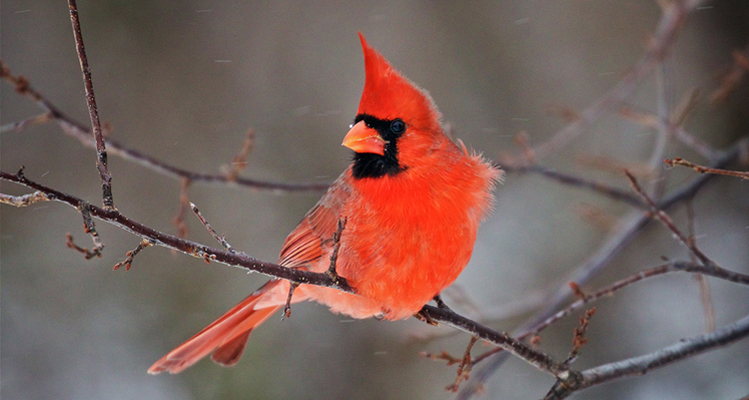
I had the morning off during another frost event in late December, so I took a drive to see if I could find new scenes of beauty a little farther afield. In Lake County, the sun came out for a few minutes east of Ramona, just as I spotted an old barn with a red brick silo standing sentinel. The red-orange color contrasted with the sun-brightened, white landscape in a remarkable way. That same morning, I happened upon a happy Northern Cardinal couple foraging along the trail at Lake Herman State Park. The male would fly up from the ground intermittently in order to scan the area for intruders. During one of those look out sessions, I happened to catch a photo of his exquisite red feathers against the white of the frosted morning. It was another magical moment brought by the cold beauty of a South Dakota frosted morning, and another reason why it wouldn’t take much to convince me that there is a little bit of magic at play on a frosty day.

Christian Begeman grew up in Isabel and now lives in Sioux Falls. When he’s not working at Midcontinent Communications he is often on the road photographing South Dakota’s prettiest spots. Follow Begeman on his blog.

Posted on Leave a comment

Chasing Birds

Spring in our part of the world is like a runner’s reward after a long distance race. During winter we hold breath, and when the south wind and longer days finally chase away the cold, it is time to exhale and breathe in the new season. We got a late start to spring’s festivities this year and subsequently all the new growth, fragrant blooms and birdsong seemed to burst on the scene all at once. Bear in mind I’m not complaining, because I was out nearly every evening for three straight weeks looking for spring scenes to photograph.

If you’ve followed my column over the last few years, it is no secret that I like to seek out and photograph the migrating warblers in May. I am tempted to call them war-blurs, because more often than I like to admit, that is all I get when trying to photograph them. They are tiny, fast and usually found in low light situations such as tree canopies, even on a sunny day. If anything, this new found spring obsession has taught me to listen first and look second, walk slowly, carry plenty of insect repellent and have patience … a LOT of patience. Hardly anything is more frustrating to a photographer than having your subject move away from the camera. So in warbler season, I’ve learned to pick a couple spots where I have reasonable views into the canopy and simply sit and wait for one of the little buggers to move into view. Sometimes it works wonders; other times I get skunked.

Even on days when I don’t get much warbler action, I’m still outside. I still see the landscape bloom and get to breathe in the clean fragrance of wild plum blossoms, chokechery flowers and lilac. All of these aromas have a tendency to conjure a flood of memories of growing up on the farm/ranch near the Moreau River. Since we had a small dairy operation, there are other smells that take me back too, but I’d much rather be amongst the lilacs and plum brush than the corrals this time of year.

Springtime in South Dakota also means planting season, spring showers and late evening sunsets. The nice thing about chasing warblers at our many state parks and recreation areas is that it gives me the opportunity to drive home during the golden hour of the evening. There is nothing quite like a slow drive down a country road with the window down, your elbow out in the breeze and a favorite song on the radio. I particularly enjoy the smell of dew in the evening. Not only is it a pleasant aroma, but oftentimes meant”quitting time” back on the farm and taking a short drive home as evening rolled over the high plains.

However you enjoy springtime, here are a few favorite photos of my bird chasing and evening drives from the month of May. I hope you enjoy them even half as much as I did capturing them.

Christian Begeman grew up in Isabel and now lives in Sioux Falls. When he’s not working at Midcontinent Communications he is often on the road photographing South Dakota’s prettiest spots. Follow Begeman on his blog.

Posted on Leave a comment

The Birdwatcher’s Wings

Willis Hall used a trip wire to photograph himself with a trio of red-tailed hawk fledglings.

I sat in the hospital room, watching my friend breathe. He was 86. I felt a little guilty watching him, because he was the most private person I ever knew, and I’m not sure he would have approved; yet it is hard to look away when you love someone. Sometimes we think if we do just a little more, it will be all right. Of course it is not our decision. Willis would have us know that.

I knew Willis Hall for 25 years. He was my mentor and my friend. That he and Rosamond let me be with them was a gift.

I met Willis for the first time when they came to our house to show a group of Yankton College teachers some bird slides. It was love at first sight. He, his Rosamond, and their incredible photographs are the things on which I imprinted as fast as a gosling on the goose. I was cooked. At 7 the very next morning, the three of us began our first of hundreds of birding trips. We three, and sometimes my husband too, eventually would cross what seemed like every prairie pothole and dusty back road in the six-state region. We never took the main road except to get to another dirt road. My gift to Willis was to find a back road he hadn’t traveled before.

By canoe in the summer, he introduced me to least terns and piping plovers on Missouri River sandbars. Above the river, in the low oak hills and on grass-covered bentonite clay cliffs, we found Dutchman’s breeches and the pasqueflower in the spring and buffaloberries and LeConte’s sparrows in the fall. We hiked the hills, checking wild plum bushes for Bell’s vireo and spotted towhee nests and scouting for deer, turkeys, prairie ring-necked snakes and his favorite, great horned owls.

In the winter, we kicked the soccer ball over the park trails or skied the woods in search of red-bellied woodpeckers and bluebirds.

And in the last two years, I played my first tennis ever, with a man who had played for 70 years. Ever patient, he never gave up on me; he just kept putting the ball over the net. If we were distracted by nighthawks and nuthatches at his favorite park counter, so much the better.

In the early days we spotted and counted birds, and he photographed. Rosamond judiciously jotted their numbers and exact locations on the back of recycled envelopes in writing so small a magnifying glass was required to read it. From him I first heard very patient answers to my questions about bird identification, photography and all things having to do with the natural world. If I spotted a bird, impulsively calling it out, Rosamond would always say,”Willis?” and only when he confirmed a sighting, would she add it to the list. I think it was five years before they accepted my birds.

His friend Phil Hall from North Dakota, who explores and writes on the natural history of the Badlands, also writes of Willis’ patience. “One spring, I believe it was in 1982, I noticed that a golden eagle had reclaimed its nest high up in the wall that defines the east side of Red Canyon. I phoned Willis, and 36 hours later he and Rosamond appeared in the pasture by my cabin. After the obligatory tea for an Englishman, we set out for the eagle’s nest, which was about 10 miles down the canyon. While the nest looked close to the road, it was a deceivingly long hike, and just short of vertical. Willis led the way, hauling a camera, a big lens, binoculars, and a heavy camera bag. At the time, I was 39 and he was 69. I struggled to keep up with him.

“We advanced as far up the canyon wall as possible. There, we ducked behind a scrubby cedar tree. Out of his bag, Willis produced a small piece of camouflage cloth, which he draped around us. We sat like rocks for two hours. However, I twice shifted my weight and once had to scratch an itchy nose. We waited without breathing.

“The eagle never came, and Willis finally announced that we should hike back to the pickup. I was chagrined at not being able to show him the eagle. As we gathered up the equipment, I asked, ‘Willis, why do you think the eagle never came to its nest?’

“‘We moved too much,’ he replied.”

At home he was constantly on the move. If Rosamond was his ears, he was her legs. She might say, “Willis, get me the bird notes from the kitchen.”

He would respond, “Where are they?”

“In the pea bag on the counter.” He would go, and return empty handed and baffled. She would carefully repeat, “Pea bag!”

“Oh!” he said, “I thought you said tea bag.”

And they both would exchange glances that said, “Pay attention, dear. Speak more clearly, dear.” But they were smiling at each other.

Their relationship was a curious delight to the college students. She regarded her students highly and held extra classes at their home. One of her former French students wrote, “I remember one time Miss Burgi called to Willis to please bring that cereal box to her. When she had it she reached in and pulled out my homework. Of course! Homework in a cereal box. He was dear and I knew there was some serious devotion going on in that house. “

Theirs was indeed the language of serious devotion. They chose their cadences carefully. She may have been the professor of Latin, but he was the poet. He spoke plain English.

From her I first heard exotic bird terms. “Is that a bird or an excrescence?”

I asked for translation, and Willis, in all seriousness, answered, “Excrescence — a bump on a log — excrescence.” And looked at her. And she smiled.

Rosamond once told me she would rather be struck from a mountain than linger aimlessly. In 1992 she suffered a stroke and passed from her mountain. He believed he would be with her again. In 1998 he wrote the poem Almighty God.

A few leaves flutter in the breeze.

These too shall all be gone.

Almighty God shall bring them

back again.

Each one, its perfect self, shall be

A part of me, as it has been.

She too, My Rosamond,

shall be again.

Willis never wanted to impose. Waiting at the doctor’ s office, he had a sniffle. I told him I had taken a zinc lozenge for my sniffles. He seemed absolutely mystified. He looked at me, and rather than have me repeat, an imposition, he tried to further the conversation by eliciting more information. He questioned, “Where does one get such a substance?”

“Oh, probably from chewing rocks,” I replied.

Somewhat alarmed, Willis said, “From chewing rats?”

Now this was a man who rescued bats and carried indoor insects outside so they’d have a fighting chance. “No,” I said, “from chewing rocks, r-o-c-k-s.” Concerned that I had confused rather than amused him I said, ”I’m only kidding, Willis. It’s a joke.” He, waiting for me to breathe as I watched his face, looked me straight in the eye and said the only zinc he knew was the kitchen zinc.

With deep relief for the moment and for so much else, I laughed. I detected a sly smile on his face. I knew that once again — I’d been cooked.

We moved Willis from the protected environment of his hospital room to an adjoining nursing home where we hoped he could convalesce from the pneumonia for which he’d been hospitalized. His beloved brother, Winston, had died six weeks before, and he was greatly saddened.

Several times over those weeks in the hospital, health care workers asked me if he was my father. One day, through deafened ears, he responded , “Daughter … and mother.”

I combed his gray hair and said he looked like a tufted puffin, the longhaired seabird whose wings are better suited for diving for fish than for flying. He said he had never had a higher compliment. Two weeks later he said he felt he had come to the end of a long race. The next week he said he wished he could start over. When I asked if he wanted anything he replied, “What I want is unobtainable.” Three days later he had a small stroke. He did not recognize the oak bough I brought. For another day he said nothing.

And then he revived.

A long time ago, trying to keep up with him, I had asked Willis if he could live without walking. He said he guessed on his deathbed he’d get up and take a walk. And he did. At sunset, we went outside and walked the half block to the edge of the bluff. In silence we looked down at ducks silhouetted on a silver bend in the river.

I told him I had spoken with his oldest friend, Wes Cook, who now lives in New Mexico. His eyes widened. “Is he well?” Willis asked. Those were his last words.

I had brought him a gift, a large photo I’d taken in Alaska, a single tufted puffin facing the sea. He looked at the bird. He smiled at me and nodded. This time he would have to fly.

Editorís Note: This story is revised from the May/June 2000 issue of South Dakota Magazine. To order a copy or to subscribe, call (800) 456-5117.

Posted on Leave a comment

Farewell to Spring

Summer is upon us once again. It really wasn’t that long ago that I saw the last of the snow on the ground. May 3 to be exact. It was up in the ditch near West Nidaros Lutheran as a spring rainbow formed over the steeple after an early evening rainshower. Meteorologic summer spans June, July and August, but my calendar tells me the astronomical first day of summer was June 21. The difference is the former goes by temperature and the latter by the position of the earth in relation to the sun, but that’s all a little too technical for what I wanted to share this month. Let’s get back to photography.

Spring and autumn have always been my favorite seasons. Nothing against summer and winter (except for mosquitos and frostbite, I guess). This particular spring was special. I was able to spend more time than any previous year following the annual warbler migration in a handful of southeastern South Dakota parks. I saw three species I’d never seen before, as well as a couple of old favorites. It is no easy feat to capture a decent image of those little bundles of energy as they cruise the canopies looking for insects, so getting a good photo always feels like a big win.

While out and about in the woodlands, hilltops and creek bottoms, I was constantly surprised by wonders beyond the world of birding. The return of butterflies and spring blossoms are a great opportunity to break out the macro lens. Getting close to butterflies in the trees or blossoms in the breeze requires patience and a stick-to-it attitude — traits I don’t normally exhibit in the world outside of photography, unfortunately. Many times, I’d get lost in the moment only to realize I’d just spent a half hour waiting for a Monarch butterfly to land on just the right flower bud in just the right light. Even so, I’ve always felt that it was time well spent. Focusing on the beauty of nature has a way of melting away daily cares and concerns. I’m not the first to say this, nor will I be the last, but drinking in the wonders of nature is truly good medicine both for the mind and the soul … and the photographer.

This column is sort of a long look back at the spring of 2017 for me. Here are 24 images of my favorite moments and memories, from having a blue-winged warbler close enough (and long enough) for me to take his portrait at Newton Hills State Park to finding a new (to me) wildflower while hiking the Dells of the Big Sioux, the season. The season did not disappoint. So, farewell spring in South Dakota. I’m happy I was able spend such quality time with you this time. Can’t wait to see you again!

Christian Begeman grew up in Isabel and now lives in Sioux Falls. When he’s not working at Midcontinent Communications he is often on the road photographing South Dakota’s prettiest spots. Follow Begeman on his blog.

Posted on Leave a comment

For the Birds

You might think that freezing temperatures and wind-driven snow pelting your face would make for poor photography. Normally I’d agree. However, there are certain places I like to go on a snowy day. One of them is the Sioux Falls Outdoor Campus near the feeders. If you are patient, there is a very good chance of spotting one of a few resident cardinals coming in for lunch or hanging around the nearby branches. The brilliant red of the male is always a joy to see, but seems to stand out even more beautifully amidst the snowflakes.

Friends and co-workers often tease me about how I’m becoming a birder, as if there’s something bad about that. I’m not a true birder, but I’ve taken more steps in that direction the last few years. True birders are interested in every bird they see or hear. I’m partial to the ones I think look cool in a photograph. True birders can tell you where migrating birds come from and about how long they’ll stay. I have to go to the internet for that kind of knowledge. True birders do this thing called”pishing” to get birds to show themselves and take good long looks at you. I try it sometimes, but I think the birds that show up are doing it more out of humorous curiosity than anything else.

Something that has really interested and awed me about birds is how much most of them travel. In the spring, we can get birds from as far away as South America. There is a similar story in the winter. Birds like Lapland longspurs from the arctic come down and hang out in open fields with flocks of horned larks. Bohemian waxwings, the northern cousin of our resident cedar waxwings, are a treat to see. But the most popular and exciting traveller from the north is the snowy owl. I’ve been lucky to see one in almost every winter over the last five years except this one, though it’s not for a lack of trying. I headed northwest of Aberdeen in mid-January, where one had been reported. I didn’t see it, but did I found flocks of snowy buntings, thousands of pheasants and a lone meadowlark, which is interesting because the closest they usually winter is Nebraska

A few Februarys ago, a local birder spent a lot of time looking for the little Northern Saw-whet owl in parks around southeast South Dakota. He reported three of them at Newton Hills State Park. Although these owls can be found along the Missouri River, particularly in the Pierre area at Farm Island and a few other hot spots, I did not know they would come this far south and east. So I went looking too. I failed miserably. On the third visit, I found dead field mice hanging on branches, which is good owl sign, but could not for the life of me spot the owl itself. Finally on my fourth or fifth try, I nearly walked headlong into the owl resting on a young cedar branch in the midst of a tangled thicket. I froze. Usually wild birds flush when discovered at close range. The owl looked at me for about 30 seconds then slowly closed its eyes and went back to sleep. It was an amazing, breathtaking encounter with a winter bird that I’ll never forget. Do seeking out and enjoying thrills like that make me a true birder? Not yet, but I’m getting there.

Christian Begeman grew up in Isabel and now lives in Sioux Falls. When he’s not working at Midcontinent Communications he is often on the road photographing South Dakota’s prettiest spots. Follow Begeman on his blog.

This slideshow requires JavaScript.

Posted on Leave a comment

Snow Birds

The first major snowstorm of the season hit the midwest on Friday. Only a few inches were initially expected in Sioux Falls, but the city saw record snowfall by the end of the day. The previous record for November 20 was 3.8 inches in 1975. A whopping 14 inches were reported on the south side of town while northern Sioux Falls received about half as much. Christian Begeman spent a few hours at the Outdoor Campus that afternoon, observing birds stocking up at the feeders. See more of his work at cbegeman.blogspot.com.

Posted on Leave a comment

A Walk in the Woods

I am not a man of the trees. I grew up under the open sky and rolling prairie. Trees were something I had to mow around in the back yard or cut down for firewood in the crick. A forest to me was any track of trees wider than three across. Therefore any story or fairy tale that featured mysterious woods held all the more magic for me. When I first hiked in the silent Ponderosa pines of the Black Hills, I was surprised at how quiet the world became. Nowadays, when I walk in the woods, I notice other things. I hear songs of unseen birds, see the flicker of a butterfly wings and catch glimpses of wildflower color, all of which make great subjects to put in front of a camera.

Photographing unseen birds, however, is impossible. Finding those birds is why I’ve spent more time in the woods of Eastern South Dakota this year than any other. It started in February when a local birder reported seeing Northern Saw-whet owls at Newton Hills State Park. This little owl is usually only found on the western side of the state. I had never seen one before and after three unsuccessful trips, I nearly walked into one resting in some young cedars north of the Horse Camp area of the park. The elfin owl looked at me with wide and unblinking eyes, seemingly unconcerned and possibly a little annoyed. I slowly backed away. The owl began to relax and fall back asleep. It may seem like I’m overstating things, but it felt like I was in one of those old fairy tales for just a moment.

Last spring I witnessed/photographed the warbler and songbird migration for the first time. I saw bold and brightly colored birds that I’d never seen before. I guess I was hooked because this spring I was back in the woods searching for more. It is a lesson in patience and listening. At Lake Herman State Park near Madison, I sat for a couple of hours in the trees as waves of warblers made their way through every 10 minutes or so. At Newton Hills State Park, I heard the distinct buzz of a hummingbird along the trail. I sat for an hour or two watching two male Ruby-throated hummingbirds make their rounds from perched preening to feeding on flowering bushes and wild bergamot blooms then achieving amazing aerial acrobatics while squabbling with each other — and then starting the sequence all over again.

I have a goal to photograph all the colorful birds that call South Dakota home. One that has eluded me to this day is the Scarlet Tanager. They are best found in Union Grove State Park or Newton Hills and are colored crimson red with black wings. This year, I made three separate trips to find them. I also took time to learn their song and call. This helped me find a female at dusk at Union Grove, but I could not get a decent photo. Later in the week, as I began another search at Newton Hills, a Summer Tanager flew to a tree next to me and gave me a long look. It was a real treat because the Summer Tanager is much rarer to find in South Dakota than the Scarlet. Later in the day, I finally saw my first male Scarlet … well, his tail feathers anyway. By the time I spotted him, he was flying deep into the tangled woods. I was disappointed. Then I thought that maybe this was an invitation.”Come back into the woods. Lose yourself amongst the leaves, listen to the song I sing and maybe one day we will meet.” I look forward to that day.

Christian Begeman grew up in Isabel and now lives in Sioux Falls. When he’s not working at Midcontinent Communications he is often on the road photographing South Dakota’s prettiest spots. Follow Begeman on his blog.

Posted on Leave a comment

Why We Go Birding

I have noticed that people may not understand what I’m doing when I go birding. They sometimes think that I’m going just to look at pretty birds. That’s true, but there is more to it for birders like me.

Searching for Different Species

When migration begins, I want to see the different birds that pass through because they’re only in our area during part of the spring and fall. A bird that’s new to our area or an early arrival would be nice to see. A rare bird would be great. If a birder sees an interesting or rare bird, it is reported to an email listserv so that other birders may go see it, too. If it is indeed a rare bird, I record what I observe and try to get a photo and/or video. My detailed report goes to a committee of the state ornithological union. If they decide I was correct in my identification, it will be entered into the state birding records. It is very gratifying for a birder to find a rare bird and have the report accepted.

Adding to My List

Birders like me keep many different lists: yard, patch, town, state, year, counties and life lists. I am very list-motivated, so I enjoy searching for different birds to add. It’s like a game for birders. The South Dakota Ornithologists’ Union website lists the top birders in the state, which is another fun goal to try to achieve.

Citizen Science

I keep a list of the birds I see and note certain details: date, place, time of day, duration, species and quantity. I also note breeding codes, such as whether a bird is nest-building, on the nest, carrying food or nesting material, feeding young, etc. It is work to get this information collected and put onto the database, but it is a great feeling to help with citizen science and know that you are contributing to conservation.

Later I put all of this information onto eBird. Launched in 2002 by the Cornell Lab of Ornithology and National Audubon Society, eBird shares these observations with a global community of educators, land managers, ornithologists and conservation biologists. Also, eBird keeps track of birders’ lists, so that is very handy for us. At the end of each reporting season, we can have our eBird information sent directly to the state database, so it will be part of our state’s birding records as well. In this way, birders are helping science by collecting data for state and global databases.

Birding is Fun

Birding is fun whether you keep lists or just observe birds. When I go birding I get exercise while hiking, yet it is very relaxing. I see wonderful places, wild animals and beautiful wildflowers, as well as birds. I enjoy seeing the variety birds, watching their behavior and listening to them sing. Birding with other birders is also enjoyable, and it is nice to spend time with like-minded people.

While concentrating on bird songs and bird identification, my troubles and worries melt away. My husband often tells people how happy I am when I return from birding. He is right. I am so thankful that I went to my first birding festival four years ago and that I was turned on to birding. This year’s South Dakota Birding Festival at Fort Randall will be May 1-3 at Pickstown. A new gathering, the Prairie Birding Festival, will be in Mitchell on May 8-10. More information is available online. You may want to come and check out these festivals for yourself.

Birding is a fulfilling activity and is enjoyed in varying degrees by different birders. I wish everyone could get outdoors more often to experience all that nature has to offer. Until then I will do my best to get people interested, so that they can feel the same joy that I have felt.

Kelly Preheim is a South Dakota Ornithologists’ Union board member. She teaches kindergarten at Armour Elementary, where she incorporates lessons on birding into the classroom. Her students have been recognized nationally for their knowledge of birds. Visit Preheim’s Flickr site to see photos from her birding adventures.