Posted on Leave a comment

The Yankton to Marty Trail

South Dakota Magazine intern Ava Brandt met Digger at Mensch’s Greenhouse in Avon.

A golden dog named Digger met us at the door of Mensch’s Greenhouse, his tail wagging like a windshield wiper. Two cats lolled on a flower worktable and a dozen colorful cockatiels chirped from two cages near the petunias.

Any traveler will crack a smile at Mensch’s Greenhouse in Avon — and that’s fortunate because for the most part this Yankton-to-Marty loop can be a solitary journey, even though it visits seven small towns in South Dakota’s populated southeast corner.

We began the loop early in the morning because of a tip that the Tyndall Bakery has amazing donuts and pastries, and some days they sell out. We had two stops to make before the bakery.


The Lakeport Church in rural Yankton County dates to 1884.

Chalkstone Church

We drove 8 miles west of Yankton on Highway 50 to 431st Avenue, then turned right to the Bruce and Donna Schwarz farm. Drive slowly through the farmyard — the Schwarzes don’t mind — and you come to a small church built of the yellow chalkstone found along stretches of the nearby Missouri. Neighbors keep up the church and mow the cemetery, which features Czech surnames still common in the area. This is Czech country, settled by pioneers from Bohemia and Moravia who began to arrive in 1869. Their first settlement was Lakeport; only the little yellow church, constructed in 1884, has survived.


A wooden church is among the historic buildings preserved at the park in Tabor.

TABOR: CZECH CAPITAL

A few miles further along Highway 50 is the town of Tabor (pop. 405), founded in 1872. Tabor is famous for its annual Czech Days celebration in June. Parking is more plentiful on the other 362 days of the year, so stop on Main Street and stretch your legs by walking through the quaint pioneer village which includes a tiny wood church that was built at Lakeport even before the chalkstone church. Now it is well-kept in the Czech Preservation Society’s heritage park along with several other antiquated structures.


Magazine interns Rose Lane (left) and Ava Brandt at Tyndall’s Eiffel Tower, a fancy flagpole that measures 100 feet.

TYNDALL’S TOWER

One wonders if Gustave Eiffel, engineer and namesake of the tallest structure in Paris, would be flattered to see the imitation in Tyndall.

Tyndall’s”Eiffel” is more than 1,000 feet shorter than Gustave’s, but nearly as old. It was constructed in 1898, just nine years after the original was completed to honor the centennial of the French revolution.

The replica stands on the lawn of the county courthouse, west of downtown on 18th Avenue. But before you visit the tower, stop at the Radack family’s bakery. We dilly-dallied too long, and the cases were nearly empty, so we missed out on the Tyndall Roll, a Bismarck-like pastry filled with white cream and topped with crushed peanuts. No one knows when the legendary roll was created, but the bakery traces its history to 1905.


Carol and Vern Tolsma at their Avon greenhouse.

AVON’S GREENHOUSE

Feeling lonely in southeast South Dakota? Just visit Vern and Carol Tolsma’s Mensch Greenhouse and Flower Shop along Highway 50 in Avon.

Carol’s grandmother, Ada Mensch, started the greenhouse in 1957. Imagine how many flowers have bloomed, thanks to Ada, in 67 years. And how many people have enjoyed the garden bounty that took root here.

The flowers and plants come with free advice. Did you know you should only water tomato plants when absolutely necessary? Vern says a thirsty plant sends roots deep into the soil, making it strong and adding taste to the fruit.

Digger, the greenhouse dog, wags and nuzzles anyone who’ll take the time. Cats and cockatiels also share the space. The cockatiels are orphans who lost their owners and found refuge here.

The Tolsmas tend a 2-acre garden near the shop, and they sell produce, canned goods and amazing pickles. They occasionally set out a table of freebies that need a home.

Some days, Vern wears a blue t-shirt that says it all:”I Love Gardening From My Head to My Tomatoes.”


Richard Langdeaux helps keep Wagner’s park looking beautiful.

A WALK IN THE WAGNER PARK

Follow Highway 50 northwest. South Dakota’s Czech heritage extends into Charles Mix County and the city of Wagner (pop. 1,603), the largest town on this loop tour. Wagner has all the amenities you might want — a coffee shop, restaurants and a grocery store.

On the west side of town, near Highway 50, lies a little lake and park that would be the envy of any city in America. The lake was created when a dam and rock structures were built in the 1930s by WPA workers. Today the park includes two walking bridges, flower gardens, trails and even a small waterfall. This is the best opportunity of the day for a walk.

Richard Langdeaux, a Santa Claus look-alike who was collecting trash in the park, told us that the stone buildings along the lake were once a Scout camp. Artesian springs keep the lake full year-round.

Wagner also offers an impressive museum, operated by the Charles Mix County Historical Society. The collection is known for its Czech exhibits, as well as artifacts from the Yankton Sioux culture that predates the pioneers.


Michael Rouse helps maintain the ground around Marty’s St. Paul Catholic Church.

MARTY’S AMAZING CHURCH

Drive west of Wagner for 6 miles to 388th Avenue and turn south for another 6 miles to Marty. The one and only enterprise is a boarding school started by the Benedictines in 1924 and now operated by the Yankton Sioux Tribe.

Alongside the school is St. Paul Catholic Church, built by volunteers — Indians and non-Indians — in the early 1940s of Indiana sandstone, mined from a quarry near St. Meinrad Archabbey, which founded St. Paul’s.

The steepled church (167 feet!) is surrounded by tall trees and other structures, so it’s hard to appreciate from afar. Exit your car and walk about the churchyard, where there are statues of Kateri Tekakwitha, the first Native American saint, and St. Theresa, patroness of missions. On most days, the church doors are open; inside, St. Paul’s looks like something you might see in a European city except that the murals, stained glass and other art are rich in Native American themes.


The tallest stone in Greenwood Presbyterian Cemetery marks the grave of Struck by the Ree.

STRUCK BY THE REE

Follow the road south of Marty for about 7 miles and a few curves. You’ll come to Greenwood Presbyterian Cemetery, where the tallest stone marks the grave of Struck By The Ree, a maligned and misunderstood leader of the Nakota. He was born in 1804, as Lewis and Clark came through the river valley. Legend says the explorers wrapped the baby in an American flag and proclaimed he’d be a great leader.

Struck By The Ree did grow to be a wise chief — an environmentalist, a feminist and a peacemaker. He urged pioneers to preserve the timber resources of the river valley. He pleaded that both Nakota and white men respect the Native women. And though he first fought the intrusion of the white civilization, he eventually recognized that it could not be stopped (ìthey are like maggots Ö”). He became a lead negotiator in the 1858 Treaty. Decades later, after the treaty was broken and his people found themselves hungry and hopeless, he was often persecuted; his cabin was burned, and his horses were stolen.


A tall memorial near Greenwood commemorates the 1858 Treaty.

Treaty Memorial

Continue south and you’ll soon come to another memorial, erected to honor Struck By The Ree and seven other Native American signers of the 1858 Treaty, which gave the government more than 11 million acres for $1.6 million and established a reservation for the Nakota.

The monument was constructed in 1907, topped with an obelisk. A few decades ago, vandals toppled the obelisk — a posthumous insult to Struck By The Ree, a century after his death in 1888. It has since been restored.


Springfield sits above a growing delta in the Missouri River.

A MISSOURI RIVER DELTA TOWN

Drive south from the treaty marker and you’ll come to the tiny community of Greenwood, once the hub of the Yankton Sioux Tribe. At Greenwood, if you are not in a hurry, turn right and follow the river for a mile or two for scenic views. Then return and continue east along the Missouri.

Eventually you’ll come to 312th Street, and then to Highway 37 which will lead you to Springfield, once South Dakota’s smallest college town. Thirty years ago, the University of South Dakota/Springfield was closed, despite furious opposition, and the campus was converted to a prison.

Townspeople feared that the prison would be the ruin of Springfield, but it has persevered. Norm’s, once a favorite hangout for collegians, still serves burgers and beer. A company known as Mr. Golf Car parks more than 200 golf carts along Main Street. A museum keeps the history of the college alive, and anglers come to fish the river.

Springfield still has a post office, bank and library — plus several eateries. On its eastern edge is a veteran’s memorial with a panoramic view of the river.

The highway sign lists the population at 834. That doesn’t count the 1,200 prisoners who live there.


Six unknown soldiers of Lt. Col. George Custer’s 7th Cavalry are buried in the Bon Homme Cemetery.

APPLE TREE ROAD

For a final treat on your loop, turn east onto Apple Tree Road (a mile north of Springfield).

A few miles down the road is a spot known as Apple Tree (though the state Game, Fish and Parks Department calls it Sand Creek). It consists of a campground and cabins, a boat dock and a little peninsula where you can walk out among the reeds and see where the invasive delta ends and Lewis and Clark Lake’s open water begins.

This was once a delightful place to enjoy the bellowing of giant bullfrogs. They were silent on our stop. Perhaps they dislike the phragmites, an invasive wetland plant that is taking over.

Continue east on Apple Tree Road and you’ll soon pass the tidy Bon Homme Cemetery where a large stone memorial marks the graves of six soldiers who traveled with Lt. Col. George Custer and his 7th Cavalry in 1873.

As Custer’s entourage camped at the nearby town of Bon Homme for four days, six became ill and died. Historians speculate that they contracted typhoid fever. The six were initially entombed at Snatch Creek and then reburied at the cemetery in 1893. In 1922 the large marker was built in the cemetery to give some measure of respect to the nameless six, who might otherwise have perished at the Battle of the Little Bighorn in 1876.


A replica log schoolhouse stands near the Bon Homme townsite.

BON HOMME WAS A TOWN

Continue south on Apple Tree Road and you soon come to a curve near the old community of Bon Homme. At the curve is a monument to the first schoolhouse in the Dakotas. A small replica of the 1860 log schoolhouse was erected in 1910 by pioneers, and it remains there today. Care to skip a rock in the river (or fish or launch a boat)? Just follow the gravel road south at the curve for less than a mile and you’ll drive right up to the water’s edge and a sandy beach.

Back at the curve, head north to Highway 52. It will lead you east to Highway 50, which takes you past the chalkstone church and on to Yankton.

Editor’s Note: This story is revised from the January/February 2025 issue of South Dakota Magazine. To order a copy or to subscribe, call (800) 456-5117.
Posted on Leave a comment

Sweet and Sour in Roslyn

Roslyn alumni parade through town during the annual Vinegar Festival, a tradition since 2001.

When Lawrence Diggs moved from San Francisco to Roslyn, he had already spent years researching the properties of vinegar. He’d visited France, Egypt, Mexico, South America, the Philippines and Italy, all to study the flavored concoction. It led to his first book, entitled Vinegar: The User-Friendly Standard Text Reference and Guide to Appreciating, Making and Enjoying Vinegar.

Diggs was looking for a quiet summer home where he could write when a real estate agent told him about a house in Roslyn, so he came to see it. He liked the town and people so much he never left.

Thanks in part to Diggs, this tiny town in northern Day County is now home to the International Vinegar Museum. The idea came as the community was looking for a unique way to draw visitors. A former opera house, auditorium and community hall provided the space.”We wanted to create something that people hadn’t done before. We weren’t going down without a fight to keep the town open,” Diggs says.

The museum was designed to teach visitors about vinegar and its varied uses. Diggs has turned over the role of museum curator to the community, but he remains connected and supportive. Fran Rougemont, Marnah Woken and Richard Snaza work at the museum and Josh Wagner handles the accounting. Mary Wagner volunteers doing the purchasing and mail orders.

A museum devoted to vinegar was not likely on the radars of Roslyn’s 19th century founders. The town traces back to 1882 when H.H. Russell, the first postmaster, took the name from his native city in Scotland. Roslyn began as Old Roslyn with just a post office and trading post. In 1914, the town was officially surveyed and platted by August W. Hartge after the community of settlers raised $60,000 for the Soo Railroad to be built. Soon businesses began coming into town.

Lawrence Diggs.

Today’s Roslyn looks a little different. Longtime businesses have closed and been replaced by new endeavors. The Roslyn Event Center, housed inside the school that closed in 2010, is rented for weddings, funerals and gatherings. Grade school kids from Webster, 12 miles south, still use the gym for basketball, volleyball and pole vault practices. Becky Lundquist’s city finance offices are inside. The former computer room is the Viking Fitness Center owned by Amber Huggett. Dave Strege lives in the school’s old library and has a business called Roslyn DÈcor.

The Roslyn Creamery Company was in business for 68 years. Nathan Johnson has turned the facility into a furnished rental for hunting and fishing groups. It also hosts the Roslyn Creamery Company Band for jamborees.

Roslyn Meat Market was built in 1914 next to the post office. After a 1964 fire destroyed most of Main Street, it was rebuilt in the same spot. In 1976, Robert Coyne sold the business to Shirley and Norman”Tubby” Schmidt. Their son, Craig Schmidt, bought the business in 1992, but it closed in 2004.

Another son, Paul Schmidt, had been working at Mike’s Jack and Jill in Webster as a meat cutter when he decided to open his own store. Schmidt’s Custom Meats is now part of a mini mall with a small grocery store, auto shop and furnished rentals. Paul still uses recipes handed down from his grandparents and parents.

Roslyn has another claim to fame that South Dakotans of an older generation will recognize. Myron Floren,”The Accordion Man,” attended school in Roslyn through his junior year of high school. He learned to play the accordion while growing up on a small farm outside of town. His 32-year career with the Lawrence Welk Orchestra and numerous television performances began after touring Europe with the United Service Organizations. He returned to Roslyn to play for his hometown’s Diamond Jubilee.

But these days, vinegar is the star. Roslyn’s first Vinegar Festival was held in 2001 in conjunction with the town’s alumni weekend. A parade, vendors, food trucks, vinegar tasting, kids’ activities and music lead up to the annual crowning of the Vinegar Quart, comprised of Princess Pickle, Princess Vinaigrette, Princess Sour and the Vinegar Queen. This year’s honorees are Helen Trautner (Princess Sour), Kimberly Lorensberg (Princess Vinaigrette), Marci Johnson (Vinegar Queen) and Shauna Kjos-Miotke (Princess Pickle).

Sure the vinegar makes things unique and fun in Roslyn, but it still has the small-town qualities that Diggs sought when he left the fast-paced life of northern California.”The best part of living here and to be part of the community are the relationships,” says Diggs, who’s become known as The Vinegar Man.”It feels good to know people and be a part of what is going on. People have opportunities to belong.”

Editor’s Note: This story is revised from the September/October 2024 issue of South Dakota Magazine. To order a copy or to subscribe, call (800) 456-5117.

Posted on Leave a comment

What Makes Hecla?

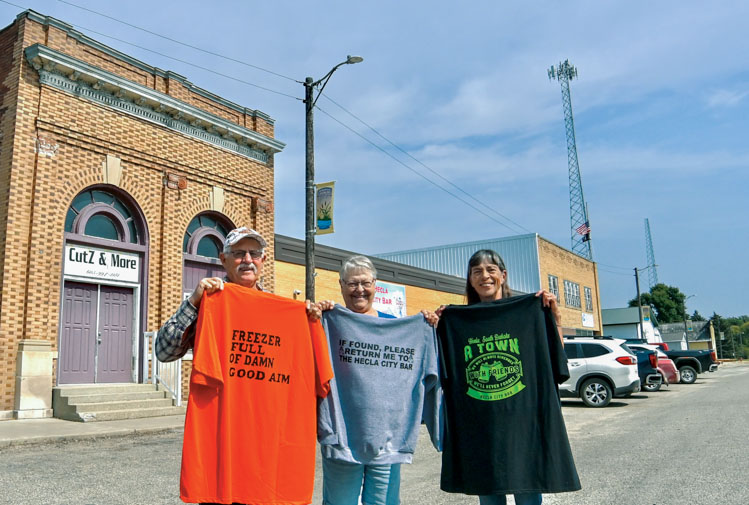
The Hecla City Bar offers a variety of apparel to visitors, as modeled by (from left) Terry and Diana Ulmer and Mary Freudenthal.

Outside influences shape the little town of Hecla, a tradition that dates to the last ice age. These days, a million winged and feathered guests migrate through the lakes and marshes south of town in the spring and fall. Humans follow the ducks and geese, and often find their way to the Hecla City Bar, where they traditionally pin dollar bills to the tiled ceiling and post photos of big fish on a”brag wall” near the door.

Hang around the bar and you eventually get a history lesson of the town. Its name comes from Hekla, Iceland, home to a stratovolcano. January Jones, a Hollywood actress who gained fame as Betty Draper in Mad Men, grew up here in the 1980s. A young couple, the Pioskes, operate an award-winning butcher shop across the street; sometimes on Friday nights they bring over a grill and cook ribs for everyone.

“It’s a pretty friendly town,” says Jess Monsen, who once ran the bar and now serves as the town’s deputy clerk.

Monsen says North Dakota is just 4 miles to the north, which explains the North Dakota State University Bison flags in some yards.”We’re pretty split between the Bison and the SDSU Jackrabbits.”

What about the Coyotes?

“I don’t even know what that is,” she quips. This is north country.

Trailers, tractors and other antique keepsakes decorate the yards of Hecla residents.

Hecla does feel like a town with a culture all its own. Jim Bauer, a woodworker who arrived from North Dakota as a youth in the 1960s, says the town has persevered even as many of its institutions have gone.

“There were 46 in my high school class in 1969,” he says. Today a memorial marker and bell are the only reminders that there was a school, which closed in 2002. Most of the downtown stores have been shuttered (though the butcher shop occupies three connecting buildings) and even some churches have left.

“Our Catholic church has closed,” Bauer says.”If I was rich, I would have bought the building and put up a big screen TV and broadcast the Sunday Mass, but I suppose the bishop wouldn’t have liked that.”

Bauer planned to parlay his woodworking skills into another enterprise for Hecla, but big business blocked him.”I was hoping to become a millionaire making caskets, and I started to build them, but the funeral home industry said I didn’t have enough liability insurance, so I never really got started.”

Weather is also not always friendly. As one of South Dakota’s northernmost communities, Hecla is among our coldest places in winter. Average January lows are barely above zero.

One asset that bishops, business tycoons and even Jack Frost cannot take from Hecla is the 21,498-acre Sand Lake Refuge that stretches for miles south of town. Fed by the James River, which flows down from North Dakota, the marshes and lakes — created when Ice Age glaciers melted 11,000 years ago — are a paradise for migratory birds and wildlife.

Hecla woodworker Jim Bauer keeps a collection of vintage lanterns in his shop at Fourth and Oak, including relics from trains, buckboards, police wagons and military vehicles.

Hunters and anglers, including many from North Dakota and Minnesota, make annual treks to the refuge. Most of the sportsmen stay at local lodges like Ruenz’s Roost or the Flatland Flyways, but others have bought homes and converted them to hunter’s cabins.

Monsen, the deputy clerk, says absentee ownership isn’t as controversial in Hecla as in mountain towns of the Black Hills.”Housing goes in cycles here,” she explains.”At times there isn’t a house to be found, and then a few years later there’ll be lots of homes for sale and not a buyer in sight.”

Refuge officials estimate that more than 75,000 people arrive every year to enjoy the outdoor paradise. They include birdwatchers, hunters and anglers.”There are three or four bridges near town that are the easiest places to fish from,” says Monsen,”and in spring and summer they might all be busy.” Northern and walleye are the prime catches.

Hecla culture today is a blend of farming, fishing and waterfowl. Antique farm machinery and duck/goose signage are common yard dÈcor, along with the Bison signs from that university in nearby North Dakota.

Editor’s Note: This story is revised from the January/February 2025 issue of South Dakota Magazine. To order a copy or to subscribe, call (800) 456-5117.

Posted on Leave a comment

The Humor of Rochford

Colleen Langley runs the Rochford Mall, also known as the “Small of America.”

You know there’s a sense of humor in a town that boasts a shopping mall and a university, but no official population.

Rochford is a tiny burg with a couple businesses and a handful of homes at the intersection of some very rural roads in the center of the Black Hills. Its population is not tracked by the U.S. Census Bureau. Locals will think for a minute, mentally counting occupied homes, and tell you the full-time year-round population is five. On a typical summer day many more than that stop in for refreshments.

A relative latecomer amongst mining towns in the Black Hills, Rochford didn’t blossom until prospectors discovered gold near the junction of Irish Gulch, Poverty Gulch and Moonshine Gulch in 1878. Deadwood and Lead had already been roaring for two years. Prospector M.D. Rochford was one of the early residents and his name was bestowed upon the community along Rapid Creek.

Homes used for weekend, vacation and hunting getaways are the predominant structures in the Rochford area now. Bicyclists and hikers on the Mickelson Trail pass through on the former railroad line that served nearby mines. The Standby Mine was the largest and longest standing, but the fondly remembered stamp mill there fell victim to rustic scrap wood thieves and was demolished in the 1980s to prevent adventure seekers from being hurt in the building’s remains. Countless photographs and a painting by artist Jon Crane preserve the memories.

Carol Pitts’ family still enjoys her grandfather’s hunting cabin just across the creek from the former railroad tracks.”Grandfather would wake us up to wave at the train as it went by,” she recalls.

Rochford Mall proprietor Colleen Langley started the store with Jerie Rydstrom as a tent selling paintings during the Sturgis Motorcycle Rally. It soon moved into a small building, and then to a renovated 1940s gas station in 2001. Langley can’t remember who began calling the store a”mall,” but when the Mall of America in Minnesota became famous for its size, the Rochford store became the”Small of America.” The sign out front still gets a chuckle from visitors.

The”small” is one of the largest sellers of Schwan’s ice cream in the Black Hills, along with shirts, camping sundries and Langley’s artwork. It’s also the exclusive supplier of Rochford Gold Dust, a meat seasoning rub.”Once you’ve had it you can’t eat popcorn or eggs without it,” Langley says.

Most traffic through Rochford today is ATVs and UTVs.

Linda Sandness and her husband bought property in the Rochford area in 1993 and built a retirement home.”If I’m going to live someplace, I want to know about it, so I started asking questions,” she says. That led to a partnership with Langley and Lauree Oerlline Buus to author a book called Rochford: The Friendliest Little Ghost Town in the Black Hills. Available, of course, at the”small,” the book includes many historic and contemporary photos.

Sandness enjoyed researching the tiny town.”I just love Rochford,” she says.”There was a time that it rivaled Rapid City.”

Rochford and the surrounding area’s population peaked at around 1,000 in the 1800s. There were hotels, a theater, butcher shop, two restaurants and a drug store. A U.S. Forest Service Station operated here in the early 1900s. Now the”small” and the Moonshine Gulch Saloon are the only functioning businesses, but that’s enough to keep things lively.

The saloon dates back to 1910 and also served as a livery stable, pool hall and barber shop. If you haven’t visited, you may recognize it from musicians Big and Rich’s 2005″Big Time” video. Irish Gulch is emblazoned on a false-fronted building next door. The former dance hall is a private cabin.

Annie Tallent, the first documented white woman in the Black Hills, lived and taught in Rochford. Outside the former school, a Rochford University sign adds another touch of whimsy to the community, but the building is now a private residence, home to just some of the people who unofficially live in this tiniest of towns tucked among the pines.

Editor’s Note: This story is revised from the November/December 2023 issue of South Dakota Magazine. To order a copy or to subscribe, call (800) 456-5117.

Posted on Leave a comment

South Dakota’s Stockholm

Steve Misener is known around the world for his historic piano collection and the knowledge he’s accumulated from years of research into piano history.

Stockholm, the capital of Sweden, is built on 14 islands and features more than 50 bridges. South Dakota’s Stockholm sits on a small hilltop in the Coteau Des Prairies roughly 15 miles from Minnesota. Stockholm was never very large — maybe 150 people at its peak in the 1920s — but longtime residents are still proud it survives as a bedroom community for nearby Milbank and Watertown.

The town’s Swedish roots can be seen in yard and house decorations and displayed inside Alice’s Restaurant. These days, Stockholm is known for its Buggy Museum and Steve Misener’s vintage piano collection.

This corner of South Dakota has a long history of dairy farming. Lifelong resident Arlo Levisen’s grandfather was a butter maker, and the Stockholm creamery was in business until the 1960s when area dairy farmers began supplying the rapidly growing Valley Queen Cheese in Milbank. Smaller operations couldn’t keep up.

“The school closed in 1970,” Levisen says.”My mom was the last teacher.”

Education is a decades-long family tradition for the Levisens and Arlo is proud to say he finished his career as the superintendent of the school where his mother graduated.

Alex”Richard” Thompson and son Alex”Richie” Jr. own Alice’s Restaurant on Main Street. Locals gather here for lively morning conversations and to roll dice to see who pays for the coffee. The restaurant was originally built as a hotel for salesmen traveling on the railroad. There are still five rooms upstairs, but they aren’t advertised; they are mainly used when a wedding or some other gathering happens in town.

Following local tradition, women still sit in the north dining room and men in the south.”You’ll need your hip boots over on that side,” the women laugh about their spouses’ penchant for telling tall tales. Some describe mornings here as a”therapy session.” Monthly birthday parties for the regulars include cake and singing.

Thompson Sr. remembers that Stockholm”used to be a going concern, but just kind of dribbled away over the years.” The town never had a theater, but summer Saturday nights included movies projected on the large white door of the lumber yard for the audience in lawn chairs.

The Stockholm Agricultural Museum is a collection of 12 buildings, with the Buggy Museum being the newest.

Religion has been a strong part of the town from the start and Judy Dorman Rieke is proud that the town has always been dry.”It just goes to show a town can make it without booze,” she said. Various traditional Swedish churches, aspects of Dakota culture, and newer versions of Hutterite and Amish cultures blend here.

A collection of 12 buildings comprises the Stockholm Agricultural Museum under the auspices of the Grant County Historical Society, with the Buggy Museum being the newest. A 2008 windstorm that damaged buildings and a few buggies inspired Levisen and others to put up a new building and collect more buggies and sleighs from the area.

Levisen says the project was funded by David Johnson, nephew of longtime Stockholm area farmer Henry Fogelberg. Several buggies have been completely restored, while some were in good enough shape to display in their donated conditions. Highlights in the collection of 19 vehicles include a horse-drawn hearse provided by the Mundwiler Funeral Home in Milbank and a Russian-Canadian sleigh. Most came from within 50 miles of Stockholm.”All these buggies have a connection to this area,” Levisen says.

Across Main Street from Alice’s Restaurant is the former Stockholm grocery store, now home to Steve Misener’s Piano Shoppe.”Welcome to the center of the music world in Stockholm,” he laughed as he opened the door.

“The collection of antique pianos is where my passion really lies,” he explained, but he’s also known for instrument tuning and repair. He has traveled between Chicago, Minneapolis and Denver tuning pianos.

Misener is happy to show his collection of 130 major instruments to anyone who calls ahead. Even though some are stored and covered, he can easily give you details on each piece’s history. A walk through is a history lesson and demonstration of the knowledge collected in Misener’s memory.”My 1574 organ is one of the oldest in North America,” he said.

“This is a Broadwood,” he said, pointing to another.”Beethoven had one.” He paused when asked about the newest piece in his collection before deciding it is a 1940 model.

Arlo and Paulette Levisen have played a large role in creating Stockholm’s Buggy Museum.

Tracking the history of the pianos has become a passion as well. Using serial numbers, sales receipts, newspaper accounts of concert performances, and passports assigned to instruments that traveled overseas, he’s been able to document the lives of several of the pianos in his collection.”What’s the story? Who owned this? Who played it? It’s just fascinating,” he said.”The detective work is fun.”

He bills one of his pianos as”the piano that Brahms nearly played.” Famous German composer and pianist Johannes Brahms was scheduled to perform on it but became ill and did not play. Another he has connected to a story of the hiding of the Liberty Bell from British troops in Philadelphia.

As Misener built his collection he sought out experts in the field with questions.”About 10 years ago I realized the questions were beginning to come to me. I had never seen myself as the go-to person, but I guess it has come to that.”

Occasional performances and history presentations for schools mean Misener’s pianos do get played if their condition allows. Some are kept as historic pieces past their musical prime.

Levisen is working to bring more visitors to Stockholm and especially to the Buggy Museum. A series of special events has already created interest, including a Burger Battle in June.

Editor’s Note: This story is revised from the July/August 2023 issue of South Dakota Magazine. To order a copy or to subscribe, call (800) 456-5117.

Posted on Leave a comment

Welcome to Agar

Ted Asmussen and Lew Robbenholt enjoy reminisching about Agar and Ted’s great-grandfather W.J. Asmussen.

Agar is small, even by South Dakota standards, but the Sully County town in the middle of wheat country thrives. Insurance adjuster Lew Robbennolt, who works inside a former grocery store on Ash Street/Agar Road — the town’s de facto main street — thinks he knows why.”Number one is the soils are really good for growing,” he says.”Number two is transportation, which was the railroad and is now Highway 83. Number three is stubborn, tenacious people.”

Agar was established in 1910 by Charles H. Agar, who also founded Onida, the Sully County seat 10 miles to the south on Highway 83. Although Agar’s population peaked at around 200 people in the 1920s and 1930s, agricultural roots and a love for sports have kept the town viable.”Basketball wasn’t a sport in Agar, it was a religion,” Robbennolt laughs, even though it’s a legendary softball tournament that still comes up in conversation.

Fernando Valenzuela lent his name to the annual invitational”Fernando” tournament in Agar, unbeknownst to the Los Angeles Dodgers pitching phenom of the early 1980s. The Fernando was Agar’s biggest summer event from 1980 to 2000, according to Jay Mikkelsen. The weekend included a pig roast, car raffle and a”wild and wooly” street dance. As many as 14 teams would play in the tournament with spectators parked around the field.”Lots of windshields got broken,” Mikkelsen admitted. Eventually the players and organizers got older, and the tournament faded into legend.

Visitors to Agar today will find two restaurants in a town that once boasted two implement dealerships, two lumberyards and a motel.

Connie and Jay Mikkelsen serve comfort food at Millie’s Diner on Connie’s grandfather Mike Smith’s homestead.

The Bunkhouse Bar came into being when a cafe that was across the street burned down during harvest season. Farmer Stan Asmussen had a bunkhouse for harvest hands that needed feeding, so he quickly converted it into a cafe and bar, which has survived ever since. Laynee Brandt is the current owner, but she wasn’t even born when the Brandt family bought the Bunkhouse in 1982. Her mother Tamie does most of the cooking. Saturday night Mexican food specials bring customers from as far away as Pierre.

Newer to Agar is Millie’s Diner, opened in 2020 by Connie and Jay Mikkelsen just six weeks before COVID shut them down for a stretch. A rural post office known as Milford, which existed before Agar’s founding, inspired the diner’s name. The dining rooms and backyard are filled with antiques the Mikkelsens pick up wherever they travel. Between browsing the historical items and enjoying comfort foods like chislic, hot beef combos and homemade pies, Jay says people always seem to leave with a smile.

Ted Asmussen’s great-grandfather W.J. was known as”Potato Pete” for his large garden; his name is still painted on the last bank in Agar. W.J. was a farmer, rancher and well-known for finding a place that would grow grass even in the Dust Bowl days of the 1930s. Much of his money was made selling grass seed to the federal government for reseeding decimated areas of the Great Plains when the drought ended.

Yes, Agar may owe its livelihood to good soil and good roads as Robbennolt believes, but Potato Pete’s great-grandson would add one more reason:”Optimistic people.”

Editor’s Note: This story is revised from the January/February 2022 issue of South Dakota Magazine. To order a copy or to subscribe, call (800) 456-5117.