Posted on Leave a comment

Beautiful Delusions of Autumn

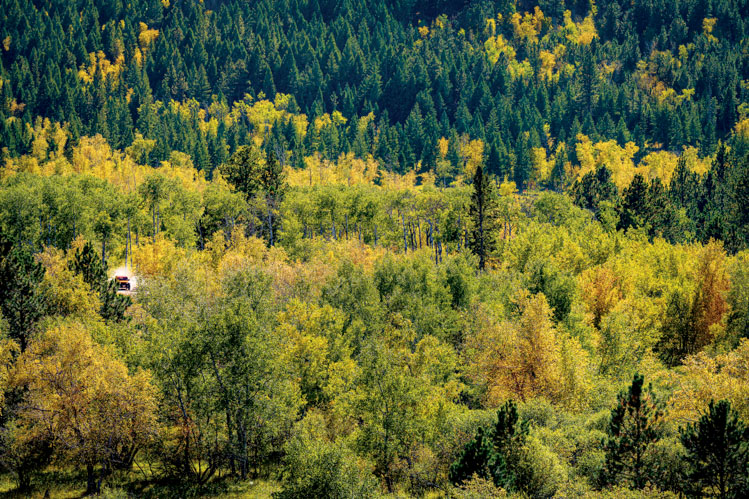
Drivers experience an autumn smorgasbord along Palmer Creek Road, which winds through thick aspen forests and broad meadows.

A SOLITARY COTTONWOOD tree on the lonesome prairie, when bejeweled with golden yellow leaves, emanates as much beauty as the human eye can absorb — especially when the sun slips southward, leaving the September sky bluer than blue.

Yet, who looks for a single tree in autumn? We tell ourselves we must see mountains and hillsides and river valleys with their forests full of leaves, each one hanging precariously by a stem, fluttering unworriedly as if winter was a thousand years away.

So yes, of course, go forth this autumn and fool yourself into believing that this glittering season is not just a cruel trick of chlorophyll. Life will always be so good. Calamity can never follow such serenity. South Dakota is paradise eternal.

Certain places in our big state are especially guilty of contributing to the delusions of autumn, beautiful though they may be. Traffic jams can occur on Highway 14 in Spearfish Canyon during peak leaf-peeking days. Sica Hollow’s oaks are almost as beguiling for people who live in the northeast. Our urban forests are resplendent in different ways because city parks and boulevards feature a gloriously unnatural mix of planned and planted trees. The McKennan Park neighborhood in Sioux Falls is an exceptional example.

We asked our chief photographer, Chad Coppess, if he knew of some lesser-known fall foliage tours. He suggested the three that follow. Interestingly, one that he chose is at South Dakota’s very lowest elevation while another is near the highest. Chad’s diplomatic third choice lies in between, along the Missouri River.

These routes won’t have bumper-to-bumper traffic in September and October when our leaves change color, but that is part of their allure. Autumn is even more striking when you escape the crowds.


PALMER CREEK

Pennington County

The graveled Palmer Creek Road is less than 4 miles long yet offers more than its weight in gold leaves between two spectacularly located campground resorts. Horse Thief Campground and Resort lies on the southwest end of the road and the Mount Rushmore KOA at Palmer Gulch Resort on the northeast. Both campgrounds have funky little stores that offer snacks and refreshments.

Midway along the road, an engineer had some fun by designing a double crisscrossing section with an over-under bridge and a cut through a rock that delivers a jaw-dropping view of Black Elk Peak no matter which way you are traveling. The road winds through beautiful aspen groves and, at times, offers a panoramic view of the entire gulch.

Little-known fact: Along the road is a parking area for Palmer Creek Trailhead, where you can trek to the top of Black Elk Peak (South Dakota’s highest point) and beyond.


PLATTE-WINNER BRIDGE

Gregory and Charles Mix counties

Those who prefer to venture off the interstates know that Highway 44, a main artery across the southern third of South Dakota, crosses the Missouri River via the Platte-Winner Bridge.

The stretch between Platte and Winner is 53 miles. The most scenic area features bluffs that drop into the river valley where you’ll discover two state recreation areas — Snake Creek on the east side and Buryanek on the west.

Lewis and Clark traveled here in 1804 and 1806, at one point losing a member of their party for several days. The Shannon Hiking Trail in Snake Creek Recreation Area commemorates the lost explorer and gives expansive views of the river and autumn colors.

Little-known fact: Unless you live in the neighborhood, you may not have heard that the mile-long Platte-Winner Bridge is about to be replaced. Construction on a new bridge may begin in 2025.


BIG STONE LAKE

Grant and Roberts counties

State Highway 109 runs up the South Dakota side of Big Stone Lake in the northeast corner of the state with a view across the lake into Minnesota. We recommend the 15-mile stretch from Big Stone City to Hartford Beach State Park with frequent stops at access points to the water. The route offers a variety of vegetation and colors for leaf peepers. Hartford Beach is one of the oldest South Dakota state parks and is popular with campers, boaters and fishermen. The log cabin trading post of Solomon Robar, along with Native American burial mounds and pioneer graves, are found along the hiking trails in the park.

Little-known fact: The shoreline of Big Stone Lake (elevation 965 feet) is the lowest spot in South Dakota.

Editor’s Note: This story is revised from the September/October 2023 issue of South Dakota Magazine. To order a copy or to subscribe, call (800) 456-5117.

Posted on Leave a comment

Cinnamon Rolls, 25 Cents

My mother used a dish towel made from a bleached flour sack to tie her hair up before baking. She would fold it into a triangle, wrap it around her springy hair, and tie it in a knot above her forehead. Even then it was not a casual look, or a casual action. In all those years, in all those hundreds of loaves of bread, and thousands of rolls, no one ever found a strand of black or silver hair. It was a ritual, a comforting pause before she began her favorite chore.

She’d hold the measuring cup above a Fiestaware bowl, letting the milk run above the red markings and over the edge of the cup, judging instinctively that on that particular day, the flour would take more milk. She never used exact measurements for her baking recipes.

When she’d finished making the dough, she placed a towel made from a flour sack over it. I remember standing on tiptoe to look at the dough, its expectant bulge beneath the rough cotton, and how she’d guide my small fist to punch it, letting the air go whoosh.

Her motions were as graceful and unchanging as a choreographed dance. She dusted the board with flour, cut a section of dough and rolled it out. She swept the softened butter over the surface, dotted it with small chunks of brown sugar and dashes of cinnamon, rolled up the dough into a log, cut it in a dozen pieces, and placed the shiny circles of deep brown and ivory neatly in a baking dish. After all the dough was gone, she carefully brushed the little heaps of flour off the breadboard back into the flour bin for the next baking project.

When my mother was a teenager, she prepared meals using a natural gas range in her family’s house in Pierre. When she arrived as a young bride on the farm with its wood burning stove, she had to learn to bake all over again. In the first days of their married life, she presented my father with a plate of biscuits from the recipe she always used. He eagerly picked one off the plate and bit down on it. He put that one aside, and tried a second. He tried another and set that one aside too. My mother came in from the kitchen just in time to see the fourth biscuit whizzing through the air toward the wall where it hit with a BANG!

“What the heck! Are you trying to make me an old man?” he asked.”Need false teeth before I’m not even 30? These biscuits are harder than a rock!”

After several more mistrials she asked her mother-in-law for advice. My grandmother, with her son’s well-being forefront in her mind, gave instructions on how to bake in a wood burning stove. To start the fire quickly, use kindling composed of ash twigs or dry corn cobs, then add ash pieces cut lengthwise to keep the fire burning steadily and minimize the”pops” caused by the dampness of knots. My brother Bob was often given the task of splitting the firewood to these specifications. He remembers well the exacting labor it required. I remember the lonely job of searching for corn cobs on the hill above our house. Our grandmother gave precise instructions about the timing and placement of baking dishes so as to brown the pastries evenly.

I like to think that my mother, who was well-educated and must have been bored while doing so many mundane chores over and over, was not only challenged, but fascinated by learning the techniques of baking in a wood burning stove, and the math and science that lay behind them. She’d been an amateur artist in Pierre. She now shifted her talents to the kitchen where she created mouth-watering meals using only basic ingredients. It wasn’t just in baking that my mother excelled. She made turtle and oxtail soup, mayonnaise and ketchup from scratch, and devised a recipe for the most delicious baked pheasant. Today the grandchildren of friends who hunted with my father cook that dish with pride.

My mother continued to bake, and the summer Bob turned 9 and I turned 7, we came up with a great way to make money. Our plan was to set up a stand by the side of Highway 12, near our farm south of Big Stone City where the bridge spanned our fields and the river. We’d use fruit crates as a storefront and draw a sign declaring,”Cinnamon Rolls! 25 Cents Each.” We ran home and into the kitchen where we excitedly explained the project to our mother, assuming she’d be happy to be our unpaid head chef.

“We won’t even need anyone to drive us there! We’ll just pick them up as you take them out of the oven and carry them through the woods to our stand. It’ll be all profit.”

Bob, a salesman even then, ended our pitch with,”They’ll sell fast, everyone loves your rolls!”

For the first, maybe the only time, I heard my mother say unequivocally,”No!”

In 1952 when my father and his friend Heinie designed and rebuilt the kitchen, they tore out our old wood burning stove and installed a new range fueled by propane in its place. When they were finished the kitchen was much more efficient, and my mother was very pleased with how it looked.

After 25 years of making my father his standard breakfast of three fried eggs (sunny side up) and five strips of bacon (well-done), my mother had become adept at bringing the plate to the table in just 3 minutes. The first morning she used the new stove, she was horrified to see that the eggs were hard and the bacon burnt to a crisp. In the afternoon she burned bread and a pan of rolls. The morning after that she ruined another skillet of eggs.

When my father yelled from the table,”What’s taking so long?” she put down the spatula, walked into the dining room and proclaimed,”Take that stove out of my kitchen! Bring my old stove back!”

Of course, that wasn’t possible. After the remodeling there was no space in the small room to fit it back in. In a few weeks, my mother learned to control the switches to moderate the immediate burst of heat propane provides. Her baking prowess continued. Presented with the challenges offered by different fuels — natural gas, wood, propane — my mother adjusted and continued to bake dough into memories.

When I returned home to South Dakota decades later, in 2019, I was amazed to hear that a third generation of Big Stone women are now using my mother’s recipes to make her pies, her spice cake, and of course, her cinnamon rolls.


Myrtle’s Cinnamon Rolls

Dough

3 cups all-purpose flour, sifted

1/4 cup sugar

1 teaspoon salt

1 package active dry yeast (not instant)

1/4 cup warm water

1 cup milk, scalded

1/4 cup shortening

1 egg, well-beaten

Combine dry ingredients in a large bowl. Proof yeast for 1 minute in warm water (100–110 degrees) or according to package directions. Mix together dry ingredients, egg, shortening, milk and yeast mixture until doughy. Do not overwork dough.

Let rise 5 minutes in a warm oven, then another 40 minutes in a covered bowl on counter until doubled in size. Roll out dough into a 1/4–1/2 inch-thick sheet.

Filling

1/3 cup salted butter, softened

1/3 cup brown sugar

3 teaspoons ground cinnamon

Dot dough with softened butter, then cover by generously sprinkling with brown sugar and cinnamon. Roll dough up into a long log. Section dough into 2-inch pieces and place cut side up in a greased 8×8-inch baking dish. Allow room for rolls to double in size. Let rise in a covered baking dish for 30 minutes. Bake at 350 degrees for 25 minutes or until golden brown.

Icing

1/8 cup milk

1/4 teaspoon vanilla extract

1 cup powdered sugar, sifted

Combine in a small bowl until there are no sugar lumps in mixture. Drizzle over cooled cinnamon rolls.

Editor’s Note: This story is revised from the September/October 2020 issue of South Dakota Magazine. To order a copy or to subscribe, call (800) 456-5117.

Posted on Leave a comment

South Dakota’s Stockholm

Steve Misener is known around the world for his historic piano collection and the knowledge he’s accumulated from years of research into piano history.

Stockholm, the capital of Sweden, is built on 14 islands and features more than 50 bridges. South Dakota’s Stockholm sits on a small hilltop in the Coteau Des Prairies roughly 15 miles from Minnesota. Stockholm was never very large — maybe 150 people at its peak in the 1920s — but longtime residents are still proud it survives as a bedroom community for nearby Milbank and Watertown.

The town’s Swedish roots can be seen in yard and house decorations and displayed inside Alice’s Restaurant. These days, Stockholm is known for its Buggy Museum and Steve Misener’s vintage piano collection.

This corner of South Dakota has a long history of dairy farming. Lifelong resident Arlo Levisen’s grandfather was a butter maker, and the Stockholm creamery was in business until the 1960s when area dairy farmers began supplying the rapidly growing Valley Queen Cheese in Milbank. Smaller operations couldn’t keep up.

“The school closed in 1970,” Levisen says.”My mom was the last teacher.”

Education is a decades-long family tradition for the Levisens and Arlo is proud to say he finished his career as the superintendent of the school where his mother graduated.

Alex”Richard” Thompson and son Alex”Richie” Jr. own Alice’s Restaurant on Main Street. Locals gather here for lively morning conversations and to roll dice to see who pays for the coffee. The restaurant was originally built as a hotel for salesmen traveling on the railroad. There are still five rooms upstairs, but they aren’t advertised; they are mainly used when a wedding or some other gathering happens in town.

Following local tradition, women still sit in the north dining room and men in the south.”You’ll need your hip boots over on that side,” the women laugh about their spouses’ penchant for telling tall tales. Some describe mornings here as a”therapy session.” Monthly birthday parties for the regulars include cake and singing.

Thompson Sr. remembers that Stockholm”used to be a going concern, but just kind of dribbled away over the years.” The town never had a theater, but summer Saturday nights included movies projected on the large white door of the lumber yard for the audience in lawn chairs.

The Stockholm Agricultural Museum is a collection of 12 buildings, with the Buggy Museum being the newest.

Religion has been a strong part of the town from the start and Judy Dorman Rieke is proud that the town has always been dry.”It just goes to show a town can make it without booze,” she said. Various traditional Swedish churches, aspects of Dakota culture, and newer versions of Hutterite and Amish cultures blend here.

A collection of 12 buildings comprises the Stockholm Agricultural Museum under the auspices of the Grant County Historical Society, with the Buggy Museum being the newest. A 2008 windstorm that damaged buildings and a few buggies inspired Levisen and others to put up a new building and collect more buggies and sleighs from the area.

Levisen says the project was funded by David Johnson, nephew of longtime Stockholm area farmer Henry Fogelberg. Several buggies have been completely restored, while some were in good enough shape to display in their donated conditions. Highlights in the collection of 19 vehicles include a horse-drawn hearse provided by the Mundwiler Funeral Home in Milbank and a Russian-Canadian sleigh. Most came from within 50 miles of Stockholm.”All these buggies have a connection to this area,” Levisen says.

Across Main Street from Alice’s Restaurant is the former Stockholm grocery store, now home to Steve Misener’s Piano Shoppe.”Welcome to the center of the music world in Stockholm,” he laughed as he opened the door.

“The collection of antique pianos is where my passion really lies,” he explained, but he’s also known for instrument tuning and repair. He has traveled between Chicago, Minneapolis and Denver tuning pianos.

Misener is happy to show his collection of 130 major instruments to anyone who calls ahead. Even though some are stored and covered, he can easily give you details on each piece’s history. A walk through is a history lesson and demonstration of the knowledge collected in Misener’s memory.”My 1574 organ is one of the oldest in North America,” he said.

“This is a Broadwood,” he said, pointing to another.”Beethoven had one.” He paused when asked about the newest piece in his collection before deciding it is a 1940 model.

Arlo and Paulette Levisen have played a large role in creating Stockholm’s Buggy Museum.

Tracking the history of the pianos has become a passion as well. Using serial numbers, sales receipts, newspaper accounts of concert performances, and passports assigned to instruments that traveled overseas, he’s been able to document the lives of several of the pianos in his collection.”What’s the story? Who owned this? Who played it? It’s just fascinating,” he said.”The detective work is fun.”

He bills one of his pianos as”the piano that Brahms nearly played.” Famous German composer and pianist Johannes Brahms was scheduled to perform on it but became ill and did not play. Another he has connected to a story of the hiding of the Liberty Bell from British troops in Philadelphia.

As Misener built his collection he sought out experts in the field with questions.”About 10 years ago I realized the questions were beginning to come to me. I had never seen myself as the go-to person, but I guess it has come to that.”

Occasional performances and history presentations for schools mean Misener’s pianos do get played if their condition allows. Some are kept as historic pieces past their musical prime.

Levisen is working to bring more visitors to Stockholm and especially to the Buggy Museum. A series of special events has already created interest, including a Burger Battle in June.

Editor’s Note: This story is revised from the July/August 2023 issue of South Dakota Magazine. To order a copy or to subscribe, call (800) 456-5117.

Posted on Leave a comment

Glacial Lakes in Winter


South Dakota’s Glacial Lakes country
is perfect for day trips this winter. More than a hundred lakes — plus sloughs, wetlands, ponds and rivers — combine to create a scenic and unspoiled countryside rich with wildlife and waterfowl, friendly farm towns and numerous opportunities to enjoy nature.

Melting glaciers shaped this prairie pothole country 20,000 years ago. The lakes are so numerous that some remain unnamed. Most have grown in size and depth over the last 25 years. Bitter Lake, once little more than a shallow slough, is now the state’s largest natural lake; it is encroaching on Waubay Lake and other bodies of water to create an ocean-less, inland sea.

In this winter of the pandemic, we are all looking for new outdoor sights and experiences. Winter serenity and solitude has always been a trademark of the unspoiled Glacial Lakes region.

Here are 10 suggestions, organized by county, on how you might explore the Glacial Lakes. Some are auto drives, others offer winter hikes that could be compromised by the amount of snow on the ground. However, this list only scratches the surface so don’t hesitate to roam the lake country. You’ll discover many surprises, and they’ll all be good.

BROOKINGS COUNTY — The 135-acre Dakota Nature Park (at the corner of 22nd Avenue and 32nd Street South) lies in the southeastern corner of Brookings. Gravel mining led to formation of ponds and wetlands, and a restored prairie now grows atop the old landfill mound. A portion of the Allyn Frerichs Trail System — named for the city’s longtime parks and rec director who passed away in 2014 — skirts the north edge of the park, while a network of paths weave around the wetlands, prairies and trees.

BROWN COUNTY — Take a trip to Sand Lake National Wildlife Refuge. Though the classic 15-mile auto tour is closed in winter due to hunting and snow conditions, other roads remain open on the perimeter of the refuge. Explore the gravel roads that lead north and south from Highway 10. The snow geese are gone, but you’ll see other waterfowl, eagles and the Arctic’s snowy owls. Deer, pheasant and coyotes are also common. Sand Lake rose from the dust of the Great Depression to become one of the world’s most important wildlife sanctuaries. It is 30 miles northeast of Aberdeen.

CODINGTON COUNTY — Just southwest of Watertown is Pelican Lake. An observation tower near an inlet on the lake’s south side provides a sweeping view of the water, its namesake birds, the prairie and Watertown’s skyline. The Observation Tower Trail is a three-quarters of a mile hike through the woods and winter grasses. A longer jaunt, the Pelican Prairie Trail, gently meanders 5.2 miles.

DAY COUNTY– Explore the trails of Waubay National Wildlife Refuge, situated in the very heart of the Prairie Pothole landscape. Scientists say the region produces 50 percent of the continent’s waterfowl. Trails range from a few hundred feet to a mile, and jaunt around an island that houses the refuge headquarters. However, the public facilities are closed in winter.

DEUEL COUNTY — Visit 12-acre Ulven Park, which occupies a point on the eastern shore of Clear Lake. The frogs and toads, noisy in summer, are now hibernating so they’ll not interrupt the serenity of the park’s half-mile hiking trail.

EDMUNDS COUNTY — Shake Maza Trail at Mina Lake (between Ipswich and Aberdeen) is a short walk that explores the flora, fauna and other features at one of the first man-made lakes in northeast South Dakota. Shake Maza is a Native term meaning”shaped like a horseshoe,” which describes the 850-acre lake, ringed by picturesque cabins and homes.

GRANT COUNTY — This fascinating region is one of the USA’s five continental divides. Lake Traverse flows west to the Hudson Bay and Big Stone Lake flows south to the Mississippi and the Gulf of Mexico. Some of the best winter trails are at Hartford Beach State Park — a tree-filled, rocky shoreline north of Milbank that is quite unlike anything else in the Glacial Lakes. Signage in the park will direct you to several easy trails.

HAND COUNTY — Hike the Pheasant Run Trail at Lake Louise, 14 miles northwest of Miller. Beginning at the trailhead in the main campground, the dirt and grass trail meanders 3.2 miles around the south side of Lake Louise, which was created by damming the south fork of Wolf Creek in 1932. More than three dozen informational plaques identify trees and plants found along the way, though leaf identification will be challenging in December and January.

LAKE COUNTY — Wander the trails of Lake Herman State Park, which occupies a peninsula on the east side of Lake Herman, just west of Madison. A cabin built by pioneer Herman Luce in about 1870 stands along the 1.25-mile Luce Adventure Trail, which encircles Herman Pond. Connecting trails include the Abbott Trail (1.1 miles) and the Pioneer Nature Trail (.4 miles). All are easy walking.

MOODY COUNTY — Much of the prairie pothole region drains into the Big Sioux River, and the waterway starts to change its personality as it reaches Flandreau and Dell Rapids. Hike Red Rock Trail in Dell Rapids, where you can enjoy a closeup view of the famous rose quartzite that underlies the region.

Posted on Leave a comment

Main Street Milbank

Our September/October issue includes a story on Milbank’s downtown. The Grant County community is long known for cheese-making and a big-winged flour mill, but its shopping district is also blooming in a time when many retailers nationwide are struggling. Bernie Hunhoff visited Milbank to meet its entrepreneurs and gather photos. Here are a few shots that we couldn’t fit into the magazine.

Posted on Leave a comment

When the Stars Align

Some people are born in Grant County and stay there all their lives. For others, settling in this county in northeastern South Dakota is a matter of fate.

Such was the case with the Benedictine monks who established Blue Cloud Abbey near Marvin. St. Meinrad Abbey in Indiana wanted to establish a new monastery in the Dakotas, so they sent a team to scout for land. The men found a spot they liked along the Missouri River near Yankton, but WNAX’s tall radio towers east of town obstructed the view of the river valley. They decided to try North Dakota, but along the way they were taken with the rolling hills of the Coteau des Prairies and Whetstone River valley. The delegation stopped to inquire about available land, and the banker told them that a property had been listed for sale just 30 minutes earlier. They bought 300 acres at $22 an acre. The deal seemed too good to be true, but when they learned the banker’s name — Effner Benedict — they knew Grant County was the place for them.

Blue Cloud Abbey was a place of worship and reflection for more than 60 years.

Monks worked and prayed at Blue Cloud Abbey until its closure in the summer of 2012. The facility has since been reopened as Abbey of the Hills, an inn and retreat center that also includes an organic farm.

Who knows what other forces were at play when Clarence Justice responded to a”Help Wanted” ad in the Minneapolis Tribune. Justice, a regular reader of the paper, was working as a printer in Miller when he saw the ad seeking a printer to work at the Grant County Review in Milbank. He called and the publisher, Bill Dolan, hired him over the phone without even asking his name (a small oversight in the world of journalism).

The Grant County Review remained in the same family for a century. Phyllis and Clarence Justice published the newspaper for several of those decades.

Justice went to work at the Review in 1952 and three years later, he and the publisher’s daughter, Phyllis, were married. They ran the paper together for more than 50 years, becoming South Dakota’s First Couple of newspapering.

Grant County was officially created in 1873 and organized five years later. It’s named after President Ulysses S. Grant. Among the county’s early settlers was Henry Holland, an immigrant from England. Holland built a 44-foot-tall windmill to grind wheat for local farmers. The mill was abandoned and moved to the city park in 1912. It was moved again in 1978 and underwent a total restoration in the early 2000s. Holland’s Mill remains a landmark along Highway 12 on the west side of Milbank.

Holland’s Mill is a Grant County landmark along Highway 12.

With 3,300 people, Milbank is the Grant County seat. It’s also known nationally for Legion baseball and high quality granite. American Legion baseball has its roots in Milbank. The program started there in July of 1925 when a group of World War I veterans thought American boys were losing interest in the national pastime. Tens of thousands of teenagers play Legion ball across the country today.

Milbank’s granite caught the eye of designers as they created the Franklin Delano Roosevelt Memorial in Washington, D.C., in the 1990s. More than 200 truckloads were hauled halfway across the country during construction. The granite around Milbank is thought to be 4 billion years old. It’s popular because of its high quartz content, which accounts for its hardness and light red color.

The Muskegon is dry docked in a local museum.

Several other small towns are scattered throughout Grant County. Big Stone City lies on the southern shore of Big Stone Lake, which serves as the very northeastern border of the county. The lake is a popular recreation spot, but it was also the site of South Dakota’s worst nautical tragedy.

An excursion boat called the Muskegon departed for a pleasure cruise in July of 1917 and never returned. A tornadic storm caused it to capsize, killing seven of the nine people aboard. The boat was pulled shore and eventually resurrected as The Golden Bantam, which plied the waters of Big Stone Lake for another 30 years. In 1960, the boat was placed in dry dock north of Big Stone City and was used as a lake cabin. In 1985, it was donated to the Big Stone County Historical Society and Museum just across the state line in Ortonville, Minn., where it remains today.

Just west of Milbank, Twin Brooks is known for its big annual threshing show the second weekend in August. But there’s also a unique restaurant in town called the Bird Feeder. Carol Kilde runs the cafÈ in the back of the town’s post office. It’s open May through December and there’s no menu. You choose your meal when you call for reservations.

Several years ago, while driving through Stockholm, we met Steve Misener on Main Street. Misener began tuning pianos more than 30 years ago and became an avid collector. His shop holds about 75 pianos and boxes stuffed with parts. Misener often exhibits his collection around northeastern South Dakota.

Steve Misener’s shop in Stockholm holds many piano treasures.

Misener told us he worried about the future of music because younger generations seem to be occupied with other things. But music seems to be in the blood of Delaney Johnston, who released her first country music CD before reaching middle school.

The youngster from Summit got her break when renowned South Dakota singer Sherwin Linton was performing at a benefit concert in LaBolt. Johnston requested that Linton sing Johnny Cash’s”Jackson” for her grandmother. Linton asked if Johnston would like to sing along, and she agreed. Linton recognized that she had talent and helped produce her CD. Now Johnston balances summertime performance at county fairs along with being a kid.

Who knows if young Delaney will stay, but Grant County is richer because of her and others — natives and transplants — who chose to make a home in the county on the Coteau.

Editor’s Note: This is the 13th installment in an ongoing series featuring South Dakota’s 66 counties. Click here for previous articles.

Posted on Leave a comment

Milbank’s Newspaper Family

Editor’s Note: Clarence and Phyllis Justice were going strong as publishers of the Grant County Review in Milbank when we visited the newspaper in 2008. At the time, the paper had been in their family’s hands for almost 100 years. Not long after this story appeared, both Phyllis and Clarence developed health problems. They sold the Review to Debbie Hemmer and Holli Seehafer in October of 2013. Phyllis died in November 2013 and Clarence followed in October 2014. They will long be remembered as one of South Dakota’s pioneer publishing families.

Lucky is the town with a newspaper owned and edited by a spunky journalist who knows the community’s history and secrets, and even its very soul. By that standard, Milbank won the lottery when Bill Dolan bought the weekly Grant County Review in February of 1911.

He married Christine Olson a year later, and they had a daughter, Phyllis. Clarence Justice joined the family in 1955 when he married Phyllis. Christine’s sister, Victoria Olson, was also involved in the paper from 1915 to 1990, selling ads, gathering news, setting type and keeping books.

That’s basically the history of The Review to this date. The family has been in charge for the last 97 years. Portraits of both Bill and Phyllis hang in the South Dakota Newspaper Hall of Fame on the South Dakota State University campus in Brookings.

Bill Dolan was a young St. Thomas College graduate — a staunch Democrat and Catholic — when he arrived in Milbank from St. Paul, Minn. He couldn’t have known the tough competition he would face in a predominately Republican and Protestant community with competing newspapers.

At times, three newspapers fought over readership, advertising and printing. Milbank didn’t become a one-paper town until 1991, when the Herald Advance ceased publication. The Review and the Herald Advance had been lively competitors for over 100 years.”When it was gone, it was like playing tennis without a partner,” Phyllis says.”It took us a long time to adjust.”

“My dad had many other interests, and he might have sold the paper somewhere along the way, but my mother was really devoted to it, and neither she nor I would hear of selling,” says Phyllis.”When mother was on her deathbed at age 101 she asked me, ‘We still have the paper, don’t we?'”

Phyllis says both of her parents chose to spend money for needed printing equipment rather than for their own use.”No matter how little advertising dad had, he never cut back on news coverage,” she says.”Even in the Depression years he always put out a newsy paper, and he never failed to include a generous number of editorials. He was determined to make Milbank a better community.”

Though he often worked 80-hour weeks, he still found time to promote community and political projects and to enjoy hunting and fishing in the Glacial Lakes. For 12 years as a Democrat on the five-member state Board of Regents, he was instrumental in shaping the future of South Dakota’s public universities. On one occasion, press day at The Review was delayed while he helped to settle a student strike at Northern Normal and Industrial School (now Northern State University) in Aberdeen. Phyllis returned to Milbank in July of 1946 to join her father in the family enterprise and succeeded him as editor and publisher when he died in 1957. A journalism graduate of the University of Minnesota, she had worked at the Minneapolis Tribune, the Minneapolis Star Journal and the Mankato Free Press. She had also served as an assistant club director for the USO in the Seattle area during World War II, and later as public relations director for the National Catholic Community Service in Washington, D.C. No matter where she was working, she always furnished her dad with a weekly column that she’d started while in college.

When many readers couldn’t afford subscriptions in the 1930s and early 1940s, Phyllis’ dad continued to mail newspapers to them. After the hard times ended, he decided it was time to make everyone a paying customer again, so he sent Phyllis and her Aunt Victoria as collectors — door to door and farm to farm. Victoria and Phyllis would start out early in the morning after the week’s paper had been printed and mailed. They packed a thermos of coffee and lunch, and headed down country roads in an old Dodge, with the subscription list in the back seat.

Some subscribers hadn’t paid for a dozen years. On a good day, however, Victoria and Phyllis would go home with more than $100. They risked dog bites, and several times they were ordered to”get off the premises and never to send that dirty Democrat rag to them again.”

For a special issue commemorating the paper’s 125th anniversary in 2005, Phyllis wrote about her family’s involvement, but she also heralded the non-family staff, several of whom had been with the paper for over 50 years. And she explained how she met her husband and assistant publisher.

“Finding a capable printer who was willing to live in a small town was very difficult,” she wrote.”In 1952, dad placed a help wanted ad in the Minneapolis Tribune. Little did he suspect that he would get a call from a printer in Miller who was a regular reader of the Minneapolis paper. Dad was so impressed with the caller that he asked him to report for work on Monday.”

She recalled that her dad put down the phone and told her he’d hired a printer who had experience on dailies and weeklies in several states.

“What is his name?” Phyllis asked.

“Oh, I forgot to ask him,” her father replied.”But he is coming.”

Phyllis doubted the printer would show, but the following Monday a tall, slender young man was at work in the office when she arrived. She became Mrs. Clarence Dolan Justice just three years later, and the two have worked together ever since. By any standard, they are the First Couple of South Dakota newspapering.

In the 2005 anniversary issue, Phyllis, Clarence and the entire Review staff invited readers to a cake and ice cream open house with a full page advertisement that read,”It hasn’t always been a piece of cake, but it has been a labor of love.”

Republicans, Democrats, Independents, Protestants, Catholics, agnostics and others showed up to celebrate.

Editor’s Note: This story is revised from the March/April 2008 issue of South Dakota Magazine. To order a copy or to subscribe, call (800) 456-5117.

Posted on Leave a comment

King of Klub

We’ve all heard of soup kitchens and spaghetti suppers. Feeds of lutefisk, Rocky Mountain oysters or wild game are not uncommon. But up in Milbank, folks feast on on a rarer delicacy — a Norwegian potato dumpling called klub.

It’s an early winter tradition in Milbank, thanks to local body shop owner and former assistant fire chief Al Mathiason. Over the years, Mathiason’s huge dumplings simmered in ham broth have raised funds for the local fire department and for youth groups at American Lutheran Church.

Mathiason learned to make klub at his mother’s knee. She was German and Irish, but picked up the technique from her mother-in-law in order to please her full-blooded Norwegian husband.”He liked potato klub, lefse, lutefisk, all the goodies,” says Al.

It’s still a Mathiason family favorite, mixed up for family dinners and special visitors. Kathy Mathiason, Al’s wife, says,”Our 90-year-old uncle George came from California. We offered to make him klub, so he was watching Al make dumplings and couldn’t believe how much flour he was using. After he saw how well they stayed together, he said that must have been what his wife and sister did wrong — their dumplings always fell apart. Al told him not to mention that to the girls or he would never get dumplings from them again.”

Like so many ethnic foods, klub has many names and many variations. Up in Pierpont, South Dakota, they call it kumla. Others call the spheres raspeballer or potetballer. You can use red or white potatoes — both have their advocates. The Mathiasons use white flour to make light dumplings; others prefer wheat or graham flour.”Traditional dumplings would have a chunk of meat hidden in the middle,” Kathy explains.”It was probably the only meat you ate.” One variation, blodklub, requires boiling the dumplings in — you guessed it — pig or beef blood.

Serving suggestions for klub also vary. Like most Scandinavian foods, it’s good with butter. Some eat it with dark Karo syrup, and others fancy a slosh of ham juice. At the Milbank feeds, it’s often served with ham, coleslaw, homemade bread and butter pickles, salads and desserts. But Kathy tells us,”a real klub eater doesn’t eat any other sides — just dumplings.” Klub leftovers are a special treat when sliced up and fried in butter.

Milbank’s klub feed is usually held in November or December. If you don’t want to wait, try Al’s method below.


Klub for a Crowd

1/2 – 1 bone-in ham
20 lbs. potatoes
5 lbs. flour
Seasoning salt
Garlic salt
Pepper
Ham bouillon, optional

In a large kettle of water, cook a half or a whole ham. When the ham loosens from the bone, remove the meat and leave the broth behind, adding ham bouillon cubes to intensify the flavor, if desired.

Peel potatoes, then shred them in a food processor. Add flour to potatoes until the mixture holds together and reaches dumpling consistency. The exact amount of flour used will vary depending on the moisture in the potatoes. Season to taste with seasoning salt, garlic salt and pepper.

Form the dumplings into balls — anything between tennis ball and softball size is fine — then drop them in the hot ham broth. Cook the klub at a slow boil for about an hour.”They’ll start to loosen and almost float when they’re done,” instructs Al.

Posted on Leave a comment

We Gave One the Chair

South Dakota borrowed this electric chair from Statesville, Illinois 67 years ago. Photo by Gail E. Myers.

Editor’s Note: This story is revised from the March/April 2009 issue of South Dakota Magazine. To order a back issue or to subscribe, call 800-456-5117.


When murderer Clifford Hayes faced electrocution under South Dakota’s three-year-old capital punishment law, it posed a problem for Warden G. Norton Jameson because South Dakota didn’t have an electric chair.

Hayes was convicted of murdering Grant County Sheriff Melbourne Lewis in the summer of 1941. Thirty-year-old Hayes had just been released from prison for good behavior and intended to ride the rails to the West Coast. He waited in Aberdeen for a westbound train, but when none came, Hayes sneaked on a boxcar going east and got off in Milbank. He stole a .22 rifle and ammunition and later shot the gun to scare some kids. A report of a man shooting a rifle on the Milbank streets brought out Sheriff Lewis. Hayes reportedly hid in a shed and opened fire on him.

Hayes brazenly announced as he pleaded guilty that he’d already spent too much”bad time in jail” and wasn’t going to spend the rest of his life there. He’d die first.

The 1939 state legislature passed a highly controversial return of capital punishment, illegal since 1915, and mandated electrocution. However, they made no provision or appropriation for the chair nor the extensive wiring, power sources, switches and high-voltage transformers needed to carry out an execution.

Warden Jameson solved the problem using the creative management skills that made him a legend in penal administration. He borrowed an electric chair for Statesville Penitentiary in Joliet, Illinois. Statesville was notorious for electrocuting three men in one day in 1928.

He might also have been aware of some power-play Illinois politics. A confusing mandate said that only counties with a population over one million could maintain an electric chair, conveniently moving all Illinois executions to Cook County and leaving electric chairs across the state out of commission.

Jameson oversaw a prison revolt in 1942 and the 1947 execution of George Sitts during his 25-year tenure are penitentiary warden.

In a letter dated Sept. 11, 1942, Warden Jameson wrote about the chair’s expense to the state of South Dakota.”I do not have the exact figures on the cost of the chair, but to date it would not exceed $250 which includes transportation and installation.”

He also described how it was installed.”The chair was set up by a man from Illinois who does not desire any publicity, and our own men here. It was transported out here by him in a truck.”

The borrowed chair occupied a room near the penitentiary’s high-ceilinged and cavernous jute mill. The mill was full of noise, brown dust, and clusters of men feeding rope-making machinery. Outside the execution room stood a closeted and locked high bank of electrical transformers, throw switches, and heavy cables. Through windows in an adjacent stone wall, the switch operator could see both the chair and the victim.

Finding the electric chair was just the beginning of the warden’s responsibilities. Jameson needed to set the execution time and announce it to the public 48 hours in advance. He also had authority over assembling witnesses and notifying attendees required through statute, such as the attorney general, the states attorney and the trial judge. The inmate could request two clergy of any denomination and up to five relatives or friends.

Everything was ready in 1942, but the Joliet chair would be used only when the defendant’s lawyers exhausted their appeals and the condemned man declined commutation from death to life in prison.

The electrocution never took place. On Dec. 7, 1942, Hayes changed his mind and asked to have his sentence commuted to life without parole. He died in 1993 at the state penitentiary. There is no published record of what happened to the borrowed chair.

Before the electric chair was banned in South Dakota, one man died in its clasp. Thirty-three-year-old George Sitts was executed on April 8, 1947 in Sioux Falls. Sitts had escaped from a Minnesota jail where he was serving a life sentence for killing a liquor store clerk. He killed Butte County Sheriff Dave Malcolm and State Criminal Agent Thomas Matthews near Spearfish in 1946 while resisting arrest.

Sitts was the fourth man sentenced to electrocution in South Dakota, but the only one whose sentence wasn’t commuted. He was executed at 12:15 a.m. with 41 witnesses. His last words reportedly were,”This is the first time authorities helped me escaped prison.”

The chair used that night is now kept at the Cultural Heritage Center in Pierre. It is almost identical to the borrowed Illinois electric chair. Collections Curator Dan Brosz carefully compared photos of the Joliet model with the museum’s and concluded the two look similar but are not the same. Those differences suggest that inmates constructed a second chair using the borrowed chair as a model.

Thirty-three states in the nation have capital punishment, but only six states still employ an electric chair as an option. In 1984 South Dakota followed other states and mandated lethal injection, believed to be more civilized.


Posted on Leave a comment

All Good Things Must End

South Dakota’s rural solitude is church-like to many of us. I don’t know how many farmers and ranchers have told me through the years that they’ve felt closer to God on the land than in a pew.

When cowboy troubadour Kyle Evans sang “I’m in Heaven on a horse on the wide open prairies of Dakota …” he spoke for everybody who has ever chewed on a blade of blue stem.

But as church-like as the prairie might be, it seemed even holier at Blue Cloud Abbey in Grant County — a picturesque little monastery that grew into a popular retreat center for all sorts of people, including South Dakota’s reflective writer Kathleen Norris.

The true story of how the monks came to locate near Milbank is as sweet as the prairie grass. The priests and monks at St. Meinrad Abbey in Indiana wanted to establish a new monastery in the Dakotas so they sent four brothers to scout the area in 1949. They liked a spot above the Missouri and James Rivers near Yankton, but WNAX’s tall radio towers obstructed the view so they decided to drive to Fargo, North Dakota.

On the way (this was before I-29 was built) they stopped outside the tiny town of Marvin and saw a rolling, wooded string of hills above Grant County’s Whetstone Valley. The land was rocky but they liked it so they went to nearby Milbank to inquire. They were directed to the Milbank banker, who told them that they land had just been listed for sale within the last 30 minutes. He offered them 300 acres at $22 an acre.

Their good timing and the banker’s name were signs they couldn’t ignore, so the Benedictine monks immediately inked the deal. The banker’s name? Effner Benedict.

There were 40 founding members, but their numbers have now dwindled to a dozen and three are over 90. “What else can we do?” asked Abbot Denis Quinkert, as he solemnly spoke of the monastery’s plan to close the doors.

Abbot Denis hopes a religious group will take over the monastery, but no one knows what will happen to the beautiful facility. The only thing we know for certain is that the same spiritual quality that was discovered by the Indiana monks 63 years ago — a spirituality that is very familiar to all who love the land in South Dakota — will be there to await the next tenants.