Posted on Leave a comment

What Makes Hecla?

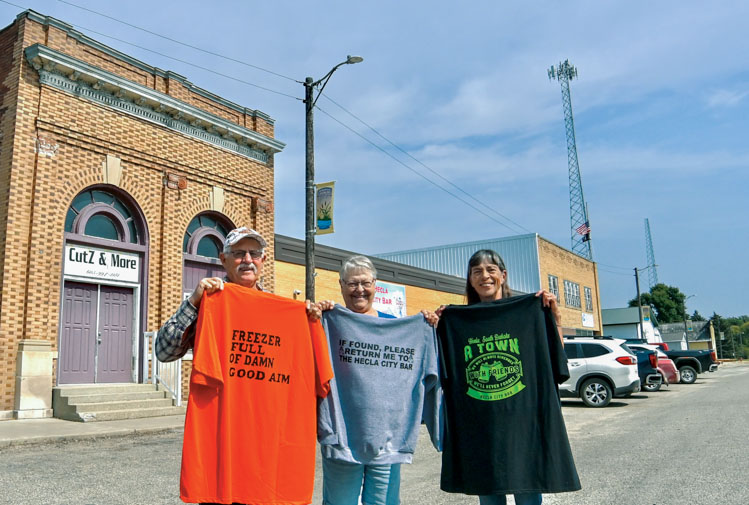
The Hecla City Bar offers a variety of apparel to visitors, as modeled by (from left) Terry and Diana Ulmer and Mary Freudenthal.

Outside influences shape the little town of Hecla, a tradition that dates to the last ice age. These days, a million winged and feathered guests migrate through the lakes and marshes south of town in the spring and fall. Humans follow the ducks and geese, and often find their way to the Hecla City Bar, where they traditionally pin dollar bills to the tiled ceiling and post photos of big fish on a”brag wall” near the door.

Hang around the bar and you eventually get a history lesson of the town. Its name comes from Hekla, Iceland, home to a stratovolcano. January Jones, a Hollywood actress who gained fame as Betty Draper in Mad Men, grew up here in the 1980s. A young couple, the Pioskes, operate an award-winning butcher shop across the street; sometimes on Friday nights they bring over a grill and cook ribs for everyone.

“It’s a pretty friendly town,” says Jess Monsen, who once ran the bar and now serves as the town’s deputy clerk.

Monsen says North Dakota is just 4 miles to the north, which explains the North Dakota State University Bison flags in some yards.”We’re pretty split between the Bison and the SDSU Jackrabbits.”

What about the Coyotes?

“I don’t even know what that is,” she quips. This is north country.

Trailers, tractors and other antique keepsakes decorate the yards of Hecla residents.

Hecla does feel like a town with a culture all its own. Jim Bauer, a woodworker who arrived from North Dakota as a youth in the 1960s, says the town has persevered even as many of its institutions have gone.

“There were 46 in my high school class in 1969,” he says. Today a memorial marker and bell are the only reminders that there was a school, which closed in 2002. Most of the downtown stores have been shuttered (though the butcher shop occupies three connecting buildings) and even some churches have left.

“Our Catholic church has closed,” Bauer says.”If I was rich, I would have bought the building and put up a big screen TV and broadcast the Sunday Mass, but I suppose the bishop wouldn’t have liked that.”

Bauer planned to parlay his woodworking skills into another enterprise for Hecla, but big business blocked him.”I was hoping to become a millionaire making caskets, and I started to build them, but the funeral home industry said I didn’t have enough liability insurance, so I never really got started.”

Weather is also not always friendly. As one of South Dakota’s northernmost communities, Hecla is among our coldest places in winter. Average January lows are barely above zero.

One asset that bishops, business tycoons and even Jack Frost cannot take from Hecla is the 21,498-acre Sand Lake Refuge that stretches for miles south of town. Fed by the James River, which flows down from North Dakota, the marshes and lakes — created when Ice Age glaciers melted 11,000 years ago — are a paradise for migratory birds and wildlife.

Hecla woodworker Jim Bauer keeps a collection of vintage lanterns in his shop at Fourth and Oak, including relics from trains, buckboards, police wagons and military vehicles.

Hunters and anglers, including many from North Dakota and Minnesota, make annual treks to the refuge. Most of the sportsmen stay at local lodges like Ruenz’s Roost or the Flatland Flyways, but others have bought homes and converted them to hunter’s cabins.

Monsen, the deputy clerk, says absentee ownership isn’t as controversial in Hecla as in mountain towns of the Black Hills.”Housing goes in cycles here,” she explains.”At times there isn’t a house to be found, and then a few years later there’ll be lots of homes for sale and not a buyer in sight.”

Refuge officials estimate that more than 75,000 people arrive every year to enjoy the outdoor paradise. They include birdwatchers, hunters and anglers.”There are three or four bridges near town that are the easiest places to fish from,” says Monsen,”and in spring and summer they might all be busy.” Northern and walleye are the prime catches.

Hecla culture today is a blend of farming, fishing and waterfowl. Antique farm machinery and duck/goose signage are common yard dÈcor, along with the Bison signs from that university in nearby North Dakota.

Editor’s Note: This story is revised from the January/February 2025 issue of South Dakota Magazine. To order a copy or to subscribe, call (800) 456-5117.

Posted on Leave a comment

A Home Run for Columbia

Columbia’s ball field and park were the impetus for citywide refurbishments.

Community spirit. Most South Dakota towns have it, but it would be hard to find one with more than Columbia, 19 miles northeast of Aberdeen. That’s largely thanks to philanthropist Dean Buntrock, who has pumped large amounts of enthusiasm into his hometown.

Buntrock, 92, fondly remembers the days in the 1940s and’50s when his father owned the International Harvester dealership and was mayor of Columbia.”He sold everything a farmer could need and I first started working there, if you could call it working,” he chuckled.”After the second World War, a lot of new things developed in farm machinery, so we had lots to sell.” That experience led Buntrock to become a successful businessman and a founder of Waste Management, Inc., a nationwide waste and environmental services company now headquartered in Houston, Texas.

Baseball has been an important part of Columbia for decades and became a focus of Buntrock’s hometown philanthropy.”When we were kids, if you had a bicycle, a baseball glove and a baseball bat, that’s all you needed,” Buntrock says. City councilman Cole Kampa agrees.”Columbia is built around baseball. As kids, that ballpark was the center of everything, even where we went to go fishing.”

Columbia’s ballpark is called Wahl Memorial Field, named for Kermit Wahl, a Major League Baseball player who grew up here. He spent time as an infielder for the Cincinnati Reds, Philadelphia Athletics and St. Louis Browns from 1944 to 1951. He died in Arizona in 1987 and is buried at Columbia’s Lakeview Cemetery.

The ballpark, framed by huge trees along the banks of the James River, was widely regarded as one of the most beautiful places in the region to play. Unfortunately, that picturesque spot also meant flooding during spring seasons when the unruly Jim overflowed its banks.

When approached with an idea for refurbishing the Columbia baseball field, Buntrock offered a donation and assistance, but wanted to do more.”I said the town needs a place to gather for picnics and things like that also,” he says. The project grew to include a relocated ballfield and greatly expanded city park.

Karen Kampa and her husband Tyler have renovated Karen’s Bar and Grill and filled it with antiques and Columbia memorabilia.

He placed good friend Terry Birck in charge of working with the community and told him,”If we’re going to do it, let’s do a good job.” Birck found additional funding sources through the state of South Dakota and, Buntrock says,”It’s quadrupled what I had ever expected.” The Columbia Community Foundation was established and is providing permanent funding for the park and other area charities.

“Dean understood that rural communities don’t have a lot of money,” Birck says.”He didn’t want it to be a Dean Buntrock project though, but a community project. The South Dakota Community Foundation was a great find. With their help this became a Columbia initiative. The gift of the park was the catalyst that got things percolating.”

The monetary gifts have spurred many projects to spruce up this tiny Brown County town. Buildings have been purchased and resold, repurposed and more. Two citywide cleanup days also made homeowners aware of grant programs that could provide things like new siding and roofing.”The cleanup days were so fun because of the connections made,” says Julie Lillis, a member of the Columbia Community Foundation.”It’s so energizing to meet people you’ve waved at, but you didn’t really know.”

Karen and Tyler Kampa reopened the old log cabin bar as Karen’s Bar and Grill in early 2023. Tyler’s love of antiques has filled the place with interesting memorabilia.

Tyler’s mother, Cheryl Kampa, is a longtime daycare provider who many Columbia residents remember as a second mother figure.”Karen’s has become an attraction for at least a 20-mile radius,” she says.

After 43 years Cheryl has turned over the daycare to neighbor Emily Eichler, a transplant who said her first week in Columbia made her feel more at home than anywhere else. She is now also a city council member. Buntrock offered to build a daycare center, but Eichler is happy to be at home.”I’m glad to be able to do my laundry while still at work,” she says.

Emily Eichler runs Columbia’s daycare, which serves the surrounding countryside and other small neighboring communities.

There’s plenty of work for Eichler.”For the size of our town we have a lot of little kids,” she says. Census stats back that up, indicating that Columbia’s median age is 33.2, fairly low for a small community in farm country. The daycare has 17 enrolled children with some coming from Claremont, 18 miles away.

Cole Kampa said the new city park, which encompasses several city blocks, has created the recreational gathering site that Buntrock envisioned.”Kids can walk or ride their bikes to the park without worry.”

In the 1800s, riverboats plied the James River south from Jamestown, North Dakota, with dreams of connecting to Yankton and the Missouri and Mississippi rivers. The dock on the west side of Columbia spurred the building of three grand hotels, Cole Kampa said. The hotels are gone, and the river is no longer deep enough here to support a large boat, but the riverboat era is remembered around town.

Mohr Honey, on the north edge of Columbia, was quickly born when someone suggested to Dana Mohr that he should look at some books about beekeeping.”The first year we had eight pints of honey. We failed miserably,” Mohr laughs.”There is a real, real learning curve.” Fortunately, Mohr and his bees eventually found their rhythm. He and wife Lisa harvested 1,400 gallons from 100 beehives in 2023. Mohr Honey is now sold in 15 retail outlets as far away as Rapid City. The couple donates bottles of honey as prizes for community events and gives educational talks at area schools.

At age 95, Lloyd Dennert is happy to be Columbia’s oldest resident, and his wife Doris is right behind him. When Doris was born in Columbia during the winter of 1932, she and her mother stayed in town for a week until her father came to get them in a horse-drawn sleigh. The Dennerts laughed about Halloween pranks like tipping over outhouses and remembered watching movies projected on the side of a barn in town.

Despite the large donations coming from Buntrock, the United Church of Christ and others, community members have resisted the temptation to spend wildly.”You’re talking about frugal people here,” says Lillis, the community foundation member.”It’s just in our DNA. No one is getting crazy with spending.”

“Dean’s donations have given us resources,” Eichler says.”And it’s laying the foundation for long-term success. It’s been a whirlwind couple of years.”

That community spirit has also created a sense of volunteerism. Community events are on the rise, with last year’s parade being the first since the city’s centennial in 1985.”Dean’s motivation is beyond just the parks, but to improve the quality of life and create a long-lasting pride in the community,” Birck says.

Even with his assistance, Buntrock doesn’t necessarily expect Columbia to boom.”I don’t think they are ever going to be more than a little independent town close to Aberdeen, but more important than the baseball field and park is that we have really brought the town together. It’s in good hands.”

Editor’s Note: This story is revised from the March/April 2024 issue of South Dakota Magazine. To order or to subscribe, call (800) 456-5117.

Posted on Leave a comment

For the Birds

The Sand Lake National Wildlife Refuge in Brown County is among the world’s most important waterfowl habitats.

On a calm summer’s morning at the Sand Lake National Wildlife Refuge, visitors are immersed in the sights and sounds of nature. The sun’s rays peek through early clouds and reflect brightly off the water’s shimmering surface. A light breeze rustles the waist-high grasses. The water moves, but so slowly that it can’t even be heard lapping against the shore. Ducks float among the cattails. A single white gull glides into a cornfield.

This outdoors heaven was in jeopardy a century ago. Wildlife was disappearing as water slowly vanished from the marshland. But thanks to the labor of a future governor, the political skills of a former governor and about 200 men who were glad for any job they could find during the Depression, Sand Lake rejuvenated into one of the most important havens in the world for waterfowl.

The refuge encompasses both Sand and Mud Lake — created by dams built along the James River north of Columbia and northwest of Houghton in Brown County — and the surrounding wetlands. Its 21,498 acres are home to more than 260 bird species, 40 mammal species and a variety of fish, reptiles and amphibians.

Perhaps the best way to observe them is a slow journey along the refuge’s auto tour route, a 15-mile gravel path open generally from April 1 through mid-October, that begins at the visitors center and follows nearly the entire perimeter of Sand Lake. A brochure indicates 12 stops along the way, but traffic was light on the day of our visit so we could stop and go as we pleased.

Almost immediately, we spotted a whitetail deer ambling through the grass. A little farther down the road a white egret stood out against the deep, blue water and tall, green reeds. As the path crossed Houghton Dam, pelicans bobbed near the bridge, sporadically dipping their heads under water in search of fish.

Sand Lake attracts nearly 75,000 visitors each year. Most of them spend just a few hours marveling at its natural wonders. Maybe they imagine what it might be like to live in such a beautiful place, surrounded by diverse flora and fauna. Stephanie Herseth Sandlin doesn’t have to imagine. South Dakota’s former congresswoman and current president of Augustana University in Sioux Falls grew up with Sand Lake in her backyard.

Sand Lake is home to more than 200 species of waterfowl, including a white egret standing among the rushes.

Her great-grandparents, Lars and Oline Herseth, homesteaded on land about 3 miles southwest of Houghton on the east side of Sand Lake in 1886. The home in which Herseth Sandlin grew up was built in 1909 and features a large picture window facing west toward the water. She remembers watching thunderheads build on the horizon and millions of snow geese blanketing the water in white during the spring migration.”The refuge was a very special part of my upbringing,” Herseth Sandlin says.”We usually had Easter at our house because it’s the family homestead. After the Easter meal, everyone would load up in their cars and take a drive through the refuge so we could spot different birds. My grandmother in particular was a bit of a birder, and that was passed along to all of her kids. I think those of us who grew up on the farm took it for granted. Our cousins who came from Pierre and Northfield, Minnesota, maybe didn’t take it for granted quite so much.”

The Sand Lake area that Lars and Oline Herseth knew changed dramatically thanks to their son Ralph, who was born in 1909 — right about the time that people began to take waterfowl depletion on the Northern Plains seriously. The federal government had issued wildlife protections as early as 1864. Fish, sea birds, bison and elk all benefited through the creation of reserves. Migratory birds became the focus with the Migratory Bird Act of 1913 and subsequent Migratory Bird Treaty of 1916, an agreement between the United States and Great Britain (on behalf of Canada) designed to protect birds that crossed the international boundary.

Numbers did recover, but it soon became evident that sustained success could only be achieved through habitat protection. Those efforts occupied Congress for much of the 1920s, beginning with a bill introduced in 1921 that sought to create refuges funded through sales of a $1 migratory bird hunting license. That measure was defeated. Another bill surfaced in 1924 and appeared destined for a similar fate when its primary sponsor lost his bid for re-election.

That’s when Peter Norbeck got involved. South Dakota’s senator and former governor was a noted conservationist who worked to grow Custer State Park. He became the Migratory Bird Conservation Act’s new champion and immediately encountered resistance, primarily from Sen. James Reed of Missouri. Reed objected to the license fee, opposed the bill’s provision to hire additional federal game wardens to enforce its provisions, and sarcastically said that it would make just as much sense to create sanctuaries for jackrabbits.”To Congress, the whole bird conservation matter is a joke,” Norbeck lamented.

Pelicans float in a cove near the Houghton Dam, the earthwork that separates Sand Lake from Mud Lake.

Norbeck lost that round, but he returned with another bill in 1927. It retained the $1 federal hunting license, which Norbeck believed would generate $1 million annually for land purchases and law enforcement, and the creation of public hunting grounds adjacent to the refuges. Senators fought, but Norbeck ultimately succeeded in passing a somewhat weakened version of the bill. The steady revenue source had been replaced by an annual congressional appropriation, which came in fits and starts. Lawmakers approved just half the money Norbeck sought over the next four years. Still, the Migratory Bird Conservation Act led to the creation of 22 refuges encompassing more than 1 million acres by 1933.

In South Dakota, experts pointed to marshy Sand Lake as an ideal location. Families, including the Herseths, donated land to help make the refuge a reality. And who better to lead the effort than the young man who grew up on its eastern shore?

Ralph Herseth was the 26-year-old supervisor of the Sand Lake Civilian Conservation Corps camp. When Sand Lake was officially added to the national refuge system in 1935, he and his 200 men got to work building dams, digging ditches and planting the uplands to provide food and cover. They moved 120,000 cubic yards of dirt to build eight islands and planted thousands of trees and shrubs. The men also constructed a 108-foot-tall steel observation tower that visitors can still climb. It provides a beautiful, panoramic view of the refuge, though the ascent is not for everyone.”You look around and it’s a nice view, but if it’s a windy day there’s something about being up there and feeling it sway,” Herseth Sandlin says.”We took my husband out there when we were dating, the first time he came to visit the farm. I don’t know that he wanted to stay up there too long, and he hasn’t asked to go back up.”

South Dakota ultimately became home to six national wildlife refuges, all managed by the U.S. Fish and Wildlife Service: Sand Lake, Waubay, Karl Mundt, Lake Andes, Lacreek and Bear Butte (managed as part of Lacreek). Each refuge boasts its own claim to wildlife fame. Bald eagles draw visitors to the Mundt Refuge along the Missouri River, trumpeter swans spend part of the year at Lacreek near Martin, and Sand Lake is home to the world’s largest breeding colony of Franklin’s gulls. Sand Lake has been designated a Globally Important Birding Area and was recognized by the American Bird Conservancy as one of the top 15 birding sites in North America.

After Sand Lake’s completion, the Herseth family enjoyed its benefits. Ralph and his wife, Lorna, hosted family and friends for hunting excursions on their land adjoining the refuge. A lifelong advocate of natural resources, Ralph Herseth brought those principles to Pierre when he served as governor from 1959 to 1961. Among his achievements was passage of the South Dakota Conservancy Law, the first step in the proposed Oahe Irrigation Project, because, he noted,”water was more precious than oil.”

Hands-on exhibits inside the Sand Lake visitors center help children learn about its variety of wildlife.

Meanwhile, Sand Lake became a playground for Herseth children. Herseth Sandlin and her brother often explored the refuge on foot or by three-wheeler. One winter, her father, Lars, bought a contraption that resembled a sailboat on ice skates that the family used to glide across the frozen pond.

It also offered early lessons in profits and losses. When Herseth Sandlin was 9, her father suggested she raise pheasants. The refuge offered $1 for every chick raised to maturity, banded and released within its borders. She began with 100 chicks, but barn cats took around 30 of them.

She tried again the next year, this time with 200 chicks. She built sturdy chicken wire fencing and eventually had nearly 200 fully healthy ringneck pheasants.”I banded them, put them out in the refuge and two days later we had the 1981 hail storm, and I’m not sure any of them survived,” she says.”But I still got my payment.”

If you’re traveling Highway 10, consider veering off at Sand Lake and spending an hour or two among the solitude. Let the grasses sway around you. Listen for the distinct song of meadowlarks. Look for the bright blue bills of ruddy ducks or the red faces and white rings of pheasants (maybe the Augie president’s birds weren’t doomed). All in all, Sand Lake provides a welcome respite for man and bird alike.

Editor’s Note: This story is revised from the May/June 2019 issue of South Dakota Magazine. To order a copy or to subscribe, call (800) 456-5117.

Posted on Leave a comment

Glacial Lakes in Winter


South Dakota’s Glacial Lakes country
is perfect for day trips this winter. More than a hundred lakes — plus sloughs, wetlands, ponds and rivers — combine to create a scenic and unspoiled countryside rich with wildlife and waterfowl, friendly farm towns and numerous opportunities to enjoy nature.

Melting glaciers shaped this prairie pothole country 20,000 years ago. The lakes are so numerous that some remain unnamed. Most have grown in size and depth over the last 25 years. Bitter Lake, once little more than a shallow slough, is now the state’s largest natural lake; it is encroaching on Waubay Lake and other bodies of water to create an ocean-less, inland sea.

In this winter of the pandemic, we are all looking for new outdoor sights and experiences. Winter serenity and solitude has always been a trademark of the unspoiled Glacial Lakes region.

Here are 10 suggestions, organized by county, on how you might explore the Glacial Lakes. Some are auto drives, others offer winter hikes that could be compromised by the amount of snow on the ground. However, this list only scratches the surface so don’t hesitate to roam the lake country. You’ll discover many surprises, and they’ll all be good.

BROOKINGS COUNTY — The 135-acre Dakota Nature Park (at the corner of 22nd Avenue and 32nd Street South) lies in the southeastern corner of Brookings. Gravel mining led to formation of ponds and wetlands, and a restored prairie now grows atop the old landfill mound. A portion of the Allyn Frerichs Trail System — named for the city’s longtime parks and rec director who passed away in 2014 — skirts the north edge of the park, while a network of paths weave around the wetlands, prairies and trees.

BROWN COUNTY — Take a trip to Sand Lake National Wildlife Refuge. Though the classic 15-mile auto tour is closed in winter due to hunting and snow conditions, other roads remain open on the perimeter of the refuge. Explore the gravel roads that lead north and south from Highway 10. The snow geese are gone, but you’ll see other waterfowl, eagles and the Arctic’s snowy owls. Deer, pheasant and coyotes are also common. Sand Lake rose from the dust of the Great Depression to become one of the world’s most important wildlife sanctuaries. It is 30 miles northeast of Aberdeen.

CODINGTON COUNTY — Just southwest of Watertown is Pelican Lake. An observation tower near an inlet on the lake’s south side provides a sweeping view of the water, its namesake birds, the prairie and Watertown’s skyline. The Observation Tower Trail is a three-quarters of a mile hike through the woods and winter grasses. A longer jaunt, the Pelican Prairie Trail, gently meanders 5.2 miles.

DAY COUNTY– Explore the trails of Waubay National Wildlife Refuge, situated in the very heart of the Prairie Pothole landscape. Scientists say the region produces 50 percent of the continent’s waterfowl. Trails range from a few hundred feet to a mile, and jaunt around an island that houses the refuge headquarters. However, the public facilities are closed in winter.

DEUEL COUNTY — Visit 12-acre Ulven Park, which occupies a point on the eastern shore of Clear Lake. The frogs and toads, noisy in summer, are now hibernating so they’ll not interrupt the serenity of the park’s half-mile hiking trail.

EDMUNDS COUNTY — Shake Maza Trail at Mina Lake (between Ipswich and Aberdeen) is a short walk that explores the flora, fauna and other features at one of the first man-made lakes in northeast South Dakota. Shake Maza is a Native term meaning”shaped like a horseshoe,” which describes the 850-acre lake, ringed by picturesque cabins and homes.

GRANT COUNTY — This fascinating region is one of the USA’s five continental divides. Lake Traverse flows west to the Hudson Bay and Big Stone Lake flows south to the Mississippi and the Gulf of Mexico. Some of the best winter trails are at Hartford Beach State Park — a tree-filled, rocky shoreline north of Milbank that is quite unlike anything else in the Glacial Lakes. Signage in the park will direct you to several easy trails.

HAND COUNTY — Hike the Pheasant Run Trail at Lake Louise, 14 miles northwest of Miller. Beginning at the trailhead in the main campground, the dirt and grass trail meanders 3.2 miles around the south side of Lake Louise, which was created by damming the south fork of Wolf Creek in 1932. More than three dozen informational plaques identify trees and plants found along the way, though leaf identification will be challenging in December and January.

LAKE COUNTY — Wander the trails of Lake Herman State Park, which occupies a peninsula on the east side of Lake Herman, just west of Madison. A cabin built by pioneer Herman Luce in about 1870 stands along the 1.25-mile Luce Adventure Trail, which encircles Herman Pond. Connecting trails include the Abbott Trail (1.1 miles) and the Pioneer Nature Trail (.4 miles). All are easy walking.

MOODY COUNTY — Much of the prairie pothole region drains into the Big Sioux River, and the waterway starts to change its personality as it reaches Flandreau and Dell Rapids. Hike Red Rock Trail in Dell Rapids, where you can enjoy a closeup view of the famous rose quartzite that underlies the region.

Posted on Leave a comment

South Dakota’s Sledding Hills

Local youth take to their sleds at Yankton’s Morgen Park. Photo by Bernie Hunhoff.

South Dakota’s reputation for geographic diversity holds true when it comes to snow sledding. Some of our eastern cities are too flat, and the slopes in some of our mountain towns are too rugged, steep and rocky.

In Aberdeen, where the terrain has been described as”flat as a barn door,” city leaders manufactured a 25′ hill so kids could enjoy winter. However, we discovered that most communities have a natural hill that becomes a hot spot when it snows.

Pack your sleds as you travel this winter because there are plenty of hills to explore. Most of the snow hills are unsupervised, so adults should be ready to act if they see something dangerous — a heavy toboggan sled, for example, that could carom out of control and hurt someone, or a motorized vehicle on the slopes. Sledding has long been a favorite winter tradition, even for our flatland friends. Let’s keep it alive.

Here’s our list of city slopes. Tell us what we’re missing. We’d also like to know where to find the closest and richest hot chocolate after a day on the slopes.

ABERDEEN — God created most of South Dakota’s hills and mountains, but man assisted with the modest slope in Baird Park (1715 24th Avenue NE), the most popular sledding spot in the Hub City. City officials created the gentle 25-foot just for kids.

BELLE FOURCHE — Slopes behind the Tri-State Museum (415 5th Avenue) are a favorite, though they may be too fast for younger kids and there is a walking path at the foot of the hill so watch for pedestrians.

CUSTER — Pageant Hill has been touted as one of the finest family sledding spots in the Black Hills. It may be too steep and long for younger kids, but you don’t have to descend from the very top. The hill is the summit of beautiful Big Rock Park, which also includes hiking trails and a disc golf course. It rises above the city’s south side.

HOT SPRINGS — Southern Hills Golf Course (1130 Clubhouse Drive) is fun and scenic.

HURON — Toboggan Hill (6th Street & Lawnridge Avenue), aka Slide Hill, is a bluff above the Jim River valley on Huron’s east side.

LEMMON — The ever-resourceful people of Lemmon discovered years ago that it was less expensive to build a small hill for their new water storage rather than just build a taller tower. Then someone got the great idea or also making it into a sledding slope with a warming shack. Tank Hill is quite easy to spot on the city’s west side. Many years ago, when the water tower developed a leak during a cold spell, kids were able to slide on the ice flow all the way downtown.

PIERRE — The slopes above the soccer fields in Hilger’s Gulch are popular. The gulch is a scenic valley just north of the State Capitol building.

RAPID CITY — Meadowbrook School Hill (3125 W. Flormann Street) is a good spot, as well as the Civic Center hill that rises above the Holiday Inn Rushmore Plaza parking lot downtown.

SIOUX FALLS — Tuthill Park in southeast Sioux Falls is the site of weddings and parties in the summer months, but when the snow falls it becomes the domain of well-bundled children with sleds. Spellerberg Park (2299 W. 22nd Street), closer to the city center, also has a fair slope. Great Bear Ski Valley welcomes snow tubers, who get to ride the ski lifts.

SPEARFISH — Hills behind the Donald E. Young Center on the Black Hills State University campus are fast and fun.

STURGIS — Lions Club Park (off Lazelle Street) is a good place for younger kids, and Strong Field Hill on Ballpark Road is fun for older youth.

WATERTOWN — St. Ann’s Hill, a sledder’s delight, is so named because St. Ann’s was the original name of the nearby Prairie Lakes Hospital. Take Highway 20 to 10th Avenue and turn uphill.

WESSINGTON SPRINGS — It’s worth a drive to experience Ski Hill on the west edge of Wessington Springs. The natural setting in the Wessington Hills is idyllic, but the real attraction is an old, homemade invention with an electric motor that powers a 1,200-foot rope lift. Jokingly called the”Rube Goldberg ski lift,” the simple equipment has been lovingly cared for by handy volunteers, including Lloyd Marken, 85, who helped to build it in 1956.

YANKTON — Morgen Park (1200 Green Street) is the go-to sledding hill in town, however kids also like to slide down the earthen slope of Gavins Point Dam, where it rises above Pierson Ranch Recreation Area west of Yankton.

Posted on Leave a comment

Oddities and Fun

“I see nothing in space as promising as the view from a Ferris wheel,” wrote children’s author E.B. White. Colorful games and rides, people of all ages spending time together, laughing, eating, chatting with neighbors. Fairs are exhibits of our culture at its finest.

Late summer gatherings date back to the early years of our United States. Eventually the fairs evolved and became more elaborate. But they’ve always symbolized a last hurrah before school begins and winter comes.

One of our favorites is the Turner County Fair in Parker (Aug. 15-18). This year the fair turns 136, making it the oldest in South Dakota. Once inside the gates (free admission, by the way) you’ll find a fun little pioneer town to tour known as Heritage Park. It has a general store, church, school and millinery. Each is furnished with antiques and open to the public. Outside you’ll find a shaded stage which hosts non-stop music and entertainment throughout the four-day spectacle. If you’re wondering about food, you’re in for a treat. Local beef and pork producers run dueling booths that garner long lines at dinner, but another popular choice is a chislic booth organized by sheep farmer Bill Aeschlimann and some friends way back in 1983. Turner and Hutchinson counties are known as the home of chislic — a Russian tradition of beef, lamb or pork seasoned and grilled over an open fire. (Or, here in America, deep fat fried as we also do with Oreos and cupcakes.)

Other fairs are known for fun and games. The Potter County Fair (Aug. 6-9) in Gettysburg features Cow Patty Bingo. An open patch of grass at the fairgrounds is divided into squares, each of which is for sale. Once the squares are sold, a cow is turned loose on the grass. The owner of the square where the cow first leaves her mark wins the jackpot.

In Aberdeen, at the Brown County Fair (Aug. 15-21), a fair staffer goes out early every morning to hide a stuffed monkey named Casey. The first kid to find Casey wins carnival tickets or another fair prize.

Visit the Corson County Fair in McIntosh (Aug. 12-14) to view turtle races — prizes go to both the fastest and slowest racers. Here’s a hint: painted turtles are faster than mud turtles, in case you didn’t know. Here’s another hint: snapping turtles can be dangerous.

Food competitions are popular attractions at our local fairs. Often attendees get to taste the results. The Custer County Fair (Aug. 11-14) in Hermosa features an ice cream crank-off. Power models are forbidden, guaranteeing an old-fashioned experience for kids who have never had an opportunity to make their own. A chili cook-off is one of the highlights of the Sully County Fair (Aug. 11-14) in Onida. The public can sample all the chili they can eat after the contest, for only $5.

Fairs are a fine way to celebrate our communities, but the food, games and exhibits aren’t as meaningful if people don’t show up to enjoy them. We hope you take the time to visit one of the dozens of fairs in South Dakota this summer.

Posted on Leave a comment

South Dakota’s Little Finland

Small town citizens bleed time and money to keep their communities alive. South Dakota’s best example might be Frederick (pop. 250), one of our northernmost cities. Farmers can still buy and sell corn in town. Neighbors share cups of coffee, stock up on groceries, dine on authentic Mexican specialties and meet for beers — but only because Frederick residents showed their stubborn Scandinavian streak when faced with adversity.

Teresa and Scott Campbell are fifth generation bankers in Frederick, a Brown County town where history and traditions are becoming a routine part of community life and economic development.

The stubbornness started in the mid 1980s when the grocery store was about to close. Several dozen people pooled their money and bought the store; then they elected a board of seven to oversee the place. The Community Store now grosses $250,000 a year and has become the town’s daytime hub. Men meet there for coffee even before the lights come on.

“We don’t open until 8, but I’m usually here early so I just leave the front door open, and there might be a dozen guys here by 7:30,” says Jim Ulmer, the store manager.”They don’t always stay long unless it’s raining, and then they’ll hang around until 10.” Women gather for coffee at 10:30, and depending on the weather the men might reconvene in the late afternoon from 4:30 to 6.

Frederick’s farmers did the same a decade later when South Dakota Wheatgrowers Cooperative no longer wanted to operate the old, wood-frame grain elevator on the west side of town. Several dozen farmers pooled their resources to keep it open as a place to trade grain and purchase livestock feed. Since then, they’ve added a million bushels of grain storage and a modern truck loading system.

Another potential setback came in the late 1990s when Frederick’s restaurant and bar burned to the ground, leaving citizens without an all-important watering hole (the town hosts a wife-carrying race every June, so perhaps a drinking establishment is essential for the victory celebration). A group of people raised money and built a new building owned by the Frederick Development Corporation. Nicholas White and his sister, Bonnie, lease the bar, opening at 3 every afternoon. The Whites hired Marco Rangel, a Hispanic chef who treats the town to Mexican specialties made from scratch on Friday nights.

Brown County is a wildlife paradise, and an opportune setting for taxidermists Mark Wooledge (left) and Lance Burns. Their shop is on Frederick’s main street.

A belief in collective ownership (some might call it modified socialism) may be engrained in the genes of many residents who date their ancestry to Finns who settled northern Brown County at the suggestion of a railroad official in the 1880s. Many of the settlers came from the forested province of Savo in Finland, and today some of their descendants still live and farm in Savo Township, and worship Sunday mornings at Savo Lutheran Church.

Others rest in the North and South Savo cemeteries. Their memory is honored every June with a Finn Fest that includes the aforementioned wife-carrying competition and a boot-throwing contest. World championships for those events are held in small farming towns in Savo province, which is not far from the Arctic Circle.

Frederick’s locale — 26 miles north of Aberdeen along Highway 281, just shy of the North Dakota border — is tropical by comparison. Only 250 people live within the city limits, but the town’s high school keeps rural families involved for miles around. The school, a handsome old brick structure at the east end of Main Street, educates about 200 students in 12 grades.

Main Street also has businesses that survive without collective ownership, most notably First National Bank, run by the Campbell family since 1914. Scott Campbell swept floors there as a teen, and eventually was promoted to teller. Today he is the fifth-generation bank president, making loans in the same stone building where his great-grandfather worked. Pictures of First National’s past presidents are framed on the east wall. Banking may be more profitable in other places, but Scott and his wife, Teresa, a former teacher who also works in the bank, say Frederick is where they want to be.

“I grew up here, I like the small-town atmosphere and I love dealing with the customers,” said Scott.

“And you love to hunt and fish,” said Teresa with a grin.

Frederick noted its 125th year in 2007 by starting a museum in an old saloon and by building a sod house.

Pheasant, waterfowl and deer are everywhere in Brown County, which is home to the sprawling 21,000-acre Sand Lake National Wildlife Refuge. The maze of lakes, cattails, grasslands and trees has 266 species of birds and is considered one of America’s best bird-watching sites.

The area’s bounty of wildlife helps to account for another Frederick business, Lone Wolf Tanning & Burns Taxidermy, just up the street from the bank. Lance Burns and Mark Wooledge practice their art under the stolid eyes of whitetail, walleye and other critters.”We’ll do close to a hundred deer this year,” Burns said,”along with 20 buffalo heads. And we’ll tan a lot of buffalo hide and do a lot of fish.” One of their next projects is a nine-foot grizzly shot in Alaska by a North Dakota outfitter.

Frederick hadn’t had a gas station for several years, so you can imagine the enthusiasm when Jim Dumire re-opened the old Coop Service Station a year ago. But the town is getting much more than unleaded gas and free air. Dumire and his wife, Kay, returned to their hometown with a wealth of ideas and enthusiasm.

The Dumires, lifelong historians and collectors, located an antique store in the station’s repair shop, and soon will open an old-time ice cream parlor near the curved-glass window in the lobby.”The place wasn’t all that bad,” Jim said.”It just needed some TLC.”

They are also active in the museum, located down the street from the station.”We have two schoolhouses to move there to refurbish,” Jim says.”A bunch of us are trying to resurrect Main Street. That’s what we’re doing. We’ve got a half-dozen younger folks who are really energetic and some old-timers like me. It takes all kinds to make things work.”

Dumire apologized for being hard to find on the day we visited town. He was attending a grant-writing seminar in Fargo, hoping to learn tricks on how to raise money for the museum and other town projects.”We’d also like to fix the old city auditorium,” he says. The roof caved in on the grand, concrete structure a few years ago, and it now sits vacant.

One of Frederick’s alleys is beautifully landscaped thanks to Mel Glarum.

But the rear of the auditorium is attractive, thanks to 88-year-old Mel Glarum. She came to town in 1945 with her husband to run the pharmacy, which was just east of the auditorium. The Glarums lived in an apartment in the back, and that’s where we met Mel — tending to flowers and bushes in the back alley. Her landscaping extends to the back of the auditorium as well as to another century-old building to the west. The blend of greenery, flowers and old architecture give Mel’s back alley a European flavor. You get the feeling that if she were a few years younger she’d extend the look on down the street.”I guess I could move anywhere if I wanted to,” she said. Her three daughters have all left the state.”But the town is quite special to me.”

The pharmacy closed when her husband died in the 1960s. Today a community library is located in her building. A post office, senior center and the museum are other notable stops on Main Street, plus a 1916 jailhouse, once featured in Smithsonian magazine, that still seems sturdy enough for one-night sentences.

The senior center hosts pancake breakfasts every Saturday morning during hunting season as a fundraiser for Finn Fest. Volunteers fry traditional pancakes, and they also bake platter-size Finnish pancakes topped with syrups made from local berries.

The museum is a new organization fittingly housed in one of the town’s most historic structures, a social hall where Masons met and school events were held. Later it became a saloon. Near the museum is a new sod house, built in 2007 as a project for the town’s 125th birthday party, which was the genesis for today’s Finn Fest.

Midsummer celebrations were held years ago at Savo Hall, northeast of town. Services at Savo Church across the road were still spoken in Finnish in the 1940s and 1950s. Today’s members pray and sing in English, but many can still speak their ancestors’ language, and several families keep in contact with their overseas cousins.

Germans settled on the farms north of Frederick. Norwegians and Swedes also helped start the town. But they all join gaily in the new Finn Fest, and much of the fun centers around the boot-throwing and wife-carrying contests. Quite specific rules are established for both competitions. Boots must be thrown underhanded, for example. And while the wife-carrying contest doesn’t require a marriage certificate or even a ring, the female does have to weigh at least 108 pounds. And it’s not a simple race: the”wife” must be carried 780 feet, past water hazards, logs, bushes, low-hanging branches and other obstacles.

The festival also features a juhannuskokko, or midsummer bonfire, an observance that dates to pre-Christian times in Finland when evil spirits were warded off by bonfires on the lakes. Frederick residents try their best to authenticate the event. Dale Groop, a local farmer and jack-of-all-trades, builds a raft that is floated onto the Maple River in Simmons Park. Finn Fest leaders hoped to light the structure with a flaming arrow shot from shore, but that proved to be harder than it looks in old Viking movies. One of the festival promoters learned that sparklers tied to a tampon stay lit in the air, but that hardly sounds like a real Finnish solution. For now, Groop rows out in a canoe and ignites the ceremonial raft with a barbecue lighter.

Some ways are better in the New Country.

Editor’s Note: This story is revised from the November/December 2010 issue of South Dakota Magazine. To order a copy or to subscribe, call (800) 456-5117.

Posted on Leave a comment

Music Man

Composer and Aberdeen native John Cacavas died Tuesday, Jan. 28 at his home in Beverly Hills, Calif., at age 83. During his long career in Hollywood, Cacavas scored more than 400 one-hour TV shows (including Kojak and Hawaii Five-O), 50 television movies and 15 feature films, but he got his start in the Hub City. He is survived by his wife Bonnie, also an Aberdeen native, and three daughters.

A memorial service was held in California, but local donations for the John Cacavas Memorial may be made in his honor to the Aberdeen Public School Foundation, 1224 Third St., Aberdeen, SD 57401.

In 2003, Cacavas wrote a short memoir for South Dakota Magazine. Here is his story in his own words.

MUSIC. THAT’S WHAT I DO. Compose, orchestrate, conduct and produce it. All kinds. It all began in Aberdeen in the early’40s. My hometown was musically rich with junior and high school bands, orchestras and choirs, plus the various musical organizations from Northern State College. There was a civic orchestra, a municipal band, a Shriner’s Band and about seven dance orchestras, not to mention church choirs, concerts from visiting organizations and artists and private music lessons galore.

The first phase of my musical career was a disaster. Like a lot of 11-year-olds, I took piano lessons on Saturday mornings. I was so ungifted on the keyboard that I flunked my first year and had to go to summer piano school. Regular summer school, OK, but summer piano school? It was very embarrassing, not only to me, but also to my folks. They thought maybe they were raising a real dummy. After all, there was some talent in my family. My mom played piano by ear (black keys only), and my dad was a great dancer, performing Greek dances and jitterbug routines.

When they told me I didn’t have to take lessons any more, I was relieved. Now I could play baseball with Bob Keeler’s South Side team.

But one Sunday afternoon when I was 13, my life changed forever. I went to the Capital Theater and saw a movie called”Stage Door Canteen.” Many of the nation’s big-name bands were in it — Benny Goodman, Count Basie, Guy Lombardo and others. I immediately decided that I wanted to be a saxophone player. My dad, citing my failure as a pianist, was not excited about participating in another fleeting interest. But eventually, with great reluctance, he bought me a used alto sax at Gallet’s jewelry store on south Main.

I taught myself to play the sax, and a couple of months later, as a seventh-grader at Simmons, I joined the junior high band. I had found my dream.

A year later I started my own six-piece band, and played my first professional engagement. Where? At the Moccasin recreation center for my own 14th birthday party. My mom hired me. I think my folks paid us $5 each. We knew only six songs, but it was a start.

When I was a sophomore at Central High, I had a falling out with the school’s band director. He did not approve of my being a professional, so I left the high school band. Even though I had started and was leading a terrific 16-member school dance band,”The Golden Blues,” it was not a hard decision.

We had 11 players in my new band, and we were not too bad. Life on the road appealed to me more than playing and freezing at high school football games. Besides, now I was getting paid to play. My parents backed me all the way. They bought me musical arrangements, a public address system, music stands and spotlights. Even a car and trailer.

I gradually began making musical arrangements for my band. My first efforts were not so hot, but gradually I became more proficient at the art.

While still in junior high, I had worked at our family restaurant, The Virginian, on south Main. I worked as a waiter — and later as a chef — from 7 a.m. to 2 p.m. on weekends and seven days a week during vacations. For that I got $11 a week.

One day I got a call from a local bandleader, Bill Klitz. He had an 11-piece band with a four-man sax section, and one of his sax players was ill. Could I take his place? You bet! The job was at Tacoma Park, a few miles northeast of Aberdeen. They picked me up, I played the job and I was a big hit. They even let me play a few jazz solos!

Afterwards the musicians lined up for their pay. For playing three hours and having the best time of my life, I got $14! I got home about 2 a.m. and woke my parents. I told them about my evening with the band and how much I’d been paid. My dad looked at me for a moment, and said,”I think it’s time for you to leave the restaurant business.” And I did.

My band played all the local venues, the Roof Garden (no longer there), private parties at the Alonzo Ward Hotel, the Country Club and Wylie Park, even in towns up to 200 miles away.

After high school I attended Northern State College for two years. My band prospered, and we grew in demand. I then transferred to Northwestern University in Evanston, Ill., where I began writing songs for campus shows, and my life-long passion for serious music flowered.

From there I got drafted and became a music arranger for the United States Army Band in Washington, D.C. It was a great time, and I learned an awful lot. There were a few South Dakota guys in the band, and we had mini-South Dakota reunions with some fellows in a nearby Air Force Band.

After my discharge I moved to New York. I had succeeded in getting some of my works published, so I felt I was on my way. I pounded pavements, wrote jingles and songs and became a freelancer for many publishers. My first song to connect,”Over and Over,” was recorded by Guy Lombardo. He played it on the”Ed Sullivan Show.”

By this time I realized there were thousands of sax players, but not many arrangers and composers. I decided that a wonderful phase of my life was over. I sold my sax one month to pay the rent.

In New York I continued to get my school music published, did a lot of arranging and even became the second conductor at CBS, a great step upwards.

During this time I was courting an Aberdeen girl, Bonnie Becker, whose parents owned the Harbor Cafe in Aberdeen. After much persuasion, cajoling and threats, she married me. As a psychiatric social worker, she had the regular job and I was the freelancer who also did the cooking. It was a great arrangement, and one of the smartest moves of my life. After 44 years together and three wonderful kids, that ain’t bad!

Bonnie went on to become a lyric writer. After all, why not keep it in the family? After our daughters were grown, they too wrote many lyrics for publication. Bonnie also began writing cookbooks, and for the last few years has been a crisis response counselor.

After visiting another Aberdeen lad, Charles Buttz and his wife Terri, in Darien, Conn., one weekend, we decided to move there. It was a small New England town and looked like a fine place to bring up kids. I became director of publications and later acting manager of Chappell & Co., Inc., then and probably now the world’s largest music publishing house. That position and a short tenure at Bourn Music as an arranger were the only full-time jobs I ever had. Not counting my career in The Virginian, of course.

We went to London to record my first album, which turned into a love affair with that city for Bonnie and me. I still do a lot of recording in London, so we have an apartment in the city and manage to spend about three months there each year.

In 1973, Hollywood called, and we’ve been here ever since. During those three decades, I scored hundreds of movies, TV shows and albums.

I don’t think any of this good fortune would have happened without my upbringing in South Dakota. I learned real values and had the opportunity to pursue my musical dream. It was a happy and golden time.

Editor’s Note: This story is revised from the March/April 2003 issue of South Dakota Magazine. To order a copy or to subscribe, call 800-456-5117.

Posted on Leave a comment

Our Hub City

Aberdeen earned the nickname Hub City in 1911 because four major railroads operated there. The old train depot at Main Street and Railroad Avenue still houses Burlington Northern Santa Fe Railway, but art, shopping, and health care now make up some of the spokes on Aberdeen’s hub.

My husband and I visited last November so I could attend a yoga workshop. We mainly explored downtown. First stop was Natural Abundance, the community food co-op in a corner shop on Main.”The co-op started as a private buying club in 1978 as a way to meet individuals needs for organic, whole and bulk foods,” says Lara Nelson, general manager.”Over the years it has evolved to be a full retail business.” The store has quite a variety of items — organic produce, grass-fed beef, supplements, health and beauty products are just a few. Thankfully for me, you don’t have to be a co-op member to shop there. I grabbed a kombucha and some bananas then headed to the yoga studio.

Lean Body Barre hosts a variety of hot yoga classes in what was once the Ward-Owsley candy factory.”It must have been pretty popular, because railroad tracks lead parallel to the building so that train cars could be filled,” says Candace Briscoe, building and studio owner. The doors that were used to load trains are now business entrances. Briscoe’s toxin free and organic skin care business has been there since 2004 and her yoga studio opened last fall.”I loved the detoxification aspect of hot yoga,” Briscoe says.”Although it seems as if the hot yoga business was intentionally placed because of its benefit to my other business, it wasn’t until a couple months after the studio opened that I realized the two businesses had so much in common.”

I had fun checking out Briscoe’s shop, sweating and learning with the guest teacher who taught the workshop. After a shower, my husband and I dined at Roma Ristorante Italiano. It’s located on the ground floor of the Ward Plaza, formerly Alonzo Ward Hotel. Raffi Ismaili and Tony Avdiu, half-Albanian and half-Italian cousins, opened the restaurant last February. Ismaili had been in the restaurant business for over 25 years, with restaurants in the Dallas/Fort Worth area, when Avdiu invited him to South Dakota. (Avdiu is also part owner of The Italian Garden in Brookings.) Roma offers a large selection of pasta, chicken, veal and seafood dishes. I tried the spaghetti marinara and my husband had cheese ravioli. Good food, inviting Italian dÈcor and the servers were so attentive. Our water glasses were never empty.

We explored the Ward Plaza a bit after we ate. Alonzo Ward built the hotel in 1894. Fire destroyed it in 1926, but in 1928 he built again. Blackstone Developers renovated the building in 2004 and 90 of the hotel rooms were converted into 15 luxury condominiums. The original dark woodwork in the lobby and the chandelier in the Crystal Ballroom were fully restored. Ward Plaza houses two event spaces, The Ward Plaza Bar and Grill, Karisma Boutique, and Labyrinth Films. Seven hotel rooms remain, but they’ll be remodeled into apartments later this spring.

Our next day’s lunch was at Red Rooster Coffee House, owned by siblings Dan Cleberg and Kileen Cleberg Limvere. They have a variety of sandwiches, soups and salads. We opted for the veggie burger, hummus sandwich and, of course, coffee. It was fun to relax in their mismatched, retro furniture and peruse local art on their yellow and orange walls. The Klebergs have been great leaders in Aberdeen’s cultural community by providing gallery space and hosting regular musical performances. They also sell used books and fair trade gifts like jewelry and scarves.

Last stop on our trip was the Dacotah Prairie Museum. We especially liked the Dakota Central Telephone Company and Western Union exhibit, with its realistic looking mannequins. The Lamont Gallery upstairs was a real treat, too. It features the work of local and regional artists, with six shows each year. We admired photos by Michaela Glugla then headed home, happy having explored some of Aberdeen’s great places!

Posted on Leave a comment

Snow Blankets Hecla

Jan Siemucha shared these wintery photos from rural Hecla. “Most of my photos are shot around the Hecla area when I am out with my dog, Sadie,” Siemucha says. “We both enjoy the outdoors. It gives the two of us some quiet time, taking in the beauty of what natures provides for us to see each and every day. Sadie just turned 13 and is heading for 14, so our time out in the country is very special.” Siemucha is retired and enjoys photography as a hobby.