Posted on Leave a comment

Beautiful Delusions of Autumn

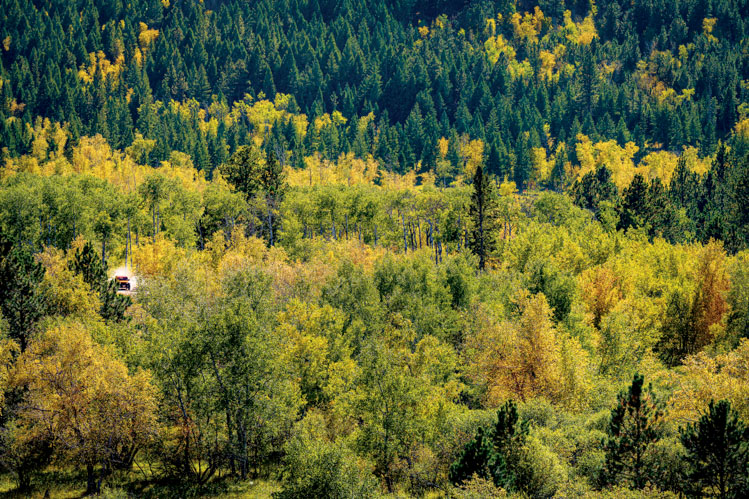
Drivers experience an autumn smorgasbord along Palmer Creek Road, which winds through thick aspen forests and broad meadows.

A SOLITARY COTTONWOOD tree on the lonesome prairie, when bejeweled with golden yellow leaves, emanates as much beauty as the human eye can absorb — especially when the sun slips southward, leaving the September sky bluer than blue.

Yet, who looks for a single tree in autumn? We tell ourselves we must see mountains and hillsides and river valleys with their forests full of leaves, each one hanging precariously by a stem, fluttering unworriedly as if winter was a thousand years away.

So yes, of course, go forth this autumn and fool yourself into believing that this glittering season is not just a cruel trick of chlorophyll. Life will always be so good. Calamity can never follow such serenity. South Dakota is paradise eternal.

Certain places in our big state are especially guilty of contributing to the delusions of autumn, beautiful though they may be. Traffic jams can occur on Highway 14 in Spearfish Canyon during peak leaf-peeking days. Sica Hollow’s oaks are almost as beguiling for people who live in the northeast. Our urban forests are resplendent in different ways because city parks and boulevards feature a gloriously unnatural mix of planned and planted trees. The McKennan Park neighborhood in Sioux Falls is an exceptional example.

We asked our chief photographer, Chad Coppess, if he knew of some lesser-known fall foliage tours. He suggested the three that follow. Interestingly, one that he chose is at South Dakota’s very lowest elevation while another is near the highest. Chad’s diplomatic third choice lies in between, along the Missouri River.

These routes won’t have bumper-to-bumper traffic in September and October when our leaves change color, but that is part of their allure. Autumn is even more striking when you escape the crowds.


PALMER CREEK

Pennington County

The graveled Palmer Creek Road is less than 4 miles long yet offers more than its weight in gold leaves between two spectacularly located campground resorts. Horse Thief Campground and Resort lies on the southwest end of the road and the Mount Rushmore KOA at Palmer Gulch Resort on the northeast. Both campgrounds have funky little stores that offer snacks and refreshments.

Midway along the road, an engineer had some fun by designing a double crisscrossing section with an over-under bridge and a cut through a rock that delivers a jaw-dropping view of Black Elk Peak no matter which way you are traveling. The road winds through beautiful aspen groves and, at times, offers a panoramic view of the entire gulch.

Little-known fact: Along the road is a parking area for Palmer Creek Trailhead, where you can trek to the top of Black Elk Peak (South Dakota’s highest point) and beyond.


PLATTE-WINNER BRIDGE

Gregory and Charles Mix counties

Those who prefer to venture off the interstates know that Highway 44, a main artery across the southern third of South Dakota, crosses the Missouri River via the Platte-Winner Bridge.

The stretch between Platte and Winner is 53 miles. The most scenic area features bluffs that drop into the river valley where you’ll discover two state recreation areas — Snake Creek on the east side and Buryanek on the west.

Lewis and Clark traveled here in 1804 and 1806, at one point losing a member of their party for several days. The Shannon Hiking Trail in Snake Creek Recreation Area commemorates the lost explorer and gives expansive views of the river and autumn colors.

Little-known fact: Unless you live in the neighborhood, you may not have heard that the mile-long Platte-Winner Bridge is about to be replaced. Construction on a new bridge may begin in 2025.


BIG STONE LAKE

Grant and Roberts counties

State Highway 109 runs up the South Dakota side of Big Stone Lake in the northeast corner of the state with a view across the lake into Minnesota. We recommend the 15-mile stretch from Big Stone City to Hartford Beach State Park with frequent stops at access points to the water. The route offers a variety of vegetation and colors for leaf peepers. Hartford Beach is one of the oldest South Dakota state parks and is popular with campers, boaters and fishermen. The log cabin trading post of Solomon Robar, along with Native American burial mounds and pioneer graves, are found along the hiking trails in the park.

Little-known fact: The shoreline of Big Stone Lake (elevation 965 feet) is the lowest spot in South Dakota.

Editor’s Note: This story is revised from the September/October 2023 issue of South Dakota Magazine. To order a copy or to subscribe, call (800) 456-5117.

Posted on Leave a comment

Our Water Stories

The Muskegon was once hailed as the handsomest boat on Big Stone Lake. It capsized in 1917 with nine passengers aboard.

For a state once considered a desert, South Dakota has a lot of water, thousands of feet of shoreline and a veritable treasure chest of lake and river adventure stories — some dating back a century and more.

The Kampeska Monster is among the wackiest. Boat-builders at Lake Kampeska were building a steamer in 1886 when they reported seeing a”20-foot long snake-like creature.” They were not taken seriously until several days later when four prominent Watertown area businessmen claimed they also saw it.

The foursome said it swam for quite a distance before disappearing into the depths. Perhaps worried about their reputations, they admitted it might have been an unusually large lake sturgeon. Big-city journalists came to see for themselves. Some poked fun at the very idea of a Loch Ness on the prairie, but one writer concluded that,”sturdy, virile Dakotans were not given to superstitious fears.”

Some of our water stories are fun, but others end in tragedy. At Big Stone Lake on July 10, 1917, nine people stepped aboard an excursion boat called The Muskegon. They never reached the other shore. Heavy rain fell and then, said a survivor, it seemed that two storms met in the middle of the lake, capsizing the 60-foot boat.

A heart-wrenching struggle ensued, as passengers and crew tried to save themselves and one another. In the end, the captain and six passengers drowned, including two young sisters. A poet memorialized the dead with a long piece that included these lines:

Those were the ties severed

In those seven peoples’ lives

Lost on this boat Muskegon

Sinking to rise no more.

But the Muskegon did rise; it was pulled from the water and restored 10 years later by a wealthy businessman who renamed it the Golden Bantam. Today it is docked at a museum just across the South Dakota border in Ortonville, Minnesota, along with memorabilia and news clippings.

Not many South Dakotans have prospered as professional fishermen, but there was a time when you could make a living by clamming on the James, Big Sioux and Vermillion rivers. Button-makers wanted the shells in the early 20th century. Clams were so abundant in the James that a particular spot called Tuscan in Hutchinson County was dubbed the”Mother of Pearl Capital of the World.”

The clam industry dwindled in the 1940s due to over-harvesting, environmental changes in the rivers and, of course, the invention of plastic buttons.

Despite the placidity of today’s tamed Missouri, adventures still occur on its waters. In 1992 a young Yankton couple saw a small object with a yellow flag on top being pulled upstream by a nylon rope. The object kept disappearing and surfacing around their boat, until the rope got tangled in the propeller and killed the engine.

They began to be pulled upstream, backwards, and to the husband’s horror the boat was slowly being pulled down into the water. They traveled about 300 yards, with their transom only inches above the water’s surface before he was able to cut the rope.

Their experience was witnessed by other fishermen and was soon published in the Yankton paper. The city was abuzz with news of the river monster. Writer Marilyn Kratz concluded that a sturgeon, which can grow to 1,000 pounds, could have been the culprit.”Their slender body and long snout, covered with bony plates, would be a terrifying sight at that size,” she wrote.”They certainly would be large and powerful enough to pull a boat about their same size.”

Huge fish were also reported by dam-builders when the reservoirs were built along the Missouri. Some divers saw fish 15 feet long floating at the bottom of the muddy river. Mysteries are still unfolding on land and in the waters of South Dakota.

Posted on Leave a comment

When the Stars Align

Some people are born in Grant County and stay there all their lives. For others, settling in this county in northeastern South Dakota is a matter of fate.

Such was the case with the Benedictine monks who established Blue Cloud Abbey near Marvin. St. Meinrad Abbey in Indiana wanted to establish a new monastery in the Dakotas, so they sent a team to scout for land. The men found a spot they liked along the Missouri River near Yankton, but WNAX’s tall radio towers east of town obstructed the view of the river valley. They decided to try North Dakota, but along the way they were taken with the rolling hills of the Coteau des Prairies and Whetstone River valley. The delegation stopped to inquire about available land, and the banker told them that a property had been listed for sale just 30 minutes earlier. They bought 300 acres at $22 an acre. The deal seemed too good to be true, but when they learned the banker’s name — Effner Benedict — they knew Grant County was the place for them.

Blue Cloud Abbey was a place of worship and reflection for more than 60 years.

Monks worked and prayed at Blue Cloud Abbey until its closure in the summer of 2012. The facility has since been reopened as Abbey of the Hills, an inn and retreat center that also includes an organic farm.

Who knows what other forces were at play when Clarence Justice responded to a”Help Wanted” ad in the Minneapolis Tribune. Justice, a regular reader of the paper, was working as a printer in Miller when he saw the ad seeking a printer to work at the Grant County Review in Milbank. He called and the publisher, Bill Dolan, hired him over the phone without even asking his name (a small oversight in the world of journalism).

The Grant County Review remained in the same family for a century. Phyllis and Clarence Justice published the newspaper for several of those decades.

Justice went to work at the Review in 1952 and three years later, he and the publisher’s daughter, Phyllis, were married. They ran the paper together for more than 50 years, becoming South Dakota’s First Couple of newspapering.

Grant County was officially created in 1873 and organized five years later. It’s named after President Ulysses S. Grant. Among the county’s early settlers was Henry Holland, an immigrant from England. Holland built a 44-foot-tall windmill to grind wheat for local farmers. The mill was abandoned and moved to the city park in 1912. It was moved again in 1978 and underwent a total restoration in the early 2000s. Holland’s Mill remains a landmark along Highway 12 on the west side of Milbank.

Holland’s Mill is a Grant County landmark along Highway 12.

With 3,300 people, Milbank is the Grant County seat. It’s also known nationally for Legion baseball and high quality granite. American Legion baseball has its roots in Milbank. The program started there in July of 1925 when a group of World War I veterans thought American boys were losing interest in the national pastime. Tens of thousands of teenagers play Legion ball across the country today.

Milbank’s granite caught the eye of designers as they created the Franklin Delano Roosevelt Memorial in Washington, D.C., in the 1990s. More than 200 truckloads were hauled halfway across the country during construction. The granite around Milbank is thought to be 4 billion years old. It’s popular because of its high quartz content, which accounts for its hardness and light red color.

The Muskegon is dry docked in a local museum.

Several other small towns are scattered throughout Grant County. Big Stone City lies on the southern shore of Big Stone Lake, which serves as the very northeastern border of the county. The lake is a popular recreation spot, but it was also the site of South Dakota’s worst nautical tragedy.

An excursion boat called the Muskegon departed for a pleasure cruise in July of 1917 and never returned. A tornadic storm caused it to capsize, killing seven of the nine people aboard. The boat was pulled shore and eventually resurrected as The Golden Bantam, which plied the waters of Big Stone Lake for another 30 years. In 1960, the boat was placed in dry dock north of Big Stone City and was used as a lake cabin. In 1985, it was donated to the Big Stone County Historical Society and Museum just across the state line in Ortonville, Minn., where it remains today.

Just west of Milbank, Twin Brooks is known for its big annual threshing show the second weekend in August. But there’s also a unique restaurant in town called the Bird Feeder. Carol Kilde runs the cafÈ in the back of the town’s post office. It’s open May through December and there’s no menu. You choose your meal when you call for reservations.

Several years ago, while driving through Stockholm, we met Steve Misener on Main Street. Misener began tuning pianos more than 30 years ago and became an avid collector. His shop holds about 75 pianos and boxes stuffed with parts. Misener often exhibits his collection around northeastern South Dakota.

Steve Misener’s shop in Stockholm holds many piano treasures.

Misener told us he worried about the future of music because younger generations seem to be occupied with other things. But music seems to be in the blood of Delaney Johnston, who released her first country music CD before reaching middle school.

The youngster from Summit got her break when renowned South Dakota singer Sherwin Linton was performing at a benefit concert in LaBolt. Johnston requested that Linton sing Johnny Cash’s”Jackson” for her grandmother. Linton asked if Johnston would like to sing along, and she agreed. Linton recognized that she had talent and helped produce her CD. Now Johnston balances summertime performance at county fairs along with being a kid.

Who knows if young Delaney will stay, but Grant County is richer because of her and others — natives and transplants — who chose to make a home in the county on the Coteau.

Editor’s Note: This is the 13th installment in an ongoing series featuring South Dakota’s 66 counties. Click here for previous articles.

Posted on Leave a comment

The Muskegon Disaster

Remembering a deadly storm on Big Stone Lake

The Muskegon was hailed as the finest boat ever on Big Stone Lake in 1909.

Just beyond the South Dakota border in Ortonville, Minn., lies a 100-year-old boat in such fine shape it almost begs for an outing on Big Stone Lake. But 94 years ago, that boat sat battered on the lake, the victim of the worst nautical tragedy in the history of the state.

Nobody paid much attention that infamous day — July 10, 1917 — as the skies grew darker around Big Stone Lake in extreme northeast South Dakota. The nine people who stepped aboard The Muskegon, an excursion boat docked at Hartford Beach, were probably thinking mostly of fun and relaxation. Summertime meant the Chautauqua season was in full swing, and people flocked to see the performances. To transport freight and keep up with the people wanting to attend the Chautauqua, The Muskegon and other boats on Big Stone Lake were busy. Captain Peter Luff of The Muskegon had set off toward the sister cities of Big Stone City and Ortonville, on his second trip of the day.

Rain began to fall as the boat approached the Brick House, about seven miles north of the cities. The crew closed the windows and pulled the side curtains in the back of the boat. Passengers noticed an ominous black ball forming in the sky, and the wind grew stronger. Rain pelted the boat, while wind gusts from the quickly forming tornado created massive waves. As The Muskegon neared Skeleton Island, the wind ripped the flag from the front of the boat and stuck it deep into the island’s rocks.

Eleven-year-old David Mengelt, a passenger on the boat, said the twister appeared to suck the water out of the lake. Crew member Ole Tranberg agreed.”It seemed as if there were two storms and they met right where we were,” he recalled.”On one side it seemed as if the water was all swept away, while on the other side of the boat the water seemed to come at us like a solid wall.” Captain Luff tried to get the boat to shore, but he was no match for the powerful wind and water. The Muskegon capsized.

When The Muskegon first arrived on Big Stone Lake eight years earlier, a local newspaper called it”the handsomest boat ever on Big Stone Lake.” It was built by Minneapolis millionaire Tom Shevlin and owned by M.W. Savage, who used it mostly as a pleasure boat on Lake Minnetonka. Captain Luff, co-owner of the North Star Boat Line with Fred Sanburn, bought it on a trip to Minneapolis in 1909.

It had a 60-foot hull, an 11-foot beam, a 75-horsepower steam engine and a capacity of 150. It was fully cabined and was finished in handsome mahogany and lush upholstery. The Ortonville Herald Star said the purchase”represents an investment that demonstrated the faith that Messrs Sanburn and Luff have in the lake business.” Now, the finest boat to ever cruise Big Stone’s waters was being torn apart.

After The Muskegon turned over, Tranberg crawled on top of the boat. He saw Captain Luff and passenger Albert Nelson in the water. He called for them to follow him to shore.”I grabbed Albert and pulled him toward the boat but the waves tore him from me,” Tranberg remembered.”Again I got hold of him only to meet with the same success. I turned around to look for Pete but he was not in sight. Albert seemed to have no strength with which to help himself and he disappeared.”

Tranberg returned to the boat and saw Mengelt through a window. After several tries, Tranberg finally pulled the unresponsive boy from the wreckage.”At first there seemed to be no life, but after working with him for several minutes he became conscious,” Tranberg said.”I told him to hold onto the boat and I grabbed a couple of life preservers. One of these I put on the boy and told him to hold onto the boat, that I was going to start for shore and if I got there would return to him; if not some one else would come and get him. I started for shore. At first I could not see land but after being in the water for some time sighted it and after swimming for what seemed to be an hour, I landed on Manhattan Island. Going to Cap Day’s house, I notified the authorities at Ortonville. Then I got a launch and returned for the boy, who was badly chilled from exposure.”

Soon rescue boats from Ortonville arrived. They pulled two bodies from the cabin, but persistent rain and wind made further recovery efforts impossible. The next day about 50 volunteers hauled The Muskegon to shore. They searched the hull for bodies, but found none. Volunteers continued the search on Thursday. By 5:30 p.m., all the bodies had been found. The story written for the July 12 issue of the Ortonville Journal reported the bodies were still missing, but shortly before it went to press editors squeezed in an update informing readers of the news.

Among the dead were Albert Nelson; Patrick Weatherly, a boy from Ortonville; Isabelle Larson, of Ortonville; Larson’s two nieces, Bessie and Hazel Erickson, of Audubon, Minn.; Barney Sweeney, a local barber; and Captain Luff. When searchers found Luff’s body his pockets were full of silver dollars he had collected from the passengers.

After the 1917 disaster, The Muskegon was towed ashore, restored and returned to the lake. Today it is dry-docked near the Big Stone County Museum in Ortonville.

There had been other shipwrecks on the 26-mile-long lake that separates northeastern South Dakota from western Minnesota, but none as devastating as The Muskegon‘s demise. The event had an impact on C.F. Foster, who wrote a song memorializing the boat shortly after the wreck:

Out from the port of Hartford
Down past Sylvan Beach
Gliding across the water
Ortonville for to reach
Born by the gentle breezes
Caught in that terrible gale
Cometh a voice of mourning
A sad and mournful wale
Staunch was that boat Muskegon
Precious the freight she bore
Gaily she loosed the anchor
Less than an hour before
Gaily she swept the harbor
Joyful she rang her bell
Little thought we of sunset
It was told so sad and nil
Oh! ‘Twas the cry of children
Weeping for father gone
Children so gay in the morning
Fatherless at the set of sun
Mothers for husbands weeping
Brothers also likewise
Those were the ties severed
In those seven people’s lives
Lost on this boat Muskegon
Sinking to rise no more
Number of death seven people
Who failed to reach the shore.

Despite the finality of Foster’s song, The Muskegon did rise again. After the wreck the boat was towed to a livery at Big Stone City, where it remained in storage for many years. In October 1927, Frank Douthitt, owner of the Big Stone Canning Company, added The Muskegon to his fleet of boats. The Big Stone Headlight reported that two locals — Joe Creese and Jack Luff — planned to spend the winter reconditioning the boat.”The Muskegon has been in storage for a number of years but is in pretty good shape, and when Joe gets through with her, she will be like new,” the paper said.

Under Creese’s guidance, workers spent the next two years rebuilding The Muskegon. They removed the old steam engine and lowered the deck to make it more stable. Renamed The Golden Bantam, it was officially christened and launched from the Creese Boat Yard in June 1930.

The Golden Bantam was roughly the same size as The Muskegon and was “staunchly built and finely tuned in every respect,” according to the Big Stone Headlight. Finished in mahogany and oak, it boasted electric lights and three compartments with velvet seats that could be turned into bunks.”Every convenience that can be found at home is present on the craft,” the Headlight said, including toilets, a stove, cupboards and a refrigerator. Appropriately, the paper called it the”finest craft ever seen” on Big Stone Lake. Not everyone could enjoy The Golden Bantam‘s amenities, though. The boat was for Douthitt’s private use only.

The Golden Bantam cruised Big Stone Lake for the next 30 years. In 1960, the boat was placed in dry-dock north of Big Stone City and was used as a lake cabin. In 1985, it was donated to the Big Stone County Historical Society and Museum, which already had a significant exhibit of Muskegon photos, artifacts and old news articles.

Today the boat is docked outside the museum, a scant few hundred yards from the lake. Freshly painted and well preserved, it looks as seaworthy as it did that fateful day in 1917.

EDITOR’S NOTE — This story is revised from the May/June 2008 issue of South Dakota Magazine. To order this back issue or to subscribe, call 800-456-5117.