Posted on Leave a comment

Beautiful Delusions of Autumn

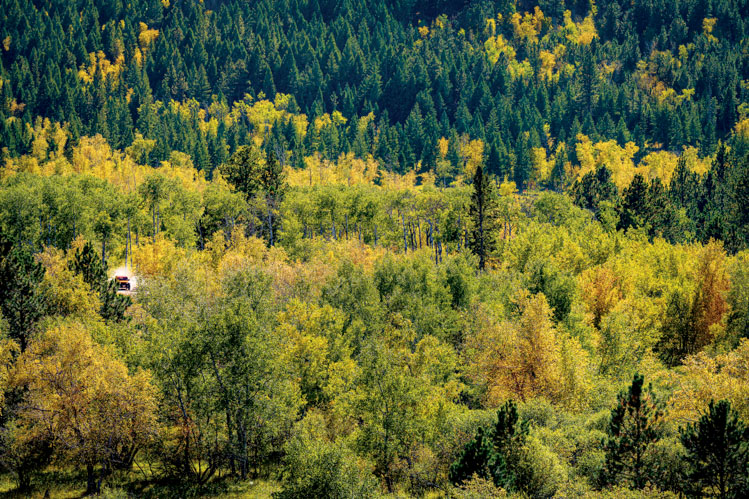
Drivers experience an autumn smorgasbord along Palmer Creek Road, which winds through thick aspen forests and broad meadows.

A SOLITARY COTTONWOOD tree on the lonesome prairie, when bejeweled with golden yellow leaves, emanates as much beauty as the human eye can absorb — especially when the sun slips southward, leaving the September sky bluer than blue.

Yet, who looks for a single tree in autumn? We tell ourselves we must see mountains and hillsides and river valleys with their forests full of leaves, each one hanging precariously by a stem, fluttering unworriedly as if winter was a thousand years away.

So yes, of course, go forth this autumn and fool yourself into believing that this glittering season is not just a cruel trick of chlorophyll. Life will always be so good. Calamity can never follow such serenity. South Dakota is paradise eternal.

Certain places in our big state are especially guilty of contributing to the delusions of autumn, beautiful though they may be. Traffic jams can occur on Highway 14 in Spearfish Canyon during peak leaf-peeking days. Sica Hollow’s oaks are almost as beguiling for people who live in the northeast. Our urban forests are resplendent in different ways because city parks and boulevards feature a gloriously unnatural mix of planned and planted trees. The McKennan Park neighborhood in Sioux Falls is an exceptional example.

We asked our chief photographer, Chad Coppess, if he knew of some lesser-known fall foliage tours. He suggested the three that follow. Interestingly, one that he chose is at South Dakota’s very lowest elevation while another is near the highest. Chad’s diplomatic third choice lies in between, along the Missouri River.

These routes won’t have bumper-to-bumper traffic in September and October when our leaves change color, but that is part of their allure. Autumn is even more striking when you escape the crowds.


PALMER CREEK

Pennington County

The graveled Palmer Creek Road is less than 4 miles long yet offers more than its weight in gold leaves between two spectacularly located campground resorts. Horse Thief Campground and Resort lies on the southwest end of the road and the Mount Rushmore KOA at Palmer Gulch Resort on the northeast. Both campgrounds have funky little stores that offer snacks and refreshments.

Midway along the road, an engineer had some fun by designing a double crisscrossing section with an over-under bridge and a cut through a rock that delivers a jaw-dropping view of Black Elk Peak no matter which way you are traveling. The road winds through beautiful aspen groves and, at times, offers a panoramic view of the entire gulch.

Little-known fact: Along the road is a parking area for Palmer Creek Trailhead, where you can trek to the top of Black Elk Peak (South Dakota’s highest point) and beyond.


PLATTE-WINNER BRIDGE

Gregory and Charles Mix counties

Those who prefer to venture off the interstates know that Highway 44, a main artery across the southern third of South Dakota, crosses the Missouri River via the Platte-Winner Bridge.

The stretch between Platte and Winner is 53 miles. The most scenic area features bluffs that drop into the river valley where you’ll discover two state recreation areas — Snake Creek on the east side and Buryanek on the west.

Lewis and Clark traveled here in 1804 and 1806, at one point losing a member of their party for several days. The Shannon Hiking Trail in Snake Creek Recreation Area commemorates the lost explorer and gives expansive views of the river and autumn colors.

Little-known fact: Unless you live in the neighborhood, you may not have heard that the mile-long Platte-Winner Bridge is about to be replaced. Construction on a new bridge may begin in 2025.


BIG STONE LAKE

Grant and Roberts counties

State Highway 109 runs up the South Dakota side of Big Stone Lake in the northeast corner of the state with a view across the lake into Minnesota. We recommend the 15-mile stretch from Big Stone City to Hartford Beach State Park with frequent stops at access points to the water. The route offers a variety of vegetation and colors for leaf peepers. Hartford Beach is one of the oldest South Dakota state parks and is popular with campers, boaters and fishermen. The log cabin trading post of Solomon Robar, along with Native American burial mounds and pioneer graves, are found along the hiking trails in the park.

Little-known fact: The shoreline of Big Stone Lake (elevation 965 feet) is the lowest spot in South Dakota.

Editor’s Note: This story is revised from the September/October 2023 issue of South Dakota Magazine. To order a copy or to subscribe, call (800) 456-5117.

Posted on Leave a comment

Summit’s Lutefisk Tradition

Diners at Summit’s annual lutefisk supper got a plateful, but the fish was the star of the evening.

Editor’s Note: The town of Summit hosted an annual lutefisk supper for around 80 years, but the event ended after the 2019 gathering. This report is from our visit in November of 2016. It appeared in the November/December 2017 issue of South Dakota Magazine. To order a copy or to subscribe, call (800) 456-5117.

***

Here’s a fun recipe for preparing lutefisk. Place a piece of lutefisk on a pine board and flatten it with a cleaver. Sprinkle salt and pepper over the fish and gently ladle melted butter over the top. Bake at a low heat for two hours. Then take the lutefisk out of the oven, throw it away and eat the pine board.

Lutefisk, the fishy centerpiece at the heart of countless memories for South Dakotans who grew up in Norwegian families, has gone from traditional holiday meal to punch line over the years. But it’s no joke in Summit, where every November the entire community helps stage one of the largest and longest-running lutefisk suppers in South Dakota. For $18, diners are treated to all the lutefisk, lefse, mashed potatoes and gravy, corn, ham, coleslaw, cranberries and coffee they can consume.

Lutefisk suppers don’t seem to fill the fall calendar in South Dakota as they once did. Perhaps younger generations aren’t as enamored with the idea of eating fish that’s been preserved in lye. Maybe it’s the distinctly fishy aroma that can emanate from a boiling pot of lutefisk, or the gelatinous texture it can take on when overcooked. Still, the lutefisk suppers that remain often sell out, attracting diners who both truly love the fish and those who are willing to eat it once a year for the sake of nostalgia or to preserve their cultural heritage. We headed into the Glacial Lakes country last year with a camera, notebook and an empty stomach to see how Summit has sustained its lutefisk tradition for nearly eight decades.

Diane Knutson, of Summit, is among the chefs who have perfected the art of cooking lutefisk.

The community of about 290 people lies in the far southern edge of Roberts County and just inside the Lake Traverse Reservation, home to the Sisseton Wahpeton Oyate. Its name comes from its location atop the Coteau des Prairies, a rise of rolling hills that sweeps down the eastern third of the state. At 1,968 feet above sea level, it was the highest point between Chicago and Mobridge when the Chicago, St. Paul and Milwaukee Railroad established a station there in 1880.

Because of the elevation, Summit is often susceptible to particularly harsh winter weather. But temperatures were unseasonably warm in the lower 60s when we pulled up in front of the Summit Community Hall. Built in 1952, the gymnasium, with its white block exterior and wood-brown basketball floor and bleachers, looks like something straight out of Hoosiers. In fact, the Summit Eagles (now the Waubay-Summit Mustangs co-op) played basketball there until just last year, when a new $3.5 million addition to the Summit school — including a new gym, music classrooms and community wellness center — was completed.

Advertisements said serving began at 5 p.m., but there were already couples patiently waiting in their cars when we arrived at 3:30. Brenda Redlin, one of the supper’s main organizers, said they often start serving at 4 to accommodate the dozens of people who arrive early and to be sure the lutefisk chefs don’t fall behind. Early arrivals head inside, take a number and patiently wait for their table to be seated.

She expected 550 diners that evening — nearly twice the population of the town — but when she began working at the supper as a high school student in the 1970s, 1,000 guests was the norm.”Back then we couldn’t cook the fish as fast, because we didn’t have the equipment that we do now,” Redlin says.”We had people on both sides of the stands just waiting and waiting. Some people would come buy their tickets and go to the bar. Now we get them through pretty fast.”

Victoria Zirbel (left) and Cathy Bauer were among the many high school students recruited to deliver plates of fish to the tables.

Volunteers are clearly at the heart of the annual supper, and it seems that nearly everyone in town has a job to do. Two days before the feed, fourth-graders at the Summit school devote their physical education class time to hauling tables and chairs and setting them up on the gym floor. On Friday night, high school honor society members carefully assemble each place setting.

Redlin has a list of ladies who help prepare 140 dozen lefse, a Norwegian flatbread made from potatoes. The ham and mashed potatoes are prepared at the school and shuttled to the hall because there’s not enough room in the tiny kitchen. Then there’s the cashier, the announcer, the servers, the butter melters, the coffee makers and the dishwashers.

But lutefisk is the star of the show. In 2016, they bought 800 pounds of lutefisk from the Olsen Fish Company. Founded in 1910 in downtown Minneapolis, Olsen’s processes 650,000 pounds of lutefisk annually, making it the largest lutefisk producer in the world. Fish from Olsen’s is used at nearly 500 community suppers throughout the country every year. They also supply novelty napkins and placemats that explain the lutefisk tradition for newcomers.

Pinpointing lutefisk’s beginnings can be troublesome. A popular folk tale says it all began more than 1,000 years ago when Irish citizens, hoping to poison a group of pillaging Vikings, boarded the Norse long ships and poured lye over their fish. But instead of dying, the Norwegians ate heartily and declared the lye-soaked fish a delicacy.

The earliest written reference to lutefisk is in a book by Olaus Magnus, a Swedish writer who worked in the 16th century. Eric Dregni discovered it while working on his book, Vikings in the Attic, about Scandinavian-Americans and the traditions they hold dear. Dregni is a professor at Concordia University in St. Paul, Minnesota, and is also the author of In Cod We Trust, an account of his year spent living in Trondheim, Norway.

Magnus’ book tells the story of an overwhelmingly successful fishing expedition in the North Atlantic. The fishermen brought their bounty of cod to shore, cleaned it on the rocks and cooked and ate as much as they could. When they finished, they simply left the rest behind.

The boisterous kitchen crew included (from left) Laurie Kneeland, Billi Whempner, Gretchen Wiste, Pan Neugebauer and Stacey Amdahl.

“Among these rocks were natural basins that filled up with rain,” Dregni says.”Birch ash leftover from their fires combined with water turns to lye, or ‘lute.’ When they came back much later, they found the fish had been perfectly preserved in this lye water. They couldn’t catch anything, so they took this leftover fish down to the sea, washed it off and cooked it. They realized this was a good way to preserve fish.”

Norwegian families used the method for centuries. The process is a bit more refined these days. Cod caught in Norwegian waters is dried before it arrives at Olsen’s in Minneapolis. It’s reconstituted in alternating baths of lye and water for about two weeks.

The lutefisk is delivered to the Summit school and refrigerated in the kitchen’s large coolers. The night before the feed, volunteers bring the fish to the community hall, where they cut it into 2- or 3-inch pieces and soak it overnight in salt water. In the morning, the fish is rinsed and prepared for cooking.

That task falls into the able hands of Diane Knutson and Sheryl Steinocker. They’ve both worked at the annual dinner for over 40 years, and have learned the proper way to prepare lutefisk more by experience than any written recipe. Water boiled steadily in two pots while they explained the process. The fish is placed inside cheesecloth and plunged into boiling water.”They used to say 4 or 5 minutes, but you can’t go by that because some pieces are thicker than others,” Knutson says.”So we stab each bag.”

Lutefisk. Cheesecloth. Boiling water. Five minutes. It sounds simple, but there’s a lot riding on the preparation.”It has to be fork tender,” Steinocker says.”There’s a fine line.”

“And a true lutefisk lover knows where that fine line is, so we have to get it right,” Knutson adds.

When they get it right, they can see it in the empty platters that return to the kitchen almost as quickly as they left.”Sometimes the plate makes it all the way around the table, and other times it only makes it through two people,” Knutson says.”That’s how you tell who the real Norwegians are.”

Patrick and Maria Quale came from Volga to help their grandmother, Kathy Quale, at the butter-melting table. The siblings are the fourth generation in their family to melt the butter for Summit’s annual lutefisk supper.

Retaining cultural identity is important to those”real Norwegians” as well as South Dakotans from other ethnic backgrounds. It may have played a role in turning this regular Norwegian meal into a community gathering. Dregni points to the World War I era, when immigrant families in the Upper Midwest still spoke their native languages, read native language newspapers and engaged in cultural practices brought over from Europe. When war broke out and patriotic fervor swept the nation, a shadow of suspicion was cast over these families (Germans specifically, but Scandinavians were sometimes included). Dregni believes get-togethers such as lutefisk dinners helped families retain their Norwegian-ness. Summit’s began at the Hope Lutheran Church. It’s now organized by a group called Summit Area Economic Growth, and money raised goes back into the community to support summertime activities for youth.

Despite the sense of togetherness lutefisk helps to foster, at some point it became the strange fish that people like to joke about. Even the internet is getting in on the fun, though perhaps unintentionally. Google the word lutefisk and among the first results is a pronunciation guide that explains the first syllable sounds like”lewd,” as in something dirty, filthy, foul, gross or nasty.

We found the pine board recipe in a book called O Lutefisk by Red Stangland, who grew up in Hetland and worked in radio in Sioux Falls but found his niche in the ethnic joke industry. He founded Norse Press and published millions of joke books featuring the exploits of Norwegian characters like Ole, Lena, Sven and the often-disparaged lutefisk. Here’s the first verse of Oh Lutefisk, Stangland’s parody of the Christmas song Oh Tanenbaum:

Lutefisk Ö Oh Lutefisk Ö how fragrant your aroma

Oh Lutefisk Ö Oh Lutefisk Ö you put me in a coma

You smell so strong Ö you look like glue

You taste yust like an overshoe

But Lutefisk Ö come Saturday

I tink I’ll eat you anyway.

We also learn through Stangland and other Scandinavian humorists like Ed Fischer that lutefisk, when placed around a campsite, is an effective bear repellent. Wrapping your money in lutefisk wards off potential robbers, but lutefisk scented after-shave is a sure way to attract a Norwegian wife.

Did you know that the first person to fly an airplane solo across the Atlantic Ocean was not Charles Lindbergh but a Norwegian pilot from Minnesota? Unfortunately his plane carried a cargo of lutefisk, so no one met him at the airport. You get the idea.

Rick Knutson (left) and Pete Eccles happily scrubbed dishes in metal washtubs.

The Summit dinner has not been without its own strange-but-true foibles. One night about 25 years ago the worst-case scenario happened: they ran out of lutefisk. So someone called a grocery store in Milbank, 22 miles east along Highway 12. The clerk put some lutefisk in the back of the county sheriff’s car and the officer sped west with lights flashing to Marvin Hill, a high spot about midway between the two towns, where he met someone from Summit who transported the precious cargo the rest of the way. Crisis was averted thanks to a law enforcement escort that perhaps no South Dakota food other than lutefisk would ever receive.

But we didn’t notice any hiccups. A kitchen full of sous chefs happily prepped hundreds of pounds of lutefisk, despite questions from a magazine writer. (“Do you want a mimosa?” one of them asked us.”Don’t put that in your article!” said another amid gales of laughter.) Kathy Quale and her grandchildren, Patrick and Maria Quale, melted 108 pounds of butter and skimmed the foam off the top of every cup, just the way grandma used to. Lyle and Candace Zirbel kept watch over the egg coffee. Earline Holt, Rick Knutson and Pete Eccles, who also serves as the mayor of Summit, joked as they scrubbed dishes in old washtubs. It seemed there was no place any of them would rather be.

And the plate of lutefisk we enjoyed was perfectly flaky, topped with a shake of pepper and a couple of tablespoons of silky melted butter. We didn’t even miss the pine board.

Posted on Leave a comment

Autumn in the High Country

Autumn always comes early to the high country. While late summer lingers across the rest of the land, the high coulees and upper draws seem to consistently show the first real signs of the season. The last week of September is normally the peak of fall color in places like Spearfish Canyon, the Slim Buttes and even Sica Hollow in the northeast corner of the state. For this reason, I regularly find myself wandering the back roads and trails of the high country every year about this time. It’s not that I welcome the end of summer, but it’s hard not to love autumn around here.

The beauty is fleeting, admittedly. When the weather patterns switch in this season of change, it brings strong winds that rob the trees of their dying leaves. That’s a lesson unto itself. There is beauty in endings. Sad though it is, it helps that there is promise of new life returning after the long winter.

This year I started around Sica Hollow during the golden hour on September 26. I was a bit early for fall color peak, but the color that was showing in the late afternoon and evening light seemed to accent the autumn beginnings quite wonderfully. A couple of days later I hit Badlands National Park, where the upper draws of Sage Creek were brilliant. One thing I learned is that yellow-leaved trees make for interesting visuals in a black and white image. They look nearly white.

After spending a day and half wandering around the Badlands, I made my way for Custer State Park. Needles Highway offers unique autumn color combined with winding roads and sweeping vistas. The fall foliage along the park’s creeks also offers colorful hues. From Custer State Park, I headed to the high country of Lawrence County by way of the Mystic and Rochford roads, finally ending up in Spearfish Canyon by late afternoon. This scenic byway is a must-drive in autumn. One extra perk this year was a small herd of mountain goats grazing near Bridal Veil Falls.

I finished up my tour of the high country in the first days of October by traveling north to the Slim Buttes and Cave Hills of Harding County. These areas are part of the Custer National Forest primarily for their stands of evergreens atop the buttes and hills, but they both offer great stands of deciduous trees along the draws and valleys. These places have become an autumn favorite for me. This year I missed the peak at the Slim Buttes as the color was nearly gone when I passed through, but the Cave Hills were nearly perfect. It goes to show just how fleeting fall’s beauty can be here on the high plains, even within a single county. Even so, the drive and views were worth every minute. The good news is that now the rest of the lower country as well as city and towns should be starting their autumn transformations. So, if you couldn’t make it to the high country, you still have a chance to get out and enjoy the rest of the season.

Christian Begeman grew up in Isabel and now lives in Sioux Falls. When he’s not working at Midco he is often on the road photographing South Dakota’s prettiest spots. Follow Begeman on his blog.

Posted on Leave a comment

Autumn Mysteries

Visitors have long reported strange occurrences at Sica Hollow in Roberts County. Photo by Chad Coppess/S.D. Tourism

South Dakotans are no-nonsense folks, so we always struggle to find supernatural tales for our October issues, but we have heard a few through the years. One of my favorite spooky stories, published in our September/October 2014 issue, is about a mysterious bright, white light in Miner County that appears out of nowhere. Locals call it the spooklight. It can be seen along a particular stretch of dirt road between Carthage and Fedora. The story’s author, Donna Palmlund, talked to family and neighbors to get their spooklight accounts.

Palmlund’s father grew up on a farm west of Spooklight Road. His grandfather would say that sometimes the spooklight was so bright they could sit inside and read by it. After the Hass family moved off the farm, a man named Joe Spader lived there. “After I moved to that farm it wasn’t long before I was aware of this light that was very peculiar,” Spader said. He described the light as looking like a bright spotlight cresting a hill and then going down the hill, but a car would never materialize. Before he heard about the spooklight, he was worried someone was trying to steal something.

Another mysterious light has been seen in southeast South Dakota, looking over Nebraska’s Crazy Peak, which rises above the chalkstone bluffs on the Nebraska side of the Missouri River. Sometimes the view gives South Dakotans an unexplainable light show. “I’ve seen all sorts of UFOs there in the past,” said Carvel Cooley, a longtime local historian. “It’s just lights. They don’t make any noise and they can stop, start, zap out of sight, disappear and reappear.” Although a lot of locals have seen the lights, most don’t talk about it. Some give credit for the lights to swamp gas. Others bring up the Santee Sioux legends of seeing “little people” in the neighborhood of Crazy Peak.

Another well-known eerie South Dakota spot is Sica Hollow in Roberts County. Reports of strange voices, lights flashing in creek bottoms and bubbling red bogs along the Trail of Spirits make Sica Hollow a spooky place to visit any time of year. Its first Indian inhabitants dubbed the forested area”sica,” meaning bad or evil.

We visited with Chris Hull several years ago. Six generations of Hull’s family have lived near Sica Hollow. He has spent countless hours hunting or camping in the forest and has seen the glowing lights. Once he also had a more mysterious experience while camping with friends. They realized they had forgotten supplies, so one friend drove home to get them.

“We were hiking and heard him yell from down in the hollow,” Hull told us. “He must have yelled five or six times. We wondered if his truck had gotten stuck and he had started walking. So we walked for a mile and got down to the bottom, but there was nothing there. We climbed a hill to search for lights and found nothing. Finally we went back to the campsite and he pulled in at the same time. He said he was at home and he had all the sleeping bags and things he’d gone to get. But all five of us heard him yelling that night.”

When the leaves fall and Halloween is close at hand, we all like a good South Dakota ghost story. If you have one to share, let us know in the comments below or email editor@southdakotamagazine.com.

Posted on Leave a comment

The Fort Sisseton Kid

Without help from Robert Perry, Fort Sisseton may have been reduced to a pile of rubble overgrown with weeds. Photo by Chad Coppess/S.D. Tourism.

In 1862, simmering tensions between the Santee Dakota and white settlers boiled into open conflict along the Minnesota River in south-central Minnesota. Known to history as the Sioux Uprising, the war ran its course in a little over five bloody weeks. About 500 settlers were killed during the fighting; at the very least 20 Indians died, along with another 38 who were hanged in the conflict’s aftermath.

In the wake of it all, white determination to prevent a reoccurrence of those events led President Abraham Lincoln to authorize construction of a chain of military forts stretching from Minnesota north into Dakota Territory. Soldiers sited one of these in what is now northeastern South Dakota, at the head of the region known as the Coteau des Prairie, and named it Fort Wadsworth.

Completed in 1864, the outpost was later renamed Fort Sisseton, a moniker it carried until the army abandoned it in 1889. Twenty-seven men served as post commander during that span, and nine military units occupied the station.

But the fort’s staunchest defender, the Fort Sisseton Kid, was neither a commander nor a member of any of those units. He couldn’t have been. He wasn’t born until 27 years after the post closed.

Robert J. Perry, who would later be called The Fort Sisseton Kid, first saw the abandoned frontier outpost as a child in the late I 920s. He remembers traveling with his father the 70 or so miles east to the fort from their home in Aberdeen. History was a family passion, and Judge Van Buren Perry took every opportunity to point out places of historical interest to his young son.

Because of his efforts to save the outpost in northeastern South Dakota, Robert Perry earned the nickname “The Fort Sisseton Kid.”

Perry remembers well that trip to Fort Sisseton. “There was a hunting party from Chicago,” he says. “Some guy from London had shot a lot of ducks, or maybe somebody else had shot them for him, Lord only knows. But he was thrilled and buying drinks. I got licorice and nothing else!”

After the U.S. Army abandoned Fort Sisseton, ownership was transferred to the state of South Dakota. (At closure, the post consisted of 22 brick, stone, frame and log buildings, settled on a military reservation of 82,112 acres.) The National Guard used the facility briefly, but by the second decade of the 1900s it was leased out for agricultural and hunting purposes. Through the 1920s, when Perry first visited, the leaseholder was Colonel William D. Boyce, owner of the Chicago Tribune and founder of the Boy Scouts of America.

Though Perry was on the grounds several times in the 1930s, years when the Works Project Administration (WPA) restored many of the fort’s tumbledown buildings, his role as defender of the post began in earnest in 1953. That’s when he moved to Britton, 18 miles northwest of Fort Sisseton, to become the local manager for Northwestern Bell Telephone.

“We had a line out there at the fort,” Perry says, “so I went and checked it.” When Perry arrived, there was a No Trespassing sign on the gate, but over he climbed anyway. “The leaseholder rode up on his horse and he shouted, ‘You don’t read very well!’ I yelled back, ‘You see that telephone truck there? I’m going in to inspect my line.”

What the young telephone manager saw shocked him. “The guy who was leasing the fort for $75 per year wasn’t supposed to be using the buildings,” Perry says. But the hospital building, one of the main structures, was filled with sheep, and the other buildings were also being misused. “So we got into a fast argument,” he says, “because I don’t mind tangling with anybody.”

By the time this scrap and its aftermath had passed, Perry and a friend from Britton maneuvered the lease from the state for themselves. When the former tenant complained that they had no livestock, Perry replied, “We’ve got 175 head of deer grazing out there, and we’re expecting some antelope,” claiming the wild animals as his herd to justify the contract for agricultural usage.

Barely 20 years after thousands of man-hours and many federal dollars had been spent at Fort Sisseton by the WPA restoration project — including, inexplicably, coating all the building interiors with pink paint — what Perry found in the 1950s was disheartening. A historical treasure was crumbling, and no one seemed willing to do anything about it.

No one but Robert J. Perry, a firm believer in public service. While serving as telephone manager in Frederick during the 1940s, Perry raised the money for new fire equipment, set up a rescue unit and established a mutual fire aid association. In 1951, he saved the life of a young boy following an accident and earned a company citation for his quick action.

“If a town is not a better place for my having lived in it,” Perry says simply, “then I’m not worth very much, am I?”

But even Perry’s service ethic had its limits. In 1959, when his fellow citizens in Britton tried to draft him to run for mayor, he flatly declined. “That’s where I draw the line,” he told a reporter. “I wouldn’t get mixed up in politics for anything.”

The barn is one of many buildings saved through Perry’s efforts. Photo by Chad Coppess/S.D. Tourism.

What makes that quotation so ironic is that Perry played politics like a master to create the future for Fort Sisseton that he had in mind. First he convinced his fellow members of the Britton Lion’s Club that this was a project worthy of their attention. (Perry was president of the local chapter.) Then he worked to build support from the larger community and began correspondence with South Dakota’s governor, Joe Foss.

“I left a number of petitions with your secretary on Tuesday,” he wrote in 1958. “These petitions asked that Fort Sisseton be made a state park. You can see by the number of names that the people of this area are very concerned.” He also invited the governor to speak to the Britton Lion’s Club.

Joe Foss understood politics, as well. He wrote back saying he had spoken to the Game, Fish & Parks Commission about Fort Sisseton, and turned the petitions over to the South Dakota Legislature. He even promised to visit Britton, and Perry recalls those days fondly. “Joe (Foss) was a good guy,” he says. “He listened to what I had to say.”

Things moved quickly after Perry and the Lion’s Club got the governor’s attention. Foss spoke on April 23, 1958, at Britton ‘s Masonic Temple, and at the end of May a legislative subcommittee on the future of Fort Sisseton scheduled a public hearing for June 2.

There was just one glitch. “The subcommittee wanted to meet in Pierre, but I didn’t want to meet there,” says Perry. “I wanted them out at the fort.”

Those planning the meeting objected that the outpost had no suitable facilities — no heat, no lights, no furniture, or anything else. Standing firm, Perry was able to sway the decision on the meeting location, but he had only from Monday to Wednesday to make acceptable arrangements.

“It was a good thing I was the telephone manager,” he remembers, “because I got on the phone and called a lot of people. At the time, I was the head of the county search and rescue squad, and I had a big generator. So I knew I had lights. It was also big enough if we needed heat. I called the Veterans’ Club and got tables and chairs.”

The North Barracks now houses a visitors center and replicas of the frontier soldiers’ accommodations. Photo by Chad Coppess/S.D. Tourism.

“We met in the little library building at the fort, and after all my phone calls, it was chock full.” Many notables were in attendance, including two state legislators from Britton, Sen. Arthur Jones and Rep. Elden Arnold, the community’s mayor and the presidents of nearly every organization in all the surrounding towns. Jones and Arnold led the testimony with statements of support.

Then Perry took the floor. He recalled for the subcommittee the thousands of signatures on petitions, and reported that informal registers at the fort had recorded visitors to the site from 46 states. “Few historical spots between the Great Lakes and the Rockies can compare,” he bragged.

After hearing Perry out and a tour of the structures and grounds, the subcommittee voted to recommend, “that the area at Fort Sisseton including all buildings located both inside and outside the moat be established as a state park.” Further, they recommended that a full-time caretaker be located at the site.

In early 1959 the South Dakota Legislature turned those recommendations into law. There was a different governor by then, Ralph Herseth, and Perry wasn’t about to let the issue die on the new chief executive ‘s desk. “Now that both the House and the Senate have passed House Bill 677, it looks like our dream is at last in your hands,” he wrote to Herseth. “We hope that you, as governor, are willing to sign the bill making Fort Sisseton into a state park.”

“We are at present planning a brochure on Fort Sisseton State Park in which we would like to have a letter from you,” he went on, subtly playing his trump card. “We should be able to attract additional tourists to South Dakota and our historic Lake Region.”

Herseth signed the bill and sent a letter for the brochure in which he announced the creation of the new Fort Sisseton State Park. In his message, the governor also commended the efforts of the Britton Lion’s Club and other public-spirited individuals, “to preserve for posterity this dramatic reminder of a colorful era in the history of Dakota Territory.” When the state park was dedicated on July 26, 1959, Gov. Herseth was the main speaker, with Robert J. Perry as master of ceremonies.

Re-enactors demonstrate the firing of Civil War-era cannons during Fort Sisseton’s annual summer celebration. Photo by Chad Coppess/S.D. Tourism.

Among the others present on that dedication day was Max Cooper, Sunday editor for the Aberdeen American News. From then on Cooper regularly used his column, ìJottings from the Dakotas,” to promote events and celebrations at the new state park, which helped immeasurably in getting it established.

Cooper and Perry became close friends, with the latter making regular appearances in Cooper’s column. At first the writer referred to Perry as “Mr. Telephone,” but soon he began writing about a mysterious fellow known only by the sobriquet, “The Fort Sisseton Kid.”

“The Fort Sisseton Kid, who just naturally hates to think about anyone’s telephone going unused, rang me up last week to tell me what he had on his mind,” Cooper wrote on one occasion. “(He) mentions that I might want to go along on this trail ride. He has heard that I recently have run 100 miles and he says I can go either as a rider or as a horse — take my choice.”

Beneath the bantering humor laid a respect for what each had done to make the state park a success. “The accomplishments of Max are many,” Perry wrote when Cooper later left the newspaper. “Without his stories and pictures, I feel that the old Fort Sisseton would still be a pile of rubble, overgrown with weeds.”

Having accomplished such a lofty goal, Perry was not about to rest contentedly on his laurels. During the 1960s he convinced yet another South Dakota governor, Archie Gubbrud, that the historic outpost deserved attention. The governor sent prisoners from the state penitentiary to the fort to work on restoration projects, often under the supervision of Perry himself.

With only shovels and chutes, Perry and his crew filled an entire basement — 9 feet deep by 148 feet long — with gravel brought by the truckload from a nearby pit, thus preventing the walls of the officers’ quarters from collapsing. Perry cut a deal with the pit owner for 25 cents per truckload, because, as he recalls, “We could get that kind of money.”

Gubbrud also visited the fort at Perry’s invitation. It was a hot day, and the governor got filthy from dust flying through open car windows as he drove the dirt and gravel road leading to the state park. Never one to miss an opportunity, Perry planted the seed of an idea when the governor complained that he didn’t look presentable. Not long after, Gov. Gubbrud arranged funding to resurface and oil the road.

The story of Fort Sisseton can now be found in the preserved-for-posterity buildings of the outpost itself. But the story of Fort Sisseton State Park can be found in the scrapbooks that Perry, The Fort Sisseton Kid, donated to the park.

Along with various documents and photographs, there are letters to and from the powerful in South Dakota’s last half-century: U.S. Senators Karl Mundt, Joe Bottum and George McGovern, U.S. Representative Ben Reifel, several governors, and even U.S. Secretary of the Interior Stewart Udall. They are tangible signs of the effort Perry put forth to make the park a reality, and a testament to the political skills of a fellow who, “wouldn’t get mixed up in politics for anything.”

Editorís Note: John M. Hilpert served six years as president of Northern State University in Aberdeen. He is currently president of Delta State University in Cleveland, Mississippi. This story is revised from the September/October 1998 issue of South Dakota Magazine. To order a copy or to subscribe, call (800) 456-5117.

Posted on Leave a comment

Beware of Long Hollow

Three historic markers atop the hollow on Highway 10 tell the stories of tragedies that occurred there. Photo by Bernie Hunhoff.

Cold, wind and snow are not strangers to South Dakotans. But the hardy residents of northeast South Dakota are especially well acquainted with bad weather. A high place in Roberts County holds special notoriety for chilly weather and chilling winter stories.

The town of Sisseton is 1,203 feet above sea level. But the top of Long Hollow, 4 miles west, is hundreds of feet higher. In the summer, that elevation is a blessing.”It can be ten degrees cooler than down below in town with a nice breeze,” Joe Schuch, a retired extension agent and a longtime observer of Long Hollow’s weather phenomenon, once told us.”The problem is that in the winter it is that much cooler, and you aren’t quite so happy with the breeze.”

Clayton Week, a local farmer who is now deceased, told us a story back in 2002 that showed why area residents are watchful of the hollow in winter. In 1937 he and a cousin, Charlie Almos, almost died there.

“Our families lived about 10 miles west of Sisseton, and because it was so far to town Charlie and I batched it,” he said.”We lived upstairs on our own in a house in town for two years so we could attend high school.”

Throughout the winter, snow accumulated over Highway 10 and travel was nearly impossible. When the sun broke out on a Friday afternoon, the boys decided to walk home because they hadn’t seen their families in weeks. They began walking up the long prairie incline, noticing that only a couple of feet of telephone poles were peeking up from the snow.”When we got to the top of the hill, it started to get dark. That’s when the wind hit. It was terrible,” Week recalled.

They couldn’t see, could barely walk in the wind, and were freezing. Almos tried to convince Clayton to sit down and rest.”No,” his cousin replied.”We’re not sitting down.” They continued to slowly make their way through the hollow, prodding each other along and refusing to let the other stop.

“You get to the point where you lose your common sense and you don’t really know right from wrong,” Week said.”If either of us would have been alone he would have probably laid down and rested and that would have been the end.”

As the cousins stumbled through the snow, they began to wonder if they would escape the hollow. The snow stung their faces, and their limbs began to feel heavy and numb. The wind was strong enough to suck the air from their lungs, and they didn’t see any landmarks except those telephone pole tops. Finally they saw the Tobias Herigstad farm in the distance and staggered to the front door. Tobias and his wife Bertha rushed the boys indoors and fed them a warm meal.

The cousins were lucky that winter night. Others caught in Long Hollow storms weren’t so fortunate. The saddest story we’ve heard from the area happened on Jan. 6, 1903. Knut Throndson and his two daughters, Theoline, 13, and Menne, 15, took a horse and sleigh across the hollow to visit the Herigstads. When they left it was a warm, sunny winter day. But when they returned in the late afternoon, the sky became dark, the wind rose and suddenly they enveloped in a full-fledged blizzard.

Disoriented by the poor visibility, they veered off their usual path. The sled hit a boulder and broke. Throndson was a tough Norwegian who had immigrated to the area 11 years earlier. He unhitched the horse and instructed the girls to hold on to the horse’s tail as he navigated through the blizzard to their farmhouse. But when he arrived home, he found both girls missing. He retraced his voyage all the way back to the Herigstad farm, and then he and Tobias searched all night for the girls. Their frozen bodies were found at sunrise less than 400 yards from Herigstad’s house.

Other tragedies from the hollow have probably been lost to history. But enough have been recorded and passed down that locals know and remember the dangers of the hollow in winter.

Posted on Leave a comment

A Farmer’s Story

Johnny Cloud, a colorful Sisseton farmer, has many descendants in Roberts County. They include his daughter, Marlene (left) and a grandson, James Cloud.

When South Dakota Magazine began publication in 1985, we hurried to interview some of South Dakota’s elder statesmen because we wanted to collect their stories firsthand. Ben Reifel and Sigurd Anderson were two such leaders. Reifel was born in a log cabin on the Rosebud Reservation in 1906 and became the first (and only) Native American to win statewide office in South Dakota.

Anderson was born in Norway in 1904, and served as governor in the early 1950s. Although Anderson and Reifel were Republican office-holders of the same age and era, they told very different stories. There was one exception: both mentioned an Indian boy from Roberts County who wanted to be a farmer.

They each spoke of him when we asked about race relations in South Dakota. Neither seemed to know any details about the boy, and the story was almost too cute to be true — like the feel-good anecdotes that politicians like to tell. We figured that one of the old pols had heard it from the other, so we gave it just a few paragraphs in Reifel’s feature article in 1989. However, I did repeat it on occasion when I was asked to speak at various events.

Anderson and Reifel told the story like this: the boy grew up on the reservation speaking only the Dakota language and a little German. His teachers told him he must learn English if he wanted to be a farmer.”After all,” said one teacher,”you don’t know how to farm, so you’re going to have to ask.”

That made sense to Johnny. He worked hard at English and other subjects. Years later, he was able to rent a patch of land in Roberts County. He decided his next step would be to meet the neighbors, who gathered for coffee every morning at the local grain elevator.

In farming country, a grain elevator is like the country club to an advertising executive or insurance agent. That’s where a farmer goes to”network” with his associates. The young Indian boy didn’t know the meaning of networking, but he intuitively understood the concept. So he bravely walked into the grain elevator and sat down at the table, ready to learn.

Imagine his surprise when he found that — after years of learning to speak English — the farmers were not speaking English, but some other language. He wasn’t sure what tongue it was, but it wasn’t German or English or Dakota. He wondered if his new neighbors were intentionally snubbing him. He didn’t know what to do. So he went home.

A few days later, Johnny mustered up the courage to confide in his nearest neighbor. He went to the man’s farm and blurted out his confusing experience at the grain elevator.”I spent years learning to speak English so I could be a farmer, and when I went to meet the other farmers they were talking something else,” he said.

The neighbor explained that nearly everyone in the community spoke Norwegian. He said the farmers at the elevator certainly didn’t mean to slight him.”They just weren’t thinking,” he assured the young man.

The two came up with a plan. The young Indian already knew three languages. Surely he could learn a fourth. A few weeks later, Johnny and his new friend returned to the grain elevator. They sat down at the table and Johnny, the Dakota Indian, introduced himself in Norwegian. Imagine the looks of surprise on his new neighbors.

Speaking in Norwegian, Johnny clumsily explained that he always had wanted to be a farmer. That his teachers told him to learn English so he could talk to his neighbors. That he still wanted to be a farmer, and he knew he needed their help and advice. And that he would help them whenever he could.

Before he could speak any further, because his Norwegian was so torturous to hear, they all welcomed him with handshakes and offers to help — offers spoken in plain English. And Ben Reifel said that was the last time anyone spoke Norwegian at the grain elevator, because they realized they had been excluding their non-Norwegian neighbors. Anderson and Reifel said the Indian boy became a skilled farmer and community leader, and all lived happily ever after.

That was their story. Whenever I told it in public, I admitted that I didn’t know the Indian boy’s name or the community where it happened. And, of course, I wasn’t even sure it was completely true.

A year ago I was asked to speak at the Center for Western Studies’ annual Dakota Conference in Sioux Falls. Wanting a feel-good conclusion to my talk, I told the story of the Indian boy from Roberts County. As I spoke, I could see that Wayne Knutson was paying close attention. He is the retired Dean of Fine Arts at the University of South Dakota and a patriarch of the arts across South Dakota.

As soon as I finished speaking, Knutson hurried to the front of the room and said to me,”That’s Johnny Cloud! I knew him. He was a big, tall Indian farmer from Sisseton who always greeted us with a god dag!” Wayne, it turns out, was born and raised in Roberts County. He said Johnny Cloud was one of the most memorable characters from his childhood in the 1940s.”Most of the Native Americans seemed more reserved, at least when they were downtown, but Johnny was a gregarious man with a hearty laugh that drew me to him,” Knutson said.”And he loved to show off that he could speak Norwegian. We’d heard that he had learned the language so he could do business with the Norwegian families,” he said.

Knutson remembered Johnny Cloud delivering”little Norwegian speeches” to the clerks in Stavig’s Department Store on Main Street.”Then he would laugh his big laugh, because it tickled him so much. I can still hear his laughter ringing out.”

I could hardly believe my ears, as Knutson brought Johnny Cloud back to life. My estimations of Anderson and Reifel — though already immense — grew still higher. Why had I doubted that the story was true?

As soon as I returned to the magazine office in Yankton, I looked in the Sisseton phone book for the Cloud name. I found James Cloud and dialed his number; James promptly answered. I asked if he knew Johnny Cloud, and he said both his father and grandfather were named John.

When I told him my story, he said his grandfather was the tall, successful farmer who spoke Norwegian.”I’m looking out my window at the land he farmed,” James said. He invited me to stop by on my next trip to Roberts County.

Sisseton, a tidy little city of 2,600 people, sits on flatlands just below the Coteau Hills. Sometimes in the winter, the sun is shining in Sisseton while a fierce blizzard rages in the hills west of town. Atop the Coteau, three markers have been erected to memorialize three separate incidents involving travelers lost in such storms.

The Sisseton area has a lot of variety for its size. The Lundstrum family’s religious ministry is headquartered there, as is the Schiltz family’s goose farm and factory, which processes 100,000 geese a year.

A glacier slid across this land a mere 20,000 years ago, creating dozens of pretty little lakes that are now ringed by cabins and resorts. The Sisseton-Wahpeton Oyate Sioux Tribe runs a bingo hall and a community college just south of Sisseton. The tribe has a rich history. Its people, starving and denied supplies in Minnesota, battled the Minnesota militia in 1862. When the hostilities ended, 38 Indian warriors were hung on Christmas Day. It is called the largest mass execution in America’s history. Chief Gabriel Renville led the tribe into the 20th century, and many of his descendants live in Roberts County today.

Johnny Cloud and Bessie Derby were married at Sisseton in 1912.

Northwest of town is the West’s smallest and prettiest forest, a 900-acre state park known as Sica Hollow. Hikers, horse enthusiasts, photographers and bird-watchers frequent the place, and sightseers come in the autumn to marvel at the hardwood trees’ golden foliage. Who could blame Johnny Cloud or any young man for wanting to make a living here on the land?

Driving into Sisseton on a weekday morning, I wondered if anyone other than James would remember Johnny Cloud. It was too early to call on James, so I stopped at the Cottage Restaurant on Highway 10 for coffee and eggs. Ken Erdahl, a longtime Sisseton banker, was seated in the next booth. We struck up a conversation, so I asked him if he knew Johnny Cloud.

ìHe was a big, tall guy,” answered the banker.”He was kind of husky. He was a good customer of ours, and a good farmer. When he wasn’t farming, he liked to hunt on Buffalo Lake. He liked to be called Goose Hunter.”

Erdahl recalled that Johnny spoke Norwegian, but he hadn’t heard the story of why he learned the language. He wasn’t surprised that Anderson and Reifel might have known the Indian farmer.”Johnny was well respected around here and very sociable,” said the banker.”He hung around Mel’s Diner for coffee. He was a very nice fellow.”

Erdahl was working at the Roberts County National Bank when Johnny borrowed $1,400 to buy his first new tractor, a shiny red”M” Farmall.”He sold it 20 years later for $1,500 and he was very proud of that,” said the banker.

Everywhere we went in Sisseton, old-timers remembered Johnny Cloud. They didn’t know of his encounter with the neighbors at the grain elevator, but their memories of his good nature, his intelligence and his passion for farming all supported the Anderson/Reifel story.

At the Roberts County National Bank, the Torness family paged through their local history books and found some specific information on John Melvin Cloud. He was born on the Fort Peck Reservation in Montana in 1891 and came to the Sisseton area as a teenager to live with relatives. His ancestry, like many Indians in Roberts County, traces to Chief Renville. Johnny married Bessie Derby in 1912 and they began a small farm on land just north of Sisseton.

Late in the morning, I drove north of town to the old Cloud farm. James, a short and slender man with jet-black hair, said he was young when his grandfather died in 1968.”I do remember helping him to feed the chickens, and if you didn’t do it right he would get after you,” he laughed.

ìCome in the house,” he said.”My mother knew him.” There in the living room, lying in a hospital bed, was James’ mother, Goldie. She was injured in a car accident in 1974, and has been confined to bed ever since. She was already the mother of 10 young children when the accident happened. Today, nine of the 10 still live in the Sisseton area and James says they all help care for mom, but he is there constantly, attending to her needs.

Goldie, despite her paralysis, is a happy and content woman. Her living room is filled with pictures of grandchildren, and she looks out a big picture window at the fields that her father-in-law once farmed. She remembers him as a big, friendly fellow who loved his neighbors and his family.

She married his only son, John Jr., in 1947. Goldie’s nearest neighbor is Marlene Campbell, her sister-in-law and Johnny’s daughter. Marlene lives less than a quarter-mile down a gravel road. We knocked on her door, and she was happy to answer our questions as well; but she noted that her husband had died two years earlier, and the shock affected her memory. Still, she had good recollections of her father.”A lot of the farmers would come to him because he could speak German and Dakota,” she said.”He probably learned it in Montana before he moved back here. He was always happy to translate for people.

ìHe helped people out, and he loaned machinery to the neighbors,” Marlene said.”He also would go to the jail and take the prisoners for a day or two. They were always so glad to get outside and work in the fresh air.”

None of the Cloud family remembered a specific story of Johnny learning Norwegian to speak at the grain elevator. But they agreed that it sounded a lot like him, and they confirmed his passion for farming. Marlene says her father built a barn even before he built a house.”He loved his farm and he was very successful,” she says. The big red barn was recently torn down, but a grove of trees and his old granary still stand on the Cloud farm.

ìHe encouraged all of his children to go to school,” said Marlene,”but I was the only one who went to the university.” She earned a master’s degree in education, and taught at Sisseton High School and the Sisseton-Wahpeton Tribal College.

Cloud family members have worked in education, health care, religious ministries and other professions. Because a boy wanted to farm — and possibly because a neighbor helped him learn a little Norwegian — his family took root in Roberts County. The benefits to the area continue to multiply, as does the Cloud family; as we visited with Marlene, her granddaughter came by the house with the family’s newest member, a three-month old baby called Azriel who has the bloodlines of a great chief and a fun-loving farmer.

While driving away from the Cloud farm, we thought that Azriel deserves the opportunity to know about her Norwegian-speaking great-grandfather. He overcame the gulfs of not just two, but three cultures — and he did it with laughter and good cheer. So, with apologies and appreciation to Ben Reifel and Sig Anderson, we’ll continue to tell the story of the Indian boy who wanted to farm.

Editor’s Note: This story is revised from the May/June 2008 issue of South Dakota Magazine. To order a copy or to subscribe, call (800) 456-5117.

Posted on Leave a comment

Autumn Mysteries

South Dakotans are no-nonsense folks, so we always struggle to find supernatural tales for our October issues. But we have heard a few through the years. One of my favorite spooky stories, published in our September/October 2014 issue, is about a mysterious bright, white light in Miner County that appears out of nowhere. Locals call it the spooklight. It can be seen along a particular stretch of dirt road between Carthage and Fedora. The story’s author, Donna Palmlund, talked to family and neighbors to get their spooklight accounts.

Palmlund’s father grew up on a farm west of Spooklight Road. His grandfather would say that sometimes the spooklight was so bright they could sit inside and read by it. After the Hass family moved off the farm a man named Joe Spader lived there. “After I moved to that farm it wasn’t long before I was aware of this light that was very peculiar,” Spader said. He described the light as looking like a bright spotlight cresting a hill and then going down the hill, but a car would never materialize. Before he heard about the spooklight, he was worried someone was trying to steal something.

Another mysterious light has been seen in southeast South Dakota, looking over Nebraska’s Crazy Peak, which rises above the chalkstone bluffs on the Nebraska side of the Missouri. Sometimes the view gives South Dakotans an unexplainable light show. “I’ve seen all sorts of UFOs there in the past,” said Carvel Cooley, a longtime local historian. “It’s just lights. They don’t make any noise and they can stop, start, zap out of sight, disappear and reappear.” Although a lot of locals have seen the lights, most don’t talk about it. Some give credit for the lights to swamp gas. Others bring up the Santee Sioux legends of seeing “little people” in the neighborhood of Crazy Peak.

Another well-known eerie South Dakota spot is Sica Hollow in Roberts County. Reports of strange voices, lights flashing in creek bottoms and bubbling red bogs along the “Trail of Spirits” make Sica Hollow a spooky place to visit any time of year. Its first Indian inhabitants dubbed the forested area”sica,” meaning bad or evil.

We visited with Chris Hull a couple of years ago. Six generations of Hull’s family have lived near Sica Hollow. He has spent countless hours hunting or camping in the forest and has seen the glowing lights. Once he also had a more mysterious experience while camping with friends. They realized they had forgotten supplies, so one friend drove home to get them. “We were hiking and heard him yell from down in the hollow,” Hull told us. “He must have yelled five or six times. We wondered if his truck had gotten stuck and he had started walking. So we walked for a mile and got down to the bottom, but there was nothing there. We climbed a hill to search for lights and found nothing. Finally we went back to the campsite and he pulled in at the same time. He said he was at home and he had all the sleeping bags and things he’d gone to get. But all five of us heard him yelling that night.”

When the leaves fall and Halloween is close at hand, we all like a good South Dakota ghost story. If you have one to share, email me at editor@southdakotamagazine.com.

Posted on Leave a comment

Who Owns Them?

The border between the two Dakotas is unique in the nation because it is divided by hundreds of granite markers, erected shortly after the two states were welcomed into the Union.

Charles Bates headed a hard-working crew that installed the markers in 1891. They were erected every half-mile along the 360-mile border. Many have stood the test of time, but a number have been lost to vandals, thieves and the Dust Bowl. Those still visible have sunk to about half of their original height.

A smalltown museum curator in northern South Dakota contacted us today, wondering how they might obtain one of the markers for exhibit. But there’s the question of who to contact. Who owns them? Who can give permission for such a task? We’re going to try to get them an answer, and we’ll keep you posted.

We know there are other museums with the stones on display, and in fact the Cultural Heritage Center in Pierre has one by its flagpole outdoors. Someone apparently dropped it off.

Posted on Leave a comment

Lady of Justice

Mildred Ramynke in 2004.


Editor’s Note: The Hon. Mildred Ramynke passed away Sept. 7, 2013 at age 96. To pay tribute to this remarkable woman, we wanted to share this story, which originally appeared in the July/August 2004 issue of
South Dakota Magazine.

Dressed in judge’s-robe black slacks and jacket relieved only with a flash of brilliant coral at the neck, 87-year-old Mildred Ramynke told her story — an incredible story of firsts — as if it was no big deal.

To her, it wasn’t.

Trick roper (she taught herself to twirl three at once), pilot (the only woman in her class), flight instructor (solo again), and finally, judge (you’ve got it — South Dakota’s first woman circuit judge), Ramynke said simply,”I just felt like I was doing what I was supposed to do.”

This tiny woman — though no one mentions her size — tilled a wide furrow across northeastern South Dakota’s legal landscape, winning the affection and respect of those she worked with, those she lived with, and even those she sent to jail.

Chief Justice David Gilbertson, who brought his first cases to Ramynke’s courtroom, said she was the biggest influence on why he became a judge.”I saw the good that she was able to do,” he said, adding that Ramynke resolved disputes as peacefully as she could and still retained the community’s respect for the court system.”I don’t have too many heroes in this life, but she’s one of them.”

It all began on what is now the Standing Rock Sioux Reservation, where her parents, Harrison and Alta, homesteaded. Mildred was their only child, born in 1917. By the time she was walking, she could ride a horse.”Riding horseback was just a way of life,” she said,”especially when we lived West River.”

When Mildred was eight, the family moved to Wisconsin to farm, but they returned to South Dakota after Mildred finished eighth grade. They bought land in the hills of Agency Township on the Sisseton-Wahpeton Sioux Reservation, where they raised livestock in the foothills.

There were no school buses and no car to drive to town, so Mildred lived with her aunts’ families in Watertown while she finished high school. In summers she helped on the farm, putting up hay and riding the fences. And she got involved with Whipple’s Rodeo, five miles down the road.

In her youth, Ramynke was a cowgirl and rope artist.

“My dad got together with him, and he did a lot of his promoting and became an announcer for the rodeo,” Ramynke remembered. Nobody planned on her joining the show, but she learned trick roping to make herself useful.

“[Roping] is one of those things you kind of grow up with,” she said. Watching the cowboys, she taught herself to jump in and out and through the spinning rope. She learned the butterfly and how to twirl three ropes at once — one in each hand, the third in her mouth.

But at age five, she had set her sights on law school.”It never dawned on me I’d do anything other than that,” she said.”I wanted to be a lawyer.” The fascination was born when Ramynke’s dad, looking for entertainment on remote Standing Rock, went to town, watched trials, then came home and acted them out.”To me, they were the big heroes, the attorneys,” Ramynke said.

She finished two years of pre-law in Brookings, and three years later, she and Margaret Crane were the first two women to graduate from the University of South Dakota Law School. Both were admitted to the bar in 1939.”There weren’t many people looking for a woman lawyer,” Ramynke said. She took a collections job with the Federal Deposit Insurance Corp., which was trying to sort out where the money had gone when banks closed during the Depression.”It wasn’t interesting,” she said,”but it was work.”

Her posting to Huron was the beginning of another adventure. It was six years before Pearl Harbor, but the Army wanted to train pilots, and began its Civil Pilot Training with ground school and 40 hours of flight instruction. Ramynke had her degree, but Huron College wanted more students in its program, so she learned to fly.”I’d never been off the ground before,” Ramynke remembered.”But I loved it, every minute.”

She earned her private license and took a receptionist job at the airport with the promise of more flight training.”I kind of got used to being the only woman doing things,” she said. That’s also where she met Cliff Ramynke, a flight instructor; they were married in March 1941.

When Cliff landed a job at Iowa Wesleyan University to train men in the Army Air Force, Mildred, with her flight instructor rating, taught young men to fly. She loved working with cadets and learning the maneuvers, including stalls and spins.”We weren’t teaching them to do loops, but whenever we had a little free time, we’d do them just for the fun of it,” she said.

During World War II, Ramynke joined the WAVES, Women Accepted for Military Service.

When Cliff went into the military, Mildred joined the WAVES, Women Accepted for Volunteer Emergency Service, only to be assigned to aerographers school to learn meteorology. She was sent to Washington, D.C. to work in Naval Intelligence, where aerographers used their weather training and Japanese weather reports to try to break the Japanese codes.

At the end of the war, the Ramynkes returned to Roberts County. The couple had three daughters, and Cliff worked with Mildred’s dad raising registered Hereford cattle. In those days, every county had its judge, but the Roberts County judge was elderly. Seeking a replacement, local lawyers came to Ramynke, who hadn’t opened her law books since she left college.”It wasn’t that they thought I’d be so smart or anything,” she remembered.”They just needed a warm body.” Besides, she said, none of the lawyers wanted to give up lucrative probate work to become a part-time judge. She won by a landslide, and took office in 1958. W. R. Brantseg, elected Roberts County states attorney that same year, said he never expected a pushover.”And we soon found out she sure as heck wasn’t.”

In court, Ramynke found her second home. While she handled probate, civil cases and mental illness, juvenile work was her forte. Kids from 10 to 18 came to her court, mostly for burglaries or alcohol violations, but not many violent crimes. Judge Ramynke tried to figure out how to help them.

Ramynke even looked after the ones whose families couldn’t do it, such as a 12-year-old who ended up in Ramynke’s courtroom. The boy’s dad was in jail for drinking when the boy was picked up. His mother’s younger brother, who had a history of trouble, had taken the boy along for a burglary. By the time the boy came to court, his mom was also in jail for drinking.

“It was pretty obvious there wouldn’t be anyplace he could go after he’d been in court,” Ramynke said, so she reluctantly sent him to the Plankinton training school. When no one visited him, she sent him letters. When no one sent him clothes, she did. When he was ready to be released, the parents’ situation had deteriorated, and Ramynke placed him with an aunt.”He turned out OK,” she said, and he still visits her.

“That was the good part about it,” Ramynke said,”getting involved.” In those days, judges had more discretion, she said. People were more concerned with children being treated well and learning right from wrong.”Now there’s more of that put-them-away-and-throw-away-the-key.”

Ramynke posed with one of her students in her flight instructor days.

Brantseg figured he and Ramynke learned the law together.”You learn not only by the books but by doing,” he said, calling Ramynke a good student and exceptionally bright. He’s not alone in saying Ramynke was always willing to listen — to everybody — and that she was fair to everyone, a virtue in a multicultural corner of the state.

Having built a reputation as county judge, a decade later Ramynke became district judge for Roberts, Day, Grant and Marshall counties. In 1974, when voters approved the State Unified Court System, she ran in a field of five judges for four Fifth Circuit Court positions. She came in second, and in 1975 was sworn in as South Dakota’s first woman circuit court judge. The circuit included Aberdeen, Sisseton, Mobridge, Redfield and Faulkton. Ramynke’s new job was full-time.

“She was an honorable judge,” said Long, who was Roberts County Sheriff from 1975 to 2003. He remembered a judge he could visit any time he wanted, one who took more time than most to interview witnesses to understand what was up.

“She’s one of these you can learn a lot from,” said Vivian Hove, who went to the Roberts County Clerk of Courts office just out of high school and later was elected to the office.”She never put herself above other people.” One of the things Hove remembered best was that Ramynke didn’t let anybody take advantage of her. When defendants told outrageous stories — about finding alcohol under a tree or along the road, for example — Ramynke let them know she wasn’t going to buy a lie.”I think that’s why she was so well liked,” Hove said.”She used wisdom, good common sense.”

Gilbertson met Ramynke in 1975, when he returned to Sisseton to practice law. He was still a young prosecutor the day Ramynke stopped court and sternly asked to see him immediately in the back room.”I thought she was angry at me,” Gilbertson remembered. Instead, the judge said,”That kid’s got a gun on him. You can see the bottom of the holster sticking out of his jacket.” Gilbertson figured he could take the gun away, but Ramynke called the sheriff. The deputy agreed to come in the back door; Gilbertson went back in the front. They jumped the boy and found a hunting knife in the holster. Gilbertson credited Ramynke for sentencing the boy only on the original charge, not penalizing him for the crime of stupidly carrying a knife into the courtroom.”She always kept her cool on the bench, was very fair to everybody, very polite,” Gilbertson said.

When she saw alcohol-related crimes, she always tried to include alcohol treatment in the sentence. When she saw kids, she’d try to educate them on where their misdeeds were heading them and what they needed to do to turn their lives around. She’d tell them she had full confidence they could make successes of themselves, and some of those speeches even choked up Gilbertson, who said he wished he could’ve recorded them.

Being a woman had nothing to do with Ramynke’s success, those who encountered her said. She earned respect.

Besides her many firsts, Mildred Ramynke was honored often, including induction into the South Dakota Hall of Fame in 1987. Looking back her life, Ramynke was one of those rare people who have no regrets.”I was fortunate to have opportunities to do all these things, because I enjoyed every minute of it,” she said.”Everything I’ve done I would have done if I didn’t earn a penny.”