
Bonny Fleming shared these photos from the back roads east of Rapid City. See or purchase more of her work at bonzeye.asiostudio.com.


Bonny Fleming shared these photos from the back roads east of Rapid City. See or purchase more of her work at bonzeye.asiostudio.com.
Here where I live, 25 miles south of the second largest town in South Dakota, I enjoy walking visitors outside at night. If they insist on taking a flashlight, I pocket it. They look up, gasp, and tell me they have never seen so many stars.
I may remind them the same stars light their sky.
We walk easily in darkness as visitors learn that tall prairie grasses seem to gather luminance from the stars, sprinkling it around our feet. With snow on the ground, the night is so bright we could run, or read a newspaper.
I’ve spent my happiest daylight hours on the prairie, working while surrounded by the unique native grasses, flowers, birds and wildlife. Night is a spiritual event, a pilgrimage to the sanctum sanctorum, the holy of holies.
Ambling through the dark, I hear the song of ancient grasses, redtop and big bluestem whispering to the stars that have shone here for millennia. Inhaling clean air, I exhale the day’s tensions. In summer, the rich ooze from a pond teases my nose with bouquets of growth and decay, flowers and mud. A duck squawks and splashes, perhaps escaping a prowling badger. Some nights, I can smell the badger’s musk as he lumbers along, swinging his head, sniffing for mice. His whistled signal to other badgers may set off a sleepy refrain from meadowlarks or redwing blackbirds, rippling through the dark. This is South Dakota, not the Serengeti; I know a mountain lion might hunt this darkness, and trust her instincts lead her to smaller prey.
Coyotes howl; a great horned owl hoots from the juniper trees, freezing a rabbit under a bush. A flock of grouse chuckles, alarmed. A deer flings her head up, her eyes like small moons, her soft ears swiveling to scoop sound from the air. When she leaps the fence, the top wire twangs against her hooves.
Looking up, I feel star heat, like a hand lightly brushing my forehead in blessing. On the prairie at night, who could doubt that the Creator of all this wonder is watching over us?
To the north, though, it looks as if each of Rapid City’s 70,000 citizens has a personal spotlight trained on the sky. Instead of directing light to the spots where visibility is needed at specific times, city street lights blaze upward all night long, wasting light and energy, interrupting the natural lives of animals, and profaning this cathedral of darkness.
West of my house stands a subdivision where families moved to escape the noise and bustle of the city, to enjoy the freedom, independence and beauty of country life. Each house is announced by its”security light.” If we look at those lights from a mile away, we are night-blinded.
As I give thanks for the life that makes my darkness pulsate with life, I feel sorry for the subdivision residents. Surely they moved here to love what I love, to experience the real prairie, yet all I can see is their fear. Properly directed and timed lighting could deter both thievery and the few dangerous animals, like mountain lions, which prowl past. Instead the misdirected lights create deep shadows where any predator could hide. Their security lights signal:”Hey! Here we are, rich enough to waste money on unnecessary lighting. The nearest law enforcement agency is thirty-five miles away on a winding road. Help yourself!”
We still have choices. If I hear suspicious noises, I switch on floodlights positioned to throw light where a predator might hide. When I turn them off again, the blessed darkness flows back.
Editor’s Note: Linda M. Hasselstrom lives and writes at Windbreak House near Hermosa. This story first appeared in the March/April 2010 issue of South Dakota Magazine. To order a copy or to subscribe, call 1-800-456-5117.



THEY CALLED HIM “The Man Who Hates Everything,” and no one ever did more to deserve their reputation. H.L. Mencken, writer, social critic and professional deflator popular during the 1920s, made a living lambasting ministers, doctors, Southerners, teachers, his fellow newspaperman and just about everyone else in the country. So when he took aim at President Calvin Coolidge no one was likely very surprised at what came from his toxic typewriter. “Coolidge’s chief feat,” wrote Mencken, “was to sleep more than any other president.” Not only was he lazy, but the President’s perpetually dour expression seemed to indicate he had been “weaned on a pickle.”
People expected that from Mencken. But it was difficult to find anybody who had really good things to say about President Coolidge. “In appearance he was stupendously null,” remembered one of his neighbors, “as if he was lacking in red corpuscles.” Shy, lacking in social graces, almost totally devoid of wit — Coolidge was all of those, and less. To the people at large he was Silent Cal, a stern, no nonsense Vermont Yankee who spoke as if he expected to live 100 years, but feared he had mistakenly been given only enough words to last half that long. Among the nation’s opinion makers he was considered an incredible dullard, if not a fool. He was popular with the business community, but that was chiefly for his stolid determination not to do anything that might rock the economy; he was a chief executive, said one congressman “who raised inertia almost to the level of a way of life.” But it fell to Dorothy Parker’s acid tongue to deliver the unkindest cut of all. In 1933, when she was informed that the ex-president was dead, her response was, “How do they know?”
Obvious though his shortcomings might be, he was still the President of the United States. Which meant newspapers took note of whatever he was doing and wherever he was doing it. And that gave some people from South Dakota an idea. Looking for a way to publicize the Black Hills nationally, Sen. Peter Norbeck and a number of others hit upon the idea of inviting President Coolidge for a visit. And by a fortuitous combination of circumstances, Silent Cal accepted.
In the days before air conditioning, summer reminded residents of Washington, D.C., that their city had been built on a swamp. It was usually hot, muggy and uncomfortable. Everyone who could left town for as much of the season as possible. Coolidge, whose bronchitis was aggravated by these conditions, suffered more than most. In 1925 he had escaped to the Massachusetts shore; the following year found him in New York’s Adirondack Mountains; for the summer of 1927 he resolved to vacation somewhere “west of the Allegheny’s and east of the Rockies.”
That was South Dakota’s signal to launch an all-out offensive aimed at convincing Coolidge to choose the Black Hills. The state Legislature passed a resolution formally inviting the president on Jan. 7, 1927, and in the words of Rex Alan Smith, ”they spared no adjectives when drafting it, and indulged in no false modesty.” There was mention of lofty peaks, magnificent forests, sparkling streams and an “ideal” climate, of course, but also, “splendid fishing, golf, polo and tennis.” To tie it all up neatly the Legislature sought to assure Coolidge that the stories of gunslingers and ladies of the evening were all in the Black Hills’ past. “The population in and about the mountains,” they declared, “is intelligent and moral.”
When Sen. Norbeck delivered the invitation, Coolidge was suitably impressed, resulting in one of the few instances of wit recorded during his administration. “Senator,” he observed dryly, “I can’t tell whether this is a chapter from Revelations or Mohammed’s idea of the seventh heaven.” True to his nature, though, the president said nothing further that day.
His frustrating silence continued for two months. In the spring, one of South Dakota’s two congressmen, William Williamson, met with the president to present the state’s case yet again.
“How are the flies and mosquitoes out there?” Coolidge asked.
“In the mountains proper, few or none,” replied Williamson.
“That’s good,” said Coolidge. “Last place I went they nearly pestered me to death.”
It seems the Legislature should have dispensed with all that chatter about scenery in their invitation and concentrated on the insects. Another advantage that they neglected to mention was the relative lack of people in the Hills. Coolidge had been annoyed on other trips by crowds who gathered to gawk at him. He was pleased that Rapid City, population 8,000 and the only town of any size in the area, was a considerable train and automobile ride from where he was going to be staying.
Before the final decision was made, Coolidge dispatched Colonel Edward Starling, head of the White House Secret Service detail, to inspect the facilities. Starling left the state after two days without a clue as to what he thought of the place, and once again the White House was silent.
For the next month there were almost daily news stories speculating on whether or not the president was actually coming. There wasn’t a word from Washington until May 27, when Colonel Starling and several assistants arrived unannounced at the Rapid City train station. Later that day every major newspaper in the state received a telegram from Sen. Norbeck’s office; in their next editions, using type generally reserved for a declaration of war or the seventh game of the World Series, the headlines blared, “President Coolidge To Arrive June 16!”
Preparations for the president’s visit had started long before anyone knew if he was even coming for sure. Now that it was confirmed, things went into high gear. Coolidge’s home while in South Dakota was to be the State Game Lodge in Custer State Park. The president and his wife would stay in the Governor’s Suite, which was a bedroom and private sitting room, with a bathroom down the hall. A new coat of paint was applied inside and out, and a sawmill on the grounds was moved two miles over the hill so as not to spoil the presidential view. Extra lines were strung to handle the increased telephone traffic, the lodge was primped and swept one last time, and everyone hoped that nothing had been forgotten. Colonel Starling pronounced himself satisfied.
Coolidge traveled with his wife Grace, staff members, Secret Service agents, three dozen or so newspaper reporters, the first family’s two collies, Rob Roy and Prudence Prim, and Mrs. Coolidge’s pet raccoon, Rebecca, who lived in a wicker basket. As the train passed into the state at Elkton, the party was joined by Sen. Norbeck and as many other local notables as could wrangle an invitation. An elderly gentleman, not part of the official delegation, climbed aboard in Lake Preston to pay his respects and the train pulled out of the station before anyone noticed.
After yet another formal reception in Pierre with Gov. Bulow and friends, the Coolidges arrived at Rapid City late in the afternoon. The local National Guard band played “Hail to the Chief,” probably the first and only time it ever rendered that particular tune, while artillery on the Box Elder firing range thundered a 21-gun salute. There was a dance at the Alfalfa Palace that evening, but Cal and Grace had a quiet supper of elk steak at the lodge and then retired.
Early the next morning Coolidge prepared to set out for his summer office in Rapid City. Some South Dakotans who hoped to establish the Black Hills as a fishing haven intercepted him, and they had made their plans well. Though the president was reluctant at first they convinced him to try his luck in Squaw Creek. Wearing a suit and straw boater, no angler in history ever looked the part less, or had a better chance to catch fish. His hosts did everything but throw the trout in his basket for him.
About a mile above and below the lodge park officials had installed fishnets across the creek. Into this pen they had dumped more than 2,000 trout from the state fish hatchery in Spearfish. These were not small fry, either. They were “tired old breeding trout … (that) the hatchery had been planning to gel rid of anyway,” wrote Rex Alan Smith. “Years of lazy living on ground liver and horsemeat had left them fat and flabby. But they were big, fearless and eminently catchable.”
Gov. Bulow, who was in on the plan from the very beginning, would pay for his sins. He and his wife were invited to the lodge for supper one evening and the main course was trout, which, the president proudly explained, he had caught in the creek. “(From) the first bite I took,” Bulow recalled, “I could taste the liver and horsemeat on which that trout had lived for years ….” President Coolidge did not seem to mind, though, and the fishing was a good part of why his planned three-week vacation in South Dakota ended up lasting three months.
There was one other person in the Hills that summer who was scheming to use the president’s presence for his own purposes, and that was Gutzon Borglum. Rushmore’s sculptor was well aware of how the publicity surrounding a presidential visit could help his project; it might even push Coolidge to endorse the idea of appropriating federal funds for the carving, which Borglum hoped would free him from his perpetual need to raise money.
Borglum decided to hold a dedication ceremony on Aug. 10. He had already dedicated the mountain in 1925, but Borglum never let logic get in the way of a good time. It was typical of him that he scheduled the event before asking the guest of honor to attend. It probably did not occur to him that the President of the United States might have something to do other than attend a Borglum event. He was not even deterred by the fact that Coolidge had repeatedly let it be known he did not wish to make any formal public appearances while on vacation.
Borglum’s opening shot was dramatic, romantic, slightly foolish, dangerous and couldnít have been more ill-timed. He hired Clyde Ice, the famous barnstorming pilot from Spearfish, to fly him over the lodge at low altitude; at the appropriate moment Borglum pitched a large flower wreath from the open cockpit onto the lawn. “Greetings from Mount Rushmore to Mount Coolidge!” announced the card that accompanied this sky borne bouquet.
Unfortunately, it wasn’t the ideal time. President Coolidge had summoned General Leonard Wood, governor-general of the Philippines, to South Dakota for consultations. At the very moment Borglum came roaring overhead the general and his commander-in- chief were seated on the verandah discussing the possibility that an insurrection could flare up in the islands. History has not recorded Coolidge’s reaction, though it is unlikely the strait-laced president appreciated being bombed with flowers during an important meeting.
Coolidge eventually consented to attend the dedication ceremony. The last mile up to Rushmore at the time was little more than a muddy trail, and on the day of the ceremony one of the autos became impossibly stuck, blocking the way. President Coolidge was forced to use alternate transportation, and so, wearing a business suit, a 10-gallon cowboy hat and fringed, white leather gloves, he arrived for the ceremony on horseback. The assembled citizens loved it, as did their president.
Silent Cal and Grace left town a month later, with rather less ceremony than when they arrived. As it turned out, the single biggest news of the summer turned out to be something Coolidge decided not to do. Around 30 newspaper reporters comprised the White House press corps, and by Aug. 2 they were frankly bored with Rapid City. When Coolidge invited them all into his office, their curiosity was aroused. As soon as they were all present Coolidge handed each of them a slip of paper, on which was typed a single line. “I do not choose to run for president in nineteen twenty-eight.” For a moment the group was shocked into silence. No one in the entire country had expected such an announcement. Finally someone asked the President of the United States if he had anything else to add.
“No,” he replied. And having said that, he left.
Editorís Note: This story is revised from the March/April 1996 issue of† South Dakota Magazine. To order a copy or to subscribe, call 800-456-5117.


Rapid City photographer Bonny Fleming shared these photos of hoar frost taken in late October. See or purchase more of her work at bonzeye.asiostudio.com.


The statewide concern for South Dakota’s West River stockgrowers warms the heart. Despite that big river, we are one state and that is especially obvious in times like this.
Most of us who live in East River have friends, relatives, customers or associates of some sort out West. As Lt. Governor Matt Michels often jokes, South Dakota is big enough to qualify as America’s 15th largest city — if we were all crowded into one big city from Buffalo to Dakota Dunes.
You might think that we would lose the camaraderie of a city, with our 820,000 people spread out over 77,000 square miles. But attend a Jackrabbit or Coyote football game (or better yet a Jackrabbit vs. Coyote game) and you’ll soon know that we have a lot in common. You can get the same lesson during deer season, or the legislative session, or countless other occasions.
We learned it again last week when cold rains doused the sheep and cattle on the West River rangeland, followed by a blizzard now called Atlas that buried the already-freezing and weakened livestock in as much as three feet of wind-driven snow.
Nothing tightens the chest of a rancher more than the sight of an animal lying dead, and it’s far less about money than the simple fact that he or she feels like the guardian of the herd. When adversity hits — even something as impossible to fight as a blizzard called Atlas — the cattleman or sheepherder feels responsible and wonders what might have been done differently.
Catastrophes are always that way.
The October 2013 blizzard was exceptional in its fury, and because it arrived when calves are usually still warming themselves in the autumn sun. But South Dakotans are blizzard survivors.
Exactly 100 years ago, a horrible blizzard blanketed all of South Dakota. The Perry family, new homesteaders, were traveling to their ranch about 10 miles east of Rapid City when the storm hit.
Mr. and Mrs. Perry and four of their nine children were in a wagon. The older children went ahead on horseback. They became separated in the blinding snow.
The bodies of the parents and the four younger chldren were found by the wagon the next day, a quarter-mile from the farmhouse. The other children survived and they made burial plans for a funeral that attracted much attention.
One visiting journalist attended and upon seeing the six coffins in the snow he wrote,”In a little cemetery out on the edge of the Black Hills, where men hunt gold, they have just dug the longest, widest, deepest grave in the great West. In that one grave lie a father, mother and four children — the most touching sacrifice offered up to the great blizzard which has just swept this bleak waste of the Middle West.”
The journalist meant well but he hardly understood this land, and its appeal. We are one community, tied together by pheasants and deer, by a 35-day legislature, a web of wild rivers, mountains and flatlands and hills in between — and by cows and sheep. And tied together mostly by a people who like the freedom of space under a big sky.
For 124 years, the citizens before us have come together to overcome floods, droughts, tornadoes, fires, depressions and blizzards.
Fortunately, in this latest challenge, we didn’t lose any human life to the storm. But some of our friends from the western side might very well lose their livelihoods.
A number of organizations are raising funds to help the ranchers hardest hit. If you have a few dollars, one of the best places to send a check would be the Black Hills Community Foundation, Box 231, Rapid City, S.D. 57701. Make it out to the Ranchers’ Relief Fund.
Updated 10/17: We’ve now learned that four South Dakotans did lose their lives in accidents or misfortunes related to the storm in western South Dakota. The four families have our heartfelt sympathy for their losses.


Pilots and crew of 10 hot air balloons flew from the historic Stratobowl on September 20-22.”Other than enjoying the magical gift of flight from such a special place in aviation history, it was an opportunity to share this special unique canyon with others,” says pilot Kay West.
The Stratobowl is a natural depression in Black Hills National Forest, southwest of Rapid City. In 1934 and 1935, the Army Air Corps and National Geographic Society launched manned balloon flights into the stratosphere from this location to a record 72,395 feet. The Explorer II flight proved man could survive the altitude in a pressurized capsule, an important part of the space program and our quest to walk on the moon. Since then, the Stratobowl has hosted aviation pioneers Ed Yost, Steve Fossett, Troy Bradley and others.
Kay West, who arranges the Stratobowl launch with her husband Mark, says all of the pilots are selected by invitation only and must have the experience and skills to fly in mountainous areas. Kay is a flight instructor and the FAA Designated Examiner for the State of SD. Mark West is Chief Technology Officer at Raven Industries.
Photos by Jeanne Apelseth. See more of Apelseth’s photos at www.sunchaserfineart.com.
From the moment you crest the hill on Highway 16 six miles south of Rapid City and glimpse the 60-foot high, black plexiglass dome encased by an aluminum grid in the valley below, you sense the exotic.
It may be the unusual reptiles, birds and plants inside the futuristic dome that entice people off the prairie and into the tropics, but it is excellent customer service, plain and simple, that keeps visitors to Reptile Gardens satisfied.
Earl Brockelsby, the man who built one of South Dakota ‘s best-known businesses, never met Walt Disney, but the two entrepreneurs shared the same philosophy on how to run a successful tourist attraction, according to Earl’s son, John Brockelsby.
Being greeted with a genuine smile from each employee they encounter, finding the spotless restrooms cleaned each and every hour like clockwork, or getting every question answered, no matter how far afield from the subject of reptiles, is not exotic, but it helps explain the success of Reptile Gardens, said Brockelsby, public relations director. He and his cousin, Joe Maierhauser, president and CEO of Reptile Gardens, are two of the second-generation family members active in the business.
“Our whole philosophy parallels what the Disney company uses,” Brockelsby said. “We emphasize, again and again, that the most important asset we have is our employees and how they treat our visitors. We don’t just give good customer service, we want to exceed our customers’ expectations at every turn along the way.” Next to friendliness in the Reptile Gardens bible is cleanliness. “We try to keep the place immaculate,” Brockelsby said. Of course, it is people’s fascination with reptiles, not clean restrooms, which created Reptile Gardens.
That love-hate relationship, an attraction coupled with revulsion, is something Earl Brockelsby always understood, his son said. The elder Brockelsby, who passed away in 1993, knew from the very beginning that people would pay money to see things that terrified them. “People want to see the biggest and the baddest,” Brockelsby said. “And that’s true of reptiles, too.”
In 1935, Kadoka-born Earl Brockelsby was 19 and working at a Rapid City attraction called “Hidden City.” It no longer exists, but it may have been some sort of naturally occurring geological formation that just happened to resemble a man-made brick wall. Whether or not tourists were thrilled with Hidden City, they were invariably impressed when Earl ended the tour by removing his cowboy hat to reveal a rattlesnake coiled on top of his head.
The next year, Earl attracted customers to his rock and mineral souvenir stand by pretending to have his partner photograph him handling a rattlesnake. By 1937, he decided to concentrate on snakes and opened Black Hills Reptile Gardens in an 18-foot by 24-foot building on Skyline Drive.
On opening day, May 19, 1937, Reptile Gardens took in $3.85. Admission was 10 cents for adults and 5 cents for children. In 1938 he grossed $26 during opening week. That’s a far cry from today’s revenues. For the 2013 summer season, adult tickets are $16.00; $14.50 for seniors; children 5-12 are $11.00; four and under are free. The admission fee comes with a free season pass, good April through October. “There are days now when we take in more in one day than we did in a full year back then,” John Brockelsby said. Of those who visit, 50 percent are either repeat customers or came because it was highly recommended by someone they know. “We’re very fortunate that local people are big supporters of Reptile Gardens,” Brockelsby said.
“He did some very, very bizarre things. He did stuff with snakes that one of our employees today would be fired on the spot for doing.”
Success is also based on uniqueness. While Florida is known for several reptile attractions, Reptile Gardens is the only attraction of its kind in the Midwest. “One of the things we have to keep in mind is that we have to be different than zoos. We have to offer things they can’t, which is where our animal shows come in,” he said.
Earl Brockelsby was self-taught on the subject of reptiles, but the staff he assembled has impressive credentials. Reptile Gardens curators are some of the nation’s foremost experts in reptiles, respected within the zoological community, John Brockelsby said. “We’ve been around so long and our reputation is such that we regularly have animals of ours on loan to zoos like Brookfield Zoo in Chicago, maybe the Bronx Zoo, maybe the San Diego Zoo,” he said.
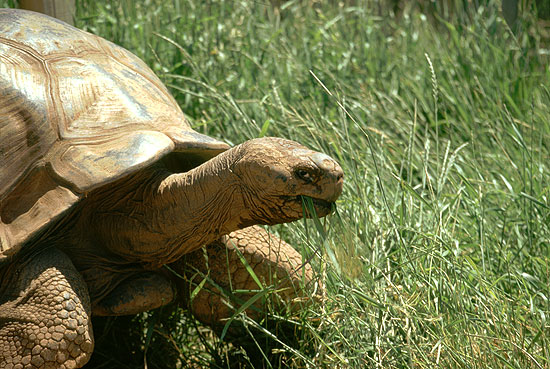
Reptile Gardens has found a unique niche in the tourist industry, falling somewhere between family entertainment and science education. Kids can experience the concept of extinction first-hand by petting Quazi and Tank, a pair of giant Aldabra tortoises, and by a visit to Methuselah’s Playground, an area which honors the Gardens’ most famous denizen with a bronze sculpture of the giant Galapagos tortoise. Bewitched Village, originally a trained animal show, is now a Wild West-style ghost town, with gemstone and arrowhead sluicing, blacklight 3D safari and goofy photo opportunities. An underground viewing bubble gives visitors a close look at the social, playful world of Prairie Dog Town.
Hundreds of orchids, bromeliads, caladiums and other exotic plants adorn the Sky Dome, initially constructed in 1964. Tropical rainforest exhibits are commonplace in zoos today, but back then it was the first of its kind in America. This is also where you’ll find the snakes, amphibians, crocs and bugs. Tortuga Falls is another lush and tranquil spot, graced in summertime by the call of Darwin the kookaburra, an Australian bird.
Then, of course, there are the animal shows, which originated with Earl Brockelsby. An early promotional postcard, entitled “Man Bites Rattlesnake,” pictures Brockelsby holding a rattlesnake next to his open mouth. “He did some very, very bizarre things. He did stuff with snakes that one of our employees today would be fired on the spot for doing,” his son said, shaking his head. “What he always told me is ‘I just always knew that they weren’t going to bite me.’ He felt he had a ‘simpatico’ with them. Whether he did or not I don’t know, but he never did get bitten. He never had a poisonous snake bite.”
In another bit of early-day hucksterism, Brockelsby dipped a common prairie rattlesnake in red dye, billing it as an exotic “Red Rattler.” His son laughs at the memory but is quick to point out that none of the species on display today is anything but genuine — as genuine as the fond memories of 76 years’ worth of visitors, many of whom rank their trip to Reptile Gardens as a highlight of their Black Hills summer vacation.
Editor’s Note: This story is revised from the July/August 1993 issue of South Dakota Magazine. To order a copy or to subscribe, call 800-456-5117.


 |
| Don and Candy Valle of Hermosa took a marker that may have adorned the grave of Wild Bill Hickock to the Antiques Roadshow taping in Rapid City. South Dakota Public Broadcasting photo. |
My wife and I are fans of the PBS series Antiques Roadshow, so we are really looking forward to the next three shows, airing at 7:00 p.m. on April 22, April 29, and May 6. More than 70 expert appraisers, in fields from Sports Memorabilia to Native American artifacts, set up shop in the Rushmore Plaza Civic Center last July for the taping. Around 7,500 tickets were handed out, but something less than that number probably came through the doors,”because it was hotter than Hades that day,” says Fritz Miller, Director of Marketing for South Dakota Public Broadcasting.
As we watch the show, Carolyn and I sometimes wonder what we would bring to a Roadshow event if ever we had the chance. I mentally stroll through our house, evaluating our possessions, and so far … nothing has come to mind. We have lots of old furniture; other than a couch, several mattresses, and a card table with four folding chairs, we have never bought anything in a furniture store. Unfortunately, it is all just plain old functional stuff — nothing I’d think of hauling anywhere for an appraiser to look at.
We also have an attic and countless bins and boxes of bric-a-brac — three or four families’ worth, I’d guess, because Carolyn never passes a second-hand store or rummage sale without stopping. She spent some time organizing her treasures last winter, and as she did, she looked up a few things online to see if they had any monetary value. I was shocked to learn that there is somebody out there willing to pay $9 for an old liver pill canister she bought for a nickel. I was ready to ship it before the guy changed his mind, but of course, Carolyn couldn’t part with such a prize. Thus ended our best shot at striking it rich in the collectibles game.
With our small population, there is a fair chance anyone who appears on Antiques Roadshow will be recognized by their neighbors, or even by people across the state. Someone you know might even hit the proverbial jackpot.
It won’t be me, but here’s hoping it’s you!

Lori Kiehn shared recent photos of Rapid City’s ever-changing Art Alley. It’s located between Main Street and Saint Joseph from 6th to 7th Street.
Kiehn lives in the Black Hawk and Rapid City area. “I have been in love with photography since I was a young girl,” Kiehn says. “I started off by playing with my grandparents’ old ‘brownie’ camera.”


Editor’s Note: Welcome to Fore South Dakota, the first in a series of columns showcasing South Dakota’s special places to play golf.
Nestled in a development just outside of Rapid City on Sheridan Lake Road is South Dakota’s only golf course that is open for play parts of every month of the year. The Golf Club at Red Rock is a public course that will let you enjoy all the golf you can handle for the day during the winter months for $49. Most South Dakotans don’t know about this little golf secret kept by our Western brethren. But this past week, when the snow in our front yard measured over waist deep, my son, Jake, and I checked out the rumor of winter golf in South Dakota. Red Rock did not disappoint.
The five sets of tees play from 5038 yards (manageable for any golfer) to the tips of 7114 (a long ways to go). The slope for the blue tees (4th longest) is 138. Slope is a universal measurement established by the United States Golf Association (USGA) to advise a golfer how hard it is going to be to find their errant golf shots. 113 is an average slope, and you probably need only two golf balls to make a round on a course with that slope. To play a 138 slope you would be advised to have a whole bag of balls along. For Red Rock, once the rough grows up on the hills’ sides in the spring, plan on using every ball in your bag.
Red Rock snakes in and out of — and over — valleys and canyons that are, well, red! Almost every hole plays along the side of a canyon, over a canyon, into a canyon, or from ridge to ridge across a canyon. Other than small, tame creeks, the only water your ball will see is in a pond that guards the front of the 10th hole.
The March days that we played there was an ice storm at home on the Coteau, and Red Rock was a pleasant 70 degrees for our golf sandals and shorts.
Jason Young, a Pierre native, is the PGA Professional at Red Rock. Since Jason answers the phone in the pro shop in the winter when you call to make tee times, he is also the most popular person for any South Dakota golfer to get to speak to between Thanksgiving and Easter. Jason is quick to get to the essence of Red Rock with the advice that, like no other course in South Dakota, the key to this course is to learn to use the slopes that exist on almost every hole. Here are a few of his pointers.
On #8, a par 3, hit to the right side of the green (or off the green) and let the ball roll down to the pin. Aim for the green, and when your ball stops rolling it will be somewhere in the gulley to the left.
On #9, a par 5 with a blind approach shot, either set it up to the right (where you will be able to see your way into a tough green structure) or land it off the green on the top of the hill and let it trickle down to the green and pin. Aim for the green, and if you find your ball, it may be down the hill and across the street.
On #14, a long par 5, you don’t need a driver. The 580 yards are designed to be played crest of hill (200 yards), to crest of hill (200 yards), to the green — which of course slopes in a manner that may send your ball down the hill and back to where you came from. Be warned, the second shot is over the second canyon — there is no fairway on the left side! If you aim to where the middle of the fairway would seem to belong, your ball will be recovered days later somewhere down the canyon sloping to the north.
Every hole at Red Rock has a similar story. Probably more than any other course in South Dakota, local knowledge is serious currency at Red Rock.
This writer is a very mediocre 15 handicap. A 15 handicap means that there are rare times when by some miracle a shot lands where Tiger Woods might hit it. More often, it lands where Mr. Rogers would hit it. But in the twists in turns of the slopes at Red Rock, every golfer has a chance for a Tiger Woods moment.
The 287 yard #7 plays around and tight against a hillside. If the golfer is blessed with a good fade (which on other days might be called a lousy slice), the ball can hit up on the hill to the right, power forward past the trap, and roll down to the green. I speak the truth — and have a photo to prove that on #7, a 15 handicapper can come within two yards of driving the green on a par 4 hole! Setting up the perfect opportunity, of course, for a three putt!
The 555 yard #14 does not require a driver, according to the club pro, Jason, but who goes all the way to Red Rock to lay up on a spring day? If you hit it just right, bounce over the ridge on the right, and catch the down slope, an average 220 yard drive, on the right day and with the right wind, can roll out to 305 yards! For one moment, you’re tour eligible. The next shot will disappear into the canyon (see Local Knowledge above).
Funny thing about golf — you get paired with strangers on the first tee box, and you always end the round with friends. We were joined on one round by Dick and Gavin Fawbush. Dick has a clothing store in Madison and his son manages a hotel in Rapid City. Gavin golfed for USD, and is a Red Rock regular, i.e. local knowledge. For example, on the par 3 downhill #15, Gavin explained that the hole punishes good shots and rewards bad ones. If you hit the big pine tree in the rough to the right front of the green, your ball will gently drop and roll to a place near the pin for an easy birdie. (Jake lucked into one of those.) If you hit a solid 3 iron into the 190 yard away green, you will find your ball somewhere in the woods, down the hill behind the green. (Jake got one of those too.)
When the snow is up to your windowsill in eastern South Dakota, remember that out west, in our state’s banana belt, there are hackers and duffers teeing it up at Red Rock. But no matter what time of the year, Red Rock is a great place to play challenging golf. And while the weather was different, some things in South Dakota never change. Since Madison was playing in the semifinals of the State A in Rapid City that day, like true South Dakotans, the Fawbush father and son picked up after the 12th hole — can’t risk being late for the state tourney tip off.
Lee Schoenbeck grew up in Webster, practices law in Watertown, and is a freelance writer for the South Dakota Magazine website.


