Posted on Leave a comment

Embracing Darkness

The days of darkness are here. No, that is not an ancient prophecy now come true. Nor is it some scare tactic about the state of the world. It is simply the time of the year when I leave for work in the gloaming and return in the dark. As we head into winter once again and the daylight shortens, one may think that finding good photo opportunities diminishes with the light, but that is not entirely true.

I first notice the shortened days in early autumn. My custom is to take a fall colors trip West River and I’m always a bit surprised how soon the sun sets in the first days of October compared to the usual long days of summer when I typically visit places like Custer State Park and the Badlands. This year I wasn’t ready to quit making photographs when the sun set, so I set out to try something new. I tried to find interesting roads with curves in the respective parks and then set up my tripod for long exposures and waited for the day to dim.

My interest in night photography has always been strong. The problem is that as I get older, the more I loathe giving up sleep. Last summer, something happened in the northern sky that renewed my willingness to overcome the loss of sleep and make images in the small hours of the night. Comet NeoWise graced the sky for a few short weeks in July. With that celestial object, my night photography interest was renewed. Fast forward to late February 2021 and you would have found me taking long exposure sequences of Sioux Falls city scenes to make short time-lapse videos for Midco Sports coverage of the NSIC and Summit League basketball tournaments. A long exposure (anything longer than a couple seconds) at night allows you to capture moving cars with the headlights as streaks of light.

I wanted to try this same concept in the parks this fall. The goal was to find interesting stretches of road with passing cars and shoot them at dusk to create unique images. It was a learning experience, as I discovered that a strong night breeze plays havoc with a long lens even when it is on a tripod. If you look closely at the image of the Big Foot Pass road at Badlands National Park, you’ll notice the taillight lines are not smooth. Wind on my lens caused this, not crazy driving. I also tried this technique along Needles Highway and Spearfish Canyon National Byway. My favorite image is from the canyon. A small white tour bus came by, and with its lights positioned higher, gave an added vertical element to the streaks.

One last note about shooting night scenes in winter. With the air turning colder, the normal humidity and dust particles in the air are reduced, so the stars are seen more clearly. Add in the fact that the solar cycle is turning active again and there are new possibilities for glimpsing (and photographing) the elusive northern lights while gazing out and up into the night.

Christian Begeman grew up in Isabel and now lives in Sioux Falls. When he’s not working at Midco he is often on the road photographing South Dakota’s prettiest spots. Follow Begeman on his blog.

Posted on Leave a comment

Autumn in the High Country

Autumn always comes early to the high country. While late summer lingers across the rest of the land, the high coulees and upper draws seem to consistently show the first real signs of the season. The last week of September is normally the peak of fall color in places like Spearfish Canyon, the Slim Buttes and even Sica Hollow in the northeast corner of the state. For this reason, I regularly find myself wandering the back roads and trails of the high country every year about this time. It’s not that I welcome the end of summer, but it’s hard not to love autumn around here.

The beauty is fleeting, admittedly. When the weather patterns switch in this season of change, it brings strong winds that rob the trees of their dying leaves. That’s a lesson unto itself. There is beauty in endings. Sad though it is, it helps that there is promise of new life returning after the long winter.

This year I started around Sica Hollow during the golden hour on September 26. I was a bit early for fall color peak, but the color that was showing in the late afternoon and evening light seemed to accent the autumn beginnings quite wonderfully. A couple of days later I hit Badlands National Park, where the upper draws of Sage Creek were brilliant. One thing I learned is that yellow-leaved trees make for interesting visuals in a black and white image. They look nearly white.

After spending a day and half wandering around the Badlands, I made my way for Custer State Park. Needles Highway offers unique autumn color combined with winding roads and sweeping vistas. The fall foliage along the park’s creeks also offers colorful hues. From Custer State Park, I headed to the high country of Lawrence County by way of the Mystic and Rochford roads, finally ending up in Spearfish Canyon by late afternoon. This scenic byway is a must-drive in autumn. One extra perk this year was a small herd of mountain goats grazing near Bridal Veil Falls.

I finished up my tour of the high country in the first days of October by traveling north to the Slim Buttes and Cave Hills of Harding County. These areas are part of the Custer National Forest primarily for their stands of evergreens atop the buttes and hills, but they both offer great stands of deciduous trees along the draws and valleys. These places have become an autumn favorite for me. This year I missed the peak at the Slim Buttes as the color was nearly gone when I passed through, but the Cave Hills were nearly perfect. It goes to show just how fleeting fall’s beauty can be here on the high plains, even within a single county. Even so, the drive and views were worth every minute. The good news is that now the rest of the lower country as well as city and towns should be starting their autumn transformations. So, if you couldn’t make it to the high country, you still have a chance to get out and enjoy the rest of the season.

Christian Begeman grew up in Isabel and now lives in Sioux Falls. When he’s not working at Midco he is often on the road photographing South Dakota’s prettiest spots. Follow Begeman on his blog.

Posted on Leave a comment

Mysteries Revealed

In the July/August 2021 issue of South Dakota Magazine, John Andrews and I collaborated on an article about the unique fens of the Glacial Lakes. This photo essay was a highlight for me, as I helped pitch it as well as provided the photographs. The last few years I have found myself drawn more and more to botany photography, primarily because of the wildflowers, but I’ve also learned how long, slow walks in the tall grass can be good for the soul. And not just walks in the tall grass, either. I’ve found amazing blooms in hillside springs of the Northern Black Hills as well as the warm waters of Cascade Creek in Fall River County. But the fens continue to be a favorite place to take my macro and telephoto lenses on a walk.

The article mentioned a”fen walk” organized by The Nature Conservancy in late August. I marked that weekend on my calendar as a great opportunity to learn more about these areas from folks who’ve studied and/or managed them over the years. I figured the tour would also make for a great follow-up column here, as well.

It was a foggy morning when just over a dozen fen walkers met at Jacobson Fen Preserve in rural Deuel County. The weather seemed fitting since many of my notions and ideas about fens came from English literature that often describe fens as foggy, misty and mysterious. Before the morning was over, there would be wind gusts, mist and then sunshine. The inconsistent weather did not stop us, however. Soon we were striding through cattails and bull rushes well over 6 feet tall into the heart of a calcareous fen and all its treasures just below one of the northern slopes of the preserve. Blooms of note included lesser-fringed gentian, Kalm’s lobelia and American Grass of Parnassus.

Just below the fen, Owen McElroy, who accompanied from the Game, Fish and Parks Department, discovered what was likely the find of the day. From a muddy side bank, he pulled out a bison horn. It has been more than 150 years since the last wild bison roamed the area. Other finds of interest included Riddell’s Goldenrod, arrow grass, jewelweed and tiny fringed willowherb blooms that I’d never noticed before. And that is the beauty of taking the time to do such walks — meeting and learning from like-minded folks as well as spending time in a small piece of wild nature, right here in our own backyard.

Once the sun emerged, I left the group to return to the Grass of Parnassus blooms to get macro photos in good light. From there I wandered south to 7-Mile Fen, nearly due east of Clear Lake. Just beginning to bloom were wild orchids that I’d never seen in my life before the previous summer. Great Plains lady’s tresses were waving in the breeze, just beginning to show their lovely white blooms. It was a wonderful way to end my time in fen country, and great motivation to come back.

Christian Begeman grew up in Isabel and now lives in Sioux Falls. When he’s not working at Midco he is often on the road photographing South Dakota’s prettiest spots. Follow Begeman on his blog.

Posted on Leave a comment

A Decade of Photos

On Aug. 19, 2011, South Dakota Magazine published my first photography web column. The magazine had just redesigned its website and the editors were looking for new contributors to help the cause. I took on the opportunity with some trepidation as well as excitement. At the time, photography was a growing passion, but I knew that contributing to the magazine just raised the bar. The last thing I wanted to do was contribute mediocre material. I was just given the focus I needed to not only get better but learn a lot more about life in South Dakota.

Sometimes I’m asked if I have a favorite photograph that I’ve taken over the years. I truly don’t know the answer. As I look back over that last decade’s worth of columns, there are standouts. Learning about and photographing the northern lights ultimately got one of my photos shown on the CBS Evening News on St. Patrick’s Day of 2015. Shimmering green-tinged aurora in the early morning hours of that particular holiday is newsworthy, I guess. Speaking of amazing sky scenery, I’ve witnessed wondrous skyscapes over the last 10 years. The most striking vistas come in the aftermath of storms, when the first rays of sunlight appear. The resulting rainbows and/or colored clouds have been more beautiful than any master painter could conjure.

My side project of finding and photographing the region’s country churches was born from this column. The”Prairie Sanctuaries” project opened another door to a new passion project that I’m very honored to be a part of. I first saw and photographed tiny Rabbit Butte church in early July of 2014. Singer, songwriter and author Eliza Blue had recently been married there and she reached out to me by commenting on my photos. We met a few years later to do the first of a short video series for the Prairie Sanctuaries Facebook page and have collaborated on various projects ever since. The most recent is a half hour television show called”Wish You Were Here with Eliza Blue.” After four experimental shows and a holiday special last year, we decided to go ahead with new episodes starting in September to air on South Dakota Public Television’s social media channels as well as their traditional broadcasting channels. The irony is that I typically don’t feel comfortable putting people in front of my lens. Even so, the folks I’ve met and worked with along the way have all been worth overcoming that hang-up. Plus, the travel and planning for the shows have given me more excuses to travel the region, camera at the ready.

As I look back over a decade’s worth of columns, I can’t help but notice when other photography interests were born. The first photo of a migrating Magnolia warbler at the Dells of the Big Sioux in May of 2016 is one example. That little guy has caused me to go out chasing warblers every May since. Most recently, botany photography has been the driving force to my wanderings. With wildflowers comes other wonders, as well: butterflies, hummingbirds and, of course, the signature South Dakota sunsets on the drive home. The last 10 years have been an amazing journey. Thanks South Dakota Magazine for the opportunity. It’s been a privilege.

Christian Begeman grew up in Isabel and now lives in Sioux Falls. When he’s not working at Midco he is often on the road photographing South Dakota’s prettiest spots. Follow Begeman on his blog.

Posted on Leave a comment

Natural Fireworks

Independence Day has come and gone. It has been a dry spring and early summer. The weather reminded of my days growing up along the Dewey and Ziebach County line near the Moreau River breaks. The’80s offered up dry and hot summers but we Begeman boys were always allowed to buy fireworks from a mail order catalog that would arrive around the first of June. I still remember watching anxiously for the UPS truck when the last week of June came around with about as much excitement as Christmas. That UPS truck would soon bring all the $10 to $15 worth of firecrackers, smoke bombs and bottle rockets that our allowances could afford. If it was dry, we always had the garden hose at the ready. If it was windy and dry, we had to wait. But the wait was always worth it.

I still enjoy a good fireworks show, but nowadays the kinds I actively seek are the tiny explosions of color and beauty found in the varieties of wildflowers blooming this time of year. A dry year, like this one, makes them a little tougher to find. A strong wind or even a mild breeze makes them difficult to photograph. Their beauty attracts insects galore, and some of those can be quite annoying, but all those troubles are a trifle when standing in a native prairie remnant under a vast blue sky surrounded by wildflowers waving in the wind. These scenes of the fleeting loveliness of summer are something I am compelled to search out and enjoy in South Dakota, not just for photography, but also to recalibrate and find that elusive center again.

Late June and early July found me in search of new wildflowers. From the Northern Black Hills to the fens of the northeast I searched for orchids and butterflies as well as the old favorites. Flowering prickly pear, yucca and black-eyed Susan found their way in front of my lens as well as stormy skies and even a short-lived rainbow. I re-established the fact that I’m a tick magnet. I ripped another pair of jeans while losing a battle with downed white spruce tree. Poison ivy somehow found its way to a single point of my elbow, much to my dismay. Deer flies, gnats and many other unknown harassing insects tried their best to annoy, but even so, the treasures found made up for the pains. Bog orchids, stream orchids, twin flowers and so much more was new to my eyes and camera. The vast array of flora that can be found in South Dakota is incredible, from alpine and mountain species through short-grass prairie country to the lush tall grass prairie remnants in the east. Throw in the ever-changing but always amazing Dakota skies and capturing images to share in this column was actually quite easy, incredibly fun, and truly a joy.

Lately rain has been finding its way to our region. Let’s hope that trend continues (minus the hail) and the late summer bloom continues to bring nature’s fireworks up from the good earth and into our view. And here’s to hoping each of you reading this can get out and experience a bit of summer’s visual poetry on the prairie yet this season. Trust me, it is good for the heart and soul.

Christian Begeman grew up in Isabel and now lives in Sioux Falls. When he’s not working at Midco he is often on the road photographing South Dakota’s prettiest spots. Follow Begeman on his blog.

Posted on Leave a comment

Growing in the Wind

The last few years I’ve found myself in knee deep grasses, spongy fens and alongside muddy sloughs more times than I can count. Why? Well, photography would be the easy answer, but in reality, the reason is more nuanced than simply getting an interesting photo.

First of all, you should know this about me: I’m a bit stubborn. Don’t believe me? Just ask my mom. I have learned this stubborn streak has an interesting way of working itself out in regard to my photography. It takes me a while to get interested in something. I mean really interested. But once I’m hooked, I’m a goner. Put another way, I’m initially reluctant (stubborn) to take on a new interest, but after a while I realize the interest that has caught my attention is what I’ve been searching for all along. This has happened to me in regard to country churches, spring birding and now botany (wildflower photography in particular).

Three Junes ago, I remember sitting in the middle of tall, green grass that swayed and flexed on a warm wind at Oakwood Lakes State Park in Brookings County. I was surrounded by blooming meadow anemones, blue damselflies and flitting orange skipperlings. I had my camera, but just sitting there quietly under the warm, early summer sun watching a little bit of nature just be, just wonderfully exist, was a revelation.

Three years later, you’ll find me wandering a Nature Conservancy prairie preserve, national park or state park nearly any time I can in the warmer months. I’ve heard folks say that being in nature is their”church.” I understand that sentiment, but it is something different for me. My time in nature is a respite, a reminder and a teacher. I find relief from the daily grind, and I’m reminded of the intricate creativity and knowledge of the Creator. As for the teaching, let me try to explain.

As a photographer who enjoys macro photography, I have learned the importance of getting down to a wildflower’s level to look a butterfly in the eye. In order to obtain clear and crisp focus as well as the best composition, I’ve learned to wait out the wind, to pause under cloud cover and make the most of sunshine. I’ve learned to look behind and above, even though I’m focusing on what is right in front. I’ve learned to take my time and not be in a hurry. I’ve learned that our prairies consist of far more than grass.

Up until the last few years, I had no idea that both our tallgrass and shortgrass prairies harbor so much diversity. It is something we South Dakotans are taught from an early age, but it wasn’t until I looked long and walked slow upon the grasslands that the truth really sunk in. Growing up West River, it wasn’t hard to find pastures never put under the plow, but on the east side of the state, the remnant tallgrass prairies are a lot harder to find. Thankfully they still exist in places. I’m grateful to those who’ve strived to maintain the tallgrass prairie and all its intricate glory. They are not only lovely places to wander with a camera, but also places to learn and grow.

Christian Begeman grew up in Isabel and now lives in Sioux Falls. When he’s not working at Midco he is often on the road photographing South Dakota’s prettiest spots. Follow Begeman on his blog.

Posted on Leave a comment

They Are A-Changin’

The transition from winter to spring this year has been interesting. There wasn’t much snow to melt, but that didn’t mean winter was ready to leave. Most of April was a tug-of-war between warm and cold with strong winds being the only common theme. Early April saw a day with temperatures reaching the 80s followed by a very active thunderstorm. In early May, mornings of frost and snow still lingered across large portions of the state. We Dakotans are used to such things. The good news is that spring eventually wins out. The subsequent return of life to our lands is always a joyous sight. For the last nine years, I have endeavored to journal the transition between seasons in this space. Looking back over the column’s imagery and dates, it is interesting to see how each year played out. This particular spring has been dry — far too dry for many of us. So here’s to a wet, late spring and a happy summer to come!


March 19

The evening before the first day of spring found me in rural Lincoln County looking due west down a ribbon of road with the sun setting almost perfectly above it.


March 22

Taking a chance, I traveled to my favorite pasqueflower patch in Hanson County to see if our state flower had appeared. A few had, including lovely bouquet just opening to greet the world. On the way home, a signature South Dakota sunset colored the sky in western Minnehaha County.


March 28

I took my macro lens to Newton Hills State Park in search of snow trillium in bloom. I found a few, including one that had retained frost melt at the base of the bloom. I also found an intriguing ground snail shell in the leaf litter.


April 4

An early Easter found me on the road in rural Hand County where sandhill cranes foraged in a corn field during a brief stop on their spring migration.


April 5

A loud and boisterous spring thunderstorm rolled through southeastern South Dakota complete with rainbows and sharp lightning.


April 11

I spotted and photographed more pasqueflower blooms while traveling the backroads of Deuel County.


April 17

I spent some time watching waterfowl and a pair of kingfishers along the east fork of the Vermillion River in Lake County when a bald eagle swooped in and caused the ducks to scramble.


April 18

I watched pollinators, including this mining bee, enjoy bloodroot wildflower blooms at Union Grove State Park and spotted my first butterfly of the spring. A mourning cloak soaked up the sun at Terrace Park in Sioux Falls.


April 21

Three tom turkeys were strutting their stuff just south of Garretson in the evening light.


April 27

I visited a friend’s place in rural Turner County where I was entertained by month-old lambs and days-old barn kittens.


April 28

A ruby-crowned kinglet allowed me to take his portrait in an ornamental tree just beginning to bloom at Terrace Park in Sioux Falls.


April 29

Tulips in bloom along a Sioux Falls boulevard are always a sure sign that spring is truly upon us.


May 1

I traveled to Hartford Beach State Park along Big Stone Lake in Roberts County to do some birding and hiking and found Canadian white violets just beginning to unfurl on the forest floor.


May 2

While walking the trails of the Sioux Falls Outdoor Campus, I spotted a snapping turtle in the shallows.


May 4

The lovely sight and sound of yellow warblers returning highlighted an evening hike at Newton Hills State Park.


May 8

Much-needed rain fell throughout the state, including these drops on blades of grass in my front lawn.


May 9

I spotted a lone prairie smoke wildflower just about ready to bloom at the Jacobson Fen Preserve in rural Deuel County.


May 10

I hiked Palisades State Park searching for migratory warblers and found one of my favorites, a Magnolia warbler, in a chokecherry thicket with blooms setting. The Magnolia warbler was the first one to really catch my attention many springs ago. Going”warbling” in May has become a favorite pastime.

Christian Begeman grew up in Isabel and now lives in Sioux Falls. When he’s not working at Midco he is often on the road photographing South Dakota’s prettiest spots. Follow Begeman on his blog.

Posted on Leave a comment

High Plains Heaven

Every April, the Fort Pierre National Grasslands staff set up three blinds in the prairie hills southwest of the capital city. The reason? To provide the public an opportunity to watch something quite special in the early-morning hours. Greater Prairie-Chickens and Sharp-tailed Grouse gather at their respective leks and begin to dance. Rain or shine, cold or warm, snow or sun, the males arrive in their respective areas about an hour before sunrise and start to coo, cackle, woo and whir, all with a singular goal: impress the ladies. In my years of watching, I’ve never seen hens actually respond receptively as they make their shy and diminutive way through the leks. But they do watch the dancers quite closely, often right up until the closest male gets a little too close for comfort and then the hen moves quickly on. Who knows? Maybe playing hard to get is all part of the process.

I’m not a scientist, but I love our wild grasslands and the hidden treasures they sustain. I grew up in Sharp-tailed Grouse country, but I never saw their spring dance before sitting in a blind at the Fort Pierre National Grasslands. As a photographer, the colorful and quick displays are challenging to capture. The Greater Prairie-Chicken’s style is a little different in that they aren’t quite as fast on their feet but employ a bit more color and sound into their routine by filling bright orange neck sacs with air. The”wooing” sound that comes next is referred to as”booming” and can be heard from miles away on a clear and calm morning.

Unfortunately, the two mornings I spent in the blinds this spring were not very calm. The wind has been extra active this time around the sun; the first morning it was gusting above 20 mph well before dawn. The temperature dropped below 20 degrees, and although the blind cut down the wind’s bite it was bone chilling, and I was happy for extra blankets and long johns. Still, the prairie chickens danced and boomed. When the sun finally climbed above the horizon, the warm light revealed around 18 males spread out on the hilltop along a two-track prairie trail. Some were fighting, some were squawking, and I even saw a few hens stroll through. To be smack dab in the middle of this ancient dance on the prairie made suffering through the cold worth it.

A couple days later, I was in another blind a little farther south. Here, sharpies danced all around the blind. They clicked and clucked and stamped their feet so rapidly that even my fast shutter speed couldn’t capture the action without a blur. More hens arrived and all the fellas picked up their pace. A couple meadowlarks joined in with their signature song and I was in high plains heaven.

A heartfelt thanks to the grasslands staff for providing this opportunity at no cost every year. They say that birders and enthusiasts come from all over the world to watch our prairie dancers. You can too through the rest of April. Simply contact the office to reserve a blind, get up well before the sun, settle into your blind and prepare for show like no other.

Christian Begeman grew up in Isabel and now lives in Sioux Falls. When he’s not working at Midco he is often on the road photographing South Dakota’s prettiest spots. Follow Begeman on his blog.

Posted on Leave a comment

Sunrise, Sunset’

I’m not much on musicals. I find it hard to stay with a story when folks sort of just burst into song and dance. Nothing against music or dancing, it is just a personal preference. That said, there are a few musicals of which I am quite fond. The Sound of Music was a movie that my family watched together on more than one occasion when I was younger. Our school performed The Music Man when I was in eighth grade and our cast pulled from elementary kids to seniors.

One musical, however, rises above all others in my esteem. I first saw Fiddler on the Roof in grade school. It was late in the school year and I think our music teacher just sort of ran out of things to try to teach us, or maybe he lost his patience. Either way, after our spring concert, we spent our music class time watching the 1971 movie version of the musical. Nearly every song is memorable, and the story was fun, funny, melancholy and downright tragic.

One of those memorable songs is also the theme of this month’s column.”Sunrise, Sunset,” composed by Jerry Bock with lyrics by Sheldon Harnick, is performed as the oldest daughter in the family is married to the young man she fell in love with (not the butcher that the matchmaker chose for her). Even as a grade schooler I could sense the weight of bittersweet time passing in the song. Now that I’m older the song is even more laden with meaning:

Sunrise, sunset
Sunrise, sunset
Swiftly flow the days
Seedlings turn overnight to sunflowers
Blossoming even as we gaze

Sunrise, sunset
Sunrise, sunset
Swiftly fly the years
One season following another
Laden with happiness and tears

Sunrises and sunsets happen to be a favorite thing for just about anyone with a camera to photograph, so much so that they far too often fall into the realm of photographic clichÈ. I’m not so quick to discard sunset photos. Every day the sun rises and every day it sets — sometimes with more flare than usual — and our South Dakota sunsets rarely disappoint.

In mid-February, I was doing my best to capture the last of the day’s light on freshly fallen snow north of Dell Rapids. It was a very pleasant sunset, but the magic wasn’t over after the sun went down. About 15 minutes into the blue hour, a low fog began to rise above the snow in the Big Sioux River valley. I stopped just southeast of Baltic, got my tripod and did my best to capture the ethereal scenes. All the while, in the back of my mind, a familiar chorus began to play. In the dying of the day, I was reminded once again of the gift of time I’ve been given and the promise of another day, another season, another year following another, laden with happiness and tears.

Christian Begeman grew up in Isabel and now lives in Sioux Falls. When he’s not working at Midco he is often on the road photographing South Dakota’s prettiest spots. Follow Begeman on his blog.

Posted on Leave a comment

Wise and Wonderful

Late last year I was asked to edit a video for Perkins County author and musician Eliza Blue to celebrate the new PBS Masterpiece series”All Creatures Great and Small.” I remember the original series played often on our TV back in the day. SDPB was the only channel we could tune in clearly, so whether I found it interesting or not my only option was such programming. I’m not complaining. My love for nature, history and geography owes a great deal to public broadcasting. This particular television show (and book from which it is based) derives its name from an Anglican hymn called”All Things Bright and Beautiful.” This hymn wasn’t one that was sung frequently in my home church, but even so, when I heard Eliza’s meditative version, I was more than happy to help with the video.

A small problem emerged. What would I use to cover the lyric,”All things wise and wonderful?” I remember joking with Eliza that video of an owl, which I didn’t have, would work perfectly. Fast forward to a winter’s walk in a heavy snowfall at Big Sioux Recreation Area on the edge of Brandon. Out of the corner of my eye I caught a glimpse of something I’d never seen before: a barred owl, relaxed as it sat out the weather. I took a few photos and then remembered my video assignment. I switched the camera to video mode, propped myself against the nearest tree trunk for steadiness and got my”wise” owl footage.

Why are owls portrayed as wise? Their rounded face is probably the most compelling reason. With a shortened beak and large eyes, an owl’s face seems more humanlike than other birds. Not all cultures see owls as wise and benevolent, however. The Lakota sometimes interpret them as bad omens, messengers between the world of life and death. Since the owl is a skilled hunter of the night, silent on the wing but sometimes quite spooky when making sounds, I can understand.

Throughout the year, up to nine owl species can be found in South Dakota. I have seen and photographed all but one. The Eastern screech owl has avoided me quite successfully over the years. I find this ironic as screechers often live closer to humans than other owls and are quite abundant, according to the experts. This year, I noticed a large number of short-eared owls in the spring and summer West River. This winter the numbers seem to be quite high East River; a troop has entertained birders in the Big Sioux River flats southwest of Brookings since Christmas.

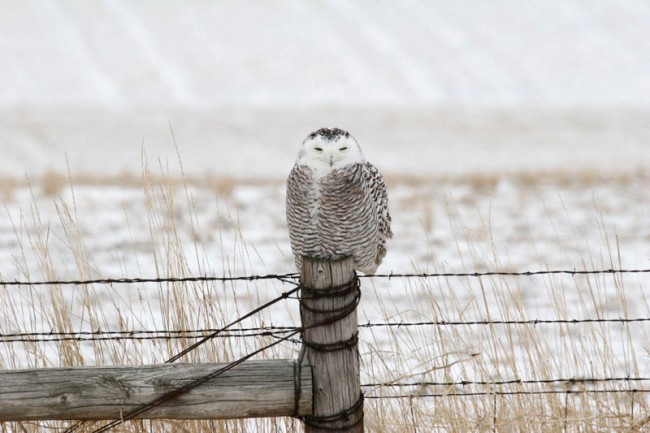
One of the most unique owl species that sometimes graces us is the snowy owl. This large white owl lives and breeds in the arctic tundra, but every few years large numbers of them descend southward in what is called an irruption. I first saw a snowy in 2011 near Okobojo, north of Pierre. In 2018, northwest Sioux Falls had three snowy owls that hung around for at least two weeks. One crisp Saturday, I watched nearly all morning as a snowy sat preening, stretching and snoozing atop a light pole just outside of work. This winter, I heard there were four in Spink County near Redfield. Last Saturday I set out to find them. I wasn’t disappointed. I located three of the four, including one very white and regal male. I’ve gathered those new photos for this column and have included some other favorites from over the years. Owls species not pictured here but found in other columns of mine in the past include the Northern saw-whet owl, long-eared owl and barn owl.