Posted on — Leave a comment

Mulled Wine, South Dakota Style

The warmth and spiciness of mulled wine makes it a favorite winter drink.

Our South Dakota Magazine crew started a coffee house called Muddy Mo’s in downtown Yankton a few years ago. On a frigid Saturday last winter, we decided to make mulled wine, both to warm our customers as they came in from the cold and also to try something new, which was the very inspiration for the shop.

Mulled wine is warmed wine with spices added, but a quick Google search shows recipes from across the world using varied ingredients and techniques. Not one to overthink, I quickly decided to mix an affordable red wine with some mulling spices from my local supermarket. Soon after pouring the simple concoction into a crockpot, a delicious cinnamon and orange aroma wafted through Muddy Mo’s — and it quickly drew customers who were happy to weigh in on my makeshift recipe.

“This is strong, too strong for mulled wine,” observed one kindly woman, who nevertheless drank several $2 glasses. Another visitor suggested that we add honey and offered to share his recipe. Someone asked if we could mix in a little apple cider next time. I don’t remember when something on our menu inspired so much conversation and interaction among customers.

Humans have been warming wine and adding spices since the dawn of the Roman Empire. The spice worked wonders to hide the taste of inferior wine, but it was also believed to strengthen immune systems during winter. Early recipes included saffron, pepper, laurel, dates, cinnamon, cloves, nutmeg, marjoram and cardamom.

Part of the fun of mulled wine is taking the ingredients and creating your own recipe. But, to ensure better success at the coffee shop this winter, I spoke to wine experts from across South Dakota. They were happy to share their recipes, along with ideas on what makes mulled wine the perfect winter drink.

SchadÈ Vineyard & Winery

VOLGA

Similar to our experience at Muddy Mo’s, Nancy Schade enjoys the community that mulled wine creates.”When you make it, it just brings people together. And there are opportunities to share recipes, because everyone has a different recipe,” she laughs. Jim and Nancy Schade founded the winery in 2000, and recently passed it on to new owners Dillon and Shelby Ringling.

Nancy recommends using SchadÈ’s Raspberry Apple Wine for mulling. The raspberries and apples are grown in South Dakota, giving a local taste to an internationally enjoyed drink. Nancy’s recipe is simple. She uses a 1:1 ratio of the Raspberry Apple wine and apple cider.”The cider gives the finished product a fuller flavor,” she says. Next, add mulling spice packets and warm the wine and cider in a crockpot (not to a boil). The winery sells its own mulling packets, but in a pinch, you can also find them at many supermarkets.

Prairie Berry

HILL CITY

Laura Schluckebier

Laura Schluckebier, the sales and hospitality manager at Prairie Berry, grew to love mulled wine during her time at the Hill City winery.”It’s made to share with other people,” she says.”As soon as the leaves change, people come in to have mulled wine next to our fireplace. The guests expect it.”

Mulling wine has also evolved into a family tradition for Schluckebier.”We go skiing at Terry Peak, then go home to drink mulled wine. Or we will split wood and then make mulled wine. It’s a tradition to do things outside in winter, then to share the drink. When you make it, it smells wonderful and it’s warming all around.”

Sandi Vojta, owner of Prairie Berry, became a fifth-generation winemaker at the age of 4 when she experimented with yeast and fermentation, she told us in a 2011 story for South Dakota Magazine. Her dad would take her out to pick chokecherries for wine, tying a piece of twine with a pail attached to her waist so she could pick berries with both hands.

Schluckebier recommends using Prairie Berry’s Pumpkin Bog for mulling. Made with South Dakota grown pumpkins, it’s slightly sweet with”undertones of cranberry and lemon zest.” Pour one bottle of Pumpkin Bog into a slow cooker on low heat. Add two tablespoons of light brown sugar, two tablespoons of mulling spice and orange slices. Leave on low for 45 minutes, making sure it does not boil.

After 25 years of producing internationally-award-winning wines, Prairie Berry will be closing soon. Sandi and her husband, Matt Keck, will continue selling as long as they have inventory. Pumpkin Bog was still available for purchase as this magazine went to print.

With the Wind Vineyard & Winery

ROSHOLT

Lisa Klein

Lisa Klein, who owns With The Wind along with her husband, Jeremiah, uses their Sacred Solitude wine for mulling. Made with locally grown Frontenac grapes, this dry red is complemented by Lisa’s recipe that includes orange juice and brown sugar.

Klein says mulled wine helps her embrace winter and everything that comes with it.”I’ve spent evenings wrapping presents while having mulled wine simmering on the stove,” Klein says.”We drink it while gathering with friends. During a frigid winter, it’s such a warm thing to serve your guests. You can’t get away from winter, so you have to embrace it.”

The Kleins have operated With the Wind for over 10 years. They hold wine tastings and events at their vineyard, where they tend to over 5,000 vines.


Sacred Solitude Mulled Wine

2 bottles of With the Wind Sacred Solitude wine

2 cups orange juice

3/4 cup (or to taste) brown sugar (or substitute maple syrup or agave)

2 oranges, sliced

1/2 cup fresh cranberries (optional)

10 whole cloves

6 cinnamon sticks

  1. Place a medium saucepan over medium-high heat on the stove.
  2. Add the orange juice and granulated sugar and stir until the sugar is dissolved.
  3. Add the red wine and all of the spices and fruits. The spices will be whole, not ground in a container, so their flavors will infuse into the liquid.
  4. Reduce the heat to low and simmer the mulled wine for 30 minutes. At this point, taste and adjust the flavor as necessary. You can simmer for up to a couple hours. Garnish with cinnamon sticks, orange peel or cranberries.

Mulled Wine can be paired with many foods. In Europe, it is often served at festivals with roasted chestnuts, and it’s also common to serve with roasted meats during the holidays. We asked Prairie Berry and SchadÈ wineries to share their favorite recipes to make with mulled wine.

Nancy Schade’s Never Fail Apple Dessert

Mix and put in a 9×9 inch pan:

4 cups sliced apples

1 teaspoon cinnamon

1 tablespoon flour

pinch of nutmeg

3/4 cup sugar

Mix together and spread over apples:

3/4 cup oatmeal

1/4 teaspoon baking soda

3/4 cup flour

1/2 cup melted butter

3/4 cup brown sugar

1/2 teaspoon salt

Bake at 350 degrees for 30 to 40 minutes. Cool and serve with ice cream or whipped cream.

Prairie Berry Kitchen’s Classic Cheese Fondue

1/2 pound imported Swiss cheese, shredded

1/2 pound Gruyere cheese, shredded

2 tablespoons cornstarch

1 garlic clove peeled

1 cup dry white wine

1 tablespoon lemon juice

1 tablespoon cherry brandy

1/2 teaspoon dry mustard

Pinch of nutmeg

Coat cheese in cornstarch. Rub fondue pot with garlic, then discard. Over medium heat, add wine and lemon juice. Bring to a simmer. Gradually stir in cheese, melting slowly to encourage a smooth texture. Stir in brandy, mustard and nutmeg. Serve with French bread, Granny Smith apples or blanched veggies.

Editor’s Note: This story is revised from the January/February 2025 issue of South Dakota Magazine. To order a copy or to subscribe, call (800) 456-5117.

Posted on — Leave a comment

Art-Warming

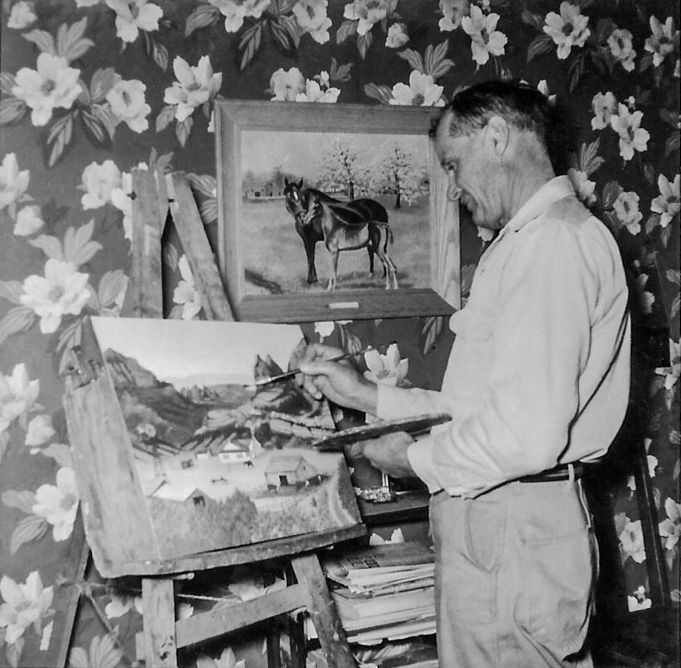
The grandchildren of Fred Mohling, pictured painting in his Aurora County farmhouse in 1957, are rediscovering his artwork and are exploring ways to share it with South Dakotans.

In 1959 Aurora County farmer Fred Mohling traveled to California for the Rose Bowl. Naturally, when he returned to South Dakota, friends and family asked about the game.

Mohling couldn’t tell them much. He hadn’t gone to watch football, he explained, but to see the roses in the famous parade. At home, in addition to selling grain and cattle, Mohling created paintings, including still lifes with flowers. Today, 40 years after his death, his descendants are sorting through his works: Midwestern and Western landscapes, people, waterfowl, horses, hunting dogs and still lifes. The family doesn’t necessarily want to sell the art but would like to exhibit some of it, maybe at libraries as a starting point. The learning curve is steep, exploring exhibition protocol, likely venues, copyright and even framing (when Mohling framed his art he sometimes purchased cheap and rather gaudy hardware store frames).

There’s another holiday season story about Mohling. Seventy years ago this December he skillfully painted a life-sized Christmas Nativity scene and other holiday images on plywood and illuminated them with 100 white and colored lights for his grandchildren. He set it up on his farm, just south of the Aurora-Jerauld County line, where it delighted more than his grandkids. As word spread, hundreds of South Dakotans drove 75 miles or more, on two-lane roads in winter, to see the scene. Memories of the Nativity art are mostly all that remain. The painted figures largely disappeared. Mohling’s farmhouse and ag buildings were razed for corporate farming, and the farmer-artist himself died in 1984.

Harmony Friends Church

His painting of a mountain scene is part of the Center for Western Studies collection at Augustana University in Sioux Falls, and another found a home in the Wessington Springs museum. But most were divided among family.”There are more than we remembered seeing around his house years ago,” says grandson John Swanson of Rapid City. He believes his grandfather completed more than 150 paintings, usually ranging from 8-by-10 inches to 16-by-20 inches in size. Another grandson, Greg Miller, notes that Mohling mostly used oils on board surfaces, and also drew with charcoal as well as colored pencils late in life.”There was something about winter scenes,” Miller says.”He looked at snow much of the year and liked it.” Miller has taken a lead role in documenting Mohling’s life through newspaper clippings and public records.

Great-grandson Ryan Aalbu of Spearfish was young when Mohling died and only vaguely remembers the man, but he treasures his paintings.”Mine are outdoor scenery and animals,” Aalbu says.”I didn’t know until fairly recently that he was a good portrait artist, too, painting people from American presidents to his own family.”

Fredrick Henry Mohling, born in 1894, grew up as the eldest of eight children on a Nebraska farm. At home he spoke German but made the mental switch to English for school. A capable student, Mohling hurried through his in-school lessons so he could draw at the end of classes, and at age 12 he won first prize for a painting he took to an Old Settlers picnic.

He married Tillie Maschman, and they had seven children, which left little time for art. The Mohlings moved to South Dakota to farm in 1920 and weathered bad ag prices that decade and the Dust Bowl and Depression of the 1930s.

The hard times led to President Franklin Roosevelt’s Works Progress Administration. Gov. Tom Berry insisted that art be part of the WPA and Mohling renewed his interest in painting by taking three classes in Mitchell. He was also inspired by a landscape artist he saw at the State Fair.

Blue Jay Wonder

Sadly, his family thinks that Mohling’s main motivation to paint was his deep grief after Tillie died suddenly from an appendix ailment in 1940. Art became his therapy, perhaps, or at least a way to occupy his mind.”When you do something requiring great attention to detail, you can’t think about other things,” Swanson says. A family member recalled coming home from a dance to find Mohling working at his easel in the middle of the night.

Still, Mohling didn’t hit his stride with art, in terms of quality and output, for a few years. There was always work on the farm. He also landscaped his big yard, created a lily pond and outdoor fireplace, and he built swings for his kids and grandkids. When Tillie died, two of his children were young adults who helped to raise the younger five. Mohling enjoyed traveling by car with his family and drove them to the Black Hills to see Josef Meier’s Passion Play, a religious drama performed in Spearfish on what was billed as the world’s”longest outdoor stage,” all of it skillfully lighted. Maybe the biblical production was the inspiration for Mohling’s own outdoor Christmas presentation.

“That could be,” Swanson says.”He liked visuals, obviously, and things built big. He drove to Texas once to see the new Houston Astrodome, which was called the eighth wonder of the world.” The family has no record as to whether Mohling saw a ballgame during that trip or simply admired the big domed stadium.

Swanson describes his grandfather as a type of man most South Dakotans might know. He was accomplished in agriculture, could build anything, and — far from the stereotype some Americans held of rural Midwesterners in that time — wasn’t cocooned in his own locality but interested in the wider world.

Mohling took enough interest in his 20 grandchildren to buy or make each a meaningful gift every Christmas, granddaughter Jane Aalbu remembers. His gifts would only get better: one of his original paintings for high school graduation and another as a wedding present if a grandchild got married.

“He was mild-mannered and soft-spoken, and fairly easy to talk to,” says Swanson, who was in his 20s when Mohling died. The farmer-artist didn’t drink except for perhaps a glass of Mogen David wine on holidays. Knowing his distaste for alcohol, his descendants have had light-hearted discussions about whether it would be appropriate to serve higher quality wines at exhibits of his art.

Through years of raising children, bonding with grandchildren, and adapting to post-World War II ag technologies, Mohling kept improving his art techniques. Swanson recalls seeing the classic Blue Boy (a portrait by 18th century English artist Thomas Gainsborough) among his grandfather’s possessions and assumed Mohling admired it and bought a print. As it turned out, Mohling copied it stroke by stroke — a time-honored method that artists have used to fine-tune their skills.

Buckeye Brown

Mohling didn’t seem interested in selling his works but in 1955 Wessington Springs hosted a horse show. Mohling loaned horse paintings to Rukstadt Hardware Store for a window display during the event. An Indiana man admired a threshing scene and Mohling agreed to sell it to him. In 1956 he won two blue ribbons at the State Fair; he’d previously taken home art ribbons from Huron but never before a first-place honor, let alone two. Those blue-ribbon paintings almost certainly remain in the family’s possession, and they hope to determine which they are.

In the late 1950s and beyond, Mohling took his art to appreciative rural audiences in Clark, Faulkton, Wessington Springs, Mitchell and Fairbury, Nebraska, near his birthplace. Plankinton journalist Adeline VanGenderen reported on a show where a woman rhetorically asked how anyone could choose a Mohling favorite given the wide variety of scenes and subjects.”We got to thinking this over, and how could you?” VanGenderen wrote.”First your eye would be drawn to a moose beside the lake; deer drinking from the stream; an Indian pony and its rider; you could almost smell the dust of the covered wagon as it groaned westward.”

If art scholars had read VanGenderen’s description, they might have concluded that Mohling was part of the Regionalism art movement, especially popular in the rural Midwest in the mid-20th century and best epitomized by Iowa painter Grant Wood. The style became popular nationally as Americans first feared that the Midwest was being blown off the map by Dust Bowl winds, and then again as they celebrated that it wasn’t.

But there’s no evidence Mohling saw his art as part of any movement or school of thought. South Dakotans tend to be skeptical of those who categorize local visual art as Fine, Folk, Regionalism or any other grouping. Most would agree with the late University of South Dakota professor and author Graham Thatcher, who warned against associating with any”sophisticated art nerd who asks you what you think in order to get an opening for his or her well-rehearsed sermonette.” Thatcher stressed, in his book I Know What I Like! Everyone’s Guide to the Arts,“There are no rules in Art Ö there is only taste.”

Mohling met the tastes of South Dakotans half a century ago. In 1974, friends and family turned out in force for his 80th birthday celebration in a Wessington Springs ag building, its interior walls decorated for the day with 80 pieces of his art.

Today, Mohling’s descendants are working to determine whether 21st century South Dakotans find significance in the art, as well. In August the family put digitized images on a video loop and played it at Mitchell’s Corn Palace Festival. They may do the same at the State Fair next year. A professor has suggested the paintings may hold value for students learning about both the techniques Mohling used and the times in which his art took form.

Relatives don’t anticipate a posthumous discovery of Mohling’s talent beyond the borders of South Dakota. They’ll be happy if small groups of observers see something in his art that warms their hearts.

That’s what art did for Fred Mohling, and it was quite enough.

Editor’s Note: This story is revised from the November/December 2024 issue of South Dakota Magazine. To order a copy or to subscribe, call (800) 456-5117.

Posted on — Leave a comment

What the Bones Say

Centuries-old bison kill sites on Candice and Dean Lockner’s ranch near Ree Heights may help us learn more about the Indigenous people who lived and hunted here.

The bison are just where the scouts have said they would be, grazing the warm-season grasses near a natural spring at the west edge of the broken country.

This hunt has been planned for weeks. Once everyone is in place, people wave branches and robes, moving toward the animals, hazing them toward the bluff. The slope is steep enough that one or two animals injure themselves, but others scramble safely into a deep ravine with no outlet. The lower opening of the canyon is blocked with fallen timber.

The animals are confused. They plunge against each other wildly, with no place to go. Hunters move into place at the edge of the ravine above them.

Archaeologists believe a scene like this occurred almost 1,000 years ago in Dean and Candice Lockner’s pasture near Ree Heights in central South Dakota. Dean found a layer of bones covered by about a foot of native sod in 2011 while checking cattle. The Lockners suspected they had found a bison kill site, with good reason. Archaeologists carried out a dig in 1960 at a bison kill site along the ridge 2 1/2 miles east of the Lockners’ discovery, and there is a later find of bison bones and artifacts, though never professionally excavated, just a few hundred yards east.

The Ree Hills — a mesa that gives the town of Ree Heights its name — rises 391 feet and covers about 180 square miles in Hand County.”It’s kind of like an island in the prairie, raised up above everything,” says Augustana University archaeologist Aaron Mayer.”And it’s a vantage point. You could see the bison herds from dozens of miles away. They were definitely using that area for different kill events.”

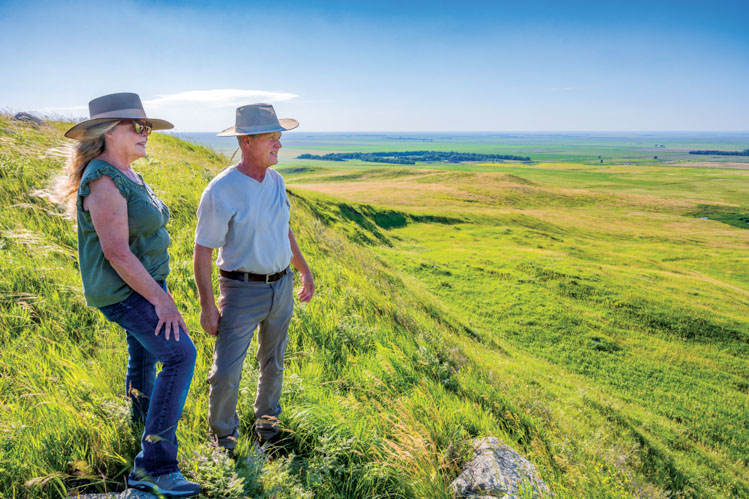
Dean Lockner found bison bones, estimated to be nearly 1,000 years old, protruding from a ridge of soil in 2011. Each season of erosion and excavation reveals more at the site.

At that first Ree Heights excavation in 1960, archaeologists William Hurt and Robert Gant found a”kitchen” area for processing meat and stone piles on the bluff. Very likely it was a bison jump in the classic sense, where Native hunters drove the animals off a cliff or rim steep enough to kill or injure many of the animals.

When archaeologist Mike Fosha, then of the South Dakota State Historical Society’s Archaeological Research Center, visited the Lockners’ site at their request, he suggested the hunters probably used a different method there: an arroyo trap.

That’s possible because Ree Hills geology consists of shale capped by Ogallala sandstone and covered by glacial material. Because shale near the edges of the landform has slumped over time, there are irregular benches along the steep edge of the ridge where animals could be trapped — either by driving them down from the bluff above or up the slope.

At his initial visit in 2015, Fosha removed a mandible of a young bison for lab work. Zooarchaeologist Danny Walker, a specialist in Wyoming, estimated the age of the young animal at 1.1 years. That indicates that the hunters probably killed it in the month of June or July. Radiocarbon testing on a molar from the animal dated the collagen in the tooth to a time between A.D. 1180 and A.D. 1270.

After exploratory work in 2017 and another excavation in 2022, archaeologists have now found four stone projectile points — either from arrows or perhaps from shafts hurled with an atlatl — as well as a scraper that may have been used for processing hides. They have also found chips of stone that may indicate hunters were sharpening tools on site.

The age of the new site makes it too early to associate it with any of the Native American tribes known to history.”We cannot make any direct connections from Ree Heights to Mandan, Hidatsa, or Arikara, but it does not mean that those people could not have been their ancestors,” Mayer says.”It may be likely the Arikara and Mandan hunted there at some points in time.”

Gardner Deegan of the MHA Interpretive Center in New Town, North Dakota, — an organization that showcases the cultures of the Mandan, Hidatsa and Arikara peoples, or the Three Affiliated Tribes, on the nearby Fort Berthold Reservation — believes the tribes lived in other regions during their history. And elders say the tribes definitely knew how to use landforms in hunting.”I do know that in the culture, they used to do buffalo jumps,” Deegan says.”They would lead the buffalo off a cliff and the buffalo would fall.”

Doyle Crume and Del Compaan, volunteers from Webster, help excavate a bed of bison bones near Ree Heights in 2022.

Candice Lockner said she’s heard other Native Americans talk about their traditional technique for leading bison into a trap, perhaps by having someone pretend to be a bison calf while others push the herd from behind. It’s the same”pushing and pulling” principle that some ranchers instinctively use to move grazing animals today. Lockner says the technique could have worked well in central South Dakota.”Located above the three Ree Hills kill sites are very large boulders, behind which the fake ‘calf’ could hide,” she says.

Whatever the method, there are clues that people living in earth lodges on the James River near present-day Mitchell, about 100 miles east, may have been involved. An arrowhead found at the Lockners’ site is similar to an arrowhead found at the James River villages, which were active between about A.D. 1050 and A.D. 1200.

Interestingly, archaeologists have unearthed a large clay-lined basin at the Mitchell site that they believe was used as a bone grease processing station. Bone grease was obtained by applying heat to crushed bone. The grease may have been used not only in feeding the village, but also as an ingredient in a dried meat product such as pemmican.

Now, with the newly discovered bison kill site at Ree Heights from the same time period, archaeologists are considering the possibility that hunters from the river villages were traveling to the Ree Hills to harvest bison. It’s known from historical records that the area remained a reliable source of bison well into the fur trade era.

Ranchers are confident there are other bison kill sites yet to be discovered in the area. In August 2022, when archaeologists were working on the Lockners’ ranch, Dean and Candice walked along that tumble of hills in their rangeland and found yet another bone bed exposed by weather. Mayer, the Augustana University archaeologist, said Dr. Kristen Carlson, a faunal and bison bone expert, was on location and confirmed the site contains bison bones. Archaeologist Alexander Anton, now in Rapid City at the Archaeological Research Center, found a stone flake that indicates hunters with stone tools were on site at that new location, as well. It’s far enough from the first site on the Lockners’ ranch to be considered a new, separate kill site. That makes four confirmed bison kill sites in the Ree Hills.

As of 2018, there are more than 30 possible bison kill sites recorded in the database of the South Dakota State Historical Society’s Archaeological Research Center, but Fosha notes that many of those have not been confirmed.

In September 2023, the Lockners learned that the bison kill site on their ranch has been approved for listing on the National Register of Historic Places. Though the site won’t be open to the public, the couple says the recognition is an important step toward preserving what is hidden on their ranch and learning more about how early Native Americans hunted bison in the Ree Hills centuries ago.

ìYou may temporarily own land,” Candice Lockner says,”but you do not own the history.”

Editor’s Note: This story is revised from the September/October 2024 issue of South Dakota Magazine. To order a copy or to subscribe, call (800) 456-5117.

Posted on — Leave a comment

Gold at Home

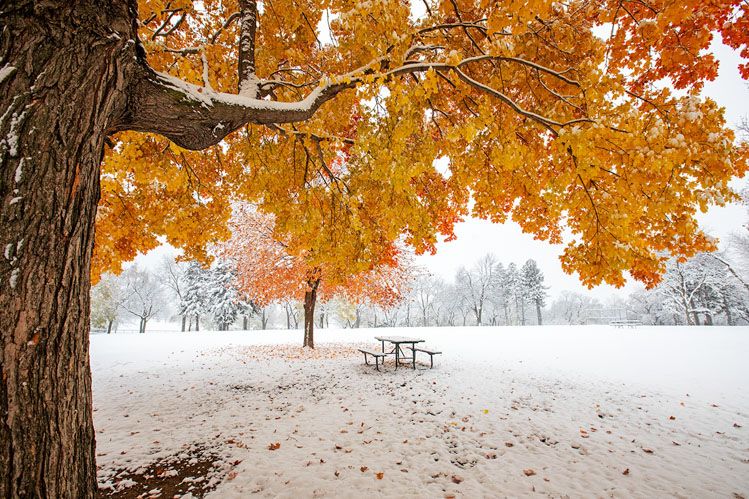
The autumn of 2025 has so far found me mostly homebound. The toils of everyday work life coupled with many of my nieces and nephews excelling in fall sports has kept me from my usual Black Hills trip seeking out the fall colors of the high country. The good news is that there is plenty of seasonal splendor to be found right here in Minnehaha County.

One of the perks of the good folks at South Dakota Magazine allowing me to share photos and thoughts in this column over the past decade plus is that I can look back at the seasons and compare and contrast the details. For example, this season has seemed like the green and warmth of summer lingered longer than past years, when in actuality, the peak of color is happening at about the same time. That said, it is a touch greener and the orange, yellow and reds are somewhat muted compared to years past. Even so, you can find the color of fall out and about if you take the time to go look.

I was able to take off work on October 24 to wander the city on a near perfect autumn afternoon. That’s when I noticed how much things have really changed over the years. There aren’t as many trees flanking the main falls at Falls Park, for starters. The views of downtown from Cathedral Hill are not nearly as easy to see because trees from the park land below the church continue to grow. And so it goes. I should remember that the only thing that remains constant is change even when it comes to photographing familiar locales, but I don’t really remember until confronted by visual proof.

Palisades State Park.

In this column, I will keep the words brief. Fall is both a beautiful and bittersweet time as the growing season comes to an end in a final colorful flourish. We all have more than a few months of the long cold winter lined up next. Even so, winter does make one enjoy the spring all the more. In this selection of photographs, the first half are from this year, and the second half are selections from past years that have never been published here before. May they inspire you to get out and enjoy a last autumn stroll or two before old man winter’s long arm reaches down from the north country.

Christian Begeman grew up in Isabel and now lives in Sioux Falls. When he’s not working at Midco he is often on the road photographing South Dakota’s prettiest spots. Follow Begeman on his blog.

Posted on — Leave a comment

What Makes Hecla?

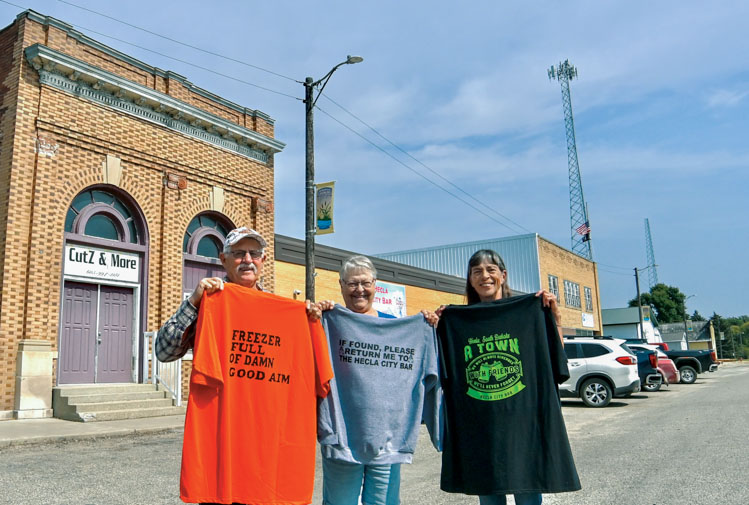
The Hecla City Bar offers a variety of apparel to visitors, as modeled by (from left) Terry and Diana Ulmer and Mary Freudenthal.

Outside influences shape the little town of Hecla, a tradition that dates to the last ice age. These days, a million winged and feathered guests migrate through the lakes and marshes south of town in the spring and fall. Humans follow the ducks and geese, and often find their way to the Hecla City Bar, where they traditionally pin dollar bills to the tiled ceiling and post photos of big fish on a”brag wall” near the door.

Hang around the bar and you eventually get a history lesson of the town. Its name comes from Hekla, Iceland, home to a stratovolcano. January Jones, a Hollywood actress who gained fame as Betty Draper in Mad Men, grew up here in the 1980s. A young couple, the Pioskes, operate an award-winning butcher shop across the street; sometimes on Friday nights they bring over a grill and cook ribs for everyone.

“It’s a pretty friendly town,” says Jess Monsen, who once ran the bar and now serves as the town’s deputy clerk.

Monsen says North Dakota is just 4 miles to the north, which explains the North Dakota State University Bison flags in some yards.”We’re pretty split between the Bison and the SDSU Jackrabbits.”

What about the Coyotes?

“I don’t even know what that is,” she quips. This is north country.

Trailers, tractors and other antique keepsakes decorate the yards of Hecla residents.

Hecla does feel like a town with a culture all its own. Jim Bauer, a woodworker who arrived from North Dakota as a youth in the 1960s, says the town has persevered even as many of its institutions have gone.

“There were 46 in my high school class in 1969,” he says. Today a memorial marker and bell are the only reminders that there was a school, which closed in 2002. Most of the downtown stores have been shuttered (though the butcher shop occupies three connecting buildings) and even some churches have left.

“Our Catholic church has closed,” Bauer says.”If I was rich, I would have bought the building and put up a big screen TV and broadcast the Sunday Mass, but I suppose the bishop wouldn’t have liked that.”

Bauer planned to parlay his woodworking skills into another enterprise for Hecla, but big business blocked him.”I was hoping to become a millionaire making caskets, and I started to build them, but the funeral home industry said I didn’t have enough liability insurance, so I never really got started.”

Weather is also not always friendly. As one of South Dakota’s northernmost communities, Hecla is among our coldest places in winter. Average January lows are barely above zero.

One asset that bishops, business tycoons and even Jack Frost cannot take from Hecla is the 21,498-acre Sand Lake Refuge that stretches for miles south of town. Fed by the James River, which flows down from North Dakota, the marshes and lakes — created when Ice Age glaciers melted 11,000 years ago — are a paradise for migratory birds and wildlife.

Hecla woodworker Jim Bauer keeps a collection of vintage lanterns in his shop at Fourth and Oak, including relics from trains, buckboards, police wagons and military vehicles.

Hunters and anglers, including many from North Dakota and Minnesota, make annual treks to the refuge. Most of the sportsmen stay at local lodges like Ruenz’s Roost or the Flatland Flyways, but others have bought homes and converted them to hunter’s cabins.

Monsen, the deputy clerk, says absentee ownership isn’t as controversial in Hecla as in mountain towns of the Black Hills.”Housing goes in cycles here,” she explains.”At times there isn’t a house to be found, and then a few years later there’ll be lots of homes for sale and not a buyer in sight.”

Refuge officials estimate that more than 75,000 people arrive every year to enjoy the outdoor paradise. They include birdwatchers, hunters and anglers.”There are three or four bridges near town that are the easiest places to fish from,” says Monsen,”and in spring and summer they might all be busy.” Northern and walleye are the prime catches.

Hecla culture today is a blend of farming, fishing and waterfowl. Antique farm machinery and duck/goose signage are common yard dÈcor, along with the Bison signs from that university in nearby North Dakota.

Editor’s Note: This story is revised from the January/February 2025 issue of South Dakota Magazine. To order a copy or to subscribe, call (800) 456-5117.

Posted on — Leave a comment

Highway 18 Color

Leaves may look the same wherever you go in autumn — red, gold and yellow — but every country road has its own personality.

Travelers on Highway 18, which dips and ducks above South Dakota’s shared border with Nebraska, probably don’t choose the route for fall colors. But the highway’s rural charm of cowboy culture, small towns and Indian reservations makes it an always-interesting drive that takes on a special aura in late autumn.

The terrain and the flora are especially scenic as you come and go from the spacious Missouri River valley in Bon Homme, Charles Mix and Gregory counties. Going from east to west, the farms grow into ranches. Trees, towns and people all become fewer, though no less colorful.

The river itself is a good place to stop and stretch. A beautifully manicured pioneer cemetery with 158 graves lies just west of the Fort Randall Dam, near the old yellow chalkstone chapel. A marker by the front gate lists not only the usual names and dates of the deceased, but also the causes of their deaths: pneumonia, lightning, scurvy, horse accident, drowned and — in the case of Herman A. Greening in March of 1886 –“found dead on prairie.”

What a beautiful place to spend eternity, or better yet to just explore on an autumn afternoon.

Editor’s Note: This story is revised from the November/December 2024 issue of South Dakota Magazine. To order a copy or to subscribe, call (800) 456-5117.

Posted on — Leave a comment

Pedestrian Politics

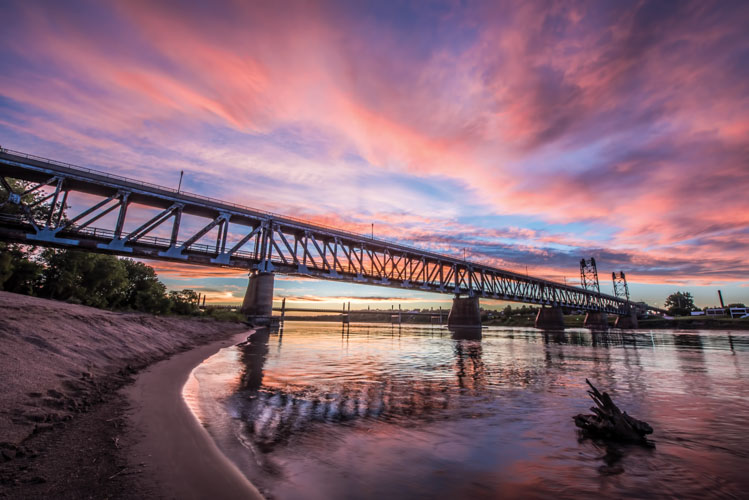
Yankton’s Meridian Bridge carried traffic across the Missouri River between South Dakota and Nebraska from 1924 until its closure in 2008, which ushered its new life as a pedestrian walkway. Photo by Pat Hansen

Bridges are famously controversial. Yankton’s double-deck Meridian Bridge, which turns 100 years old this year, is a classic example.

In the 1920s, Yankton booster D.B. Gurney and his supporters sought to circumvent the political process by raising private funds, but they still had to navigate approval from both Washington and Pierre before they could drop the first barrel of concrete into the Missouri River channel in 1922.

They also confronted politics within the Yankton community as they cajoled friends and neighbors to make major investments in the bridge. Gurney once donned boxing gloves for a meeting and suggested that the fundraising could require fisticuffs. Though Gurney’s friends thought he was joking, they quickly offered more money.

When the $1.1 million Meridian Bridge opened on Oct. 11, 1924, it became the first highway bridge constructed across the Missouri River in South Dakota. The double-decker design was chosen in anticipation of a railroad line that never materialized, so motorists driving south into Nebraska used the lower deck and northbound traffic took the upper. Drivers paid tolls until the cost was recouped in December of 1953. Gurney’s wife Henrietta paid the final toll.

Seven decades after the first cars rolled across, Meridian Bridge politics re-emerged as local and state leaders debated where to build its replacement. Then, even after the Discovery Bridge was completed, the Meridian was not free of politics. In fact, some of the old bridge’s most highly charged moments came in 2008 and 2009, after it was closed and slated for demolition.

The new Discovery Bridge was opened to traffic on Oct. 11, 2008 — the same date as the Meridian’s official opening 84 years earlier — with a gala ribbon cutting. Dan Specht, then the mayor of Yankton, remarked that the bridge shows the river does not divide South Dakota and Nebraska, but truly brings people closer together.

On that exciting afternoon, busloads of school children were diverted over the Meridian; the very next day, it was deemed unsafe for any use. Entrances were fenced and a sign declared it off-limits to the public.

The late Father John Garvey, then a feisty and good-natured Catholic chaplain at Mount Marty University and Sacred Heart Monastery, was the first to demonstrate the bridge’s future potential.

Garvey was known for challenging authority. He once was arrested for trespassing at Offutt Air Force Base in Omaha to protest nuclear weapons. He found it hilarious that the old bridge was strong enough for 18-wheelers and school buses on one day, and then unsafe for pedestrians the next. True to character, he climbed over the temporary orange fence and strode out over the river in the autumn of 2008. He did it with a twinkle in his eyes, and the Yankton police, with equally good cheer, led the grinning, white-haired priest back to Walnut Street.

Other Yanktonians were resigned to the idea that the old bridge would come down. Fortunately, a few local citizens — particularly Jim Means, a longtime businessman and civic leader who has been involved in nearly all of Yankton’s successful historic preservation projects over the last 50 years — patiently lobbied city commissioners, lawmakers and other officials to explore its potential as a pedestrian bridge.

“I always thought it was Yankton’s signature piece of architecture,” Means says.”I felt it would be short-sighted to let it fall into the river. Ever since it was built, it has set us apart from every other town. You could meet people from all over the country, and if they knew anything about Yankton it was that they’d traveled over the double-decker bridge.”

Opponents to preserving the Meridian included several of Means’ friends.”People thought it would be a waste of money. One of my neighbors said he didn’t think anyone would even want to walk on it.”

The Meridian Bridge was built with a lift span that rose 25 feet to allow steamboat traffic on the Missouri River to pass underneath. Raising and lowering the 220-foot span took about 8 minutes in each direction. It was deactivated in 1984, and the lifting mechanism was removed. Photo courtesy of the Yankton County Historical Association

But Means and others kept alive the notion of preserving the bridge, and eventually they gained support from two strangers south of the border: Bob Puschendorf, a native of nearby Norfolk, Nebraska, was then the state historic preservation officer in Lincoln, Nebraska, and John Kingsbury, a banker in Ponca, Nebraska, was chairman of the Nebraska State Highway Commission.

Puschendorf hoped to preserve the bridge for its historical and recreational possibilities. Kingsbury remembers that he was just looking for the finish line.

“The new Yankton bridge was one of the most controversial and environmentally complicated projects of my time on the commission,” he says.”As people in Yankton will remember, there were two factions. One wanted the bridge downtown as it is today and another group preferred a bypass bridge to the east. Nebraska was neutral, but at the time was generally preferring a bypass around communities.”

As the lead state for planning and construction of the new bridge, Nebraska was responsible for public hearings. Kingsbury felt the primary hearing should be in Yankton because the city had so much at stake.

“After discussion between the two states, it was agreed Nebraska could hold a public hearing in South Dakota,” Kingsbury remembers.”I am sure I was the first state commissioner to hold a large public hearing in another state. I believe [South Dakota transportation officials] felt a neutral Nebraskan would be a good choice to lead a controversial public hearing. There was a huge crowd with signs and buttons supporting their cause. The room was packed along with three television stations. The meeting went unexpectedly well. The speakers remained reasonably calm. In the end, both states agreed to the downtown location based on dozens of factors.”

Left in limbo, however, was the fate of the old bridge. A federal Environmental Impact Study favored preservation over demolition.

“Yankton was also asking Nebraska to make the new bridge more attractive than a flat, basic concrete bridge,” Kingsbury recalls.”Nebraska was opposed to the added cost because the many delays had greatly increased the cost projections. As negotiations continued, I recommended Nebraska beautify the new bridge with the pillars and lighting in exchange for Yankton or South Dakota taking ownership of the old, historical bridge.”

South Dakota authorities liked Kingsbury’s compromise, though they didn’t yet know if Yankton would accept responsibility for the Meridian. For nearly a year after car and truck traffic ceased on the old double-decker bridge, conversations and meetings continued in city hall and other locations.

Kingsbury’s proposal created an opening for Puschendorf and Jay Vogt, his counterpart in Pierre. Vogt was director of South Dakota’s historic preservation office; he was also well-acquainted with the Meridian Bridge. His grandparents had lived in Yankton, and one of his favorite childhood memories was of driving over the Missouri River on the double-deck bridge.

Yankton had yet another important connection: longtime local trucker Ralph Marquardt was then serving on the South Dakota Transportation Commission.

Puschendorf, Vogt and transportation officials from both states offered to work with the City of Yankton if its leaders wished to accept responsibility for the historic bridge.

Yankton attorney Nick Moser was a newly elected state representative in 2009.”It was one of the first things I worked on as a legislator,” he says.”All of the lawmakers from Yankton were in favor of preserving it but there were a number of people who were opposed for a variety of reasons: they thought no one would use it, they thought it might not be safe, some even thought it would be an eyesore.”

Moser and Yankton’s other lawmakers met on several occasions with Department of Transportation officials during the 2009 session, and they also organized meetings with Marquardt and city commissioners back home — often gathering at the publishing offices of South Dakota Magazine.

Demolition of the bridge would have involved liabilities, environmental issues such as lead paint and other unknowns, so preservation of the bridge appealed to some state officials who felt it was the safest decision.

Most city commissioners eventually embraced the view that the historic bridge still had something to offer but they were concerned that the city wouldn’t be able to afford restoration costs in the short-term, and that local taxpayers could be stuck with demolition costs sometime in the future.

Those financial worries were alleviated when state transportation officials agreed to devote $1.8 million from South Dakota’s share of the American Recovery and Reinvestment Act, which had been passed by the U.S. Congress to stimulate the economy after the Great Recession of 2008.

Kingsbury and his Nebraska associates, anxious to close the chapter on the Yankton bridge, offered the remainder of the restoration costs, which totaled $5 million. The two states also agreed to deposit their respective shares of the estimated demolition cost into a trust fund so that monies are available for that purpose if needed. The fund was started at $2.8 million but it has nearly doubled.

Two years later — after rehabilitation and the installation of a railing and lighting — the Meridian Bridge was opened to pedestrians and bicyclists in November of 2011. It’s difficult to find any detractors today, and the officials who were involved see it as a success.

“Every time I drive across the new bridge, I smile at the beautification,” says Kingsbury, who is still a banker in Ponca.

“Today I can walk out the front door of my office and I have a full view of the bridge,” says Moser.”I see people walking it at all times of the day, and all times of the year. On weekends from spring to summer and fall it’s packed.”

Means walks the bridge regularly and enjoys seeing the various ways it’s used by the community — from weddings to fundraisers, lovers’ padlocks, family gatherings and, of course, the constant stream of people who simply want to stroll at treetop-level above the grand Missouri River.

Editor’s Note: This story is revised from the September/October 2024 issue of South Dakota Magazine. To order a copy or to subscribe, call (800) 456-5117.

Posted on — Leave a comment

What’s in the Water at Wallace?

Wallace artists Adam and Madison Grimm are both federal duck stamp champions. Adam has won the Federal Duck Stamp Contest three times. Madison has three wins in the junior contest.

THERE AREN’T MANY ducks in Elyria, Ohio. It’s only 6 miles south of Lake Erie, but the second smallest of the five Great Lakes is hardly a South Dakota prairie pothole.

When Adam Grimm began hunting waterfowl, he and his dad drove an hour from their home in that far-western suburb of Cleveland to a public hunting area where the birds were often few and far between. It was no place to live for an outdoorsman, hunter and burgeoning wildlife artist.

Several years later, when he was married and had a daughter named Madison, he suggested moving to South Dakota, a place he’d visited as a child and had never forgotten. He spoke so glowingly of the state that his wife Janet, who’d never stepped foot within its borders, agreed to come check it out. Though it rained for five days straight, the young family was smitten and made the move.

They are now a family of six and firmly settled in Wallace, a town of 91 people in northwestern Codington County famous for being the birthplace of Hubert H. Humphrey, Minneapolis mayor, U.S. Senator and the nation’s vice president from 1965 to 1969. But the town could also rightly claim both Grimm and 17-year-old Madison among its favorite sons and daughters. They are both federal duck stamp champions, achieving success that the national art competition has never seen.

*****

Drawing was Adam Grimm’s first passion. He drew his favorite cartoons and other things he saw on television until one day Bob Ross appeared on the screen. His long-running PBS show The Joy of Painting captivated artists and non-artists alike, and Grimm began imagining life as an artist.”That Christmas I asked for oil paints,” he says.”I ended up not painting the way Bob Ross does, with the putty knife and three-inch brush, but I started to develop my own way. I achieved the look I was trying to get, and it just started to snowball.”

He sold his first drawing at age 11. His grandfather realized Grimm’s potential and Insisted on paying $20 for it.”He always had that confidence that I was going to be able to do this as a living. I remember him telling my sisters, ‘Your brother will probably never have to have a real job.’ He just had such belief in me, and I think that had a lot to do with my own thought process and thinking that I could actually do this. If I won something, he would call everyone he knew and tell them.”

Adam grew up in Ohio, where he worked at the dining room table on his early wildlife paintings.

The next year he was invited to exhibit his work at a local craft show. He sold every item he brought and went home with nearly 40 orders for drawings. He started following other artists and became encouraged that he could make a living drawing and painting.

At the same time, his passion for the outdoors blossomed after a trip to South Dakota. Grimm first became acquainted with the state through his grandfather, an avid collector of Native American artifacts. Then his father began making annual hunting trips, and when Grimm was old enough, he came along. The country was unlike anything he’d ever seen.”I didn’t know anywhere like this even existed. I think people in South Dakota take South Dakota for granted. They don’t realize that it’s not like this everywhere else. The people, the nature, it’s not this way.”

His Interests In wildlife and art finally married when he saw his first federal duck stamp, a pair of canvasbacks by Minnesota artist Bruce Miller that appeared on the 1993-94 stamp. Still a teenager, he began submitting artwork to the junior duck stamp contest, open to students in kindergarten through 12th grade. He never won, but he gained valuable experience.

Grimm enrolled at the Columbus College of Art and Design in Columbus, Ohio, though he struggled to fit in. His professors urged him to experiment in a variety of art genres, but he had a plan.”I was doing realism and wildlife art, and I told them that I would like to win the federal duck stamp one day,” he says.”No one at the college had ever really heard of it. It was like, ‘Who cares if you get a painting on some stamp?’ I remember telling them, ‘Well, it’s kind of a big deal if you win.'”

He began entering the contest as soon as he was eligible. In his first year, he submitted a painting of a mottled duck that took 16th place. The next year, his green-winged teal won eighth place. In 1999, the two species eligible for submissions were the black scoter, an ocean bird typically found in Alaska and along the Atlantic coast, and the mottled duck. He chose the mottled duck and pushed his own creative limits.

He thought back to a scene on a marsh near Timber Lake.”I had snuck up on this little water area and there were blue-winged teal out there,” he says.”The hen is pretty drab in color, but so is a mottled duck. She raised up and flapped her wings on the water, and the sunlight was shining through her feathers. That was so beautiful. If I could paint that, but with this other duck, that could win, because it would be more about the lighting on the bird than the bird itself. But I needed the reference. I was painting this in Ohio.”

Adam’s painting of a mottled duck stretching its wings won the 1999 Federal Duck Stamp Contest. He was 21, making him the youngest winner in the contest’s history.

Grimm contacted a biologist in Texas who was doing a banding project on mottled ducks and requested photos. Then, a friend sent him a mottled duck that he had shot (again, there aren’t many ducks in northern Ohio).”I would thaw the bird out the night before because I wanted that early morning lighting,” he recalls.”First thing in the morning I would run outside with this dead duck and hold it up and stretch the wings out. Then I would run back in and try to capture the colors I had just seen.

“I wonder how many of my parents’ neighbors were watching this crazy kid with a dead duck,” he laughs.”You do what you have to do in life, and there was no other way to do what I was planning on doing.”

Say what you will about his methods, his painting of a mottled duck stretching its wings in the soft sunlight of early morning finished first. At 21, Grimm became the youngest person to ever win the federal duck stamp contest.

What followed were several months of travel and delivering speeches about his artwork, which now appeared on a stamp that would be in hunters’ wallets and collections worldwide.”It’s almost like if you won American Idol,” he says.”You can go from being a nobody to being launched into the limelight. Everyone knows who you are. It’s a crazy thing.”

*****

Such a life-changing competition had humble beginnings that can be traced to legislation that another South Dakotan shepherded through Congress nearly 100 years ago. Waterfowl depletion on the Upper Plains was beginning to be a serious issue in the early 20th century. The federal government issued numerous protections, but it became clear that sustained recovery hinged on habitat protection.

South Dakota Sen. Peter Norbeck, who had already worked to establish wildlife preserves in western South Dakota and was the major force behind creating Custer State Park, became a champion of the Migratory Bird Conservation Act, a piece of legislation that had advanced in fits and starts during the 1920s. By 1929, he had a version that successfully passed through Congress. It created the Migratory Bird Conservation Commission, which approved the purchase or rental of wetlands upon the recommendation of the Secretary of the Interior. The only thing it lacked was a permanent funding source.

That came in 1934 with passage of the Migratory Bird Hunting Stamp Act, which required hunters to purchase a $1 stamp before hunting waterfowl. Ninety-eight percent of the proceeds from their sale go the Migratory Bird Conservation Fund for wetlands preservation.

President Franklin Roosevelt asked Jay”Ding” Darling to design the first stamp, which featured two mallards landing on a pond. Darling was an American cartoonist and two-time Pulitzer Prize winner who was serving as director of the Bureau of Biological Survey, the forerunner to today’s U.S. Fish and Wildlife Service. He had grown up in Sioux City, Iowa, where he developed an appreciation for the outdoors. After a year at Yankton College, he transferred to Beloit College in Wisconsin and had a successful career as an editorial cartoonist. He also founded the National Wildlife Federation in 1936.

Other artists were invited to contribute until 1949, when a contest was opened to the public. Rules, including that year’s eligible species, are released in the spring. Entries are taken from June 1 through August 15 and the winner is announced in September. A panel of five art, waterfowl and stamp experts judge the entries based on their anatomical accuracy, artistic composition and ability to be reproduced on a stamp. The winning design is featured on stamps that are valid from the following July 1 through June 30. Winners receive no compensation, but can sell prints of their work, which are highly collectible.

Today, federal duck stamps sell for $25. They are required for waterfowl hunters, and philatelists around the world are always eager to add them to their collection. The program raises about $40 million annually to conserve waterfowl habitat and, since its inception in 1934, has raised more than $1.2 billion to purchase more than 6 million acres of wetlands.

*****

With the big win under his belt, Grimm left school and became a full-time artist. Other accolades and milestones followed. In 2005, his painting of a wood duck won the competition to illustrate the Ohio Wetland Habitat stamp. Later that year, he and Janet were married.

Not long after the nuptials, the conversation turned to South Dakota.”I didn’t know if she would even want to move someplace like South Dakota,” Grimm says.”For people who enjoy nature, hunting and fishing, this area is so great. And for raising a family, this area offers so much more of the kind of life I want my kids to have. The place where I grew up just isn’t the same as it once was.”

Madison was a little girl when Adam began bringing her into the field to gather reference photographs for future paintings.

The couple and their new daughter Madison found a farm near Burbank in southeastern South Dakota and moved in 2006. Grimm quickly began taking advantage of his new surroundings. Searching for reference material in Ohio had always been a burden, but now he was surrounded by waterfowl aplenty. Donning a full ghillie suit, he began sitting in marshes and sloughs with his camera, spending hours photographing ducks in the early morning light.

They also began to notice Madison’s interest in art. Grimm recalls a particularly realistic drawing she did on a chalkboard at 2 years old.”Is that normal for 2?” he wondered.”She was our first child, and we weren’t around other kids her age, so I didn’t know what was normal for a 2-year-old. My sister is a speech pathologist and works with kids on certain benchmarks, and she said kids don’t normally do what Madison had done until much later.”

When Madison was 5, she asked if she could try to do a painting like Daddy. She found a photo of a canvasback from Grimm’s collection and began working in his studio.”She could enter the junior duck stamp contest,” Grimm said.”It’s a great contest for kids and there are a lot of prizes. I thought that would be a fun thing for her to try.”

The junior duck stamp program was launched in 1989, and the first national contest was held in 1993. Students from kindergarten through 12th grade are divided into four groups. States choose a best of show each year, and the winner is then entered into the national contest.

As Madison spent hours working on the painting, her parents worried she might not make the submission deadline. She was not dawdling. After years of watching her father, she was struggling to achieve the same realism.”I remember her crying, not because we were making her do this painting, but she was striving to reach the level where I was, and she couldn’t get there because she didn’t have the experience. She knew she wasn’t getting there, and it was upsetting her.”

Madison remembers the struggle, too.”I remember being really frustrated that it wasn’t going faster. I wanted it to be done,” she says.”I remember working on it for hours and losing total track of time. I would just get totally absorbed in the painting. Mom would come get me for supper and I’d realize that I had been in the studio the whole day.”

Adam and Madison each painted canvasbacks for their national duck stamp wins in 2013.

With her father’s encouragement, Madison finished the painting. She entered the state contest and won Best in Show.”She’s only 6,” Grimm says, his voice still reflecting the astonishment he felt 11 years ago.”I thought she did a nice job, but she’s only 6. I kept trying to rationalize it in my mind.”

Figuring Madison’s chances were slim in the national contest, the family went about their farm work on the day of judging.”It was being livestreamed, but we weren’t even watching it. I was working out in the garden,” Grimm says.”Then I got a phone call from a friend of ours and she said, ‘Madison’s doing really well. She’s at least fourth place.” So I ran in, and we had dial-up internet, so it was slow. By the time we pulled it up, she said, ‘I think Madison won.'”

With her victory, Madison became the youngest person to ever win the junior duck stamp contest, echoing her father’s achievement 14 years earlier and making them the first parent/child duo to win their respective contests. 2013 got even better for the family when Adam’s painting of a pair of canvasbacks standing on a shoreline that he entitled King’s Realm, won the federal duck stamp contest, giving him his second national win.

Madison won the junior contest again in 2020 as a 13-year-old, with a painting of a wood duck. The rules require junior winners to sit out a year after a victory, so her next entry came in 2022. She won for the third time with a painting of a green-winged teal.

*****

The Grimm family ó which has grown to include Hannah, Jonas and James ó relocated to Wallace six years ago. Adam and Madison’s shared art studio occupies the top floor of a guest house across the street from their home. The first floor accommodates hunters who come from out of state. It’s decorated with Grimm originals, including a painting that appeared on the cover of Ducks Unlimited magazine (he has twice been named the Ducks Unlimited Artist of the Year).

Madison goes photographing with her father to the sloughs and marshes around Wallace, though many of her photos are taken in the aviary that they built after her second junior duck stamp win. It houses 17 species of ducks, some bobwhite quail and a red golden pheasant that spends most of its time trying to impress the hens. In fact, the drake pintail that both of them painted for their most recent duck stamp entries lives in the aviary. Adam and Madison both finished second nationally.”You know what this means,” Grimm joked.”We’re going to have to eat that bird. Clearly, he’s not a first-place bird.”

Grimm says the wonderful people of the tiny town on the Coteau des Prairie welcomed them with open arms. Not long after they arrived, he was helping coach youth baseball and had joined the volunteer fire department. The kids have friends in town that they can see daily. And they are surrounded by ducks.”I used to drive 45 minutes to an hour away just to get to a marsh where I could try to photograph birds,” Grimm says.”Now, I can walk down the street. Even our yard has wood ducks and hooded mergansers flying through and trying to nest in our trees. Sometimes I think maybe it would have been easier to just get a regular job. But I really love what I do, painting these beautiful creatures in their natural habitat and having the inspiration right out our back door. It’s everything I want.”

Editor’s Note: This story is revised from the July/August 2024 issue of South Dakota Magazine. To order a copy or to subscribe, call (800) 456-5117.