Posted on — Leave a comment

The Yankton to Marty Trail

South Dakota Magazine intern Ava Brandt met Digger at Mensch’s Greenhouse in Avon.

A golden dog named Digger met us at the door of Mensch’s Greenhouse, his tail wagging like a windshield wiper. Two cats lolled on a flower worktable and a dozen colorful cockatiels chirped from two cages near the petunias.

Any traveler will crack a smile at Mensch’s Greenhouse in Avon — and that’s fortunate because for the most part this Yankton-to-Marty loop can be a solitary journey, even though it visits seven small towns in South Dakota’s populated southeast corner.

We began the loop early in the morning because of a tip that the Tyndall Bakery has amazing donuts and pastries, and some days they sell out. We had two stops to make before the bakery.


The Lakeport Church in rural Yankton County dates to 1884.

Chalkstone Church

We drove 8 miles west of Yankton on Highway 50 to 431st Avenue, then turned right to the Bruce and Donna Schwarz farm. Drive slowly through the farmyard — the Schwarzes don’t mind — and you come to a small church built of the yellow chalkstone found along stretches of the nearby Missouri. Neighbors keep up the church and mow the cemetery, which features Czech surnames still common in the area. This is Czech country, settled by pioneers from Bohemia and Moravia who began to arrive in 1869. Their first settlement was Lakeport; only the little yellow church, constructed in 1884, has survived.


A wooden church is among the historic buildings preserved at the park in Tabor.

TABOR: CZECH CAPITAL

A few miles further along Highway 50 is the town of Tabor (pop. 405), founded in 1872. Tabor is famous for its annual Czech Days celebration in June. Parking is more plentiful on the other 362 days of the year, so stop on Main Street and stretch your legs by walking through the quaint pioneer village which includes a tiny wood church that was built at Lakeport even before the chalkstone church. Now it is well-kept in the Czech Preservation Society’s heritage park along with several other antiquated structures.


Magazine interns Rose Lane (left) and Ava Brandt at Tyndall’s Eiffel Tower, a fancy flagpole that measures 100 feet.

TYNDALL’S TOWER

One wonders if Gustave Eiffel, engineer and namesake of the tallest structure in Paris, would be flattered to see the imitation in Tyndall.

Tyndall’s”Eiffel” is more than 1,000 feet shorter than Gustave’s, but nearly as old. It was constructed in 1898, just nine years after the original was completed to honor the centennial of the French revolution.

The replica stands on the lawn of the county courthouse, west of downtown on 18th Avenue. But before you visit the tower, stop at the Radack family’s bakery. We dilly-dallied too long, and the cases were nearly empty, so we missed out on the Tyndall Roll, a Bismarck-like pastry filled with white cream and topped with crushed peanuts. No one knows when the legendary roll was created, but the bakery traces its history to 1905.


Carol and Vern Tolsma at their Avon greenhouse.

AVON’S GREENHOUSE

Feeling lonely in southeast South Dakota? Just visit Vern and Carol Tolsma’s Mensch Greenhouse and Flower Shop along Highway 50 in Avon.

Carol’s grandmother, Ada Mensch, started the greenhouse in 1957. Imagine how many flowers have bloomed, thanks to Ada, in 67 years. And how many people have enjoyed the garden bounty that took root here.

The flowers and plants come with free advice. Did you know you should only water tomato plants when absolutely necessary? Vern says a thirsty plant sends roots deep into the soil, making it strong and adding taste to the fruit.

Digger, the greenhouse dog, wags and nuzzles anyone who’ll take the time. Cats and cockatiels also share the space. The cockatiels are orphans who lost their owners and found refuge here.

The Tolsmas tend a 2-acre garden near the shop, and they sell produce, canned goods and amazing pickles. They occasionally set out a table of freebies that need a home.

Some days, Vern wears a blue t-shirt that says it all:”I Love Gardening From My Head to My Tomatoes.”


Richard Langdeaux helps keep Wagner’s park looking beautiful.

A WALK IN THE WAGNER PARK

Follow Highway 50 northwest. South Dakota’s Czech heritage extends into Charles Mix County and the city of Wagner (pop. 1,603), the largest town on this loop tour. Wagner has all the amenities you might want — a coffee shop, restaurants and a grocery store.

On the west side of town, near Highway 50, lies a little lake and park that would be the envy of any city in America. The lake was created when a dam and rock structures were built in the 1930s by WPA workers. Today the park includes two walking bridges, flower gardens, trails and even a small waterfall. This is the best opportunity of the day for a walk.

Richard Langdeaux, a Santa Claus look-alike who was collecting trash in the park, told us that the stone buildings along the lake were once a Scout camp. Artesian springs keep the lake full year-round.

Wagner also offers an impressive museum, operated by the Charles Mix County Historical Society. The collection is known for its Czech exhibits, as well as artifacts from the Yankton Sioux culture that predates the pioneers.


Michael Rouse helps maintain the ground around Marty’s St. Paul Catholic Church.

MARTY’S AMAZING CHURCH

Drive west of Wagner for 6 miles to 388th Avenue and turn south for another 6 miles to Marty. The one and only enterprise is a boarding school started by the Benedictines in 1924 and now operated by the Yankton Sioux Tribe.

Alongside the school is St. Paul Catholic Church, built by volunteers — Indians and non-Indians — in the early 1940s of Indiana sandstone, mined from a quarry near St. Meinrad Archabbey, which founded St. Paul’s.

The steepled church (167 feet!) is surrounded by tall trees and other structures, so it’s hard to appreciate from afar. Exit your car and walk about the churchyard, where there are statues of Kateri Tekakwitha, the first Native American saint, and St. Theresa, patroness of missions. On most days, the church doors are open; inside, St. Paul’s looks like something you might see in a European city except that the murals, stained glass and other art are rich in Native American themes.


The tallest stone in Greenwood Presbyterian Cemetery marks the grave of Struck by the Ree.

STRUCK BY THE REE

Follow the road south of Marty for about 7 miles and a few curves. You’ll come to Greenwood Presbyterian Cemetery, where the tallest stone marks the grave of Struck By The Ree, a maligned and misunderstood leader of the Nakota. He was born in 1804, as Lewis and Clark came through the river valley. Legend says the explorers wrapped the baby in an American flag and proclaimed he’d be a great leader.

Struck By The Ree did grow to be a wise chief — an environmentalist, a feminist and a peacemaker. He urged pioneers to preserve the timber resources of the river valley. He pleaded that both Nakota and white men respect the Native women. And though he first fought the intrusion of the white civilization, he eventually recognized that it could not be stopped (ìthey are like maggots Ö”). He became a lead negotiator in the 1858 Treaty. Decades later, after the treaty was broken and his people found themselves hungry and hopeless, he was often persecuted; his cabin was burned, and his horses were stolen.


A tall memorial near Greenwood commemorates the 1858 Treaty.

Treaty Memorial

Continue south and you’ll soon come to another memorial, erected to honor Struck By The Ree and seven other Native American signers of the 1858 Treaty, which gave the government more than 11 million acres for $1.6 million and established a reservation for the Nakota.

The monument was constructed in 1907, topped with an obelisk. A few decades ago, vandals toppled the obelisk — a posthumous insult to Struck By The Ree, a century after his death in 1888. It has since been restored.


Springfield sits above a growing delta in the Missouri River.

A MISSOURI RIVER DELTA TOWN

Drive south from the treaty marker and you’ll come to the tiny community of Greenwood, once the hub of the Yankton Sioux Tribe. At Greenwood, if you are not in a hurry, turn right and follow the river for a mile or two for scenic views. Then return and continue east along the Missouri.

Eventually you’ll come to 312th Street, and then to Highway 37 which will lead you to Springfield, once South Dakota’s smallest college town. Thirty years ago, the University of South Dakota/Springfield was closed, despite furious opposition, and the campus was converted to a prison.

Townspeople feared that the prison would be the ruin of Springfield, but it has persevered. Norm’s, once a favorite hangout for collegians, still serves burgers and beer. A company known as Mr. Golf Car parks more than 200 golf carts along Main Street. A museum keeps the history of the college alive, and anglers come to fish the river.

Springfield still has a post office, bank and library — plus several eateries. On its eastern edge is a veteran’s memorial with a panoramic view of the river.

The highway sign lists the population at 834. That doesn’t count the 1,200 prisoners who live there.


Six unknown soldiers of Lt. Col. George Custer’s 7th Cavalry are buried in the Bon Homme Cemetery.

APPLE TREE ROAD

For a final treat on your loop, turn east onto Apple Tree Road (a mile north of Springfield).

A few miles down the road is a spot known as Apple Tree (though the state Game, Fish and Parks Department calls it Sand Creek). It consists of a campground and cabins, a boat dock and a little peninsula where you can walk out among the reeds and see where the invasive delta ends and Lewis and Clark Lake’s open water begins.

This was once a delightful place to enjoy the bellowing of giant bullfrogs. They were silent on our stop. Perhaps they dislike the phragmites, an invasive wetland plant that is taking over.

Continue east on Apple Tree Road and you’ll soon pass the tidy Bon Homme Cemetery where a large stone memorial marks the graves of six soldiers who traveled with Lt. Col. George Custer and his 7th Cavalry in 1873.

As Custer’s entourage camped at the nearby town of Bon Homme for four days, six became ill and died. Historians speculate that they contracted typhoid fever. The six were initially entombed at Snatch Creek and then reburied at the cemetery in 1893. In 1922 the large marker was built in the cemetery to give some measure of respect to the nameless six, who might otherwise have perished at the Battle of the Little Bighorn in 1876.


A replica log schoolhouse stands near the Bon Homme townsite.

BON HOMME WAS A TOWN

Continue south on Apple Tree Road and you soon come to a curve near the old community of Bon Homme. At the curve is a monument to the first schoolhouse in the Dakotas. A small replica of the 1860 log schoolhouse was erected in 1910 by pioneers, and it remains there today. Care to skip a rock in the river (or fish or launch a boat)? Just follow the gravel road south at the curve for less than a mile and you’ll drive right up to the water’s edge and a sandy beach.

Back at the curve, head north to Highway 52. It will lead you east to Highway 50, which takes you past the chalkstone church and on to Yankton.

Editor’s Note: This story is revised from the January/February 2025 issue of South Dakota Magazine. To order a copy or to subscribe, call (800) 456-5117.
Posted on — Leave a comment

Grassland Delight

“Here was the endless prairie, so rich in its blessings of fertility, but also full of great loneliness–a form of freedom which curiously affected the minds of strangers, especially those to whom the Lord had given a sad heart.”
―
O.E. R¯lvaag, Giants in the Earth

There aren’t nearly as many places to look out over endless prairies as there were before immigrants arrived. Yet there are still a few places where it can be accomplished right here in South Dakota. From the farmhouse I grew up in, you could drive about 2 miles west over prairie dirt tracks to the rim of the Moreau River breaks and look out over what seemed like a vast wild land of hills, draws, cactus and grass. Thunder Butte hovered in the distance with an unknown number of prairie dogs, rattlesnakes and deer making their living in vastness between. Some years it was green for most of the summer, other years only saw it green for a few weeks in May. Even so, the views affected any and all who laid eyes on it, and especially me.

I saw my first Golden Eagle”out west” as we called it. It made a large wooden fencepost seem tiny as it slowly lifted off to catch the swirling wind. When night rolled in from the east, I heard my first coyotes sing to the evening out west. It wouldn’t be the last I’d hear that lonely song drift in. Rainstorms and thunderclouds seemed to always originate from out west. It wasn’t hard for me to understand why Thunder Butte was so named. This landscape of the open, mixed grass prairie got a hold of me then and I haven’t shaken it since.

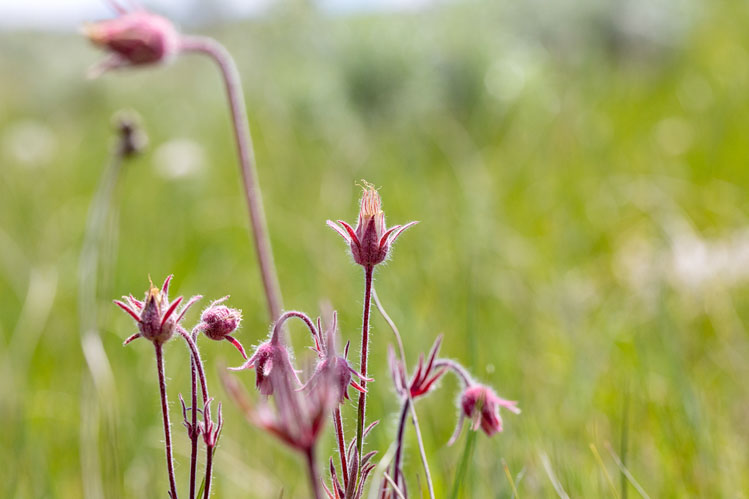
From spring to late summer, the magic of the grasslands can often go unseen. The shy wildflowers don’t grow in vast numbers but instead sprinkle the grasslands with decorative color. Butterflies and songbirds are easier to spot in season, but still, you have to be intentional when seeking them.

I have now lived the majority of my life east of the Missouri, and I have come to appreciate the tall grass patches on that side of the state. There is not as much of it to be found since the soil is so conducive to growing corn and other small grains. Even so, when you can find a good patch of tall grass it is worth taking a close look. The hiking is a little harder as the grass is thicker. It took me many years to be comfortable putting my foot down where I could not see the ground. Thankfully prairie rattlers do not abide in tall grass country.

This column is a long look back at the few times I was able to get out and explore our state’s grasslands this past growing season. From Harding to Moody counties and points in between, please enjoy a few postcards from the prairie.

Christian Begeman grew up in Isabel and now lives in Sioux Falls. When he’s not working at Midco he is often on the road photographing South Dakota’s prettiest spots. Follow Begeman on his blog.

Posted on — Leave a comment

What About Doc?

Doc Middleton was a Nebraska outlaw who gravitated northward to run saloons in southwestern South Dakota. His exploits included running in the 1893 Chadron to Chicago horse race, where he was pictured at the finish line.

TO BE CLEAR, Doc Middleton never earned a doctorate. Sometimes it seems that’s the only thing we know for certain about the outlaw.

Middleton spent considerable time in western South Dakota, first arriving nearly 150 years ago and variously described as horse thief, cattle drover, saloon keeper, murderer, sheriff and wannabe showman. For what it’s worth, he possessed one of the Old West’s best beards. In early photos, his facial adornment — maybe a foot long — could have made him the front man in ZZ Top. After it grayed, Middleton trimmed it; he then bore a resemblance to Buffalo Bill Cody.

In the Black Hills, a place long fascinated by notorious men like Wild Bill Hickok, Lame Johnny, Fly Speck Billy and even George Armstrong Custer, it seems as if Doc Middleton has fallen through the cracks. Not that he’s been completely forgotten. Look up Ardmore, South Dakota, on Wikipedia and you’ll see two people noted as playing roles in local history: President Calvin Coolidge, who visited in 1927, and Doc Middleton,”a former resident who was an infamous outlaw.”

What made Middleton an outlaw? It’s hard to top murder. He was indicted on that charge after shooting an Army private in 1877 during a dance hall brawl in Sidney, Nebraska. The charge never went to trial, says Rapid City writer Scott Lockwood, whose new book Alias: Doc Middleton, attempts to bring the somewhat mysterious Middleton back into the public consciousness. Horse-stealing did put him behind bars on several occasions.

Middleton’s thieving began at age 14 in his native Texas. One theory about his nickname is that he developed skills for”doctoring” horse brands. Or it could have stemmed from a sloppy signature with the initials for David and Charles scribbled together and mistaken for Doc. David and Charles, by the way, were not his actual first and middle names. He stole them. And Middleton, at birth, was a middle name and not his surname. His last name was Riley. Records show Doc was born in the Texas Hill Country, though he sometimes claimed Mississippi as his birthplace.

Rapid City author Scott Lockwood was introduced to Doc Middleton through his fascination with the town of Ardmore. Lockwood’s new biography traces the outlaw’s life as well as his connection to the Fall River County ghost town.

Doc’s life was so full of contradictions and outright lies that writing a book-length biography would challenge any author. But Lockwood embraced the historical detective work. As he was researching, Lockwood was asked if he liked Middleton. No, Lockwood replied. He can’t condone murder and won’t minimize it. He suspects the Sidney incident wasn’t the only time someone died due to Middleton’s violence. On the other hand, there were certainly not dozens of killings, as some exaggerated newspaper stories of the era claimed.

“For a while I didn’t really understand how bad horse stealing was in the 1800s,” Lockwood says. It deprived a person of transportation, perhaps their livelihood, and sometimes their closest companion. Some of Middleton’s early thefts may have been particularly nasty, taking animals from Oklahoma’s Indian Territory because he believed authorities wouldn’t pursue or prosecute. It’s possible he followed the same line of thinking on the Pine Ridge and Rosebud reservations in Dakota.

Lockwood was born in Huron and graduated from Custer County High School. He wasn’t particularly curious about history classes in school but, he says,”I was always interested in the stories about the ‘old days’ my elderly relatives and neighbors told me.” He worked for railroads throughout the country’s midsection, making and supervising track repairs, and eventually managing sections of Burlington Northern Santa Fe’s maintenance from Montana to Texas, and from Alabama to Illinois. When Lockwood retired, he came home to South Dakota and its”rhubarb and lilacs.”

Ardmore interested him in ways similar to the stories his older relatives and neighbors had recounted decades earlier. Virtually a ghost town now on the South Dakota-Nebraska line, south of the Black Hills, Ardmore similarly attracted Middleton in 1900. He bought town lots, served as sheriff for a while and owned a saloon. He may have failed in the liquor business in another town, Lockwood thinks, but by the time he arrived in Ardmore he had learned not to drink his profits.

Lockwood first learned of Middleton by reading the Wikipedia post linking President Coolidge and the horse thief. “I guess I was intrigued with him because he chose to make tiny Ardmore his home,” Lockwood says. And”he was able to steal hundreds of horses and escape vigilante justice.” Vigilantes operated outside the law, often lynching horse thieves and cattle rustlers in the Old West, including Middleton’s Nebraska partner-in-crime, Kid Wade. Middleton may have considered vigilantism more criminal than anything he perpetuated.

“He was such a restless man,” Lockwood says.”He liked to see his name in the newspapers and became a folk hero to many. He was great at promoting things he believed in.”

This is the earliest known photograph of James Middleton Riley, later known as Doc Middleton, taken around 1871 when he was 20.

Middleton obviously believed in Ardmore. But what he really wanted to promote was his own Wild West Show. There are stories claiming he performed briefly in Buffalo Bill’s Wild West. Maybe he did and maybe he didn’t, but Lockwood thinks Buffalo Bill Cody didn’t care for Doc Middleton. In Middleton’s mind, his own show, actually incorporated in 1904 in Rapid City, would be no less an extravaganza than Buffalo Bill’s. But it never happened. If it had, Middleton could have woven in plenty of his own real-life adventures: rounding up wild cattle roaming Texas after the Civil War, then becoming one of America’s original cowboys who drove herds north for public domain grass and less bovine disease. He rode through Kansas and Nebraska (the state that’s done the most to document Middleton’s outlaw history) and in 1877 he made it to the Black Hills, according to Lockwood. Middleton spent time in early Custer and Deadwood and was particular about whom he claimed as a friend or associate. Calamity Jane?”She ain’t my kind of people,” he reportedly said.

There’s an adventure the public would no doubt have demanded be recreated in abbreviated form as part of a Doc Middleton Wild West Show. That was a thousand-mile horse race from western Nebraska to Chicago in 1893. A Chadron, Nebraska, man promoted the idea as a hoax in an era of elaborate hoaxes nationally — ones that newspapers often reported, winning national attention for a community. In part, the news of a super-sized horse race spread because the idea appalled humane societies, and they took action to stop it. Middleton announced he would compete, and the Deadwood Pioneer Times entered into jokey reporting by remarking he should be ineligible because he would surely end up stealing other racers’ mounts.

Then remarkably, driven by the publicity, the race began to be taken seriously. In fact, humane organizations inadvertently boosted the competition when they said they would supply representatives to monitor animal health along the route. Middleton did, indeed, ride the distance on a gelding called Jim Fisk. Some observers predicted a win for Middleton. Strangely, Lockwood says (or maybe not so strangely when you consider the strong-willed contestants), the race didn’t begin until 6:15 one evening because of an argument over eligibility. The date was June 13, 1893. John Berry, riding a horse from Sturgis called Poison, first reached Buffalo Bill’s Wild West grounds near the Chicago World’s Fair on June 27. Berry wasn’t declared the winner, though, because in Chicago the eligibility issue flared again, and Berry had played a role in selecting the route, giving him an unfair advantage. Middleton finished about 27 hours behind Berry. Of eight riders who completed the long course, Middleton came in sixth.

Newspaper accounts of Middleton’s participation in the thousand-mile competition likely surprised some people. Reports of his death had circulated numerous times over the years, usually owing to gunshot wounds but once due to smallpox in Ardmore. It was as if the press was certain that Middleton would meet death at an early age and was ever ready to pounce on the news. While Middleton liked newspaper stories, even those maudlin and false reports, he had no use for anyone proposing a book about his life. He wanted that writing assignment reserved for himself, although he never got around to it.

“He even threatened to come after anyone attempting to write a book,” Lockwood says.

The Middleton family in 1899 included (from left) Doc; children Joseph William, Ruth Irene and David Wesley; and his wife, Irene.

Middleton married three times. In 1911 his third wife, Irene, died at Hot Springs after gallbladder surgery. Funeral services were conducted in Ardmore and then her body was interred about 30 miles south in Crawford, Nebraska. Certainly that’s where Middleton believed he would someday be buried, in prime horse country. Crawford sits a short canter from Fort Robinson, a major base of operations for the U.S. Cavalry during Middleton’s time.

But Middleton never made it to Crawford. He was occasionally involved in unauthorized alcohol sales and that landed him in jail in Wyoming in December of 1913. He died on December 27 at age 62 from a bacterial infection complicated by pneumonia. A burial plot at Douglas, Wyoming, was supposed to be temporary, but it’s where Middleton lies 112 years later. In 1968 a group of Nebraskans petitioned to move the body but didn’t gather many signatures. Lockwood, during his railroad career before he ever heard of Doc Middleton, lived in Douglas just blocks from the gravesite.

Knowing the geography of Middleton’s life was a plus for Lockwood in writing this book. So was newspapers.com, which allowed for electronic access to papers that Middleton knew and admired.”Sometimes I’d be so excited about what I found that I couldn’t stop at dinner time,” Lockwood says.”Other days I’d walk away and not care if I ever looked again.”

Such mixed feelings are to be expected about a man as conflicted as Middleton. Readers who love Western lore and the Black Hills — and are eager to rediscover a man nearly lost to history — will be glad he stuck with it.

Editor’s Note: Contact Scott Lockwood at b735198@gmail.com to purchase a book or to schedule an author talk. This story is revised from the March/April 2025 issue of South Dakota Magazine. To order a copy or to subscribe, call (800) 456-5117.

Posted on — Leave a comment

The Modern Rewards of Quilting

Mary Kirschenman (left) and Sally Schroeder guide quilters at Sassy Cat Quilting, headquartered in a former horse barn north of Yankton.

April Flying Hawk began quilting after her son, Ethan, died at the age of 3.

“I wanted to do a giveaway when my son passed,” Flying Hawk says.”And, I wanted to do the quilts myself, not buy them from anyone.”

Flying Hawk, a Wagner native and a member of the Yankton Sioux Tribe, reached out to the women in her community who create star quilts. Each of those women quilted differently. She took what she could from each quilter and began sewing, developing a process that worked for her. Now, Flying Hawk hand-stitches all her quilts to finish them. She only uses a sewing machine for the initial work of piecing them together.

Quilting feels like second nature for Flying Hawk.”The intention and goal of starting this was to find healing. It’s now become my second job.”

Quilting is growing across South Dakota. Shops catering to the quilters are especially showing up on main streets in rural communities. The reasons for the resurgence are as many as the stitches in a square.

Sally Schroeder’s shop, Sassy Cat Quilting, is located in a spacious, remodeled horse barn north of Yankton. She believes quilting is rooted in joy and passion. She also learned that it seams friendships.

Sally Schroeder’s Sassy Cat Quilting north of Yankton is one of nearly three dozen shops that cater to quilters in the state.

When Schroeder’s husband, John, was diagnosed with cancer a few years ago, she did not know how she would keep the business going.”My posse pitched in and helped me keep the doors open,” she says. The posse consists of family, friends and customers who share her love of quality. Fortunately, the fledgling business and her husband both survived the ordeal. Today, carloads of quilters make daytrips to Sassy Cat to learn the latest techniques or shop for fabrics.

When you hear the stories of quilting communities, the question of why people stitch and stitch and stitch is less mysterious. This is not a solitary craft.

Susan Sanders is the chair of marketing and advertising for the popular Hill City Quilt Show.”My sister has told me that quilting is like breadmaking,” Sanders says.”You take perfectly good ingredients and tear them up to make something new.”

Quilting is a thriving pastime in Hill City. The mountain town of less than 1,000 people has five stores dedicated to fabrics, notions and quilting. Hill City has also hosted an annual quilt show for the past 25 years.

“There’s definitely demand,” Sanders says.”If one business closes, another quickly opens up.”

Craft Industry Alliance data lends support to Sanders’ statement. This national community for craft professionals predicts that the nationwide quilting industry, which currently stands at $4.2 billion, will become a $5 billion industry by 2027. Though no one has an exact count, there are at least three dozen quilt shops in all regions of South Dakota.

Enthusiasm and love for quilting can span generations. Grandmothers and mothers pass down their knowledge and skills and foster important family relationships.

“I was born into quilting,” says Yvonne Hollenbeck, whose family ranches west of Winner in Tripp County.”I’m a fifth-generation quilter, starting with my great-great-grandmother.”

Hollenbeck is also a quilt historian. Traveling the Plains and Upper Midwest, she conducts educational programs on the history of quilting and teaches would-be quilters the basics. A writer and cowgirl poet, she has an entertaining style and a love for rural America’s arts and crafts.

Mariah Baumberger cuts fabric in her mother’s store, Always Your Design, an anchor of the business district in Dell Rapids.

“Amazon wasn’t available 150 years ago,” Hollenbeck says.”Quilts were made out of old clothing and scraps to keep the family warm. People lived in sod houses or shacks and houses were cold. Quilts were a necessity to everyone.”

Hollenbeck starts her education programs with a history of the Civil War and her own family’s roots in Franklin County, Iowa.

“Every soldier leaving Franklin County for the war had a quilt in their issue made by the local women’s guild,” Hollenbeck says.”Men were also issued a ‘housewife,’ which was a sewing kit, and the men learned to sew — uniforms and even wounds. Lint was used to repair wounds.”

While economic data suggests that quilting might be an expensive endeavor, Hollenbeck disagrees. She tells would-be quilters that the hobby doesn’t have to be spendy. Hollenbeck frequents second-hand stores to purchase goods that have quilting potential. She recycles worn-out clothing into quilts. And, she does not use a sewing machine. Every stitch is fingered.

“I find sewing by hand relaxing,” Hollenbeck says.”I keep a quilting kit in my purse. While I’m waiting at a doctor’s appointment or the airport, I take out the kit and piece. Once I get the quilt made, it becomes a member of the family.”

Lake Andes librarian Mary Jo Parker is working to broaden the appeal of quilting in her community. Parker launched a quilt-making project in the fall. It began with an inquiry to the library from the Public Library Innovation Exchange (PLIX), sponsored by the Massachusetts Institute of Technology.

“Our local school has no FACS [Family and Consumer Science]. The art teacher does a little bit with quilting, but it’s limited,” Parker says.”And, math is more than adding and subtracting.”

Parker believes that all youth — Native American, white and others — can benefit from understanding the symbolism of the Lakota star quilt, which has become a powerful cultural art piece in South Dakota.

Through the Lake Andes project, people of all ages will learn to construct star wall hangings or pillow tops. Community members will also be invited to work together to construct a 58-by-58-inch star quilt wall hanging for the library, using the colors of the Lakota Medicine Wheel (black, red, yellow and white).

Quilting has an emotional appeal, but it’s also good for rural main streets. Earleene Kellogg of Edgemont saw quilting as a way to go into business with family members. Kellogg, her husband Jerry and daughter Natalie, started Nuts and Bolts in Edgemont in 2005. Located in an old bank building, half of the business was devoted to quilting and the other half to motorcycle repair.

Earleene Kellogg and her husband Jerry started Nuts and Bolts as a quilt shop and motorcycle repair business in Edgemont, but the quilting half eventually took over.

“We started in the old bank building because it really lent itself to the quilting side of the business,” Kellogg says.”We’re on the edge of nowhere, so we draw people from Wyoming and Nebraska and southern South Dakota.”

The business has evolved in 19 years. Quilting is strong, but the motorcycle department never grew.

“We both rode motorcycles and we thought there would be a bigger market for that,” Kellogg says. When Jerry retired from the railroad, he began to do sewing machine cleaning and repair. He cleans and repairs long-arm quilting machines and treadle sewing machines. Business is booming without a Harley or a Honda in the shop.

Quilting can also be a lesson in mindfulness. Kathy Grovenburg, sales associate with Always Your Design Quilt Shop in Dell Rapids, says she quilts for mental clarity.”It’s my god time. I like the creativity, the art and challenge of making something work and come out right. It’s great for keeping your mind alert.”

Grovenburg has been quilting for 20 years.”I do one thing at a time and only focus on that step. When I’m squaring out my fabric, that’s what I focus on. When I’m cutting, I make sure everything is exact. I can’t think of anything else in those moments. People are hesitant to try quilting for a variety of reasons. If they tell me they’d like to but they’ve never tried it, I say just try it. If they say they don’t know how to quilt, I say we’ve got classes for that. If they say they’re not good at color, I tell them we have people who can help them with that. If they don’t have a sewing machine, we can fix that.”

Our ancestors sewed out of necessity. They wanted warm blankets. Today, quilting attracts people for myriad other reasons — passion, healing, mathematics, business and art. Grovenburg recommends that newcomers to the craft consider their goals.

Blankets are now a side benefit; the other rewards are just as heart-warming.

Editor’s Note: This story is revised from the November/December 2024 issue of South Dakota Magazine. To order a copy or to subscribe, call (800) 456-5117.

Posted on — Leave a comment

Living with Lions

Mountain lions, found from Chile to the Yukon Territory, are the most widely distributed wild, terrestrial mammal in the Western Hemisphere. Researchers estimate that between 200 and 300 mountain lions live in the Black Hills, though their secretive nature makes sightings rare in the wild. Photo by Sam Stukel

REPORTS BEGAN COMING into Yankton police at 5:50 on a Monday morning in June of 2004. Two hours later, police and state Game, Fish and Parks Department officials had found a 115-pound mountain lion beneath a camper in a quiet neighborhood just east of the Yankton Middle School. Tranquilizing and relocating the big cat was not an option, so officers shot it in accordance with Game, Fish and Parks policy.

There was still a buzz about the mountain lion when we moved to town a year later. In fact, people talk about it today. Mountain lions live in the Black Hills, 400 miles away. One had never been seen in town. The only previous evidence of a lion nearby was a confirmed footprint found in Yankton County in 2002.

I thought about the excitement of that lion sighting when police congregated in my neighborhood in July of 2020. An officer said a mountain lion had been spotted just a few blocks away — captured on a home security camera sauntering between split-level homes — and was last seen heading east through a cornfield between the airport and my house.

Suddenly alert neighbors stood in driveways, hoping to catch a glimpse of our unusual visitor. I kept watch at the window for a flash of tan moving through the tall green cornstalks. But I think we all knew that the lion had slipped quietly into the country just as quickly as he had appeared.

Mountain lions still show up in Yankton, mostly on game cameras that are monitored by residents living along the forested river bluffs on the south edge of town. None have been shot since the 2004 incident.

Few animals in South Dakota seem to captivate us quite like the mountain lion. Fifteen years ago, Sam Stukel was hunting elk in the Black Hills when he suddenly noticed a young lion about 15 yards away. He captured a shaky video and posted it to YouTube, where the 75-second clip has amassed 232,000 views.”I still get email notifications every time someone comments on it,” says Stukel, who is also a photographer and a fisheries biologist at the Gavins Point National Fish Hatchery west of Yankton.”The variety of critiques is amusing. I’m an idiot for not being more afraid of the cat, or I’m a chicken for being so afraid of the cat. Everyone’s an expert on YouTube.”

Mountain lions are just as divisive offline. People like my Yankton neighbors are eager to someday see one in the wild, while others think one mountain lion is one too many. They are seen as both majestic creatures and vicious predators out to kill pets, livestock and maybe even humans. Reality is somewhere in the middle. Mountain lions lived in South Dakota long before people and have become an important part of our ecosystem. They are our neighbors, so we should get to know them.

*****

Jonathan Jenks and John Kanta are our state’s leading authorities on mountain lions. Jenks, a distinguished professor emeritus of wildlife science at South Dakota State University in Brookings, spent 17 years closely studying mountain lions in the Black Hills. Kanta is a terrestrial section chief for the South Dakota Department of Game, Fish and Parks based in Rapid City who has devoted nearly all of his 27 years with the agency to mountain lions.

Jenks began his research in 1998 when GF&P noticed an uptick in reports of mountain lion attacks. Livestock and horses on West River ranches and two mule deer within the Rapid City city limits were believed to have been killed by mountain lions. A year before, GF&P had estimated only 15 to 25 mountain lions lived in the Black Hills, but officials wanted to learn more. The agency partnered with SDSU and Jenks and his graduate students began capturing and radio collaring lions to establish a population estimate and learn about their lives, which date back millions of years on the continent.

The lions’ earliest ancestors likely migrated across the Bering land bridge into the Americas between 8 million and 8.5 million years ago. Mountain lions became recognizable as a distinct species about 400,000 years ago and roamed the continent alongside giant sloths, mammoths, dire wolves and saber-toothed lions.

Scientists believe the climate grew too cold for mountain lion populations to survive during the Pleistocene ice ages, but they later returned from more southern regions. They can be found from the southern tip of Chile to the Yukon Territory, making them the most widely distributed wild, terrestrial mammal in the Western Hemisphere.

As settlers populated the Upper Midwest in the 1800s, mountain lions became targeted as threats to livestock. The animals were hardly mentioned in the reconnaissance ahead of Lt. Col. George Custer’s 1874 expedition into the Black Hills. But the following year, Richard Irving Dodge, who had been with Custer’s men, accompanied geologist Walter Jenney back into the Hills. He noted mountain lion prints around their campsite.”He thought these lions were investigating the camp at night because they are nocturnal,” Jenks says.”They would approach the camp, probably mostly out of curiosity. As a result, Dodge called them cowards,” implying they wouldn’t come out when they could shoot them.

South Dakota State University professor Jonathan Jenks and Steve Griffin of the state Game, Fish and Parks Department (in the foreground) collect information on the age of a mountain lion.

In 1889 the South Dakota legislature placed a bounty on mountain lions, and by 1906 they were nearly extirpated. Sightings were scant for decades. A man named Earl Bedell killed one near the head of Stockade Creek in Wyoming in 1930. Ted Mann, who ranched near Dewey in southwestern Custer County, shot one in the early 1950s. Four were spotted in Wind Cave National Park in 1964 and 1965, and tracks were found west of Custer in 1965 and near Crow Peak in Lawrence County in 1968. No one could be sure if they lived in South Dakota or were transients. By 1978 all bounties were gone, and mountain lions were declared a state threatened species, which garnered legal protection.

That opened the door to recovery. Jenks and other researchers believe that lions from southeastern Wyoming followed northeasterly draws that effectively funneled them into the Hills.”That’s why when we first started studying them, it was easier to capture mountain lions in the southern Black Hills because there were potentially more of them there than in the northern Hills,” Jenks says.”It was right at the beginning of the recolonization of the Black Hills in the late 1990s.”

After a few years of research, Jenks and his team of graduate students estimated that 100 mountain lions lived in the Black Hills — far surpassing the GF&P estimate of 15 to 25 in the late 1990s. The animals were removed from the threatened species list and reclassified as a big game animal.

In 2005, GF&P announced the first experimental mountain lion hunting season with a limit of 12, no more than half female. It resulted in a lawsuit from the Mountain Lion Foundation of California and the Black Hills Mountain Lion Foundation, which sought an injunction to stop the harvest, arguing that there was still not enough known about the local population and that a hunting season could once again lead to regional extinction. A judge in Pierre ruled in favor of the state a week before the season was to open. A mountain lion season has continued every year beginning the day after Christmas and running through April. The season ends earlier if either 60 total mountain lions or 40 females have been harvested.

So began a delicate balance between those fascinated with the presence of mountain lions and those who want to hunt them. Kanta says between 3,000 and 5,000 licenses are sold for every season.”A lot of our mountain lion hunters are very dedicated and love that opportunity,” Kanta says.”I would also offer that there are a good number of folks who feel like this is a magnificent critter and would love that one-in-a-million chance to see a mountain lion out in the wild. They are intrigued by mountain lion tracks in the snow, or just knowing that they are out there.”

As mountain lions re-established themselves in the Black Hills, Jenks’ SDSU team and GF&P researchers like Kanta learned as much as they could. Adult males can be more than 8 feet long and weigh an average of 150 pounds. Adult females are around 6 Ω feet long and weigh 90 pounds. Adult males are generally solitary, while lions seen traveling together are usually a mother and her kittens, which stay together for 12 to 14 months.

Lions are solitary hunters that stalk their prey. They take advantage of thick vegetation or attack from upslope when they need a quick sprint. Lions have low endurance in chases, so targets that can run fast and long will likely escape. Older lions have better success rates because they learn the traits of other wildlife. Their preferred meal is deer, but Jenks learned that they are opportunistic, capturing whatever might be near, including rabbits and porcupines.

A capture crew including Jenks and SDSU graduate student Brian Jansen determines the weight of a male mountain lion in Custer State Park.

Mountain lions that show up East River and beyond most likely come from the Black Hills. Young males want to leave their home range and their mothers.”We did a lot of work on dispersal, trying to figure out where these cats were going,” Jenks says.”We followed them through North Dakota, northern Minnesota, the Niobrara River in Nebraska. There was one in Howard, one in Brookings. A 3- to 4-year-old male ended up about 8 miles south of Brookings, which was unusual to have a cat that age.”

In most instances — including the animals that wandered into Yankton — the mountain lions were simply passing through. They have no interest in interacting with people.”What they want to do is get away from you,” Jenks says.”It’s exciting to see them, and they are such an amazing animal, but they really just want to get away from you. In order for them to interact with you, there’s got to be some reason. A worst-case scenario might be standing on a hillside, and you slip into a den with kittens. In all the other situations that you can envision, lions are trying to avoid you. They might be climbing up a tree to let you go by, or running away from you, or staying quiet while you pass. That is borne out by looking at the number of negative interactions between people and mountain lions in the Black Hills. They are very few to nonexistent.”

As their familiarity with lions increased, it grew challenging to deal with public perceptions, which seem to be black and white.”There are two sides of the coin with mountain lions, and that’s what makes them interesting,” Jenks says.”You’ve got people who love them to death and people who hate their guts, and you’re trying to weave between the two to make everyone happy.”

That divide has a long history. The Cougar Hunt is a 1920s silent film created by the United States Department of Agriculture in which mountain lions are nature’s scourge slayed by noble hunters.”Predators of the range,” reads the opening slide before showing a lion lounging in a tree.”Uncontrolled predators exact a heavy annual toll of livestock and game,” reads the next slide, before shots of grazing cattle and sheep. Then, a group of men walking through the woods encounter an animal carcass covered with debris,”The work of that prince of predatory cats — the American lion, or cougar.” The film ends with a hunter shooting a treed lion. As it falls, the final slide reads”a ëgood’ lion at last.”

Others have admired the big cats. A mountain lion from Arizona named Josephine became the mascot of Theodore Roosevelt’s Rough Riders during the Spanish-American War. Roosevelt clearly respected lions.”It is itself a more skillful hunter than any human rival,” he said.”Ö It is a beast of stealth and rapine; its great velvet paws never make a sound, and it is always on watch whether for prey or for enemies, while it rarely leaves shelter even when it thinks itself safe.”

A student once asked Jenks if she could raise two cute mountain lion kittens In her home.”What happens when you’ve got a 150-pound mountain lion in your living room with your two small kids?” he asked.

During a GF&P commission meeting, after Jenks testified about the number of lions in the Black Hills, a local resident objected, saying there were many more and their numbers should be reduced. He believed he had seen the same mountain lion three different times near Hill City, and suggested lions were decimating the deer population.”It’s really tough to get by those perceptions, because mountain lions do kill deer,” Jenks says.”If you have a mountain lion, it has to be killing deer, and that’s the real simplistic vision of people with predators and prey. But there are a lot of other things going on in the Black Hills. Harvest, predators and disease make species management difficult, and mountain lions bear perhaps an unfair burden.”

Fear might even lie in the animal’s very name. Because of their wide dispersal and interactions with different subsets of American culture, they have assumed many monikers. In Florida they are panthers, in New England catamounts, for cat-of-the-mountain. Elsewhere, they are cougars or pumas. In South Dakota, they are lions, which conjures a very specific image.”When people hear lion,” Jenks says,”they think African lion.”

*****

Mountain lion numbers in the Black Hills ebb and flow. The GF&P’s current population objective is between 200 and 300, as established in the South Dakota Mountain Lion Action Plan, first written in 2010 and updated every five to 10 years. Kanta recalls one year when numbers surged, and his office fielded multiple reports of mountain lion sightings.”Anything that flashed by was a mountain lion and people would call us,” Kanta says.”Ninety percent of them were not legitimate, so you’d start to get a little complacent.”

One day he responded to a report of a mountain lion living in a garage. When he arrived, he found the garage door open about a foot. The homeowner explained that he had housecats and left food for them in the garage.”I’m standing right in front of this door, and I told him to go inside and push the button and let me take a look. As he opens it, a full-grown mountain lion comes running out and almost bumps into me. It turned out that the lion had been going inside the garage in pursuit of those cats.”

Information collected on radio-collared mountain lions has confirmed dispersal from the Black Hills to Minnesota, Oklahoma, Nebraska, Wyoming and Saskatchewan. DNA from lions captured in the Black Hills has been linked to cats that have traveled to the Chicago area and central Connecticut.

Mountain lions will take domestic animals. It’s one thing Jenks and Kanta want the public to know about living with big cats as neighbors.”If you have small children, you need to keep them close,” Jenks says.”If you have livestock or pets, you need to have them close. You need to watch if deer are spending a lot of time in your yard, because of the potential for drawing a cat in. And you need to know how to act if you encounter a cat. Act big. Don’t run. Yell at them. Show them that you’re not afraid of them and don’t act like prey, because there’s a chance that you might get attacked.

ìWe do need to learn to live with mountain lions, and that means people in South Dakota and the Black Hills have to take an active role in learning how to react when you see a mountain lion or if you’re going to recreate or live in mountain lion habitat.”

That may take time. Jenks is many years removed from actively working with mountain lions, but friends and neighbors in Brookings still call when they find suspicious tracks.”I never say that I don’t want to go out and look at it, because it very well could be a cat, and I’d be really interested if it was,” Jenks says.”People get excited.”

One recent winter, he was called to an area along Western Avenue on the west side of the city to examine tracks in the snow. He quickly realized it was something entirely different.”If you look at dog tracks, eventually you will find one that does not have nails and you can’t see the hind pad, so it looks like a lion print. I didn’t want to say this to the guy, but the reason he thought it was a cat print is because he was afraid of cats. And it was really just a dog that was walking along Western Avenue.”

Mountain lions are not fuzzy like bison (which can still be dangerous, as several visitors to South Dakota have discovered). They don’t have trophy antlers like elk and deer, or the uncanny ability to scale sheer rock faces like mountain goats or bighorn sheep. Yet they are mysterious, charismatic and — no matter if you’ve never seen one or have spent decades studying them — always captivating.

Editor’s Note: This story is revised from the January/February 2025 issue of South Dakota Magazine. To order a copy or to subscribe, call (800) 456-5117.

Posted on — Leave a comment

Sweet and Sour in Roslyn

Roslyn alumni parade through town during the annual Vinegar Festival, a tradition since 2001.

When Lawrence Diggs moved from San Francisco to Roslyn, he had already spent years researching the properties of vinegar. He’d visited France, Egypt, Mexico, South America, the Philippines and Italy, all to study the flavored concoction. It led to his first book, entitled Vinegar: The User-Friendly Standard Text Reference and Guide to Appreciating, Making and Enjoying Vinegar.

Diggs was looking for a quiet summer home where he could write when a real estate agent told him about a house in Roslyn, so he came to see it. He liked the town and people so much he never left.

Thanks in part to Diggs, this tiny town in northern Day County is now home to the International Vinegar Museum. The idea came as the community was looking for a unique way to draw visitors. A former opera house, auditorium and community hall provided the space.”We wanted to create something that people hadn’t done before. We weren’t going down without a fight to keep the town open,” Diggs says.

The museum was designed to teach visitors about vinegar and its varied uses. Diggs has turned over the role of museum curator to the community, but he remains connected and supportive. Fran Rougemont, Marnah Woken and Richard Snaza work at the museum and Josh Wagner handles the accounting. Mary Wagner volunteers doing the purchasing and mail orders.

A museum devoted to vinegar was not likely on the radars of Roslyn’s 19th century founders. The town traces back to 1882 when H.H. Russell, the first postmaster, took the name from his native city in Scotland. Roslyn began as Old Roslyn with just a post office and trading post. In 1914, the town was officially surveyed and platted by August W. Hartge after the community of settlers raised $60,000 for the Soo Railroad to be built. Soon businesses began coming into town.

Lawrence Diggs.

Today’s Roslyn looks a little different. Longtime businesses have closed and been replaced by new endeavors. The Roslyn Event Center, housed inside the school that closed in 2010, is rented for weddings, funerals and gatherings. Grade school kids from Webster, 12 miles south, still use the gym for basketball, volleyball and pole vault practices. Becky Lundquist’s city finance offices are inside. The former computer room is the Viking Fitness Center owned by Amber Huggett. Dave Strege lives in the school’s old library and has a business called Roslyn DÈcor.

The Roslyn Creamery Company was in business for 68 years. Nathan Johnson has turned the facility into a furnished rental for hunting and fishing groups. It also hosts the Roslyn Creamery Company Band for jamborees.

Roslyn Meat Market was built in 1914 next to the post office. After a 1964 fire destroyed most of Main Street, it was rebuilt in the same spot. In 1976, Robert Coyne sold the business to Shirley and Norman”Tubby” Schmidt. Their son, Craig Schmidt, bought the business in 1992, but it closed in 2004.

Another son, Paul Schmidt, had been working at Mike’s Jack and Jill in Webster as a meat cutter when he decided to open his own store. Schmidt’s Custom Meats is now part of a mini mall with a small grocery store, auto shop and furnished rentals. Paul still uses recipes handed down from his grandparents and parents.

Roslyn has another claim to fame that South Dakotans of an older generation will recognize. Myron Floren,”The Accordion Man,” attended school in Roslyn through his junior year of high school. He learned to play the accordion while growing up on a small farm outside of town. His 32-year career with the Lawrence Welk Orchestra and numerous television performances began after touring Europe with the United Service Organizations. He returned to Roslyn to play for his hometown’s Diamond Jubilee.

But these days, vinegar is the star. Roslyn’s first Vinegar Festival was held in 2001 in conjunction with the town’s alumni weekend. A parade, vendors, food trucks, vinegar tasting, kids’ activities and music lead up to the annual crowning of the Vinegar Quart, comprised of Princess Pickle, Princess Vinaigrette, Princess Sour and the Vinegar Queen. This year’s honorees are Helen Trautner (Princess Sour), Kimberly Lorensberg (Princess Vinaigrette), Marci Johnson (Vinegar Queen) and Shauna Kjos-Miotke (Princess Pickle).

Sure the vinegar makes things unique and fun in Roslyn, but it still has the small-town qualities that Diggs sought when he left the fast-paced life of northern California.”The best part of living here and to be part of the community are the relationships,” says Diggs, who’s become known as The Vinegar Man.”It feels good to know people and be a part of what is going on. People have opportunities to belong.”

Editor’s Note: This story is revised from the September/October 2024 issue of South Dakota Magazine. To order a copy or to subscribe, call (800) 456-5117.

Posted on — Leave a comment

The Christmas Medals

Dean Jorgensen was not my biological father, but he was my dad in the truest sense. That was cemented the first Christmas he shared with my younger brothers and me. We three boys were Mom’s from a first marriage; ultimately there would be seven boys in our new blended family. For Dean, all seven were”his boys.”

Our first Christmas together was in 1955. Dean and my mother Virginia had married after a courtship that seemed to include us boys as much as the two of them.

When he came to our home in Hurley to pick up Mom for dates, he would be greeted by joyous shouts of”Dean! Dean!” We were just as taken with him as was our mother. Often, while waiting for her, he would share stories with us, some about superheroes he named Starkhans and Johhny. Other stories were about his childhood, or his Army days.

After their marriage and our move to Dean’s Spring Valley farm, those Army stories included tales about medals and military insignia that he treasured from his time in service. Each medal had a story. Mom often implored us to”leave poor Dean alone,” especially after a hard day of farm chores or fieldwork. But regardless of how tired he might be, he would share them.

As our first”family” Christmas approached, we also were excited that Mom was having a baby. Our new brother or sister might even be born on Christmas!

Mom went into labor on December 23, and we all raced to the hospital 50 miles away in Yankton where our brother was born. We spent that night and Christmas Eve morning with Mom until our grandparents offered to drive us back to the farm.”We’ll take you home and then come back to get you tomorrow,” Grandma said.”We can all share Christmas with Virgie and the baby at the hospital.” Dean, who was very tired, readily agreed. We piled into Grandpa and Grandma’s car and headed to the farm.

We didn’t have a telephone, so Dean told our grandparents we would see them on Christmas morning and off they went. We boys bounded inside, not at all tired.”Yay!” we shouted.”We’ve got a new brother! And tonight Santa Claus is coming!”

Many years later, Dean told us that he then realized he had forgotten about Santa and that the Christmas gifts planned for our stockings were in the trunk of the car, 50 miles away. So, after dinner and checking the livestock, he quietly tucked us into bed and smiled at our excitement over Santa’s pending arrival. He had a plan.

When we raced from our beds Christmas morning, our stockings were bulging. But before we could look into them, Dean lifted a letter off the table.”Look! A letter from Santa,” he said. He opened it and read:”Hello boys! I know how much your Mom and new brother want to see what you’re getting from me for Christmas, so I’ve taken your presents to the hospital so you can open them there after you go back with your Grandpa and Grandma.”

“Ain’t that nice of him boys?” Dean said.”Your Mom will be so happy.” We all looked a bit skeptical at that but could still see that our stockings seemed pretty full of something.

“What’s in our stockings?” I asked.

“Well, let’s take a look.” Dean stepped aside and we reached in to pull out apples, oranges, nuts, toothbrushes and a shiny piece of cardboard. Affixed to that cardboard in each of our stockings were Army medals and insignia.

“Well, would you look at that,” Dean said.”Just like mine. Santa must’ve heard me telling you about them and knew how much you liked them.”

They were Christmas gifts beyond our wildest dreams, a memory created by our new dad to last a lifetime.

About the Author: Dan Jorgensen began his writing career with the Sioux Falls Argus Leader at age 19. He is also the author of several books, including Killer Blizzard, And the Wind Whispered and Rainbow Rock, all set in South Dakota. He and his wife Susan live in Milliken, Colorado.

Editor’s Note: This story is revised from the November/December 2024 issue of South Dakota Magazine. To order a copy or to subscribe, call (800) 456-5117.

Posted on — Leave a comment

The Good, the Bad and the Beautiful

Life on the Northern Plains is ever changing. One of my favorite times of the year is thunderstorm season. Generally speaking, it runs from late April through September, but I’ve seen lighting in February and experienced thunder snow in March. The best time, however, to watch a storm build across our Dakota skies is in June and early July.

Our neighbor on the farm lived all his life as a shepherd, rancher and sometimes farmer in both Dewey and Ziebach counties. He swore by what he called the”solstice storm.” Every year on or around the summer solstice we’d get a big thunder boomer. I remember one year it was late and we wondered if he was just pulling our leg about this phenomenon. Then on July 3, as we were in the front yard lighting off firecrackers, a low, menacing cloud raced in from the west. It brought wicked wind, rain and hail. After it had rolled through, the sides of our white house had mud high up on the walls. The storm’s fury had literally stirred up the elements.

Even so, that wasn’t even close to the worst our neighbor had witnessed during storm season. He told me he watched the virgin prairie transform into what looked like a plowed field when a behemoth storm produced large hail that was driven into the ground.

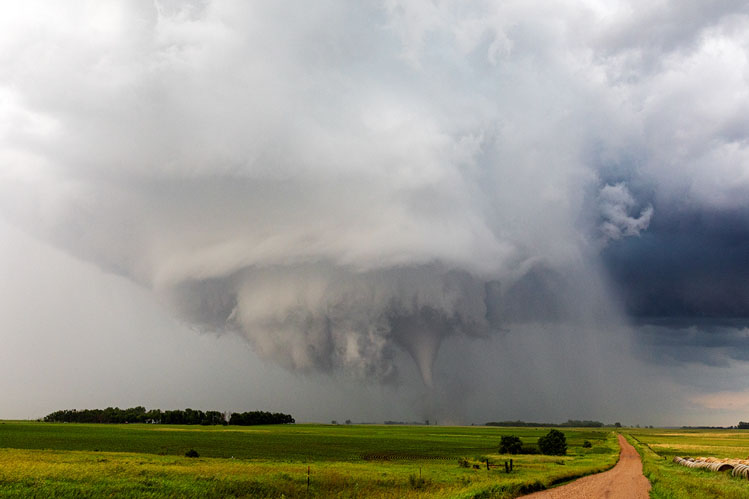
We didn’t get many tornadoes in that part of the country though. I had never seen a twister in real life until May 28, 2025. Not only did I watch my first tornado form and drop in rural Deuel County, but I saw a second one from the same system about an hour later head east toward Gary. That afternoon I was out looking for wildflowers as I slowly made my way north out of Sioux Falls. It was a little after 6 p.m. when I found myself looking up at a massive thunderhead building quickly west of 7-mile Fen Preserve. Not wanting to get hailed on, I checked the storm tracker on my phone and planned to flank the system to the south.

Avoiding the rain and hail shaft found me a few miles west-northwest of Clear Lake, but I had driven into a problem. Directly in front of me I saw a new cell developing with little rain but a lot of rotation in the clouds. It was unnerving and coming right at me. I quickly drove under it and beyond a few miles then turned around and watched the twister form. I don’t consider myself a storm chaser and am happy to watch bad weather from a distance. Therefore, my photos are not real close but feature the immense cloud formations. I do like getting the rainbows after a storm, and ironically enough, a shaft of sunlight hit the forming tornado cell prior to its touching the ground. I witnessed and photographed that unique convergence of wild weather.

Thankfully no lives were lost that day, even though there was some property damage. This column shows you the photos I took from that storm and then subsequent wildflowers and storm scenes into July. It is a beautiful irony that the prime wildflower beauty and delicateness on the prairie exist at the same time when such power and dread can descend from the skies.

Christian Begeman grew up in Isabel and now lives in Sioux Falls. When he’s not working at Midco he is often on the road photographing South Dakota’s prettiest spots. Follow Begeman on his blog.

Posted on — Leave a comment

Joyful Noise

Mike Pedersen treasures opportunities to entertain visitors at his vintage general store in tiny Nora. His annual Christmas season sing-alongs have become a tradition in southeastern South Dakota.

For 34 years, Mike Pedersen has opened the doors of the historic Nora Store and beautiful music has flowed out onto the cold and wintry prairie. His Christmas season singalongs have become a tradition for people of all ages who enjoy the melodies, fellowship and the sense of stepping into the past.

With a current population of two at the intersection of Union County Roads 25 and 15, Nora never was much of a town, but it did have a creamery and blacksmith shop at one time, along with the store. Pedersen describes it as”the Walmart of its era. It had a lot of things, but only one of each.” The store opened in 1907 and included gas pumps for a while but closed in 1962. Pedersen moved into the store in 1973 and lived there for 15 years before building a home next door.

Walking into the store is a bit like stepping into The Waltons or Little House on the Prairie; the store’s shelves and walls hold antiques, many with Christmas flair, and carolers gather around a vintage wood stove on chilly winter evenings. The centerpiece is the large, 1907 pipe organ, originally housed inside the Lake Preston Lutheran Church. Pedersen first saw the organ after it had been donated to the National Music Museum in Vermillion, but it was in pieces scattered in a storage room.

Seven years later the museum decided it didn’t need the organ and offered it to Pedersen if he would reassemble it and play it. Friends helped him complete the installation in the Nora Store; the first song played on it was a tearful version of”Jesus Loves Me.”

Guests at the Nora Store sing-alongs are greeted at the door as friends and thanked as they leave.

From there Pedersen’s childhood love of Christmas songs took over and he ran an ad in a local newspaper asking people to join him for singalongs. Around 3,000 people attend each year over several weekends between Thanksgiving and Christmas. He invites school and nursing home groups in mid-week. Guests are welcome to play the organ or piano, or ring sleigh bells passed throughout the crowd.

Pedersen has never missed an open house.”There’s never been a person that’s come that I haven’t greeted,” he said proudly. One 2023 evening saw visitors from South Dakota, Nebraska, Iowa and Ohio. He has hinted for several years that the singalongs might be nearing an end, but he hasn’t stopped yet.”I don’t take any day for granted,” he says.”For the future, I don’t know. I live in the moment. The building is kind of like me. It’s starting to wear out.”

For now the event seems in good hands, with several longtime friends taking turns on the organ and piano. Free will offerings are accepted, but there isn’t much of a budget. Friends and neighbors bring cookies and other treats to hand out along with hot cider and coffee. In the last few years friends have organized fundraisers to help purchase new siding and roofing.

“Where else in America will you find an event like this?” Pedersen asks.”There’s no real good way to describe it other than something you don’t forget. It’s been called a living Norman Rockwell painting. If I can bring a smile to a face, it makes my day. I think an hour or two here cures a lot of lonely.”

Editor’s Note: This story is revised from the November/December 2024 issue of South Dakota Magazine. To order a copy or to subscribe, call (800) 456-5117.

Posted on — Leave a comment

Dakota Kaleidoscope

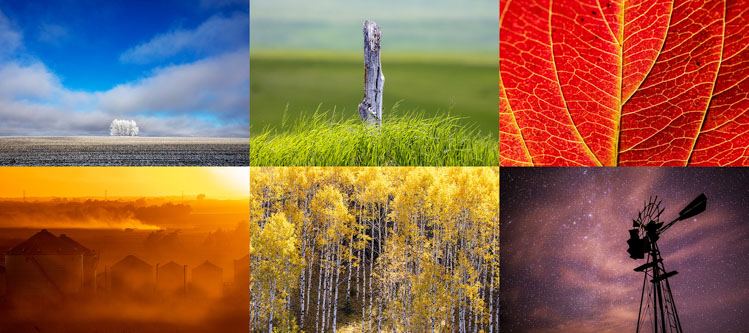
I remember watching a PBS”American Masters” special on photographer Dorothea Lange and being struck by how she prepared for a retrospective at New York’s Museum of Modern Art (MoMA). Lange’s most famous photo, entitled Migrant Mother, is one of the most recognized and poignant photos of the 20th century. As she looked through her life’s work, she didn’t choose to show just single images but grouped photos into sets of three. She described it as equating sets of three to a visual sentence. It was an idea that stuck with me, and I wondered if I’d ever be able to produce such a thing.

Earlier this year, John Andrews asked for two photos that would be considered for printing in South Dakota Magazine. The first was a winter scene in Moody County with frosted trees under a winter blue sky and the second was harvest haze at sunset in Yankton County. The dust and low light gave the image a very orange overtone. The two images gave me an idea. What if I could find other photos with strong green, red, yellow and purple tones and match them up in a six-photo set? It would be a celebration of Dakota color. It took me a couple of hours, but after a cursory review of photos from the last couple of years, I put together an edit I was happy with.

I posted the new image on my Facebook page and called it a South Dakota kaleidoscope of color. Folks seemed to like it and then John suggested it could be a new column. I agreed and started the process of searching my archives for images that emphasized a strong single color. I reviewed a decade of work from across the state. When the search was over, I had well over a hundred photos separated into blue, green, orange, purple, red and yellow folders. From there I tried to find themes. Since I photograph country churches, that became a set. The last handful of years I’ve been interested in botany (wildflowers) and macro (close-up) photography, so there were two more sets. We Dakotans know that weather and seasonality are huge parts of our lives, so there was another set.

All in all, I came up with eight more sets. The most difficult was the bird set, as there are not many purple birds. Thankfully I had photographed a purple finch at the Dells of the Big Sioux a few winters ago. I also had to choose from a lot of yellow birds. I ended up going with the yellow warbler over the meadowlark, but it was tough decision as I’m a huge fan of both species.

Thanks to John and Dorothea for the inspiration of this look back over a decade of photos. My images are vastly different than the black and white real-life photos of Lange’s, but I do wonder what she’d make of these Dakota kaleidoscope sets. I’ll never know, but it was fun to put together and show here. And really, isn’t that the best part of being a photographer? I bet she’d agree with that.

Christian Begeman grew up in Isabel and now lives in Sioux Falls. When he’s not working at Midco he is often on the road photographing South Dakota’s prettiest spots. Follow Begeman on his blog.

This slideshow requires JavaScript.