Posted on — Leave a comment

Beautiful Delusions of Autumn

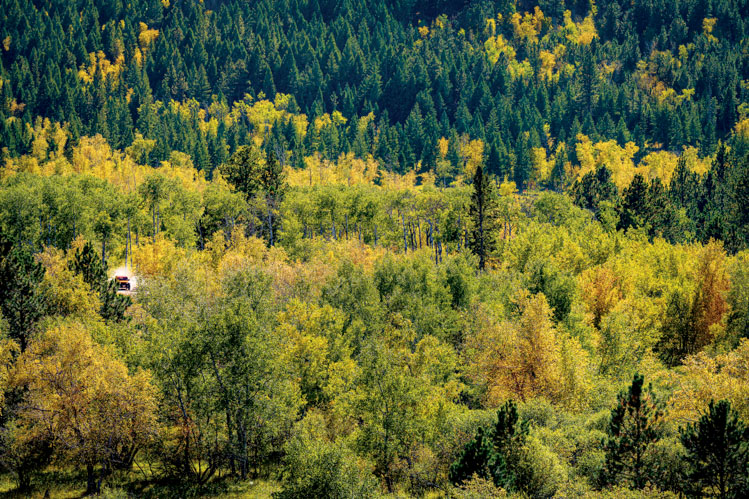
Drivers experience an autumn smorgasbord along Palmer Creek Road, which winds through thick aspen forests and broad meadows.

A SOLITARY COTTONWOOD tree on the lonesome prairie, when bejeweled with golden yellow leaves, emanates as much beauty as the human eye can absorb — especially when the sun slips southward, leaving the September sky bluer than blue.

Yet, who looks for a single tree in autumn? We tell ourselves we must see mountains and hillsides and river valleys with their forests full of leaves, each one hanging precariously by a stem, fluttering unworriedly as if winter was a thousand years away.

So yes, of course, go forth this autumn and fool yourself into believing that this glittering season is not just a cruel trick of chlorophyll. Life will always be so good. Calamity can never follow such serenity. South Dakota is paradise eternal.

Certain places in our big state are especially guilty of contributing to the delusions of autumn, beautiful though they may be. Traffic jams can occur on Highway 14 in Spearfish Canyon during peak leaf-peeking days. Sica Hollow’s oaks are almost as beguiling for people who live in the northeast. Our urban forests are resplendent in different ways because city parks and boulevards feature a gloriously unnatural mix of planned and planted trees. The McKennan Park neighborhood in Sioux Falls is an exceptional example.

We asked our chief photographer, Chad Coppess, if he knew of some lesser-known fall foliage tours. He suggested the three that follow. Interestingly, one that he chose is at South Dakota’s very lowest elevation while another is near the highest. Chad’s diplomatic third choice lies in between, along the Missouri River.

These routes won’t have bumper-to-bumper traffic in September and October when our leaves change color, but that is part of their allure. Autumn is even more striking when you escape the crowds.


PALMER CREEK

Pennington County

The graveled Palmer Creek Road is less than 4 miles long yet offers more than its weight in gold leaves between two spectacularly located campground resorts. Horse Thief Campground and Resort lies on the southwest end of the road and the Mount Rushmore KOA at Palmer Gulch Resort on the northeast. Both campgrounds have funky little stores that offer snacks and refreshments.

Midway along the road, an engineer had some fun by designing a double crisscrossing section with an over-under bridge and a cut through a rock that delivers a jaw-dropping view of Black Elk Peak no matter which way you are traveling. The road winds through beautiful aspen groves and, at times, offers a panoramic view of the entire gulch.

Little-known fact: Along the road is a parking area for Palmer Creek Trailhead, where you can trek to the top of Black Elk Peak (South Dakota’s highest point) and beyond.


PLATTE-WINNER BRIDGE

Gregory and Charles Mix counties

Those who prefer to venture off the interstates know that Highway 44, a main artery across the southern third of South Dakota, crosses the Missouri River via the Platte-Winner Bridge.

The stretch between Platte and Winner is 53 miles. The most scenic area features bluffs that drop into the river valley where you’ll discover two state recreation areas — Snake Creek on the east side and Buryanek on the west.

Lewis and Clark traveled here in 1804 and 1806, at one point losing a member of their party for several days. The Shannon Hiking Trail in Snake Creek Recreation Area commemorates the lost explorer and gives expansive views of the river and autumn colors.

Little-known fact: Unless you live in the neighborhood, you may not have heard that the mile-long Platte-Winner Bridge is about to be replaced. Construction on a new bridge may begin in 2025.


BIG STONE LAKE

Grant and Roberts counties

State Highway 109 runs up the South Dakota side of Big Stone Lake in the northeast corner of the state with a view across the lake into Minnesota. We recommend the 15-mile stretch from Big Stone City to Hartford Beach State Park with frequent stops at access points to the water. The route offers a variety of vegetation and colors for leaf peepers. Hartford Beach is one of the oldest South Dakota state parks and is popular with campers, boaters and fishermen. The log cabin trading post of Solomon Robar, along with Native American burial mounds and pioneer graves, are found along the hiking trails in the park.

Little-known fact: The shoreline of Big Stone Lake (elevation 965 feet) is the lowest spot in South Dakota.

Editor’s Note: This story is revised from the September/October 2023 issue of South Dakota Magazine. To order a copy or to subscribe, call (800) 456-5117.

Posted on — Leave a comment

David Wolff’s Black Hills

David Wolff spent 17 years teaching history at Black Hills State University in Spearfish. His new “Black Hills History Tours” book series blends travel with the region’s most colorful historical stories.

Every mountain range needs a few curious historians. They help the rest of us appreciate the peaks and valleys.

David Wolff of Spearfish fills that role in the Black Hills, and now the former professor is embarking on a six-book project that will not only recount the region’s colorful history but also serve as a guidebook for those who share the author’s itch to explore.

Mountain towns also need pharmacists — and that’s where Wolff got his start. Forty years ago the Denver native who was raised in Wyoming was working the pharmacy counter at a Pamida store in Sturgis. He wrote a history paper as an amateur and took it to a conference organized by university historians.”Pharmacists wear ties and that’s what I wore to the conference, and the history professors moved toward me when I arrived, assuming I was one of them,” Wolff recalls. He sensed they were less enthusiastic in greeting an amateur when they learned his identity.

The pharmacist eventually left the Black Hills, off to greener medicinal pastures, people in Sturgis surmised. In fact, he left to study history, first at the University of Wyoming where he earned bachelor’s and master’s degrees, and then at Arizona State University where he gained a Ph.D. In 1998 he returned to South Dakota to teach at Black Hills State University. He became Dr. David Wolff not as a matter of pursuing a personal goal or for job security (no one will tell you a historian’s position is more secure than a pharmacist’s). Rather, Wolff became a historian because he considers the field vital, especially the multi-layered history of the Black Hills and its mining culture — a significant component to American history overall. And yes, the snub he sensed at that long-ago conference was a motivator in reinventing himself. He didn’t want the lack of academic credentials to limit his ability to reach the public through university offerings, writings and at local history society talks that are free and open to all.

“He comes across as an everyday person,” says photographer and author Paul Horsted, creator of books with photos that compare and contrast historic and modern images.”But he’s got such a depth and command of knowledge at his fingertips, especially gold rush history and what happened afterward. As I was feeling my way in learning that history, David was so kind in being a sounding board.”

When Horsted mentions Wolff’s depth, he could include his friend’s recognition of romance in even the gritty business of mining. Wolff remembers the soft glow of light emanating from windows in Deadwood and Lead’s mining mills, reduction plants and slime plant at night as his family vacationed there –“evidence of workers’ massive efforts, round the clock, in grinding out wealth from the earth,” he says. The Wolffs lived in Cheyenne, Wyoming, when he grew up. His dad was a traveling salesman, mostly supplying drug stores. David sometimes tagged along and that was his introduction to pharmacists — nice people and important members of their communities. Wolff’s parents encouraged him to pursue pharmacy himself. Sure, they knew David’s interest in history and his love for Wyoming’s past as documented throughout the capital city and at nearby Fort Laramie.

“But nobody in the world I grew up in thought you could make a living in history,” Wolff says. Still, the idea briefly crossed his mind in college after reading Watson Parker’s classic Gold in the Black Hills. Wolff wrote to Parker, a history professor at the University of Wisconsin-Oshkosh, and Parker replied. He thought Wolff might be better off using money that would cover tuition for building a personal library of good books delving into history.

If Wolff got a delayed start as a historian, he more than made up for it — and continues to do so with an agreement with the South Dakota Historical Society Press to author six books in the coming years that will combine Black Hills driving with learning history. He taught 17 years at Black Hills State, a period that overlapped 18 years as a member of the South Dakota State Historical Society board of trustees. Still, the term he feels best describes him is simply”a history buff.”

Which is exactly how he comes across sitting in downtown Custer’s Way Park talking to a couple friends about historic cabins. Specifically he mentions this park’s Daniel Flick cabin, long proclaimed as the first built in the Black Hills. And that may be, Wolff says, although it’s unlikely the structure would pass a test by modern historians for such designation. Judge Henry Way pretty much declared the Flick cabin as first while developing the park across the street from the county courthouse in the 1920s.”That was fifty years after the presence of gold in the Black Hills was first confirmed in Custer,” Wolff says,”and the men and women who were here soon after gold discovery were aging and wanted credit for what they built. Almost every town in the Black Hills had its cabin.”

Wolff met with author Paul Higbee (right) in Custer’s Way Park. Despite his long academic career, Wolff says the title that best describes him is “history buff.”

Wolff believes the demand for credit by pioneers is more interesting than whose cabin came first. And while the Black Hills claimed structures more impressive than those humble dwellings — especially its great mines — there was something uniquely American about log cabins. They seemed to assert the Black Hills had become part of America rather than uncharted territory.

“There are a lot of myths and mistakes in history,” Wolff says.”I started out thinking I could correct those things. But misinformation hangs on so tenaciously.” People tend to believe what their families told them as kids, whether they lived in the Black Hills or visited as tourists. Embellished tales survive because they incorporate good storytelling techniques. Deadwood, most South Dakotans understand, has spawned myths since its founding in 1875 and 1876, and the HBO series Deadwood, which ran from 2004 to 2006, took that mythology to new heights. Wolff, frequently asked to comment on the series during its run, understood it as historical fiction and not a history lesson.”Something I looked for in the show, though, was whether or not it remained true to the personal qualities of the historical characters it portrayed,” Wolff says.”And I think it mostly did.”

For example, take Deadwood’s first sheriff, Seth Bullock. The series’ writers and actor Timothy Olyphant created a lawman who was mostly hands-off when it came to little things.”That was authentic to Bullock,” Wolff says.”He didn’t go after the drunk and disorderly and thought that celebrating by shooting into the air was okay.”

Wolff accepted an invitation to discuss Bullock on the Discovery Network’s Gunslingers series. It turned out well although he had to tell producers there’s no evidence that Bullock slung his guns or engaged in shootouts. And the program prompted this question: What does a professional historian facing TV cameras look like? It seems there’s a school of thought that says anybody living in the West and writing its history must be so enmeshed in the culture that they dress in character.”The Discovery Network asked me to show up with my look,” Wolff recalls.”I don’t have a look,” and he didn’t invent one for the appearance.

Wolff accepted another invitation related to Bullock, this one from the state Historical Society Press to write a biography, Seth Bullock — Black Hills Lawman. The book came out in 2009 and addressed aspects of the subject’s life that were not fodder for a TV shoot-em-up: personal friend of Teddy Roosevelt, government official who worked to establish Yellowstone National Park, federal Black Hills Forest Reserve (today’s Forest Service) superintendent, ranching innovator and Belle Fourche founder.

Wolff’s next book for the Historical Society Press profiled a remarkable Deadwood man, James K.P. Miller, strangely forgotten by history. Even Watson Parker told Wolff he never heard of him, although when Miller died at age 45 in 1891 a local paper predicted”his name will always be coupled with the prosperity of Deadwood and the Black Hills.” But it wasn’t, and no one was more instrumental in retrieving it than Wolff 130 years later. Among tools Wolff worked with in exploring Miller’s life and times was newspapers.com, technology that didn’t exist when he wrote the Bullock book. Miller was a native New Yorker, frontier grocery proprietor, builder of Deadwood’s Syndicate Block, and a wheeler-dealer who brought two railroads into Deadwood by setting up something of a competition between the Fremont, Elkhorn and Missouri Valley Railroad and the Burlington and Missouri River Railroad.”Sometimes we forget,” Wolff says,”how competitive railroads were back then. They hated each other.” Miller apparently understood that industrial hatred and made it work for Deadwood, which became one of a select number of South Dakota towns served by two railroads. Very likely that saved Deadwood from deteriorating into something unrecognizable and beyond rehabilitation in the years after the gold rush.

Without Miller, would there have been Days of ’76 celebrations, today’s gaming industry or the Deadwood TV series? Maybe not. The Miller biography, The Savior of Deadwood, James K.P. Miller and the Gold Frontier, was published in 2021.

The Gold Rush and The Gateway to the Hills are the first two installments of Wolff’s “Black Hills History Tours” series.

Wolff’s new book, The Gold Rush, is far from a biography. It resembles the Works Progress Administration’s state guidebooks of the 1930s, with more detail yet retaining a thumbnail listing format. The book identifies driving routes from Custer northward (later volumes in the series will take travelers elsewhere through the Black Hills and surrounding plains), identifying historic locations along the way.”It is a travel book,” Wolff says,”but I don’t recommend places to stay or eat. It’s all history.”

It’s history that is found along roads accessible by regular cars — no ATVs required. Among the author’s favorite sites, most retaining an air of historical mystery, are the Flick cabin and the so-called China walls at Galena (on Galena Road off U.S. Highway 385 south of Deadwood). Galena was best known for its silver mines in the 19th century but in 1909 it was announced that the area held great quantities of copper. Construction began on a copper mill but only stone walls, impressively crafted, were completed.”It has become commonplace,” Wolff says,”to look at old rock work and mistakenly assume Chinese did it.” Indeed, Chinese laborers contributed to much construction during the Black Hills gold rush early on, but by 1909 few remained. Was there really a copper fortune to be mined at Galena? No, says Wolff.

There was no shortage of nefarious mine developers who attracted naÔve investors to sink money into operations that would never yield profits. Three-and-a-half miles below today’s Pactola Dam, about 10 miles west of Rapid City on Highway 44, the Fort Meade Hydraulic Gold Mining Company (perhaps named for Fort Meade army officers who invested) began blasting a tunnel to move water for a sluice box that would work supposedly gold-rich gravel. The company’s very real tunneling, done from 1879 to 1882, probably kept investors engaged, but it closed. Soon, another company picked up the work, also relying on investors, but disappeared in 1889. Not much gold was recovered. What remained was a tunnel moving swiftly flowing water and an underground falls, later illuminated with electricity and named Thunderhead Falls for tourists. The attraction is permanently closed now, but the inspiring natural setting of cliffs and rushing waters makes it easy to see how investors thought something good was bound to take root.

Another site Wolff introduces is one the Forest Service calls the”only gold mining site on the BHNF (Black Hills National Forest) with a standing mill frame.” That’s the Gold Mountain Mine, northwest of Hill City down Burnt Fork Road. Lots of infrastructure work was done there in the 1920s and ’30s.”There is, however, no record of production,” Wolff says. That didn’t stop the Black Hills Historic Preservation and Trust Society from deciding to preserve the mill, rock work and exterior boilers a few years back, with volunteers and students from the Boxelder Job Corps Work Center, joining the effort.

This is a travel book, yes, but it will undoubtedly reach armchair travelers around the world and find use as a well-organized reference. A glance reveals the remarkable range of historic personalities connected to the Black Hills across the years, from giant American industrialist George Hearst (who developed Homestake, the western hemisphere’s biggest gold mine at Lead) to Lakota traditionalists committed to retaining a modern presence. Wolff is certainly describing more authentic Indigenous historical views than the WPA writers and in part credits landing on the faculty of Black Hills State, a university committed to Native course offerings and its Center for American Indian Studies. In particular he appreciated his late colleague Jace DeCory, a widely respected Lakota elder and teacher.”She was invaluable in helping me understand Lakota perspectives, and was always balanced and thoughtful,” Wolff says.

The book was released this summer, and surely readers will want to collect the entire series of six. They won’t wait long. There’s a chance the second will come out later this year, and Wolff and his editor and designers are working at a pace that could see two more published in 2025 and the remaining two in 2026. Upcoming books will address the Lawrence County triumvirate of Deadwood, Lead and Spearfish, Rapid City and the central Hills, the southern Hills, the Belle Fourche River and Wyoming Black Hills, and what Wolff calls”unknown, under-told or under-appreciated stories.”

The Black Hills delight people who sometimes declare they’ve found a pristine natural environment. But travel with David Wolff and you’ll see it’s a rare patch of the Hills that hasn’t been touched profoundly by humans — Lakota defenders, the U.S. Army, railway builders, miners, loggers, engineers who transformed land and water, town builders and, after devastating fires, town rebuilders.

Editor’s Note: This story is revised from the September/October 2024 issue of South Dakota Magazine. To order a copy or to subscribe, call (800) 456-5117.

Posted on — Leave a comment

Grandmother Power

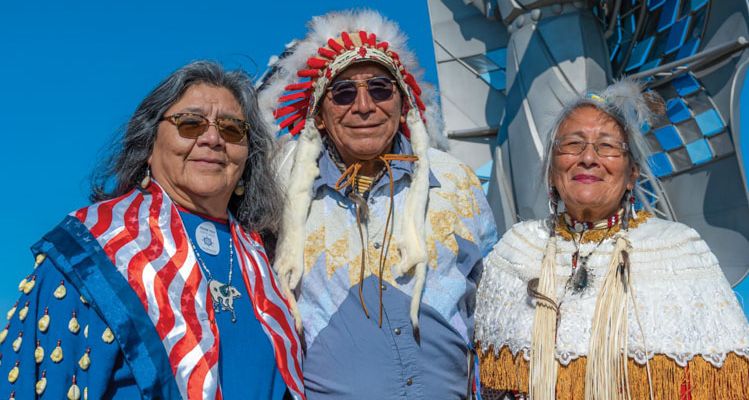
Native American leaders from across the state, including (from left) Cecilia Fire Thunder, Arvol Looking Horse and Belinda Joe, attended a Women Take Back Honor event at the Dignity of Earth and Sky statue near Chamberlain.

FORT THOMPSON IS A complicated place with a tragic history, but the tribal community’s residents are finding hope in grandmothers like Belinda Rencountre Joe, a scholar and dancer with a vision for action.

Joe is among the organizers of Women Take Back Honor, a four-year initiative to restore the leadership role of the woman in Native American culture. The effort began a year ago with a day-long event at the Dignity of Earth and Sky statue near Chamberlain.

Grandmothers empowering girls is an intriguing concept, so we telephoned Joe to ask if we could come to Fort Thompson to learn more about her efforts.

“Can you hear me?” she answered.”I am standing outside on my porch looking at the full moon.”

Yes, we heard her loud and clear.

When told that the success of the Women Take Back Honor event prompted our call, she laughed and said it was a coincidence that she was looking at the moon.

“The full moon symbolizes the woman,” she explained.”It symbolizes the woman’s gift to meditate and pray and then get things done. The full moon is when we are at our strongest.”

She said her own activism took hold in 1999 when she and her aunt, the late Stella Pretty Sounding Flute, represented Crow Creek at World Peace Day in San Juan, Costa Rica.”A message was given to me there, a seed was planted, that the grandmothers — Native and non-Native — have a role that must be renewed. It felt like a message from our Creator, Him or Her? I don’t know.”

She says the participants prayed on a mountain for four days, and on the last day several Indigenous grandmothers called her over to them, gave her gifts, and then asked her to”keep the light going within our women in North America, and they would do the same in South America.”

She admitted that she felt unsure that a Dakota girl from Buffalo County could bring that Indigenous message to fruition.

*****

A FEW DAYS LATER, we drove to Fort Thompson on a hot summer day to meet Belinda Joe and learn more about her mission to empower women.

We exited Interstate 90, South Dakota’s principal east-west highway, at Chamberlain. The road from there to Fort Thompson parallels the Missouri River and winds past prairie foothills covered with wild grasses and occasional herds of cows and horses.

Belinda Joe walks along the Missouri River at a park known as The Old Fort with Hillary Hyde, a local youth.

Fort Thompson, with a population of more than 1,200, is the largest community in Buffalo County and the Crow Creek Reservation. The name Thompson is a constant reminder of its tragic history. Clark W. Thompson of Minnesota was serving as Superintendent of Indian Affairs in Abraham Lincoln’s administration when bloody battles and skirmishes broke out that are now referred to as the U.S./Dakota War of 1862. The hostilities between the Dakota and pioneer families were sparked by broken treaties, poor administration of government programs and the brutal winter of 1861 that led to starvation and frustration.

More than 400 settlers and soldiers were killed in the war. Historians didn’t document how many Dakota died, but 303 Dakota warriors were sentenced to death by a military court. Episcopalian Bishop Henry Whipple asked Lincoln to intercede, arguing that they were prisoners of war. Even though the president was overwhelmed with the Civil War, he took time to review each case and cut the number to 38, who were hanged in Mankato, Minnesota, on Dec. 26, 1862. It still stands as the largest mass execution in American history, and probably always will.

In the spring, Congress abolished the Dakotas’ Minnesota reservation, nullified the treaties, crowded 1,300 men, women and children onto steamboats and exiled them to live on the eastern shore of the Missouri River in Dakota Territory. A federal order mandated that the Dakota race,”be annihilated or forever pushed from the boundaries of Minnesota.” A $200 bounty was placed on every Dakota Indian, causing many of them to be hunted for years. Others died of disease, malnutrition and despair.

The story of the war and the infamous date of the hanging is well-known to all residents of Crow Creek today, many of whom are descended from the executed or of the hundreds of Dakota who were incarcerated as prisoners of war.

The descendants created communities in the forested bottomlands of the Missouri River by building homes, churches, stores and schools. And despite federal efforts of forced assimilation, some of their culture was preserved in the shade of the cottonwood trees.

Then in 1963 the federal government finished Big Bend Dam and flooded 56,000 acres, including many small communities of the Dakota. Families moved to higher ground, and that is when many came to live at Fort Thompson.

Ironically, the 3-mile earthen dam was completed exactly 100 years after the beleaguered Dakota arrived on the river. Hardships at Crow Creek remain today, but Belinda Joe and others like her promise that there is reason for hope, and their hopefulness lies in the cultural strengths that their Dakota ancestors brought with them on steamboats from Minnesota and somehow kept alive in that cottonwood forest.

*****

BELINDA JOE MET US at the Lode Star Casino, a windowless coliseum of glitz in an otherwise humble town that has few private businesses other than three convenience stores. There are four churches and myriad tribal government buildings. The casino has the town’s only restaurant, so it often hums with a lively mix of ranchers, local families and visiting gamblers, including many who come to fish for walleye on the nearby river.

Joe is 69 years old with striking white hair. She is tall, gracious and articulate, though she was easier to interview that moonlit night on the telephone because at the casino she had a 5-year-old grandson, Oaklynd, in tow. Altogether, she has three children, 14 grandchildren and four great-grandchildren. While at the casino, she was also trying to arrange a trip to Chamberlain to gather some clothing and bedding for a family in need. In fact, everyone she met at the restaurant had a question or a request.

We ordered sandwiches, but she soon asked for a to-go box because she hardly took a bite between phone calls, table visits and telling her story to us. Life was simpler when she was Oaklynd’s age, she laughed.

“We lived off the land,” she recalled of her childhood in the 1960s.”We ate wild game, which our dad and male relatives brought home. We fished and picked wild fruits. We grew our own potatoes. In the summer we walked down to the river and swam all day and then walked home.”

She says the family home, on the east side of Fort Thompson, was a hub for young relatives.”They would help us bag potatoes, and we would play a neighborhood game of softball, tag and make-believe.”

Her father, Whitney Rencountre, was a paratrooper in the Korean War who later worked as a tribal policeman and road worker. He hunted and cured mink pelts to buy groceries.”We grew up poor, but we didn’t see it as poor because we had everything we needed and the mainstay of that was our family. We were very close.”

She remembers her father as a good man who was always present. He and other relatives sang around a drum during warm evenings, and it was there that Belinda learned the songs and dances of the Dakota. The drum group, the Hunkpati Singers, still performs today.

Her mother, Thelma Black Tongue Rencountre, was the backbone of the family.”She was a petite woman who could do whatever it took to survive. She grew up as a Lakota girl in Promise, South Dakota, and was sent to the Pierre Indian Learning Center and the Stephan Mission when it was a harsh boarding school.” She spoke Lakota, English and Dakota.

Her father ran away from boarding school as a sixth grader, and her mom’s education was hampered by cruelties and illnesses. However, Belinda found refuge in books and became a voracious reader of stories that took her around the world. When she was a sophomore at Gann Valley High School, an encouraging teacher told her she had the talent to go anywhere she wished, and she taught Belinda to speed read.

“But I was scared to leave the reservation,” she recalls. A few years later, a young man on leave from the Vietnam War went to her father and asked if he could marry her — without asking her.

Her father’s answer was,”No, she’s going to college.”

Belinda remembers feeling relieved that he said no, but also thinking that she didn’t want to go to college because she wanted to see the world and she believed the only options for women were to be a nurse or teacher. Instead, she went to Denver and studied to become a court reporter. After working for the Navajo Tribe and the Bureau of Indian Affairs, she eventually gravitated home to Crow Creek. There was no work for a court reporter so she went back to school and earned degrees in education, determined that she would not discourage her students from learning about their own heritage.

Combining her mother’s fortitude and her relatives’ cultural teachings, Joe soon became an instrument of change at Crow Creek. She incorporated Dakota and Lakota songs, stories, dances and identity into her elementary curriculum and encouraged the students to use their voices to empower other youth.

She brought her young dancers to the dedication of Dale Lamphere’s Dignity statue in 2016. Lamphere’s 50-foot stainless steel sculpture of a Native woman wrapped in a star quilt immediately became an inspiring symbol of feminine empowerment. Jane Murphy, the sculptor’s wife, says several dozen Native and non-Native people are working on a vision that fits the art and the times.

Dignity, by artist Dale Lamphere, honors the cultures of the Lakota and Dakota people.

“Belinda did a blessing of the ground at Dignity before the ground was broken,” Murphy says,”and she is so connected to the Native culture and the people of her community, so she needs to be a part of this.”

Joe says she wasn’t really looking for another role, but the opportunity to build an initiative around Dignity seemed like a path to the calling she felt in Costa Rica.

Three years after the Dignity dedication, Joe accompanied Native Korean War veterans to Seoul, South Korea, where she represented her father and other veterans. At a banquet, she sang the Lakota Brother Song to honor the warriors.

While in Seoul, she learned of the”Comfort Women” who were taken from their homes in Korea during World War II and forced into sexual slavery by the Japanese military. Some of the victims are still alive, and they recently received apologies from Japanese grandmothers as well as the Japanese government after decades of official denials.

Joe says their story reinforced her commitment to honor the women of all nations.”Perhaps someday we Native and non-Native women will receive apologies for the harm we have endured and recovered from,” she says.”A legacy of love and honor is what I pray for in my lifetime, for we are the life-givers of our families, communities and nations.

“Our language and our culture are our lifelines to the past, to today and to the future,” she says.”Too many of our youth are struggling with addictions, drugs and alcohol. I believe we are targeted because we are vulnerable. We are targets because of our poverty, targeted by the dealers and even by some of our own people. It’s an easy way to make money. They groom you and pull you in because there aren’t many jobs here for young people.”

Along with her teaching career and community activism, Joe also serves as the prison liaison for the Crow Creek Sioux Tribe, visiting young men and women in the state prisons at Pierre and Sioux Falls during their spiritual conferences. Some of the young inmates are former students. Some are relatives.

“Most of our young males and females are in there for crimes involving meth — ingesting, using, selling, transporting,” she says.”A young grandson went in two weeks ago. In our Indian ways, they are all our grandsons and granddaughters, and we have an obligation to guide them and correct them and help them.”

Prior to one of her first prison visits, inmates warned her that her life was in danger. A threat was made by an inmate who was enraged that she’d reported a case of child abuse. Because Joe is a teacher, she is a mandatory reporter.

“At this point in my life, I wasn’t going to stop the visits,” she says.”My legs were shaking but I went anyway.”

When she arrived, the grateful inmates welcomed her warmly and promised they would see to her safety.”Come in and light up the darkness,” said one man. They presented her with a star quilt and beaded medicine wheel crafted by an inmate who worked all night to have it ready.

*****

THE TRIBAL HEADQUARTERS at Fort Thompson, a modest, metal gymnasium-style building, is a beehive of activity. People are constantly coming and going, asking about utility problems, stray dogs, vandalism and all the things that are talked about at city halls across the United States. Meanwhile, a half-dozen youth are shooting baskets while others visit on the bleachers.

At the center of it all is Peter Lengkeek, the 48-year-old tribal chairman who stands as straight and tall as he did when he served in the Marine Corps despite some service-related back injuries that cause him to work today from a stand-up desk.

He lowered the desk to normal height and sat down to visit with us about Joe’s work to empower the women.

“I think it’s beautiful,” he said.”It has to happen. The woman thinks from the heart,” he said, holding his hand to his heart,”while us men, we are from here” (pointing to his head).”Our culture was traditionally more matriarchal, but we were forced into a patriarchal society. It is unnatural for us, and it is not working for us.”

Though Lengkeek says the Marines were his only”college,” he speaks like a studied philosopher and historian when he reflects on his Dakota culture. He maintains that the rightful place of the women of the Dakota and other Native American tribes was diminished in the 19th century because”the government would only recognize men as leaders.” Wars, diseases, poverty and forced assimilation further reduced the traditional role of the woman in Dakota society.

Lengkeek says restoration of women’s rightful role will strengthen the entire culture, both at Crow Creek and other tribes.”We need healthy relationships, healthy communications and healthy boundary settings. Our young people must learn how to regulate your emotions, how to control your anger. That is something our language and culture teaches us. It teaches us how we address the physical, the spiritual, the mental and the emotional on a daily basis. Today, too often, we seem to care only about the physical. Our patriarchal society teaches us to put the emotions down and to not show weakness, compassion, tenderness, and love.”

Lengkeek says young people must have a good concept of healthy masculinity and healthy femininity.”The work of Belinda and others like her give me hope. Our aunties have a special obligation to teach. I’ve seen our women teaching our culture and traditions, teaching us how to pray. They are giving us hope.”

The tribal chair says he experienced the lack of culture in his own childhood at Crow Creek.”Many of my generation were not raised with the language and the culture, but when we hear it, we connect with it, and we want to learn more. My mother was raised in a boarding school. She could talk Dakota, but she never spoke it around us.

“On her deathbed, she was talking in her native language, and I was listening to her without her knowing I was there. Then she realized I was holding her hand and she stopped.

“Mom,” I said,”why did you not teach us this beautiful language?”

Lengkeek says his mother began to cry, and then she said,”I didn’t want you to go through what I had to go through.” She’d been so traumatized at boarding school by assimilation-minded teachers that she couldn’t bring herself to speak Dakota to her children.

Yet, Lengkeek says the language still has a powerful impact on Dakota youth.”A lot of study has been done on cellular memory, and it is recognized today as something real. Our people suffered historic trauma, but they also have a cultural or cellular memory that goes back to the early days of time. They did their best to take our culture and our language from us, but it is still here. They did their best to dehumanize us, but we are still here. All it did was make us stronger, make us more resilient. Yes, we are one of the poorest counties in the United States — but we are also one of the richest because we still have our culture.”

As the tribal chairman talked to us, Belinda was mingling with youth in the gymnasium. She wanted us to meet them, beginning with Keith Heth III, a 16-year-old who loves to skateboard, play the guitar and learn his native Lakota language.”My people went through 100 years of depression,” he says.”I love staying true to the culture and tradition.”

Jayton Pease, 19, is studying business management at Presentation College in Aberdeen. He hopes to return to the reservation to start some businesses, perhaps a barber shop and an arcade.”The younger guys look up to us older guys. It’s pretty cool but it brings a responsibility to set a good example,” he says.”I have a cousin who ended up in a dark place, but his young daughter helped him come back in the light.”

Hillary Hyde, 20, was shooting baskets. She says she worries about many of her friends.”Whenever I see police cars on the road, lights flashing, I pray for them. I wish I could change the world. They just need help, somebody to talk to. A family member or a friend. I saved a little cousin from drowning in a pool in Rapid City. Now I want to save him from drugs the same way, protect them all.”

Perhaps Joe took us to the gymnasium to show us there are others like her working for change. Or maybe she just wanted to occupy us while she returned phone calls to arrange for the clothing assistance.

As we talked with Hillary, Joe dialed a number and said,”I was supposed to be there at 3 to pick up the clothes. Will you still be there if I get there at 3:30?”

She handed her uneaten sandwich to one of the youth who hadn’t had lunch, then she rushed for her car, which she calls her”white pony.”

“Call me later,” she said.”I’ve got to go.”

Editor’s Note: This story is revised from the September/October 2022 issue of South Dakota Magazine. To order a copy or to subscribe, call (800) 456-5117.

Posted on — Leave a comment

A University Town

Burbank is a town along the old Dakota Southern Railroad about 6 miles from Vermillion and the University of South Dakota. It was named for John Burbank, the governor of Dakota Territory and a railroad director, when the line came through in 1872.

Burbank doesn’t look like a college town when you first arrive. The little village is surrounded by corn that grows 7 feet high in the lush bottomlands of the Missouri River.

Burbank has dirt streets. Chickens outnumber people two to one, and its most prominent architectural features are a railroad track and an old grain elevator.

But nearly every Burbanker has a connection to the University of South Dakota in Vermillion, just 6 miles away.

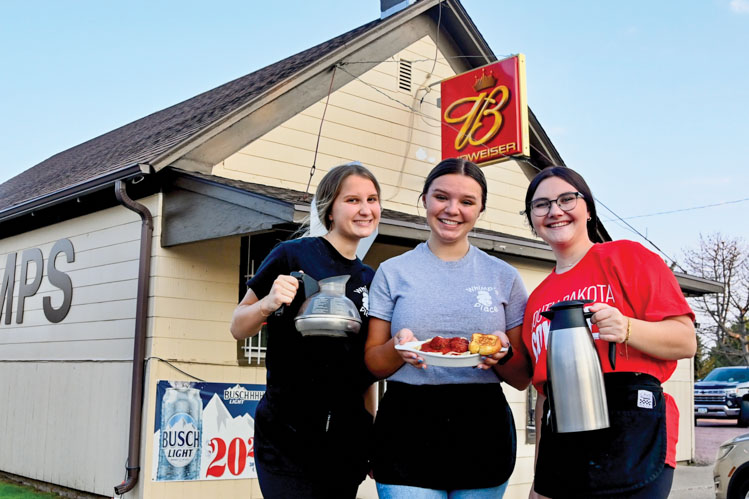
Jim Slattery runs Whimp’s, Burbank’s only eatery — and its only business — along with his brothers Nick and Tom. He learned to cook at the Silver Dollar in Vermillion while studying political science at USD.

He acknowledges that the town looks more like a traditional farm town. Some of the locals wear Coyote red with their seed corn caps, and they frequent Whimp’s along with professors and students.”The farmers know I’m a city boy,” Slattery grins.”I haven’t been asked to drive a tractor, but I can do that.”

Whimp’s was started in 1967 by Leonard”Whimpy” Girard and it has been a staple ever since, thanks to the Taggarts and Radigans who also spent stints as owners. Now it’s the Slatterys’ turn. All four families are”old names,” both in Clay County and on the USD campus.

The Slattery brothers haven’t changed the menu or decor since buying Whimp’s as well as Toby’s, a popular chicken shack in nearby Meckling — which is like a sister city to Burbank on the west side of Vermillion.

Whimp’s’ menu has six signature burgers (Burbank, Keg, Cornhusker, Mushroom & Swiss, BBQ Bacon Cheddar and the Dark Lord).”We’re one of the few places you can still get liver and onions,” Slattery says.

Popular specials include the $5 cheeseburgers on Tuesdays, chicken wings on Wednesdays and all-you-can-eat spaghetti on Thursdays, with mouth-watering meatballs made from tenderloin trimmings.

Carley Johnson, Grace Reynolds and Taryn Taggart are students at USD and waitresses at Whimp’s, a popular eatery in Burbank.

“If we can make it, we do it,” Slattery says.

Ted and Karen Muenster — namesakes of USD’s Muenster University Center — were at the bar for a recent spaghetti night.”We drive out here one or two nights a week,” says Ted, who’s now retired from a distinguished career in business, politics and academia. Karen served as a state senator from Sioux Falls and was a leader in historic restoration of downtown Vermillion for many years.

“Whimp’s has always been run by these old families who have been well-connected to the university,” Ted says.”Some people say it’s wicked,” he grins, gazing at the lawyers, teachers and retirees seated at simple tables.

Despite Burbank’s tiny population, Muenster notes that hundreds of thousands of people live within a 40-mile radius encompassing Yankton, Sioux City, Sioux Falls and Vermillion, so Whimp’s is actually a dirt-street oasis in a well-populated region.

The tiny town has a history of attracting outsiders. Frank Verzani, an Italian immigrant, ran a ferry on the Missouri River, just a few miles away. His crossing was called Victors, and then Green Point. When the Dakota Southern Railroad extended into Dakota Territory in 1872, the community was renamed in honor of John Burbank, the fourth governor of the territory and a director of the railroad.

Bob Hudelson is one of the few Burbankers without a connection to the nearby university, but he knows history and his own life story sounds like a Charles Dickens novel.”I was raised on the streets of Sioux Falls,” he says. He escaped from an orphanage and made his own way as a child, thanks to the benevolence of kindly policemen, store owners and others who helped him find a place to sleep and a meal. On some cold nights, he remembers being locked inside stores so he would be safe and warm.”I wish I knew how to say thank you to the people of Sioux Falls who helped me survive as a boy,” he says.

Ted Muenster (left), a longtime champion of USD, is a regular at Whimp’s, now run by Jim Slattery (right) and his brothers.

For 23 years, he and his wife Barbara have lived in Burbank, where he has soaked in the wicked past that Muenster referred to. Hudelson says Burbank was a wild cow town because ranchers brought stock here to be shipped on the railroad. He points to a house that was once a brothel and tells a story of when the notorious outlaw Jesse James nearly got involved in a shootout on main street.

Jerry and Colleen Johnson live across the street from the Hudelsons, along with a dozen ducks, 10 dogs and more than 200 chickens. Colleen takes the eggs with her to Vermillion every day, where she works as a custodian at the university.

“I like it here because at 6 o’clock at night it’s so quiet you could hear a pin dropping,” Johnson says. Or a rooster crowing.

Like any university town, Burbank has an ongoing fundraising project. It involves a historic school building that closed in 1972. Every September, the town holds a barbecue to raise money for repairs to the school, which is now used as a community center.

Nick Slattery, a local contractor and part-owner of Whimp’s, helps with the project. His brother, Jim, assists with the food.

“We’re here to help, whether it’s the schoolhouse or whatever,” Jim says.”This will not be a ghost town. There will always be people here.”

Editor’s Note: This story is revised from the November/December 2024 issue of South Dakota Magazine. To order a copy or to subscribe, call (800) 456-5117.

Posted on — Leave a comment

Bird Signs at Bear Butte

Bear Butte, an ancient volcano in Meade County, is a sacred place for Native tribes.

GRANDMA USED TO SAY that her father shouldn’t have been a farmer, though he made do. Besides wearing overalls, the man liked to dance and take photographs and had a deep, bellowing laugh. During the summer, he’d come in for lunch, turn on the radio and lay down on the cool kitchen floor, listening to voices discuss grain prices. His wife did all the farm thinking, bought livestock and paid the bills. That was before they had children, and then she delegated most of the management to her two oldest sons while the younger sisters drove the grain truck with their father.

My grandmother was born in Gary in 1927. Back then, people not only watched, but looked for birds — and believed in them — as signals. Cardinals came in spring, an owl was a ghost, a red-tailed hawk was good luck (three of them worth a harvest) and an eagle was a sign of greatness.

Each Sunday, our family would visit Grammy in the nursing home, and she’d tell stories; how her mother had premonitions, signs of things to come, like when a glass was broken in the kitchen on the same afternoon an ornery hog trampled a farmhand and bit off the tip of his thumb. As she spoke, she would turn her attention to each audience member and then let her eyes drift off to the horizon.

Four months before she passed away in October 2021, Grammy took a road trip to Bear Butte, a place she had always wanted to visit. She saw the buffalo pasture, fell asleep at the lake and stayed at the Hotel Sturgis, closer to Rapid City for an evening dinner with her sister. It was left unsaid that it would probably be her last trip back to South Dakota. To give Mom, Grammy and her sister some time alone, I decided to hike Bear Butte.

*****

NORTHEAST OF THE STURGIS”Hollywood” sign, the hillside rises into a thicket of pine trees, a brief territory that expands roughly 2,000 feet and encompasses prime land for cabin plots. From a bird’s eye view, ripples of igneous rock run parallel to Highway 34, eventually disappearing into a plain of county highway, foothills and hay country. The air is clear, and you can smell the sweet oil from miles of prairie grass that can grow as high as a buffalo, pitched with a wind that makes the fields appear to roll like the Atlantic Ocean. From a distance, the saddle of an isolated hill forms two small, furry bumps, the shoulders and rear haunches of something gargantuan. It looks as if some beast might be sleeping on the wide prairie.

As you approach on a wide-bending county road, signs mark the beginning of Bear Butte National Wildlife Refuge. The lake appears on your left with a burgundy sign for the Centennial Trail head and then another sign showing you through the buffalo pasture at the base of the butte.

Bear Butte is Mato Paha to the Lakota Nation, or Bear Mountain. People don’t agree on whether the geographer’s standard appropriately rules-in the formation as a butte or just a lonesome hill, deep with rocky crags.

For hundreds of years, the mountain has been an active ceremonial site, with indigenous tribes utilizing it for a variety of spiritual experiences. The mountain has also served as a destination waypoint for travelers across the Great Plains long before the creation of an iPhone, Wi-Fi or Google Maps. As the ancient volcano rises 900 feet abruptly into the sky, the rocky laccolith is considered a bridge from this world to the next, a place to communicate with, interpret, signal and understand a world beyond the physical one we experience.

I started early, just as the middle of night began to shrug off. At sunrise, I watched light pour into the creek valley. The reflection looked like a golden Colossus, a giant with arms reaching toward the sky. With each step up the trail, light expanded across the horizon, warming the back of my ears. Immersed in the cozy scent of pine, I felt a force, a great spirit, as if it might lift me off the Earth.

Thousands of people ascend Bear Butte every year, some seeking spiritual clarity.

From the lodge at the base of the mountain, the trail furrowed through the forest. I saw trees filled with sacred offerings: articles of cloth tied into pouches with tobacco, peppermint and other prairie herbs, each offering knotted around branches of cedar and pine. The cloths flapped in the quickening wind, the number of offerings so great that the bundles looked like people in a caravan toward the top. The scene reminded me that I wasn’t alone.

Approaching the trailhead, I saw two mule deer and they saw me. They turned to stone, the white button of each tail tufted into the dark air, their ears turned flat in my direction. Stepping forward, my heel crunched the gravel. They moved 10 or 15 feet and then looked back again with the same curiosity. They moved off further. I moved and they moved, turning to look back one last time before pelting off down the slope of the mountain.

Closer to the summit, I saw a shirtless man meditating off the trail on the eastern face of the rock, the boundless wind lifting his long, braided ponytail into the sky. He seemed to be inviting the sun onto the mountain. He must have started his journey earlier than me — or he was there all night. He gently tied a knotted piece of cloth to the outer branch of a young pine, careful not to cause a change in the growth of the stripling. The article is offered to the elements: the Great Sky, the Sun, the Earth, eternally blessed by the spirit of the morning light.

The man stopped at each promontory on his travel down the mountain. As the switchbacks slither up and down through the jagged slopes, these portions triangulate, leveling off to cradle valuable lookout points where the soil is amenable enough for yucca to grow.

At each nest of rocks, the man paused. He cupped his hands to his mouth, but there was no noise at first. Then I heard a flickering whistle.

Weet, weet, weet.

The warble of a bird, as if a meadowlark shadowed him up the mountain. He continued this ritual until I could no longer see him in the folds at the base valley. I descended the trail feeling better than when I began, my mind quiet and more connected, thinking of ways to take this sacred mountain with me wherever I go.

*****

AFTER MY GRANDMOTHER’S death, I returned to Bear Butte in January wanting to reconnect, looking for a sign. I thought of my grandparents, and how they made their home into ours when we moved to Nebraska from the East Coast. How they sheltered us from the storms in life. How they showed us good and believed in enduring altruism. I carried these spirits as well as a promise to look for something great, like an eagle. Incredibly, I saw one as I left Lincoln, Nebraska, for the Sandhills. It was a good sign and a rare sight for the capital city. I knew it would be a wonderful trip.

From the Sandhills I traveled through Pine Ridge, Rapid City and then Sturgis, arriving just as the sun pushed the horizon. The blue daylight turned an orange cream, like the inside of a Cadbury egg. The stores in town still slept, and there was no place to eat besides the gas station. I filled up on coffee and bottled water before heading out to Highway 34.

The temperature started in the teens. The wind was festive, always present and nipping before the 900-foot ascension. Sunrise on January 16 was at 7:26 a.m. I plowed into the mountain, feeling the furnace on the horizon beginning to brighten.

Prayer cloths and bundles, found along the trail to Bear Butte’s summit, are left as offerings to higher spirits.

Halfway up I saw a couple farther along the trail, perched on the slope 75 feet above. The wind unexpectedly rushed, brushing off my stocking cap and making me teary-eyed. Heavy clouds in the distance indicated that a weather system was sprinting towards the butte. The couple appeared, then disappeared before emerging again on the trail before me. The man carried a plastic bag and a bone-pipe flute. I suddenly realized they wore blue jeans, sneakers, stocking caps and thin cotton gloves, the kind you’d use to detassel corn. I felt empathetically cold, dressed in coveralls, hiking boots and insulated gloves.

It began to snow. With this wind, the flakes bit at my cheeks, sharper than glass.

ìDid the weather scare you off?” the woman asked as she pulled the hood of her windbreaker around her chin.

ìSomething like that,” I replied.

The man told me that they had to reach the top of Bear Butte for their ceremony; a sacred rite, part of which requires summiting the mountain under any circumstances and depositing their offerings at the top. The objects to be offered were in the plastic bag — an umbilical cord and placenta. These pieces were bound in clothing and tied into the trees. Some were placed underneath the yucca. He described it as a blessing. For their children. For better education, opportunities, wealth and beyond that — a home. So that no matter what happens, they will never be lost, they will always have a home, a place they can always return to on Bear Butte.

We exchanged a warm wave and they departed.

ìHave a good day,” the man said.

ìSafe travels,” I replied.

I watched them travel down the mountain, stopping at the next promontory 50 feet below. He held the flute to his lips. I could hear it, the notes sounding tiny in the wind, the high-pitched air fluttering through the bone tube towards the sun. The warble of a meadowlark. To the west the sky was dark, hiding a range of rock behind low clouds southwest of the mountain. In the east, the glowing sun peacefully climbed.

That’s when I saw two mule deer, perhaps the same pair that I met during the summer. They stared like they knew me, perhaps carrying the spirits of what was. I thought of the eagle, and my promise to look for something great, and I was reminded here on Bear Butte, no one is lost. Wherever life takes us, there is always a place, if only sometimes a feeling, that we can call home.

I listen.

Weet, weet, weet.

I thought of my grandparents, loved ones, lost or not, imagining them as part of the caravan of colored cloth traveling through trees.

Alex Zappala is a writer and musician living in Lincoln, Nebraska.

Editor’s Note: This story is revised from the July/August 2022 issue of South Dakota Magazine. To order a copy or to subscribe, call (800) 456-5117.

Posted on — Leave a comment

A Legacy in Lead

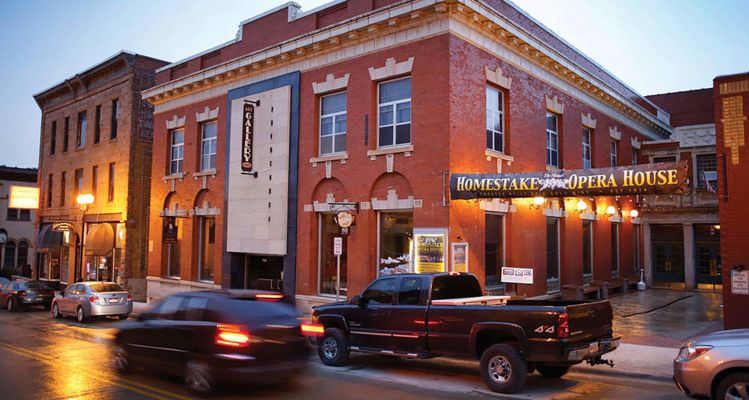
Phoebe Apperson Hearst’s many philanthropic endeavors in Lead included the Homestake Opera House, which opened in 1914.

Phoebe Apperson Hearst died in 1918, several decades before Linda Wiley was born, but their paths crossed in the small Black Hills community of Lead.

Linda studied Phoebe’s writings and accounts of her business and philanthropic ventures and brought her to life through a production on Lead’s Historic Homestake Opera House. Linda believes South Dakotans should know about this remarkable woman who made a big impact in the Black Hills. When Phoebe’s husband George Hearst (mining entrepreneur, U.S. senator from California and fictionalized villain in the HBO TV series Deadwood) died, his 48-year-old widow inherited every penny of his considerable wealth. She gave much of it away.

Her belief in helping those in need could be traced to when she and George lived in San Francisco in 1873, the year an economic depression gripped the country. The couple got by okay,”because of the mines. People in San Francisco fared worse and when I witnessed the impact on the city and families, my philosophy changed towards wanting to help the needy, for I realized I could help,” Phoebe said.

Okay, let me clarify. Phoebe said that in Linda’s script and through Minneapolis actress Kathleen Dodsen Smith’s interpretation. And Jon Steven Wiley, Linda’s actor husband, had a hand in things, too, as script editor. Dramatizing history is a complex matter but a great way to communicate true stories to a mass audience, if the writer, performer and script editor are skilled and conscientious. I can personally vouch for these three. Linda combines a love of the Black Hills with a professional ethic that insists on accuracy. I’ll explain before the end of this column but right now I don’t want to drift too far from Phoebe.

Phoebe Apperson Hearst.

Phoebe considered George’s mining ventures across the West to be immune to the boom-and-bust phenomenon. Homestake grew continually, and after George’s death, Phoebe went to Lead and took a look. She invested in a private railway car she called the Lucania and traveled in comfort. Liking and apparently feeling somewhat maternalistic towards Lead’s people, she began sending $200 (nearly $6,000 in today’s dollars) to all 12 Lead churches every Christmas. She also endowed a fine library and was an advocate for what we now call early childhood education; Phoebe established a free kindergarten in the community. Some critics have looked at her love of Lead and her humanitarian gestures overall and wondered if she couldn’t have done more to prevent community hardship that stemmed from Homestake’s labor lockout over the winter of 1909-10. Whatever the case, Lead didn’t seem to direct anger toward her. Homestake’s board of directors in San Francisco took most of those barbs. Phoebe, meanwhile, rode the Lucania across the United States supporting a wide range of interests, from restoration of George Washington’s Mount Vernon home in Virginia to development of the University of California at Berkeley. She was the first woman to serve as a University of California regent.”I attributed my success in a man’s world of that time to politeness, clear goals, and sheer determination,” Phoebe says in Linda’s script. That style, Linda thinks, likely stunted Phoebe’s effectiveness as a suffragette, although that’s certainly where her sentiments were.

Her last gift to Lead, working with mine superintendent T.J. Grier, was the Homestake recreation building and opera house. In the script Phoebe expresses satisfaction with how Lead responded to an opening night opera in 1914:”I heard that there was standing room only with employees from the mine and their children!”

Historians have mostly overlooked Phoebe’s relationship with South Dakotans. Even Alexandria Nickliss’s fine biography, Phoebe Apperson Hearst: A Life of Power and Politics, only briefly touches on Lead in 664 pages. Thankfully, another California writer, Leta Miller, has written about Phoebe for the South Dakota State Historical Society, and the Homestake Adams Research and Cultural Center has archived South Dakota press accounts about Phoebe’s connections here.

All were resources for Linda, a native South Dakotan and meticulous researcher. She worked as a manager for Caterpillar, Inc., for 30 years across the United States and around the world. All the while, she and Jon knew they would retire to the Black Hills. They found their spot 7 miles outside Lead, and like Phoebe, quickly developed affection for the town. Both volunteered at the opera house that Phoebe made possible, and Linda served for a time on its board and then as president.

And she became a Phoebe Hearst expert. That’s very much a necessity in a town where residents told me the opera house — Phoebe’s final grand gift — is the very heart of the community.

Editor’s Note: This story is revised from the May/June 2022 issue of South Dakota Magazine. To order a copy or to subscribe, call (800) 456-5117.

Posted on — Leave a comment

Gator Shows

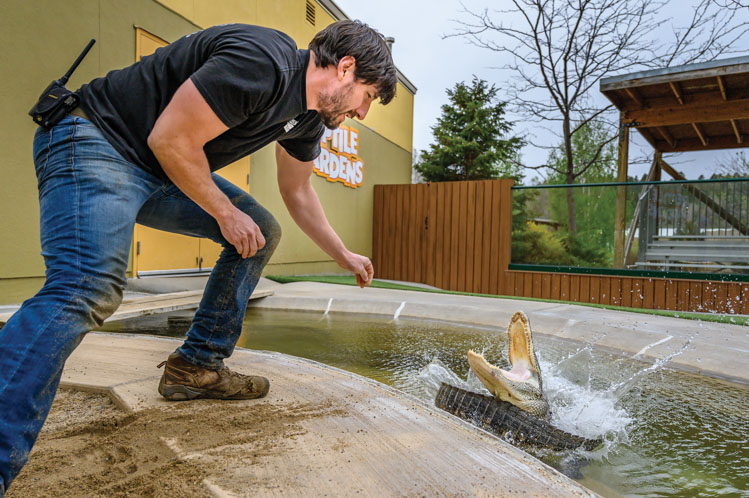
Ryan Comer deals with an ornery gator in the show arena at Reptile Gardens.

Rapid City is a thousand miles from the natural habitats of giant lizards, but Matt Plank’s boyhood dream was to work with alligators and snakes. Fortunately, one of the world’s largest collections was right down the highway.

Reptiles were”always a passion,” Plank says.”I always watched Animal Planet, was always catching garter snakes, frogs and toads. It seems to be luck that I grew up next to this,” he said as he walked through the Sky Dome of Reptile Gardens.

Plank got a job in the cafe at the expansive attraction in 2002, worked there seasonally while earning a biology degree in 2010 from Arizona State University and joined the permanent staff in 2013. He is now assistant curator and show coordinator, overseeing the educational performances for summer visitors.

Now he works alongside Head Curator Terry Phillip, who found his way to Reptile Gardens after managing a pet store in Colorado and focusing on”reptiles, dinosaurs, girls and business, not necessarily in that order,” he says with a smile.”I was not so successful at most of them.”

Phillip moved to the Black Hills, where he had relatives, and started doing alligator shows at Reptile Gardens in 1997. Today he is among the country’s top authorities on crocs, venomous snakes and other reptiles.

American alligators are one of the great success stories of conservation. Once endangered, they could have easily been hunted to extinction when people moved into their habitats. But alligators adapted and responded to preservation efforts; today they are thriving in the southern United States. Most of the gators at Reptile Gardens are captured in places like eastern Texas and South Carolina where they have become a nuisance in populated areas.

Rapid City native Matt Plank found a calling among the large reptiles that live just outside his hometown.

“Gator wrestling” has been a staple at reptile zoos for decades, however the shows at Reptile Gardens do not actually include grappling. At Rapid City, the entertainers seek to demonstrate the agility and strength of their alligators and crocodiles.

The shows took a two-year break due to the COVID-19 pandemic but returned in 2022. Phillip said the revived shows brought together an inexperienced staff and animals that weren’t used to the handling, a hazardous combination. Even though the staff and the animals grow accustomed to each other, there’s reason for caution around them.”We aim for the art of perfection,” Phillip says.”You can’t make mistakes. The biggest problem is complacency. You don’t want that with dangerous animals.”

“You get hit by one of these gators you’ll feel it,” he said. Right on cue, an alligator that was being moved to a different enclosure swung his head and smashed the taillight on a pickup.

Accidents and injuries do occur.”I made it my first year without getting bit,” Plank says, but admitted he has been injured several times.”Now I do everything I can not to get on a gator,” he chuckled.”When it’s exciting it means something’s not going well.”

Showing scars along his arm and fingers, Plank recalled a bite that required 17 stitches.”I remember his mouth right here,” he says, clamping one hand onto the scarred one. Reptile Gardens Public Relations Director Johnny Brockelsby — son of Earl Brockelsby, who founded the popular Black Hills attraction in 1937 — recalls hearing on the staff walkie-talkie that a manager was needed at the alligator arena immediately.

“‘Immediately’ means there is something serious,” Brockelsby says, pointing out that he’s not at his best in emergency situations.”When I got there, Matt was just sitting on the gator like normal and I asked what was wrong.”

“Johnny, my hand is in his mouth,” Plank replied.

Terry Phillip has trained numerous animal wranglers and emergency personnel on handling dangerous reptiles.

“Matt had sweat streaming down the side of his face, so I gave the gator a light tap on the nose, but nothing happened,” Brockelsby says. After another smack on the nose, with Plank pushing down as hard as he could, he got the animal to open his jaws.

“Then he says, ‘Johnny, should I finish the show?'” Brockelsby laughs.”I said, ‘No, I’m taking you to the emergency room.’ Luckily his fingers were between the teeth, or it could have been a lot worse.”

Phillip calls the incident the”most significant in my time here,” and Plank agrees.”It’s the close calls that scare you the most,” he adds.

Recognized as one of the largest collections of reptiles in the world, Reptile Gardens is also a place where other people seek advice.”We get questions from all over the planet,” Plank says. The staff also keep one of the largest and most diverse supplies of antivenom in the world.

Phillip is proud of the training he’s helped provide for area medical technicians, law enforcement officers, EMTs and first responders. He has offered staff training for other zoos and animal parks. He recognizes that his expertise is unique and helpful in certain situations.”Anytime, anywhere, for any reason for law enforcement and emergency personnel,” he says. He has also been part of several confiscations of illegal reptile collections around the country, some of which were added to the displays at Reptile Gardens.

Plank loves his job and wouldn’t want to be anywhere else.”Sometimes I’m jealous of the Florida parks because of the weather,” he says.”But there’s something about this place.”

Not even a gator bite will change his mind.

Editor’s Note: This story is revised from the March/April 2023 issue of South Dakota Magazine. To order a copy or to subscribe, call (800) 456-5117.

Posted on — Leave a comment

The Fourth in Kranzburg

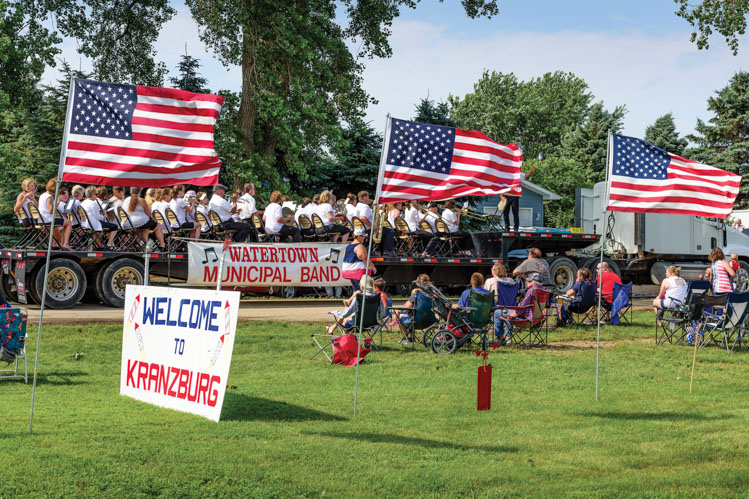
Kranzburg’s Fourth of July parade is one of the state’s largest.

An unorganized celebration keeps Kranzburg hopping each July 4 as anywhere from 4,000 to 10,000 people descend on the tiny town 8 miles east of Watertown.”No one is really in charge,” laughs Dale Plunkett, owner of Kranzburg’s Tip Top Tavern.”If you want to be in the parade, you just line up on the east side of town.”

Over the years it seems that every well-known South Dakota politician has marched in the Kranzburg Fourth of July Parade, community bands have played and plenty of free beer has been handed out. In fact, beer is how the whole thing started in 1958 or’59 when the late Charles Strang and Willie Kranz celebrated the town’s incorporation by driving around with a keg in the back of a pickup truck handing out free beverages.

Now the parade”kind of just happens,” says Carol Rinehart, Strang’s daughter. She and her sister Mary Ann Stahlke spot people they haven’t seen in years and agree it’s a community reunion.

“Three hundred and sixty-four days a year it’s a quiet little town,” Plunkett says.”Then everyone who has a connection comes.”

“It’s wall-to-wall people,” Stahlke adds.”And it hasn’t lost its momentum.”

Dale Plunkett and his mother Marge run Kranzburg’s Tip Top Tavern.

Kranzburg was named for the Kranz family that still lives in the area. It is historically a Catholic town with streets named for saints and the large Holy Rosary Church dominating the skyline. The impressively ornate church was built the same year the town was founded and placed on the National Register of Historic Places in 1986. Its school served the community from 1906 to 2014. At one time so many students attended that they overflowed into the one-room community school in town.

That public school was the first in Codington County and the Strang family sisters have lovingly restored it over the last several years. Carol Rinehart, Mary Ann Stahlke and Eileen Lindner all attended the District 5 Kranzburg school, as did their mother and other siblings. Although their father Charles Strang did not attend the school, he served on the town board that met in the schoolhouse until a town hall was built next door. Before he died in 2015, he made it clear that he wanted the school preserved.

“We promised and a promise is a promise,” Rinehart says.”I really think our dad helped us even though he wasn’t here.”

Carol Rinehart (left), Mary Ann Stahlke and other Strang family members continued their father’s wishes to preserve the Kranzburg public school.

So the sisters devoted one day a week to clearing out junk that had been stored in the building, scrubbing, sanding and painting. They discovered treasures like original books, posters and even artwork students had left in cabinets. They baked 300 rolls to raise funds and the Watertown Area Community Foundation provided a grant that helped put new shingles on the roof. Roofers Mark and Doug Kranz also repaired and painted the belltower.

Fourth of July parade attendees in 2022 got their first look at the restored school.”Everyone who came really appreciated it. Like us, they got a little nostalgic,” Rinehart says. Memories of Kranzburg when it boasted a grocery store, cheese factory, mink farm, the Kranz Hotel, a train depot, three bars and a liquor store are also collected in displays in the school.

Plunkett bought the Tip Top Tavern from his parents; his mother still works with him at the gas station/convenience store/Marge’s Diner/bar. In 1918 the Tip Top was built as a Standard Oil gas station at the corner of Highway 212 and County Road 3. Rebuilt, remodeled and repurposed over the years, it still occupies the original spot.

Community values are at the core of Kranzburg’s survival, according to Marge Plunkett.”It’s just a family community,” she says.”It’s home.”

Editor’s Note: This story is revised from the March/April 2023 issue of South Dakota Magazine. To order a copy or to subscribe, call (800) 456-5117.

Posted on — Leave a comment

Milkweed Champs

Sydney Kreutzmann, a biology technician in the Olson-Manning Laboratory at Augustana University in Sioux Falls, leads experiments on the ability of South Dakota’s milkweed species to absorb moisture.

Woe is the ancient milkweed. South Dakotans have hoed, chopped, sprayed and cussed it for one hundred years.

Milkweed finally gained respect when nature-lovers learned that the flashy monarch butterfly nests only in it. But the butterfly chews on its leaves, defoliating the poor plant sometimes to the point of death. Where’s a milkweed to turn for love?

That would be Augustana University in Sioux Falls, where a team of young scientists and students are studying the intriguing plant.

“Whenever I’m wearing one of my milkweed t-shirts at the airport, someone always comes up to me and says that they love the milkweeds,” says Steven Matzner, an Augustana biology professor.”Usually it’s because they like the monarchs.”

He and Carrie Olson-Manning, an associate professor of biology, were looking for a local plant system to study in 2017 when she found a blurb in a Plants of the Prairie guidebook that said two major species of milkweed — the showy and the common — hybridize only along a strip of land that includes the very center of South Dakota.

“I ran down the hall and showed it to Steve,” she recalls.”Based on his knowledge of our state, he knew that the hybridization was around the 100th meridian.”

The two Augustana teachers and their students have been studying the plant ever since. Last year, Olson-Manning won a $1.2 million National Science Foundation award given to promising young scientists, so the milkweed project is ramping up.

South Dakota is the ideal place to study milkweeds because of the 100th meridian, the longitudinal line that is considered the border between the arid West and the more humid East. The invisible boundary crosses north-to-south in the very center of South Dakota.

Olson-Manning says there are 130 species of milkweed in North America, but two varieties cover much of the continental United States. Common milkweed (Asclepias syriaca) grows from the Atlantic Coast to the 100th meridian. Showy milkweed (Asclepias speciosa) grows from the Pacific Coast to the 100th meridian.

Neither species has encroached naturally past that boundary, and the two have not intermingled or hybridized anywhere else in the wild.

Milkweed plants are crucial in the life cycle of monarch butterflies. Female monarchs lay their eggs only on milkweed leaves.

Milkweeds are an ancient plant, possibly dating back 2 million years. The two Augustana colleagues believe that the species they are studying were likely separated during the Ice Age and then began to reconnect and hybridize sometime after the last glaciers melted about 10,000 years ago.

Why don’t the hybridized species grow beyond that swath along the 100th meridian? Why doesn’t the common milkweed grow west of it, and why doesn’t the showy grow to the east? What can we learn from the plants that might be useful to other plants or humans? And why are milkweed species disappearing from rural landscapes? Those are some of the questions being asked.

As the research project literally took root on the Augustana campus — where milkweeds are now nurtured near the front steps of the glass-and-brick Froiland Science Center and indoors in a sunny laboratory greenhouse — the public became aware that the eastern monarch butterfly is also in trouble.

The demise of the milkweed relates to the well-being of the monarch. Female monarchs lay their eggs only on milkweed leaves. The hatched larva eats on the leaves for about two weeks before the caterpillar forms a cocoon, or pupa.

In another 8 to 12 days, the pupa blossoms into the beautiful monarch, which then seeks nectar and thus serves a valuable purpose in farm country as a pollinator.

The monarch caterpillar absorbs a toxin from the milkweed that tastes bitter and can be poisonous to vertebrates. When it morphs into a butterfly, its colorful markings act as the opposite of camouflage. The orange and black signal”danger” to birds, snakes and rodents who might otherwise consider it a tasty treat.

Wildlife enthusiasts are enchanted by the monarch’s amazing annual migration from Canada and the northern United States to the Sierra Madre Mountains of central Mexico, 2,000 miles from South Dakota. It is the only butterfly that makes a two-way migration. Other species winter as larva or pupa, but monarchs cannot tolerate the cold Dakota winters.

Dr. Steven Matzner, like most farmers’ sons, grew up believing milkweeds were to be chopped or sprayed to death.

Increased use of pesticides and insecticides has severely damaged monarch and milkweed populations. Changing weather patterns have also had a negative effect.

Nobody seemed to care about the lowly milkweed until the monarch, its colorful pest, was reported to be in decline. Scientists say the monarch population has dwindled as much as 80 percent in the last 20 years.

Fascination for the intermingled species was apparent last August when faculty and student researchers from across the state met at the University of South Dakota campus in Vermillion for the annual BRIN (Biomedical Research Infrastructure Network) convocation.

Matzner spoke about Augustana’s milkweed project in a lecture hall with 25 young scientists who listened raptly about the plant’s peculiar hybridization habits.”They don’t move past each other,” he said,”but they seem to be stuck in a transition zone that seems to be several hundred miles wide.”

He explained that the hybridization extends throughout both Dakotas and southerly through Nebraska and Kansas. He noted that he and Olson-Manning are especially interested in how the common milkweed and the showy milkweed differ in their water-related traits.

The audience of teachers and students had many questions.

“Is there a difference in drought tolerance?”

Matzner said students at Augustana have weighed pots for months to measure the two plants’ ability to extract water.”We thought the showy milkweed would be more drought tolerant, but when we did the experiments the two species were similar. That left us with the question of how the showy milkweed lives in the drier part of the state when it is not more drought tolerant.”

He says part of the answer is that it is constrained to wet places within the drier western part of South Dakota; it avoids drought by growing where the land is wet.

Another audience member asked,”What is the role of the milkweed in the ecosystem?”

Dr. Carrie Olson-Manning grows milkweed near the front steps of her Augustana University research lab.

“So,” answered Matzner,”have you heard the phrase, ‘Nature abhors a vacuum?’ Milkweed is one of those species that is good at colonizing after a disturbance. Like when a river floods and creates bare ground. It is one of the weedy spaces that fills in the holes or gaps created by disturbances. Interestingly, many of our crop species also evolved from these same types of weedy plants. When humans started plowing the prairie, we likely increased the habitats available for plants like milkweed, and so farming was probably initially good for milkweed abundance. Ironically, we now have gotten so good at killing the ‘weeds’ that intensive agriculture has decreased milkweed abundance.”

“Do you have any contact with the monarch butterfly people?” asked a young teacher.

Matzner answered,”We have a lot of people who love monarchs who come by the fields.”

He noted that Olson-Manning knows many monarch scientists. She is planning experiments this summer with butterfly researchers. Together they’ll study how the caterpillars are able to survive and grow on the two milkweed species and their hybrids.

After the conference, Olson-Manning further explained that the Augustana team is now recruiting teachers to plant gardens in local schools,”so they can learn about climate change and biodiversity from this beautiful system.”

Matzner and Olson-Manning hope to convince 10 school districts to collaborate by planting milkweed gardens.”We are recruiting K-12 teachers to create curriculums around the two species — the monarchs and the milkweed. We’re leaving it up to the creativity of the teachers to decide what their projects should be,” she says. They expect that the teachers and students will participate for love of the monarch rather than the milkweed, but they’ve come to welcome the symbiosis.

The Augustana profs have already established large research gardens at the state Game, Fish and Parks’ Outdoor Campus sites in Rapid City and Sioux Falls. They also intend to start a garden at Custer in the southern Black Hills.

Never in South Dakota history has the lowly milkweed garnered so much love and attention, and Matzner and Olson-Manning are the perfect persons to lead the research.

Olson-Manning’s father was a northern Minnesota farmer who had an interest in native plants and mentored young agriculture students on the importance of working with nature. She remembers watching caterpillars and butterflies on milkweeds, picking pods and scattering their wispy fluff.

After her father died two years ago, she came across a picture he’d taken long ago of a milkweed on their farm. It now sits in her office at the Froiland Science Center.

Matzner also grew up on a farm. His father is retired from decades of staving off milkweeds on the family fields near Stickney, southwest of Mitchell.”Dad keeps asking me why I study milkweeds,” says the professor.”He is a good Christian fellow, so I ask him, ‘Isn’t the milkweed one of God’s creations?'”

Yes, God created the monarch and the milkweed. Who else could conceive such an unlikely alliance?

Editor’s Note: This story is revised from the May/June 2024 issue of South Dakota Magazine. To order a copy or to subscribe, call (800) 456-5117.

Posted on — Leave a comment

Bittersweet in Leola

Bonnie Gill with her rhubarb cookbook.

Bonita”Bonnie” Gill loved rhubarb. She helped spearhead Leola’s first Rhubarb Festival in 1972. She compiled a cookbook, wrote a poem about the town’s favorite vegetable, and was even crowned the town’s Rhubarb Queen.

Gill died at age 96 in January of 2023. Just as she would want, the town’s festival continues, though for many it’s as bittersweet as a stalk of unsugared rhubarb.

Merilee Beck, one of Gill’s seven children, remembers her mom working on the first rhubarb cookbook in the 1970s. A few years ago, she and her sisters decided to redo the local bestseller.”We gathered even more recipes from our kitchens and from others and published a new version. And since it’s our mom, we decided to name the cookbook after her.”

Beck says they come from a long line of bakers.”Mom grew up in a bakery and had a natural start, as did her six siblings. Her dad was a lifelong baker, owning several bakeries during his lifetime. His parents, originally from Sweden, were bakers as well.”

In 1942, Gill’s dad moved to Leola to start a bakery, which was eventually taken over by Gill’s brother, Tubby, and his wife, Agnes.”They made bread, buns and rolls — and kuchen was a specialty,” Beck says. Kuchen, a German fruit pastry pie, is now South Dakota’s state dessert.

Swanson Bakery was a mainstay for decades in the little McPherson County town of 440.”People passing through Leola would make a point of stopping,” Beck remembers.

Richard Jasmer, one of the 2023 festival organizers, says Bonnie Gill was a dedicated promoter of”the pie plant,” her nickname for rhubarb.”She will be missed because she was one of the originals. She helped get the festival started and was such a sweet lady. She did so much for our community and so much to promote the use of rhubarb, especially through her cookbook.”

Jasmer says volunteers work throughout the winter and spring to get ready for the biennial event.”Planning for the festival really brings people together. And it gives us a fun activity to do while we go through the winter blahs.”

Gill’s daughters (from left) Merrilee Beck, Kimberlee Geary and Lorrilee Gill at a recent Rhubarb Festival.

Activities include a poker run, bake sale, turtle races, craft show, bean bag competition, street dance, fireworks, kiddie train rides, face painting, watermelon feed, pig scramble and street picnic. Another good-natured highlight is the battle for biggest rhubarb leaf and longest stalk.”We have quite a few entries,” Jasmer says.”It is like a reality show. People are measuring each entry. It’s always close and there are always disappointed competitors.”

Rhubarb royalty is determined every year by a dessert contest. Entries are judged by a panel.”The tastiest entries win. There’s a waiting list for people who want to be judges. Any age can enter. One year the king was a boy of just 10 or 12,” Jasmer recalls.

Though Bonnie Gill will be missed, her children emphasize that she would want everyone to celebrate with the same sense of fellowship and fun that Leola residents and guests have to come expect at the festival. In fact, she expressed that very sentiment in a poem she once wrote about rhubarb:

The lowly pie plant has come a long way

And finally been honored with a special day

So when life goes sour add a little sweet,

and you, too, will be like a rhubarb treat.


Mom’s Easy Layered Rhubarb Cheesecake

2 pounds rhubarb, sliced into 1/2-inch pieces

2 cups white cake mix

1 egg white (reserve yolk for filling)

1/4 cup unsweetened rhubarb juice

3/4 cup sugar

2 tablespoons unsweetened rhubarb juice

2 (8 oz.) packages of cream cheese

2 eggs, separated plus reserved yolk

Preheat oven to 350 degrees. Grease and flour a 9×13 inch pan. Place 2 pounds of rhubarb into the saucepan and add water to almost cover the rhubarb. Bring to a boil and continue cooking until rhubarb is mushy. Pour rhubarb through a sieve, but don’t force it; you want clear rhubarb juice. Combine cake mix, egg white and 1/4 cup of rhubarb juice. Beat batter as directed on the cake mix box. Pour batter into the prepared pan and bake for 12-15 minutes. While baking, mix together sugar, 2 tablespoons of rhubarb juice, cream cheese and 3 egg yolks. Beat 2 egg whites until stiff and fold into the cheese mixture. Remove cake from oven and spoon filling over baked base. Return to the oven and bake for 20-22 minutes. Cool before serving. Spoon your favorite rhubarb sauce over each serving.

Editor’s Note: The 2025 Rhubarb Festival will be June 27-29. This story is revised from the May/June 2023 issue of South Dakota Magazine. To order a copy or to subscribe, call (800) 456-5117.