Posted on — Leave a comment

Dakota’s Doolittle Raiders

Tracing the paths of two South Dakota war heroes

While home on leave in July 1942, Don Smith attended the Black Hills Roundup in Belle Fourche with his parents, Laura and A.W. (Doc) Smith. That November, Smith died in a plane crash in England. His is buried in Belle Fourche’s Pine Slope Cemetery.

By Paul Higbee

In April 1942, South Dakotans Henry (Hank) Potter and Don Smith were key players in one of history’s most daring military feats. Half a century later another South Dakota native, Curt Hills, traveled halfway around the globe to trace their adventure, finding both physical remnants and Chinese citizens who were part of this World War II adventure.

The 1942 operation was the famous Doolittle Raid, where 16 U.S. Army Air Corps B-25 planes struck back at Japan, 134 days after that country’s military bombed Pearl Harbor in the Hawaiian Islands. The American raid has often been cited for providing a tremendous morale boost for the United States, facing a real possibility of losing the war as it engaged strong foes in both the Pacific and Atlantic oceans. But historians note that the Doolittle Raid also stunned Japanese citizens who believed their home island to be immune to air attack because it sat isolated in a wide sea. Japanese leaders were forced to realign their far-flung Imperial Navy fleet to better protect the homeland, which created an advantage for America and its allies later in the war.

The air raid was planned and led by Lt. Col. Jimmy Doolittle, a California-born aviation pioneer who set well-publicized airplane endurance records in the 1920s, experimented constantly in hopes of improving aircraft safety and efficiency, and who, against long odds, in the 1930s convinced the Army to switch to higher octane fuels to increase engine power. As it turned out, Doolittle would use every drop of his high-octane fuel for the raid that bears his name. In fact, he would have been better off with a few more ounces.

Doolittle’s B-25 dropped four bombs on Tokyo industrial targets at about noon on Saturday, April 18, 1942, and then swooped low and sped west to escape Japanese air space. In escaping, he credited his navigator — Hank Potter — for plotting “a perfect course.” Potter grew up in Pierre, and then attended Yankton College.

Potter lived long enough for Hills, part of the group who traced the raid, to meet and travel with him. “He was very honest, sincere and caring,” Hills says. “He had those qualities that made it easy to believe he came from South Dakota.”

Don Smith, the other Doolittle Raider from South Dakota, mirrored those qualities. “A straight arrow,” recalled his flight engineer, Edward Saylor. Smith, a pilot, was born at Oldham in 1918, spent most of his childhood in Belle Fourche and graduated from South Dakota State College (now SDSU) in Brookings after winning football’s Little All-America honors as Jackrabbit center. His B-25, dubbed TNT by its crew of five, dropped bombs on Kobe factories more than an hour after Doolittle hit Tokyo.

Don Smith (number 26) played center for the South Dakota State College Jackrabbit football team

What baffled Japanese leaders (and the general public in the United States) for months was how 16 B-25s got into Japanese skies in the first place. The closely guarded secret was that Doolittle and Army brass decided the attack was worth risking something that had never been attempted: launching fully loaded medium bombers from the deck of a ship, the carrier Hornet. “It was such a bold plan,” recalled George McGovern, South Dakota’s long-serving U.S. senator who was just preparing to enter the Air Corps himself. “I don’t think anyone but Americans would have tried it.”

Taking off from a carrier meant pilots had to use less than 500 feet of deck instead of 1,000 feet of runway, as was typical on land. Smith practiced steep-angled takeoffs on land in Florida. At sea on April 18 he used fewer than 300 feet of deck — the best mark of the day. In fact, it can be said Smith flew a perfect mission: a takeoff that military aviators could only have imagined weeks before, finding and hitting his industrial targets and executing a smooth water landing 13 hours after launch.

Still, nothing went exactly according to plan that day. After a Japanese trawler spotted the Hornet, all planes took off early, adding 600 miles to their flights. That meant they could get to the safety of China after their bombing runs thanks only to a stout east-to-west tailwind and the quality fuel for which Doolittle had argued.

The Raiders soon learned that China wasn’t as safe as they had hoped. No lighted airfield or fuel awaited the planes on April 18, either because of a communications mix-up or because the Nationalist Chinese government grew leery of helping Americans in the face of likely Japanese revenge. Like the United States, China was at war with Japan, and Japanese troops controlled sections of the country. The American pilots had little choice but to parachute out of their planes with their men or make crash landings (although one crew drew Doolittle’s ire by landing in Siberia where the Soviets seized the B-25).

Potter, Doolittle and the rest of the Plane One crew bailed out into the pitch-black night and survived. Smith approached the China coast, sensed his plane didn’t have enough fuel to climb over a coastal mountain range and made a remarkably smooth sea landing a few hundred yards from Tantou Island (also known as Tantouschan, just off the coast of China). He and his crew had eight minutes before the TNT began sinking, which was time enough to climb out while pulling an inflatable raft with them. After two hours in the water they got to the beach with a cold wind piercing their flight uniforms. Eventually they found shelter in a livestock pen before the Ma Liagshui family spotted the men and invited them into their nearby hut.

Of the 75 Americans who attempted to leap or crash into China that night, one died due to a parachute malfunction, two drowned and eight were quickly captured by Japanese soldiers. The two South Dakotans, along with their 62 scattered peers, made their way hundreds of miles cross country to the Nationalist China capital of Chungking with help from Chinese friends — many of whom later died at the hands of vengeful Japanese soldiers. Potter recalled that he, “walked, went in rickshaws, sedan chair, rode a horse, went on a boat in the river, some sort of car, a so-called bus which was a truck we sat on, a train and finally a C-47 airplane at Chung-king.”

All of the Doolittle Raiders experienced crowds such as this one, gathered in Sanmen County, Zhejiang Province, to see Don Smith and his crew, who had ended up in China following their retaliatory airstrike against Japan in April of 1942.

Smith, to his great credit, took a detour on his route to Chungking. Through Chinese guides he learned the crew members of Plane Seven had been badly injured in their crash landing and were in a little hospital at Linhai. The raid’s flight surgeon, Dr. Thomas White, flew aboard Smith’s plane, and Smith decided he had to get White to Linhai over rugged foot trails. There can be absolutely no doubt that White saved Plane Seven pilot Ted Lawson’s life.

Smith returned home on leave in time for Belle Fourche’s Fourth of July rodeo, an event he loved growing up. Sadly, he died later in 1942 in a plane crash in England. Potter went on to a distinguished Air Force career, rose to the rank of colonel, and was commander of Bergstrom Air Force Base in Texas when he retired in 1970. He often made time to attend the famous Doolittle Raiders Reunion each April and took a lead role in organizing the 1978 reunion in Rapid City.

A few years after the reunion in his home state, Potter met Bryan Moon. As a boy growing up in England during World War II, Moon befriended American airmen stationed there, and developed a fascination for their planes. He grew up to become a Northwest Airlines executive based in Minneapolis and an acclaimed artist, specializing in aviation scenes. One of his paintings depicts what he guessed Smith’s TNT might look like beneath the China Sea.

The late Moon was also a true adventurer, willing to spend whatever it took to track down military history and, through an organization he founded called MIA Hunters, the remains of combat casualties interred overseas. In 1990 he led an expedition into China to find Doolittle Raid artifacts and organize ceremonies where brave Chinese people who helped the raiders could be thanked. Curt Hills — born in Chamberlain, raised in Mitchell and by then part of a real estate management group in Rochester, Minnesota — heard Moon speak at a Sertoma Club event. Hills decided he wanted in on the adventures. So did fellow South Dakotan Hank Potter, who represented the Raiders in thank-you ceremonies.

Moon and his fellow travelers met a woman named Zhao Xiaobao who, living on Tantou Island in 1942, helped hide, feed and clothe Smith and his four crewmates. She said her son, a fisherman, knew the exact location of the TNT because he had pulled up small scraps of aircraft metal. Also, islanders had noticed occasional oil slicks there. Moon contacted Smith’s copilot, Griffith Williams, and by Williams’ calculations the crash site matched the fisherman’s description.

But it wouldn’t be easy for Moon’s group to gain access. The island sat near a submarine base in a zone controlled by the Chinese military. Still, Moon wrote to request permission to dive, photograph and videotape. His request gained a boost when Gen. Jimmy Doolittle, in his 90s, wrote to the Chinese government endorsing Moon’s project. Permission was granted in September 1993 — the same month Doolittle died — and Moon dashed to organize an expedition the following April.

The Rochester Post-Bulletin wrote that Smith’s plane, “might be World War II’s most treasured aviation artifact.” Moon told the paper that, “the ideal scenario is we find the airplane in an ideal position,” meaning a wing might extend to within 15 feet or so of the surface. The worst scenario was that nothing would remain beyond a “pile of nuts and bolts.”

Moon’s group of 19 traveled to Tantou Island, 150 miles south of Shanghai, the next spring. Hills noted the island, in some ways, hadn’t changed much since Smith saw it. Its people mostly lived in poverty, eking out livelihoods through fishing and small subsistence farming. Moon’s group learned that a hill up from the beach where the TNT crew climbed to find shelter was actually more of a cliff.

Don Smith, wearing medals received for his role in the Doolittle Raid.

Moon had arranged for a retired military vessel that was positioned over the crash site and used sonar-equipped sensors to create images of what sat beneath. He brought expert divers from the United States, but, Hills says, “diving was quite dangerous. Very strong currents swept divers away. And we learned the plane is submerged much deeper than we expected.”

It is, in fact, about 50 feet beneath the surface. Local islanders had guessed about 30 feet. No part of the TNT extended close to the surface. While the plane is much more than a pile of nuts and bolts, Hills says, “it’s in deep mud and has been beaten by typhoons through the years.”

Raising the TNT was never discussed with the Chinese government in the 1990s, and the 1994 expedition proved that to be unfeasible in the future. Don Smith’s famous warplane will rest underwater until, in coming years, it is indeed a pile of nuts and bolts.

Hank Potter died at age 83 in 2002. His New York Times obituary mentioned a reunion in the 1990s with Zhu Xuesan, an English-speaking man who came to his rescue the morning after he parachuted into China. The reunion happened thanks to Moon’s group. “To be able to meet the man who helped me so much when I was wandering and tired and cold,” said Potter, “it’s just amazing.”

Don Smith didn’t live to attend Doolittle Raiders reunions or to understand how deeply his adventure touched Americans for decades. But 2019 has been a good year for him. The South Dakota Historical Society Press published a new biography called First Strike: Doolittle Raider Don Smith. And in April, Dick Cole — the last surviving Doolittle Raider — accomplished something meaningful just before his death at age 103. Cole kept in his possession one of 80 Congressional Gold Medals, struck for the families of each Raider. No one ever claimed Smith’s, whose widow and only daughter had passed away. Cole wanted the medal to go to South Dakota as a gift from him. With help from Sioux Falls author, filmmaker and aviation artist John Mollison, and others, the medal was delivered to the South Dakota Air and Space Museum, near Rapid City, on the raid’s 77th anniversary. Though Smith’s TNT will forever lie at the bottom of the China Sea, a tangible reminder of South Dakota’s role in one of the world’s most fearless military missions had come home.

Editor’s Note: This story is revised from the November/December 2019 issue of South Dakota Magazine. To order a copy or to subscribe, call (800) 456-5117.
Posted on — Leave a comment

Yes, We Pe-Can

Nut trees can flourish in a sliver of South Dakota, but will their growers ever be more than hobbyists?

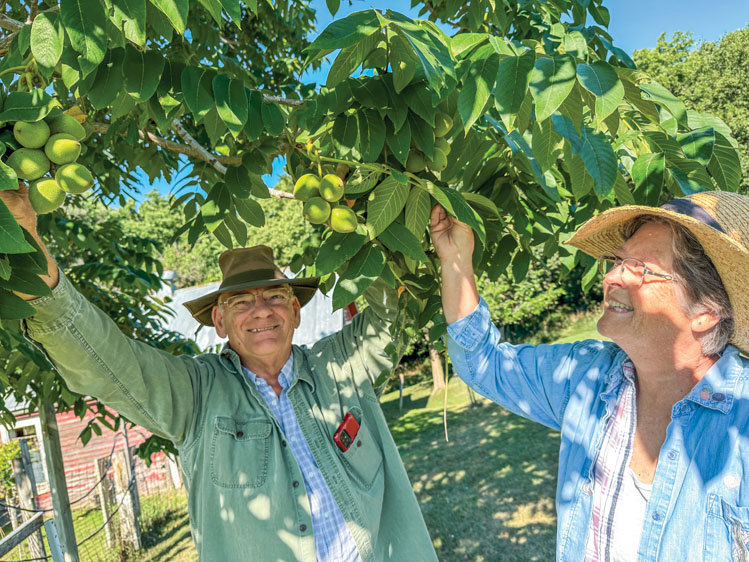
Darrell and Martha Ausborn have experimented with nut trees on their 10-acre farm west of Yankton since 2008.

By John Andrews

Dan DeBuhr was 6 years old in the early 1960s when his grandmother returned from a vacation in Texas with two pecan trees. She planted them in the backyard of her Elk Point home — the same patch of land where DeBuhr lives today — not knowing what to expect. “They told her they couldn’t guarantee that they would make it in South Dakota,” DeBuhr says. “And they would never bear fruit.”

Today, motorists passing by on Interstate 29 can easily spot them because they are the tallest trees in town. In fact, measurements taken last June confirm that they are the two biggest pecan trees in South Dakota, both supplanting a 61-foot pecan in Rapid City.

A severe thunderstorm pelted Elk Point with baseball sized hail early last summer, greatly diminishing the year’s pecan crop. But near the end of most Septembers, DeBuhr wages a daily battle with squirrels to collect the prized nuts. The little critters clearly collect their share, evidenced by the tiny trees that spring up from pecans buried around his yard.

We think of more temperate places when we think of pecans, but they have a history in South Dakota. Pecans — as well as hickory, chestnuts, heartnuts, butternuts, English walnuts and maybe even pine nuts — can indeed grow in certain parts of South Dakota, and experimenters are working to create the best varieties for our environment.

*****

South Dakota is not a robust nut-producing state. Black walnuts are the only nut trees considered native, but John Ball, a professor at South Dakota State University in Brookings, says you can find butternut, American chestnut, English walnut, Manchurian walnut and even pecan, though the growing season is not always long enough to produce nuts. Far southeastern South Dakota, however, is another story.

“It is an unusual part of the state,” says Ball, who is also an SDSU Extension forestry specialist and South Dakota Department of Agriculture and Natural Resources forest health specialist. “We should call it Western Iowa/Northern Nebraska, not South Dakota, and then it would fit. Growing pecans in those states would not be surprising, and southeastern South Dakota is kind of an extension of that. But it’s a rather abrupt line as we move out of there as to where something grows, where something’s a shrub and where something just never makes it at all.”

Our native black walnut provides a good example. “Black walnut is only native to eastern South Dakota, and really the southeast, though there is one population up in Codington County,” Ball says. “But it will even grow in Harding County. I’ve seen some trees out by Union Center and Bison. The difference is the ones down by Yankton and Vermillion can get a couple feet in diameter and 70 feet tall. The ones up in Bison get about 6 inches in diameter and maybe 20 feet tall. So while they can grow there, they grow very slowly. Down in the southeast, you can grow most of the nut trees that can grow out East, though not always as productively and not as quickly. And you have to really work at it. It doesn’t come easily.”

Any discussion of trees and plants and where they might succeed brings to mind the USDA Plant Hardiness Zone Map, the reference that many gardeners consult before planting. The map is based on a region’s annual average extreme minimum temperatures, with lower zone numbers coinciding with colder temperatures. Much of the northern half of South Dakota lies in Zone 4b (-25 degrees Fahrenheit to -20), though some pockets, including Aberdeen, fall in 4a (-30 to -25). The southern half is largely 5a (-20 to -15), with some areas of 5b (-15 to -10) west of Yankton and around the Black Hills, including Rapid City.

But the map may be irrelevant. Ball says the more important factor for nut trees is the number of frost-free days. “I recommend throwing the zone map out when you get to South Dakota,” Ball says. “The zone maps were first developed in Boston. They started drawing the lines back in about 1927, and they did it without ever coming to South Dakota. The real difficulty is it is based upon only one climatic factor: the annual average extreme temperature, or, essentially, how cold it could get in January. That doesn’t do well here, because what really affects our nut production is our early frost in the fall, late frost in the spring, that cold snap that occurs in April after it’s already been warm or a nice mild fall and then suddenly the temperatures fall to freezing.”

The native range of pecan trees stretches from east Texas and Louisiana up through Oklahoma and Arkansas into portions of Missouri, southern Illinois and southern Indiana. They tend to follow river valleys, extending as far north as the Iowa/Illinois line along the Mississippi River. Those areas are most likely to give pecan trees the minimum 140 frost-free days needed for nut production. In South Dakota, those conditions are most likely to be replicated in the southeast.

Perhaps that’s why the DeBuhr pecan trees have flourished in Elk Point. Three more pecans purchased from Gurney’s Seed and Nursery in Yankton in the mid-1940s tower over Rick Gray’s home just north of Dakota Valley High School near McCook Lake. And Ball knows of a few pecan trees in Sioux Falls that produce nuts every few years. “While we do define areas and which trees will grow and perform well there, no tree has ever read a book,” Ball says. “We always get the outlier, the tree that’s growing where it shouldn’t, yet performing better than anyone would ever expect. And that’s the fun of South Dakota. It’s not like trees grow everywhere, and you really appreciate it when they make it.”

*****

John Goeden is an agronomist and self-described “collector of cultivars.” When he’s not consulting on corn and soybean hybrids for Channel Seed, he’s tinkering with trees on his 1.8 acres just west of McCook Lake. “My dad was a carpenter, and he loved hardwood trees, particularly walnut,” Goeden says. “That’s probably where it all started. I helped him take out a grove of about 100 walnut trees that were going to get ripped out of the ground and farmed in the late ‘90s. So in some ways, I’m paying for the sins of my father — and myself.”

John Goeden is a self-described “collector of cultivars.” His grove at McCook Lake includes at 25 pecan varieties.

He is particularly interested in pecan and hickory trees. He believes hickories were a prominent part of the river valley landscape until homesteaders began flooding the Plains in the 1860s. “We had a huge mass migration of people from east to west, and they came in wagon trains made of wood and iron,” he says. “When they were making and repairing things, they were all looking for the straightest, hardest, most durable wood they could find, and hickory was it. That’s probably a reason why we don’t have a lot of hickory remnants left. It’s also the best firewood.”

Historically, the Lakota were familiar with hickory from their time living in eastern Minnesota, before they were pushed west. Similarly, many Great Plains tribes had a word for pecan. “That means that they were either trading in pecan or making trips to where they were plentiful, which would be eastern Iowa, Illinois and Missouri,” he says. “They knew pecan.”

Those species command most of his attention. By the summer of 2024, Goeden’s experiments with tree grafting had resulted in at least 25 different pecan cultivars, along with 15 hickory and four English walnut.

Grafting is a tricky process by which two trees are fused together. Scion wood from a donor tree is cut and attached to rootstock so that their corresponding layers of cambium — the main growth tissue located just beneath the bark — align. The graft is then tightly wrapped and kept moist until the tissues begin to grow together.

“We’re probably not going to extend the harvest to Timber Lake,” Ball says. “But they’re trying to improve the quality of the nut. The rule of thumb I always use is the better the nut, the less chance it has of growing here. You’ve really got to work to develop those qualities, and grafting is how we do it. Thank goodness for the hobbyists that are doing that work to help push the limits and extend the higher quality nuts to our area.”

It was a failed graft that led Goeden to learn about the process. “I had planted some English walnuts,” he says. “I had them in the ground nearly 20 years and they produced nuts. Well, if you look at the leaflets you can tell the difference between an English walnut and black walnut. Somewhere along the line — either before I got those trees or perhaps after — the graft died back, and the black walnut took over. That’s what I actually had.”

His interest in grafting led him to the Nebraska Nut Growers Association, an organization that since the early 1970s has worked on grafting nut trees and placing them in the northern landscape. Grafting is particularly beneficial when working with nut trees, because it can dramatically reduce the time it takes to bear fruit. Self-pollinated pecan, oak and walnut trees might not produce nuts for 15 to 20 years. A hickory might take 40 years. “But if you take wood from a pecan tree and attach it to a two-year seedling and it takes, chances are in eight to 10 years you can have a pecan in your hand,” Goeden says. “It takes the memory of that tree it was on and puts it on top of a seedling. It basically cuts the time in half.”

Grafting and selected cross pollination have resulted in dozens of pecan cultivars, each with different nut sizes, bearing times, percentage of nut meat within the shell and cracking ability. Goeden is growing several of them in his backyard. “My goal is to see what we can effectively grow here and what we can’t,” he says. “Pecans and hickories can grow here, and we’ll find out which ones will survive. I’m trying to get the biggest, best nut possible, and the way to do that is to look at a number of cultivars in your own environment.”

Several of Goeden’s grafted cultivars are growing on Darrell and Martha Ausborn’s 10 acres of land west of Yankton overlooking Lewis and Clark Lake. Ausborn is a retired forester who began in private industry in Florida and Alabama. He later transferred to the Bureau of Indian Affairs where he worked as a forester until retirement. 

 He and Martha, an Alabama native, chose the Yankton County acreage because, Martha says, “he needed a place to play.”

To stay busy in retirement, the couple set their sights on nut trees. In 2008 they planted a batch of grafted seedlings that included English walnut, black walnut, pecan, Chinese chestnut, heartnut and butternut. As they’ve experimented, the Ausborns have added cultivars from various nurseries as well as grafted cultivars from Goeden.

“For pecans, we’re about as far north as you can get,” Darrell says. “The trees do okay, but some years there aren’t enough summer heat days for the nuts to mature. Last year they did mature, and this year they are growing. We’ll see how far they make it into the fall. If we get a cool September or an early frost, the pecans won’t be there. But the rest of the nuts do produce.”

A visit to the Ausborns’ grove in early August found healthy hazelnut trees, the nuts still tightly wrapped within flower-like green husks. “You have to hunt for the hazelnuts,” Martha said as she searched the branches. “I like to pick them because it’s like looking for Easter eggs. They lay up underneath the leaves. The husk has to dry and turn brown, and the nut will be loose. When you can touch it and it will spin, usually the last week in August, that’s when you can harvest.”

Dan DeBuhr enjoys pecan trees his grandmother brought to Elk Point from Texas in the 1960s.

The Ausborns also boasted healthy crops of heartnuts, butternuts, English walnuts and Chinese chestnuts. A Korean pine nut tree looked somewhat out of place but seems to enjoy the Yankton County environment. “That was something out of pure curiosity, just to see if it would grow,” Ausborn says. “In about 30 years you might be able to taste a pine nut, so remember it’s here.”

*****

Nut harvests are modest. The Ausborns spend fall days using homemade equipment to gather, wash and shell their assortment of nuts. Goeden shares his pecans and other nuts with friends and family. They gather every winter with the Nebraska Nut Growers Association for an annual nut evaluation that measures each nut’s size, cracking ability, flavor and quality and quantity of nutmeat. The results help them determine what cultivars are working.

They are also willing to help others. “Without the knowledge and expertise of the Nebraska Nut Growers Association, Darrell and I wouldn’t have had the success that we’ve had,” Goeden says. “Grafting nut trees is an fading art that needs to be passed from one generation to the next in order to push yield potential.”

People like Goeden and the Ausborns will never grow rich from nut production. Ball says a commercial operation in South Dakota is likely not viable. Still, with the right trees, bags of South Dakota-grown hazelnuts or pecans could show up at farmers’ markets and craft fairs. “It’s kind of like farming has gone,” Ball says. “When I was a kid, a family of five could live on a 140-acre mixed farm. Now that’s a hobby farm. Nut production is the same way. It’s hard to get the scale to where you’re actually able to make a living out of it as opposed to supplementing your income. But for a supplement, yes, you can have a hobby that actually pays.”

Dan DeBuhr’s grandmother likely never thought of her tiny pecan trees as a profitable side hustle, but she loved all trees and encouraged her grandson to care for them long after she was gone. “My grandma told me, ‘I’ll never be able to see the pecans, but if you stay here long enough, you probably will,’” DeBuhr recalls. “‘Do me a favor,’ she said. ‘When the trees get big, take a chair on the hottest day, when there’s no wind, and go sit under the trees, because they’ll talk to you.’

“One day in July I was out here working, and it was so hot, no air. So I got a chair and put it right between those trees. All of sudden the leaves were just shaking. That’s what she meant by talking.”

Perhaps they were saying they belong here after all.

Editor’s Note: This story is revised from the November/December 2024 issue of South Dakota Magazine. To order a copy or to subscribe, call (800) 456-5117.

Posted on — Leave a comment

Boating the Springfield Delta

The most claustrophobic experience on water

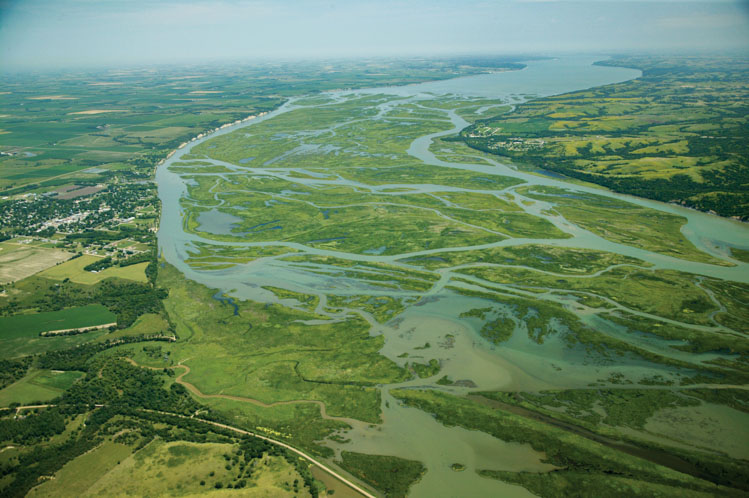
Yankton photographer Dave Tunge’s aerial view of the delta shows its complex web of channels.

By Katie Hunhoff

Boaters and adventurers often shy away from the shallow delta that is overtaking the Missouri River by Springfield in southeast South Dakota.

They worry about snags and stumps in the water. The ever-changing channel is confusing. Dozens of sandbars create a maze, and in many places the swamp grass is 10 feet high, making it impossible to see the hills of the shoreline that could provide bearings. Water depths vary from 12 feet to less than a foot.

Snakes, snapping turtles and other critters add to the mystique of a place like nowhere else in the American West.

We wouldn’t explore the delta with just anyone, but Greg Stockholm seemed reliable. Stockholm knows and loves the rivers of America. The tall, cheerful 67-year-old has boated much of the Missouri and Mississippi, as well as the Ohio and numerous other lakes and waterways.

But he’s especially at home on the delta. He boated the Missouri with his dad as a boy, when the reservoir known as Lewis and Clark Lake was sparkly new. Water then extended from shore to shore — more than a mile wide and deep enough for him and his friends to experiment with five-man pyramids on water skis. In 1977 he was skiing with a kite on Lake Poinsett when it sailed skyward and dropped him hard on the water. He was hospitalized for eight weeks, but he was back in a boat almost before his injuries healed.

As a youth, Stockholm watched his father, Alfred, build a 21-foot cabin cruiser. His earliest memories are of taking the wheel of the cruiser at age 4. In 2022 he began construction of a 72-foot sailboat that he hopes to launch near Sioux City, Iowa. His plan is to motor the boat to the ocean, raise its 80-foot mainsail and set off across the Atlantic.

Springfield river rat Greg Stockholm guided South Dakota Magazine publisher Katie Hunhoff through the delta.

Stockholm has operated a body shop for most of his adult life. In his spare time — between fixing cars and building the big sailboat — he still found time to restore a classic 1975 Tahiti jet boat with a 389-inch Pontiac engine.

“Half the boats around Springfield never get in the water here,” he says, because the owners are leery of the delta. We climb aboard the Tahiti at the boat docks on the east side of town. The big engine rattles to life, sending vibrations throughout the little black craft.

Just as we leave the docks and enter the delta, Stockholm points to the Eagle depth finder below the steering wheel of the Tahiti. It reads 6 feet.

“We’re in the main channel right here,” he says.

But then we enter a water alley between two sandbars and the big engine sputters. The propellor has hit sand. The Eagle says we are in a foot of water.

It’s not a problem. Stockholm shifts to “R” and we reverse into a few feet of water.

We’d imagined a delta of grassy sandbars with frogs, toads, crawdads, crabs, flying insects and patches of brackish mud. That’s not the South Dakota delta.

The water seems clean and fresh and there is little mud. It’s mostly sand below the water and on the islands or sandbars. Growing on nearly all the sand is a tall perennial grass called phragmites, an invasive species that is spreading to lakes and wetlands throughout eastern South Dakota. Unfortunately, it creates a dense, nearly impenetrable jungle that deer and other wildlife try to avoid. Phragmites even affects fish because the massive roots dry the marshland and reduce habitat for minnows, frogs and other small creatures.

Stockholm says the U.S. Corps of Engineers, overseer of the Missouri River valley, sends helicopters with herbicide sprayers to attack the phragmites infestation in the Springfield delta. Once the reeds die and turn white, the federal authorities sometimes burn the sandbars. Their goal is to eliminate all vegetation on the sandbars so the endangered piping plover will have better nesting conditions.

It would be nice if the herbicide, which has been approved for aquatic use by the EPA, would enable cattails, Russian olives and wild grasses to regain a foothold, but on our trip through the maze it appeared that the phragmites are winning the war with the Corps.

We saw few signs of wildlife. A lone deer peeked out of the reeds. A massive old snapping turtle, 2 feet in diameter, balanced on a stump in the water.

Stockholm says the river has quieted in his lifetime. “I remember lying awake in bed in our house in town and hearing the honking of geese all night long,” he says.

The throaty baritone of bullfrogs was a regular sound of summer. Beavers, muskrats and other wildlife added to the cacophony of the river. On our outing, there was nary a sound when Stockholm shut down the Pontiac engine.

Still, he says, this is a wild place. “The river is alive. You can never outguess it. It’s always changing, and it probably always will be.”

Two main channels of the old river can be found in the delta, one on the South Dakota side and another below the yellow chalkstone bluffs of Nebraska.

Stockholm sped up the Tahiti for a 7-mile zig-zag journey southwest on the river to the little fishing village of Running Water. Phragmites are there, too, lining the shore by the boat docks. Just beyond Running Water is the Standing Bear Bridge, a 3,000-foot crossing that gives motorists an expansive view of the delta.

West of Running Water is the town of Niobrara, Nebraska, and the mouth of the Niobrara River, which brings several million tons of sediment into Lewis and Clark Lake every year — creating the unusual delta that is slowly creeping eastward. Experts predict that the grassy delta — with its phragmites-laden sandbars — could reach Gavins Point Dam at Yankton if an affordable solution isn’t found.

The sediment is considered a scourge in South Dakota and Nebraska. Ironically, it is badly needed in the Gulf of Mexico where the coastline is disappearing due to erosion and rising sea levels. Before the six dams were built on the Missouri River in the 1940s and 1950s, sediment from the 2,341-mile Missouri — North America’s longest river — flowed unimpeded to the Gulf.

Now it lays above Gavins Point Dam.

Upon reaching the Standing Bear Bridge, Stockholm steered the Tahiti northeast and motored back toward Springfield. Moving with the current, the big motor had easy work. The sun was now at our backs and setting low over the delta. Blue herons began to show up along the shore. Sometimes, the graceful birds craned their long necks and stared. Just one other boat was on the water that night, so we were a rare sight. A curious crane took flight and followed us down the river.

The water widens just west of the Chief Standing Bear Bridge.

“Sometimes I think they want to race the boat,” grinned Stockholm.

Other waterfowl appeared at sunset. A small flock of Canada geese flew in formation from the east.

When we arrived at Springfield, where we’d begun, Stockholm asked if we wanted to see where the delta ends and “the lake begins.” Of course, we did.

So we traveled east just a few miles — past another fishing village known as Apple Tree. A flock of perhaps 50 big white pelicans sat on a shallow ledge.

Stockholm pointed to the Nebraska shoreline, about a mile and a half away, and said he’s quite sure we could walk there. “I doubt the water is more than waist high all the way across.”

If the sediment continues to fill the lake, scientists say the delta will extend all the way to the Yankton dam, 15 miles away. The tallgrass phragmites will surely follow.

We rounded a sandbar and there was open water as far as we could see to the east — a fresh sight after spending hours in the claustrophobic delta.

Editor’s Note: This story is revised from the March/April 2025 issue of South Dakota Magazine. To order a copy or to subscribe, call (800) 456-5117.

Posted on — 1 Comment

Roaming the Tall Grass

By Christian Begeman

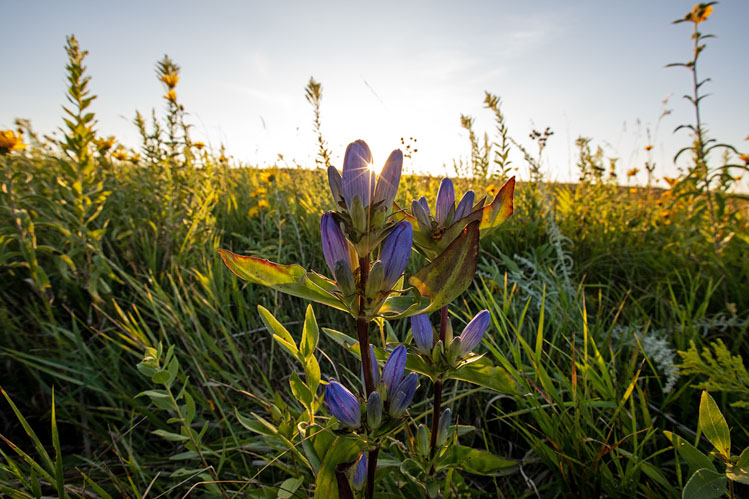
The May/June 2026 issue of South Dakota Magazine features a story on the few tall grass prairie remnants remaining east of the Missouri River. When I was asked to help illustrate the story, I was surprised by how many photos I have taken in and around these places.

I grew up in short and mixed grass country along the Dewey and Ziebach county line west of the Missouri. Only in wet areas or in wet years did the grass get so high that you couldn’t see where your boot fell, which is an important thing in rattlesnake country. When I first began exploring the tall grass preserves with camera in hand, it was unnerving to not be able to see the ground below … and whatever sinister critters may be lurking. Turns out plenty of creatures call the tall grass home. My favorite are the colorful and elusive butterflies. From monarchs to tiny eastern-tailed blues, I have been known to spend hours on the trail seeking that perfect close-up shot.

I also discovered the beauty of the grass itself when peering through my macro lens at blooming sideoats grama florets at the Sioux Prairie Preserve near Colman. Big bluestem, cordgrass and many other tall grass regulars all flower during the summer and photographing them can be nearly impossible due to the wind that we regularly endure on the Northern Plains. To be honest though, a good breeze is welcome in that it keeps the gnats and mosquitos mostly at bay. Yep, it’s not all butterflies and flowers in tall grass country. Myriads of insects live there and a good breeze plus insect repellent is a must when exploring.

After gathering photos for the article, I was asked to gather again for a flyer promoting the new prairie grass area at Good Earth State Park. As I waded back into the archives, I noticed the crescendo of forays into tall grass preserves started slowly about 10 years ago and reached full throat when I was challenged to find and photograph the elusive green orchid. Until that point, I thought wild orchids only grew in exotic tropic locales. Thankfully, I was wrong. South Dakota is home to over 20 orchid species depending on who’s counting. The tall grass preserves are a haven for these beauties and their allies, all of which are a paradise for a camera guy with a macro lens.

Earlier this month, I was out finding the season’s first pasque flowers in the Coteau Hills overlooking Jacobson Fen in Deuel County. As I got up close to frame a few fuzzy portraits of our state flower, I got the idea to share these new photos along with a few other tall grass favorites I had gathered but did not make the final printed story. I hope they convey the sense of wonder and enjoyment I get while out roaming the tall grass remnants.

Christian Begeman grew up in Isabel and now lives in Sioux Falls. When he’s not working at Midco he is often on the road photographing South Dakota’s prettiest spots. Follow Begeman on his blog.

Posted on — Leave a comment

Aberdeen’s Graveyard Girl

Tasha Tietz, like all nurses, has a caring soul. She believes people should be remembered even after they’re gone.

Walk through a cemetery with Tasha Westby Tietz and you soon learn that tombstones represent life.

The same happens when you visit Tietz’s Facebook page. Watch her YouTube channel. Catch one of her talks or peruse her research on websites like Find a Grave and Ancestry.com. Tietz considers herself”a loner,” but the vivacious Aberdeen nurse is quickly becoming recognized as an authority on cemeteries. She even has an online persona,”Graveyard Girl,” though she shares the moniker with a rap musician and a fashion and beauty YouTuber — interesting company for the introverted daughter of an Aberdeen bricklayer and a beautician.

“I couldn’t even speak at my own wedding,” she laughs,”but I just spoke at the genealogy society and at the Aberdeen library. I can’t believe all that is happening.”

Tietz’s interest in the deceased began when she was working as a nurse’s aide at Mother Joseph Manor, an Aberdeen nursing home. She soon grew to love the Presentation sisters, and she worried that they might be forgotten when they die because they don’t have children and spouses. Even to this day, one of her favorite cemetery walks is a section of Sacred Heart Cemetery in Aberdeen devoted to deceased Presentations.

But it wasn’t long before she took an interest in more grave sites: those of other patients at the nursing home, her own ancestors and eventually perfect strangers.

“There is a quote that says a person is truly forgotten when their name is spoken for the last time,” she says.”That makes me believe that every person should be remembered and one way to do that is to be sure they have a tombstone.”

And in today’s online world, every tombstone should be searchable. Seven years ago, she began to enter tombstone photos on Find a Grave; today she is among its busiest contributors. She has posted more than 2,400 memorials and obituaries and 5,000 photos.

Aberdeen’s four cemeteries are her favorite places. She has documented many of their markers on Find a Grave.

Her paternal ancestors are buried at Claire City and Sisseton, so she has also visited them for years.”I try to take a bouquet to all my direct grandparents on Memorial Day,” she says.”I like to go to Claire City in September and visit the graves at Sica Hollow.”

In 2021, she found three tombstones of the Roy family, some of the first white settlers, among the autumn foliage of Sica Hollow. Most of her explorations have been in northeast South Dakota, but she has also roamed cemeteries as far away as Washington, D.C., Canada, Arizona and Texas.

She includes”graving trips” on family vacations when her husband, John, and their three daughters — Chloe, Claire and Charlotte — are willing.”The girls are not super-impressed yet,” she says.”John is also not a fan, but he’ll take me. We went to the Black Hills last summer and we explored Mountain View Cemetery at Keystone. I picked it because some of the Mount Rushmore carvers are buried there, and the actor Bobby Buntrock died and was buried there. There is also a Native leader, a medicine man, an artist and some kind of a wild Old West guy. It’s the only cemetery with a view of Mount Rushmore.”

She recently visited the De Smet cemetery where Charles and Caroline Ingalls are buried, along with their daughters Mary, Grace and Carrie.

Her social media posts also include information she gathers from other sources, including a recent bit about the Jewish custom of placing stones rather than flowers on tombstones. She also spotlighted a report of an Iowa cemetery that features three pyramids, built by the local newspaper editor who planned to be buried in one of them.

Graveyard Girl’s Facebook page now has more than 6,000 followers. Her sites have grown so much that they earn her small amounts of money, some of which she has used to help pay for gravestones on unmarked graves. If the revenues continue to grow, she plans to also invest in camera equipment and research materials for the ever-growing avocation.

She finds genealogy research the most rewarding aspect of being Graveyard Girl. People from across the nation have sent her notes of appreciation for her assistance in finding the graves of their ancestors.

Still, her favorite part of being Graveyard Girl is the time spent in cemeteries.”I like to be out in nature, and I am pretty much a loner. I think I’m also an old soul. I’m happiest when I’m with my family, outdoors in a beautiful cemetery.”

Editor’s Note: This story is revised from the March/April 2025 issue of South Dakota Magazine. To order a copy or to subscribe, call (800) 456-5117.
Posted on — Leave a comment

Scoping the Missouri

Members of the South Dakota Ornithologists Union look for birds at Union Grove State Park between Beresford and Elk Point.

Roger Dietrich was scoping along the shore of Lake Yankton when a Rapid City woman approached him with a question about the tiny Ross’s gull, which had been sighted in the area.

“I’ve gone to Alaska twice and I didn’t see the bird there,” she said.”Is it still around?”

Dietrich pointed to a gull, sitting on ice in the middle of the lake.

The Missouri River is a bird-watching paradise. Hundreds of species of ducks, geese, gulls, loons and other birds congregate in parks, woodlands and farm fields that border its 443-mile corridor. But it still helps to know for what you’re looking.

Every habitat attracts different birds, says David Swanson, professor of biology at the University of South Dakota and author of Birder’s Guide to South Dakota, and habitats vary dramatically along the Missouri as it winds from Nebraska to North Dakota.

Following is a guide, from south to north, of habitat patches and the surprises that await birdwatchers, both the serious birders looking for the rarest”lifer” bird and those who are happy spotting sparrows and swallows.


The Adams Nature Preserve attracts wading birds such as blue herons.

Adams Nature Preserve

Southeastern South Dakota

The Adams Homestead and Nature Preserve near North Sioux City includes many trails.”It has a variety of habitats,” Swanson says.”It has an extensive cottonwood forest that borders the river, and there’s also a little lake called Mud Lake that’s attractive to waterfowl. The ring of trees surrounding Mud Lake can be good for woodland birds, too.”

Mud Lake is approximately a quarter mile from the Adams Homestead parking lot, so a brief hike is required to access it. Wooden observation blinds lie along the trail with a view of the lake.

“The other habitat at the park is a restored open prairie,” he says.”It’s one of the few sites in the southeastern part of the state where you can find Eastern meadowlarks. The common meadowlark in South Dakota is the Western meadowlark, but the Eastern meadowlark is expanding its range in the southeastern part of the state and Adams Homestead is one of the places where you can find those.”

Since first being sighted in 2017 by Swanson and his ornithology students, the Eastern meadowlark has made regular appearances in the open-prairie habitat, often with multiple birds singing among the scattered trees.

“I wasn’t aware at the time that Eastern meadowlarks had started to expand their range, and I heard these Eastern meadowlarks calling,” Swanson says.”I go, ‘That is very unusual.’ We kept walking and saw them and everybody in the ornithology class got to see me geek out over it.”

Though birdwatching at the Adams Homestead is enjoyable year-round, it’s best in spring, summer and fall.”Mostly, it’s hiking the trails during migration and seeing a variety of birds at that time,” Swanson says.”It’s lots of warblers and sparrows, so the migration periods are late April to mid-May. Then in the fall, from mid-to-late August into about mid-September is probably the peak for warblers and vireos, some of which migrate all the way down to Central and South America.”

Sparrows that migrate to the southern U.S. and Mexico slightly later in the year can typically be seen at the Adams Homestead from mid-September to mid-October. Along the river and at the lake, birdwatchers encounter ducks and geese, as well as wading birds like herons and egrets.

“In the cottonwood forest, there are Eastern whippoorwills,” Swanson says.”Those are birds that don’t really get too much out of the southeastern part of the state. Of course, they’re nocturnal, so they don’t start calling until it starts to get dark.”


Least terns can be found on sandbars below Gavins Point Dam.

Gavins Point Dam

West of Yankton

Gavins Point Dam, the southernmost project on the Missouri’s system of six dams, is surrounded by unique bird habitats.

During the summer, hundreds of American white pelicans can sometimes be seen near the dam, while on the river itself, there are piping plovers, still considered a threatened species in most of the U.S., and the least tern, North America’s tiniest tern, often seen flying low over the river and hovering before plunging for prey.

“One of the reasons I like birding is the idea that it would be so cool to fly, and least terns are just the best flyers,” says Roger Dietrich, a local authority on ornithology.”They’ll fly and they’ll see a minnow, and then they dive straight down in the water — and splash!”

In winter, the 2-mile-long earthen dam creates an unusual condition for birds and birders.”Some years, when it doesn’t freeze, like lately, there’s been lots of open water above the dam,” Dietrich says.”Some years, we get lucky and even the Lewis and Clark Marina doesn’t freeze over real early. So, that’s a popular spot where some grebes and loons will stop.”

Black scoters, surf scoters, white-winged scoters and long-tail ducks, which are mainly ocean birds, are known to visit the lake and river in winter.

“I tell people from other places that we have those birds here and they’re just not believing it, because they don’t think of the center of the United States as a place where these birds would show up,” Dietrich says.”And when I say they show up every year, usually, for a fairly long period of time, they just can’t believe that we’re so lucky.”

The common loon migrates through the area, as well as a number of gulls — including Sabine’s gulls, kittiwakes, black-legged kittiwakes and even the Ross’s gull, which is associated with the remote arctic. Crest Road, which passes over the dam, is a good place to observe such birds. It requires no special pass or permit.

“Scan for the birds with binoculars or a spotting scope and chances are, you’ll find something different,” Dietrich says.”Sometimes there are huge flocks, and you can spend hours just scoping the birds there,” he says.”So, if you see somebody there with their scope out or binoculars, stop and ask them what they’re seeing. I’d say 99 percent of the people will be glad to point things out to you, and maybe even let you look through their scope to see what they’re seeing.”

Several snowy owls hung out along the dam road a few years ago.”They were feeding on the flocks of coots that were there.” Wintertime also brings large flocks of lesser scaup, which birdwatchers will scan for specimens of greater scaup, a polar bird that tends to prefer saltwater and is rarely seen inland, Dietrich says.

“It’s the same with the big flocks of common goldeneye,” he says.”People try to scope out the Barrow’s goldeneye, which is another species. It’s more of a West Coast bird, but once in a while, we’ll get one here — always a highlight.”

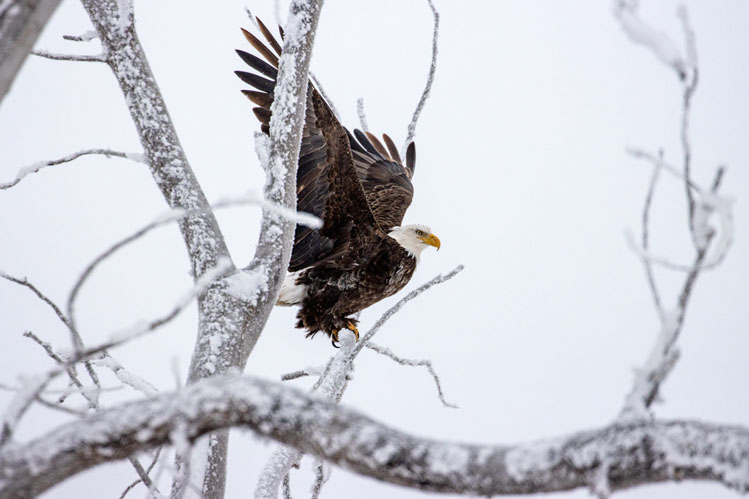
Bald eagles frequent Gavins Point Dam and some now nest year-round in the tall cottonwoods that border the Missouri.”They’re used to a lot of people around and some of the trees they perch in are right along the local roads,” Dietrich says.”You can see them in action, swooping down and picking up fish. I’ve seen eight or nine at a time on the ice up above the dam, eating the dead snow geese they’ve picked off.”


A pair of Barrow’s Goldeneyes at Fort Randall.

Fort Randall

Pickstown

Fort Randall Dam also hosts a large congregation of bald eagles. Below the dam is the Karl E. Mundt National Wildlife Refuge, which provides habitat for the eagles.

Kelly Preheim, a kindergarten teacher in Armour and a well-known local birding enthusiast, especially likes the wooded area around the Fort Randall Dam.”We’re mostly on agricultural grassland in southeastern South Dakota,” she says.”But the dams have a lot of woodland, forested areas, and I enjoy walking on the trails.”

She found 71 bird species on a recent camping trip to Pickstown.”In the morning, oh my goodness, the singing,” she recalls.”My husband’s like, ‘I can’t get any sleep. It’s so loud here!'”

A hike to the tailrace, the channel below the dam that carries water away, will often be rewarded.”Fish that go through the dam come out somewhat stunned in the tailrace,” Preheim says.”Then, all these birds, like gulls and eagles and certain ducks, eat those fish.”

Like nearby Gavins Point, Fort Randall Dam is also home to many types of waterfowl in autumn and winter.”There are a lot of different ducks on the scene, hundreds and hundreds, if not thousands, of different ducks there at a time,” Preheim says.”I saw a brown pelican one time. That’s actually an ocean bird.”

Other surprise visitors at Fort Randall include a yellow-billed loon, typically associated with Alaska and America’s western coast, and a great black-backed gull, which is an Atlantic coastal bird, Preheim says.

Scarlet tanagers are often found in South Dakota but summer tanagers, a rare visitor, might also be seen around Fort Randall.


Pelicans near Big Bend.

Big Bend Dam

Fort Thompson

The best birdwatching at South Dakota’s northernmost dams — Big Bend and Oahe — occurs from April through May and from September to November, according to lifelong birdwatcher Ricky Olson, who lives at Fort Pierre.

Big Bend has fewer access roads and trail amenities than Oahe and the other dams, but it has its own charms. Ospreys nest below the dam and brown pelicans have been spotted.

“Once in a while, in the wintertime, you get a Brant goose at Big Bend,” a seacoast bird.”I run down to Big Bend at least every two weeks in the winter to see what’s there,” Olson says.

Big Bend also attracts smaller goose species, including snow geese and white-fronted geese, both of which are common to the area.”In the fall, it’s neater to go to Big Bend,” Olson says.”Also, the shad and minnow species will be in the shallows then, and you’ll get all kinds of cormorants and pelicans and hundreds of gulls in these frenzies where they’re all feeding, and the gulls are trying to steal from everybody.”


Canada geese along the Missouri River.

Oahe Dam

Central South Dakota

Ring-billed gulls, herring gulls and California gulls may be sighted at Oahe, as well as the arctic tern, a mega-find for birders.

A spectacle occurs during flooding when Oahe Dam’s hydraulic turbines are running.”It’s a feeding frenzy. You get thousands of gulls, maybe 20,000, below the tailrace in a half-mile stretch,” Olson says.”It’s like a snowstorm. Thousands of people come to watch the ‘gull snowfall.'”

Oahe also has cliff-dwellers.”In the sand layers in the cliffs, in the holes, there are barn owls nesting,” Olson says.”They dig their own holes, and often, they’re near where colonies of bank swallows have dug holes.”

In autumn, Sabine’s gull may be spotted.”It’s very pretty. It’s black and white with half a diamond on the wing,” Olson says.”We also get Bonapartes and Little gulls, which is a little gull, and we get some of the big ones. Once in a great while we get the great black-back, which is the biggest gull.”

Gulls breed on a few islands along Oahe, Olson says.”There are only a few places in South Dakota where that happens.”

Another rare visitor to Oahe, among the sea ducks like the scoters and the long tail duck, is the occasional coastal harlequin duck in the tailrace.

“We get loons,” Olson says.”Sometimes we get the Pacific or the yellow-billed or red-throated loon, which are rare for our state.”

Further north on Oahe, retired biology teacher Stan Mack says opportunities are available even in Mobridge’s city limits.”There’s a walking trail along the south side of town. Just follow Main Street to the river and walk west and you’ll see the ducks and geese and gulls that sit on the water.”

Mack says Indian Creek (east of Mobridge) and Indian Memorial (across the river to the west) offer trails and habitat.

Mack doesn’t walk well enough to explore like he once did, but the birds will come to him.”I’m doing a feeder watch for Cornell University. Right now, I’m looking at a collared dove — we never saw them before — and I see about 16 more picking up seeds on the ground.”

Editor’s Note: This story is revised from the March/April 2025 issue of South Dakota Magazine. To order a copy or to subscribe, call (800) 456-5117.

Posted on — Leave a comment

Winyan

Elizabeth Winyan (standing) was long associated with the Riggs family, caring for young Thomas in Minnesota and later joining him at Oahe Mission.

On a spring day in 1830 a family, including a 3-year-old girl, was harvesting sweet syrup from maple trees along the banks of the Minnesota River near present-day Mankato. Suddenly and viciously, they were attacked by an unidentified rival tribe.

The girl’s father was one of several Dakota Sioux killed in that attack. The young girl’s mother realized she could not escape the deadly melee while running with two children, so she emptied a pot of boiling water and hid the girl underneath. She then picked up her son and ran to safety.

For two days and one night the little girl stayed silent under the kettle. Then, her mother crept back and retrieved her.

“Even in her old age,” wrote historian Thomas Hughes,”Winyan never forgot that terrible experience and how, when her mother lifted the kettle, the moonlight showed on the bloody faces of the outstretched dead, her father among them.”

Winyan, who would later be given the name Elizabeth while working with Dakota Territory missionary Stephen Return Riggs, spent the rest of her life serving others. In Dakota, Winyan means mother and protector. She lived the name. Winyan was a human bridge over the most difficult waters of Dakota Territory and early statehood, when the federal government sought to force rapid assimilation of Native people, in part by creating reservations. By the time she died six decades later, Winyan was a legend among Native people, white missionaries and settlers on the Dakota frontier of the 1870s and 1880s.

Oahe Mission Chapel, next to the Riggs family home, was built in 1877. When Lake Oahe flooded the site it was moved to the Oahe Dam Visitors Center, where it stands today.

She often traveled the preaching circuit with the Riggs missionaries, blending her mission work with knowledge and practices of her own Dakota people. The Sioux, with a rich oral history tradition, have tried to keep stories like Winyan’s alive, but in the written annals of Dakota Territory her works are sparsely mentioned.

“She was amazing in her time,” says Winyan’s great-great-great granddaughter, Lora Neilan, of Summit.”And it is sad that it got forgotten.” When Winyan died in 1890, the noted Dakota Territory missionary Mary Collins, a good friend, wrote,”She was one of the grandest women I ever knew.”

Even my introduction to Winyan was accidental, a result of research into an entirely different woman on the Dakota frontier. In 1989, I spent a year studying political migration during a journalism graduate fellowship at Stanford University. While there, I did considerable research on the American frontier, which included paging through countless editions of 19th century newspapers in the archives. One advertisement in an 1888 edition of Minnesota’s St. Paul Daily Globe caught my eye. In huge type, I read:”SHE LOVES A SAVAGE!” It was an advertisement for a dime museum appearance of Corabelle Fellows, a young white missionary, and her new husband, Sam Campbell, a mixed-race man of Dakota Sioux and white blood.

I suspected there was a good story behind this headline. I tucked away a copy of the ad and years later, decided to investigate. I have often been surprised by how few female and Native voices are used in the telling of the history of Dakota Territory. I thought Corabelle may have something to say. This hunch — and years of research — resulted in my book Life Painted Red: The True Story of Corabelle Fellows and How Her Life on the Dakota Frontier Became a National Scandal.

The book follows young Corabelle and Sam as they set out on the sideshow circuits and Buffalo Bill’s Wild West show to make ends meet after Corabelle’s family disowned her for marrying a man of mixed blood.

During my research I also discovered Winyan, who had played a role in Corabelle’s early missionary work. In the winter of 1885-1886, she was in her third year of teaching and serving in missions in Nebraska and Dakota Territory. That winter, one of the coldest and harshest on the Plains, she lived and served with Winyan from a rough-hewn cabin at the Oahenoua village on the Cheyenne River, northwest of present-day Pierre. It was one of the most isolated posts on the frontier, serving people who had recently returned from exile in Canada with Sitting Bull. By then, Winyan had gained a reputation as one of the physically strongest women in the territory. She built the log cabin she lived in, hauled water uphill from the river and traveled long distances through harsh conditions to nurse the sick or dying.

Thomas Riggs.

Living with Winyan that winter, Corabelle, whose mother immediately disowned her after the marriage to Campbell, began calling Winyan”Ina,” or mother. Winyan had initially gained notoriety when, as a young woman during the bloody Sioux uprising in Minnesota in 1862, she secretly swam food to an island in the Minnesota River where Riggs and a small band of fellow missionaries and Sioux friends had hidden with their families. After her father died, Winyan had been taken under the tutelage of Riggs and his fellow missionary Thomas Smith Williamson. When the Dakota people in Minnesota were pushed west to reservations, the missionaries went with them, so Elizabeth gave up her life among the lush fauna of the Minnesota River valley to the harsher, starker and more expansive high plains of western South Dakota.

The granddaughter of the legendary Dakota leader Sleepy Eyes, she had grown up with a strong connection to the natural world. Winyan helped raise several generations of Riggs children, nursed the ill with herbs and practices passed on to her from her ancestors and sat with the dying when others were too afraid of evil spirits.

Tales of her physical strength spiced Sioux oral histories. Stories of her quiet mercies were also abundantly shared.”Winyan was a woman of strong character, fine mind and a natural leader,” the historian Hughes wrote.”Her great desire was that her people should hear the Gospel, so as the years went by, her work widened, and she was sent to various fields. She held meetings, discussed the Bible, visited the sick, buried the dead, and occasionally addressed conferences of white people. Even the Indian men held her in the highest esteem.”

Collins, the missionary, was struck by Winyan’s loyalty, her knowledge of her people’s past and her understanding of the natural world, particularly the constellations in expansive prairie night skies.”She is a faithful friend, true to her character as a Dakota,” Collins recalled.”She enjoys camp life with us, and evenings, as we sit by the campfire, she will tell stories of her early life, or fables, or legends of the stars. She is quite an astronomer. She reads the sky like an open book.”

Together, during that rough winter of 1885-86, the broad-shouldered Winyan teased Corabelle — barely 5 feet tall — about being able to keep up with physical work. Hauling water from the river to the cabin, Winyan would balance two large buckets on her shoulders, often while plowing through new fallen snow. Corabelle would follow with one pail, struggling, but rejoicing in Winyan’s eventual approval.”She always looked me over skeptically when we reached the house” after hard work outdoors, Corabelle recalled.”Invariably, when she found me unbroken, she would put her hands on her hips and laugh so hard that I was obliged to join her.”

Thomas Riggs established Oahe Industrial School in the 1870s as a training school for girls.

One night in the middle of that winter, Winyan fell asleep while Corabelle was teaching a group of young Sioux men. One of the men later returned to kidnap the bewildered Corabelle, catching her as she came outside to do a chore before bed. Winyan, awakened by a rush of ice-cold air from an open door, plowed through snowbanks to catch up with the young man, who had wrapped Corabelle in a blanket and was carrying her to his home.

“What bad thing is this!” Winyan shouted, shooing the man away.”Now you stop!” Her unwelcome suitor dropped Corabelle in the snow. Winyan wrapped her in a blanket and escorted her back to the cabin, where she consoled and soothed her with an herbal bath. Winyan scolded Corabelle for carelessly ignoring her warning to never go outside alone.

Corabelle and Winyan talked long into that night, marveling at how this white missionary and the Native missionary ended up together after growing up in such different worlds of culture, customs and religion.”How we talked,” Corabelle remembered.”Really talked, there in that crude cabin, shut away from the rest of the world. She asked and answered, and I asked and answered until that day, with its closeness of spiritual touch, became a highlight of my whole life.”

Missionaries and newspaper reporters alike simply called her Winyan. Eventually, she had a son, Edward Phelps, a minister, who along with his wife, Ellen, became missionaries and served rural South Dakota churches.

In her 50s, Winyan began speaking more frequently to donors and churches, traveling as far as Chicago. Neilan, Winyan’s descendant, has collected photos and articles that highlight her impact. Winyan’s life spanned the great events of the 19th century frontier: the government’s many treaties with the Sioux; the 1862 uprising in Minnesota, in which hundreds of white settlers and Native people were killed, and which ended with the mass hanging of 38 Dakota men; the many battles and massacres between U.S. Army forces and Native people on the Northern Plains in the mid- and late-19th century; the last stand of George Armstrong Custer’s 7th Cavalry on the rolling Montana hills in 1876; and the rapid settlement and statehood of South Dakota in the last quarter of the 19th century.

Louisa Riggs considered Elizabeth Winyan (standing) a colleague. She is pictured with Mary Collins (second from right), another missionary.

“She was a legend,” Neilan says.”What I found out, in the time frame that she lived, with the racism she faced and everything that had happened, I am most proud of how she rose above that, of how she left her mark and how many other ones did as well.”

Even while helping Native people adapt to relocation to the reservations, she often quietly longed for her childhood life along the Minnesota River.”She missed it so much,” Neilan says. Once, when sitting with fellow missionary Collins, Winyan told of something she had just seen that”well represents our present condition as a race.

“A man named Longfeather, dressed in Indian dress paint and feathers, was teaching some boys the Indian dance and song,” Winyan told Collins. There were three boys: One with long hair and painted face and Indian dress, one with shirt and leggings and a white boy’s shoes and stockings on, the third dressed well in entirely white men’s clothes.”One represents the past, the second the present, and the third the future,” Winyan said.”I know it has to be, but to me the one dressed all in the Indian child’s clothing looked the best, but I’m only an Indian.”

Neilan finds inspiration in her ancestor even today. She says she and her daughters (Lauren, Bailee and Falon) have also begun to study native plants, and to learn about the constellations that illuminate our prairie nights.

“She was a beacon,” she says,”a beacon of power in her own self.”

Chuck Raasch is a native of Castlewood and a graduate of South Dakota State University. He has written for the Huron Daily Plainsman, the Sioux Falls Argus Leader, the St. Louis Post-Dispatch and USA Today. Raasch has also authored two books, Imperfect Union: A Father’s Search for His Son in the Aftermath of the Battle of Gettysburg, published in 2016, and Life Painted Red: The True Story of Corabelle Fellows and How Her Life On the Dakota Frontier Became a National Scandal in 2023.

Editor’s Note: This story is revised from the January/February 2025 issue of South Dakota Magazine. To order a copy or to subscribe, call (800) 456-5117.

Posted on — Leave a comment

Finding the Wilds of Winter

Spotting winter wildlife on the Northern Plains can sometimes seem impossible. Frigid temperatures, relentless wind, snow and ice usually keep critters out of sight during the diminished daylight hours. When I was in junior high, I spent a good chunk of an afternoon sitting in what I thought was a pretty good hiding spot overlooking a stock dam bordered by a chokecherry thicket. A recently deceased cottontail was on the edge of the ice, placed as a lure. I think I hoped a hungry coyote or maybe even a hawk or eagle would arrive. Nothing did. All I heard was the wind though the thicket and all I saw was gray and sullen clouds overhead.

I’m not sure when I figured out that the golden hour was when wildlife is most on the move. Maybe it was deer hunting with my brother or simply noticing more things after I shut the tractor down for the day. This tip generally still holds true when I’m out looking for wildlife with my camera. Not only are there more opportunities to see wildlife, but the golden hour provides beautiful light. Win-win.

It has been my family’s custom to find time to survey the countryside when we get together for the winter holidays. To this day, I keep this tradition alive. Sometimes I’m with my dad, sometimes with brothers and nephews and sometimes it is just me and my camera. This year, I spent three days looking for wildlife in Badlands National Park, Custer State Park and Wind Cave National Park between Christmas and New Year’s Day. And yes, late afternoon and early morning proved to be the most fruitful times.

I arrived in the Badlands around 3 p.m. on December 27. This may seem like mid-afternoon, but winter light is short-lived and angled low and lovely, which is a photographer’s delight. At 3:20 a great-horned owl was out on a ridge waking itself up in the sunlight. About a half hour later I spotted a golden eagle riding updrafts near the Sage Creek Wilderness Road. After photographing a few solitary bison bulls, I headed west and got to Custer State Park with very little light left on the western horizon.

Overnight, a skiff of snow fell in the Southern Hills and there was frost on the grass as I headed to a favorite spot along Highland Ridge Road in northern Wind Cave National Park before sunrise. There were elk below the ridge and bison on the horizon as the sun appeared with warm tones even though the temperatures were well below freezing. As the day lengthened the light brightened, the wind increased and the frost fell to the ground. After driving a few of my favorite routes, I ended up calling it day fairly early. I repeated this routine for the next few days, and it was glorious. Here are some of my favorite photos from that vacation. I’m already counting down the days for another foray or three into South Dakota’s winter wilds.

Christian Begeman grew up in Isabel and now lives in Sioux Falls. When he’s not working at Midco he is often on the road photographing South Dakota’s prettiest spots. Follow Begeman on his blog.

This slideshow requires JavaScript.

Posted on — Leave a comment

From Ashes to Art

Randall Blaze lost his home and art studio to fire, but the Pine Ridge Reservation sculptor is rising from the ashes.

Pine Ridge artist Randall Blaze hurried home from a grocery trip to Rapid City on an April evening in 2020 because he was eager to watch a TV documentary on Ernest Hemingway. Blaze lit a candle and set it on the arm of an upholstered chair. The next thing he knew, the chair was a ball of fire and within minutes the entire house was burning.

Flames were surely visible for many miles around because Blaze’s property sits atop Cuny Table, a mesa on the southern edge of the Badlands. However, nobody was watching. Nobody came to his rescue. The nearest fire truck was an hour away in any direction, and within minutes the entire studio was afire.

In the morning, Blaze surveyed the smoldering rubble. Sculpture tools, brushes, bronze artworks, furniture and business records were all lost. Though the fire didn’t spread across the grassy prairie, it did blacken a cottonwood tree that provided shade to the west side of the house. It was the lone tree on his 100 acres.

Cuny Table was settled by the Cunys, who arrived from Wyoming in 1880. Several of the young men married Native women; 50 years later, more than 100 families called it home. Many were Charles Cuny’s descendants. They had a school, church, dance hall and a few stores.

However, most were forced to leave in 1942 when the U.S. Army appropriated 340,000 acres in the Badlands for a bombing range. Families were given two weeks to pack up and go. Many of the young men joined the military.

Cuny Table and the entire region continued to be a practice range for the U.S. Air Force until 1958, and then was used by the South Dakota Air National Guard until 1974 when tribal leaders began to negotiate with the government for a return of the confiscated property.

Though Blaze was born and raised in Montana, his mother was a Cuny.”It turned out that Mom owned 17-and-a-half acres of trust land,” he says.”She and her family were moved out for the bombing range, and nobody came back. Every time a relative died, the executor of the estate would urge us all to sell, but I always objected.”

Myriad art faces are embedded around Blaze’s land on the Pine Ridge Reservation.

Blaze joined the Navy and served on a refrigerated cargo ship during the Vietnam War.”One of the nicest things that ever happened to me was the GI bill, which gave me a month of education for every month I served.” He studied art at the University of Montana and was fascinated to learn about a variety of materials from Rudy Autio, a renowned ceramics professor and artist whose work garnered international acclaim.

Early in his career, Blaze devoted his creative energies to making jewelry, but he grew disillusioned by his customers’ lack of appreciation for the art form.”All they saw was a product, and it became all about the money.” Like Autio, he began to experiment with various materials, including bronze, metal and ceramics.

He also began to explore his Lakota roots at Cuny Table and started to buy his relatives’ small holdings; over the course of several years, he acquired 100 acres. Inspired by the solitude and the natural environment, he dreamed of building a studio and home there in the early 1990s, though he didn’t have the resources. Then came a visitor.

“One day my friend Rich Red Owl stopped over and said, ‘I hear you need a studio.’ I told him that I wished I could build one, but I didn’t have the money,” Blaze said, recalling the conversation.

“Do you have $1,500?” Red Owl asked.

“I have about that much,” Blaze said.

“Then let’s get started,” said Red Owl.

Blaze got a lesson in Indian-genuity. Red Owl showed him how to salvage and scavenge for inexpensive building materials, and before long he was moving into a 3,000-square-foot home that became known as the Oglala Art Center.

His career began to grow. He won fellowships at the Smithsonian and the Heard Museum in Phoenix, and his bronzes were featured at exhibitions in Japan, Germany and Australia. He authored a book, Heartdreams and Legends, on the contributions of indigenous artists of the United States and Australia. Seven Council Fires, a nonprofit that exhibits Native arts and crafts, marketed his sculptures worldwide.

Though he traveled the world, Blaze found that he was happiest when creating art at his humble studio. He rented most of his land to neighboring farmers but maintained a buffer of wild grass between his home and the crops.”After seeing what Agent Orange did to some of my friends in Vietnam, I just wanted some space between me and the chemical sprays,” he explains.

When a neighbor’s cattle trampled his yard and damaged some tipis that he had created as mini studios, he started a fence of driftwood to keep out the cows. Soon he assimilated art into the fence. Often, his pieces show faces of figures, perhaps in a spiritual search. Maybe they represent relatives who were driven from Cuny Table generations ago, or ancestors who were killed at Wounded Knee, which is just 20 miles to the east.

Blaze has gained attention in his home state over the past 20 years as a popular participant in the state arts council’s Artists in the Schools program.”I love working with the kids,” he says.”I am always amazed at what they can do.” He often incorporates his trademark faces into his teaching, and sometimes he takes samples of the students’ works back to Cuny Table and finds a place for them in his fence and wild garden.

When the original studio burned in 2020, he wasn’t sure, at the age of 71, that he had the energy or resources to rebuild. His friend Red Owl is now too elderly to help. But other support has arrived. Someone gave him a camper trailer. He salvaged what he could from the old house and became a regular shopper at Habitat for Humanity’s ReStore in Rapid City.

Blaze built a driftwood fence around his Cuny Table home to keep cattle away from the studio. The fence has become part of the art.

“That place is wonderful. But I was paying whatever they asked for windows and doors until my grandson suggested to me that I could dicker with them,” he grinned.”Guess what I paid for this window? It had been there for months, and I told them it wasn’t selling very fast. I got it for $95.”

In 2023 he was awarded a $5,000 fellowship from the South Dakota Arts Council to help fund the next studio. His adult grandchildren came from Utah to help install windows and start a deck.

He recognizes that his style of architecture and the isolation of living on Cuny Table are acquired tastes. He was married and he’s had several lady friends,”but not a lot of women want to live out here where a toilet is a luxury.” Winters are long, even for the solitary artist; he spent the last few at St. Petersburg, Florida, because he hasn’t yet restored electrical service or plumbing.

“You can get stuck out here for six weeks or more in winter,” he says.”The wind blows all the time, and when it snows it can be incredibly beautiful, like waves on the ocean. St. Petersburg has art galleries and studios and people everywhere, but I get lonely there and by spring I’m happy to get back here.”

He likes being visited by badgers, coyotes, bobcats and deer. A sense of quiet permeates the outdoors; he can hear Canada geese approaching in the sky long before he can see them.

While winterizing the studio in preparation for his trip south, he saw that the cottonwood tree that burned in the 2020 fire had sprouted leaves on its bottom branches.”I thought that was dead after the fire,” he said.

The same might have been said about his studio. Though its reincarnation is primitive by Florida standards ó by just about any standards ó it fits nicely on Cuny Table.

Editor’s Note: This story is revised from the January/February 2024 issue of South Dakota Magazine. To order or to subscribe, call (800) 456-5117.

Posted on — Leave a comment

If Our Trees Could Talk

A pair of oak trees known as the Twin Oaks are among the trees chronicled in Paul DeJong’s book on the Sioux Falls urban forest.

“Have you been here before?” asks Paul DeJong as we sit around a small conference table inside Touchmark at All Saints, a senior living community in one of Sioux Falls’ most historic buildings — the former All Saints School. The massive, four-story granite building in the heart of the city was finished in 1884 under the direction of William Hobart Hare, the first Episcopal bishop of South Dakota. The all-girls boarding school was designed to serve the daughters of missionaries who were serving the sparsely populated Dakota prairies.

But that’s not where this conversation is heading.”Some of the most majestic trees in the city are right outside,” DeJong says.”There’s a catalpa and a ginkgo tree on this property that were probably planted in the late 1800s or early 1900s.”

It stands to reason that the trees would be at least as old as the building itself, and of course DeJong would notice them. He worked at Landscape Garden Centers for more than 30 years, first as an employee and then its owner. He’s had a hand in selecting trees for nearly every neighborhood in Sioux Falls, an accomplishment made even more impressive considering the city’s rapid growth.

He seems to know every inch of soil beneath South Dakota’s sprawling metropolis. His quick and encyclopedic knowledge of trees allows him to tell you exactly why an American sycamore would thrive in one neighborhood but not another.

The book publishing team includes (from left) Jeremy Brown, Paul Schiller, Paul DeJong, Heather Kittelson and Mike Cooper.

The urban forest of Sioux Falls became his passion, and now, with help from friends, he’s finishing a book that he hopes will inspire future generations to appreciate the diversity of the city’s arbor culture. If Our Trees Could Talk: Discovering the Urban Forest of Sioux Falls is a 172-page coffee table book, completed in collaboration with the Mary Jo Wegner Arboretum, that traces the development of several historic Sioux Falls neighborhoods and the trees that give them life and character.

The idea for a book has been in the back of DeJong’s mind for at least 10 years, but it’s coming to fruition at perhaps the perfect moment. He was diagnosed with Parkinson’s Disease at age 53. He retired from ownership at Landscape Garden Centers in 2018, though he continued to work part-time until 2022. Eventually, he sold his home and moved to Touchmark.

The urgency of such a diagnosis led to the creation of a team to help make the book a reality. Heather Kittelson is the self-described”connector” of the team. She met DeJong in March of 2023, while both served on the board of directors for the Mary Jo Wegner Arboretum, a 155-acre greenspace tucked next to the Big Sioux River just off Highway 42 on the east side of the city. As she learned about DeJong’s health challenges (which included a serious car accident and a bite from a brown recluse spider earlier in life), she was inspired by his drive to persevere.

DeJong was equally impressed by Kittelson’s energy and positive attitude. She subsequently invited him to be a guest on her podcast called”Fortitude,” in which she interviews people who have overcome adversity. DeJong’s is among the most listened-to episodes.

After the podcast, Kittelson asked DeJong if he had any dreams he would like to see fulfilled. The answer was a book about the trees of Sioux Falls.”It really was a dream,” she says.”He just needed someone to help execute it. I love being resourceful and a connector, and I wanted to see Paul’s dream come to fruition.”

The rest of the team quickly formed. They include Mike Cooper, the arboretum’s executive director and a retired city planner for Sioux Falls; Jeremy Brown, the head of Throne Publishing; and well-known regional photographer Paul Schiller. Cooper and DeJong drove many miles around Sioux Falls, identifying neighborhoods and trees, and Schiller captured them throughout the year.

McKennan Park in spring.

DeJong wants the book to be an educational tool and hopes it will direct more attention to the arboretum. It could also be the culmination of a life devoted to the outdoors.

DeJong grew up on a farm between Sheldon and Hospers, Iowa. He got an associate degree in business and marketing from Northwest Iowa Community College and then headed to Sioux Falls, looking for opportunity. He stopped by Lakeland Nursery and noticed they were hiring.”Having grown up on the farm, I had a general knowledge of trees,” DeJong says.”They were taking applications and I needed money fast, so they said I could start working there the next day. I had no idea what I wanted to do, and in a couple weeks’ time I had found my passion working with trees, landscaping and outdoor living areas. You’re enhancing everybody’s opportunity to spend more time outdoors with their families as opposed to sitting in the house.”

He threw himself into the work, getting to know our native and non-native species and talking with both residential and commercial customers about the trees they wanted and the trees they needed — which were not always the same thing. DeJong is a huge advocate for tree diversity, and that can be challenging in South Dakota.”We can beat up on ourselves for not diversifying, but we are a prairie state with a mix of prairie grasses, so we’re limited in what species thrive here,” he says.”Trees weren’t necessarily by God’s hand meant to grow in South Dakota.”

An American larch in McKennan Park.

When settlers first arrived in Dakota, they would have seen a nearly treeless landscape, other than the occasional willow, elm, ash, box elder and the cottonwoods growing in the river valleys.”Cottonwoods are so towering and large, and they’ll grow in wet, boggy areas,” DeJong says.”They could be several miles away and see these stands of cottonwood trees in the distance and know that there was likely water nearby.”

As railroads moved into Dakota, it became easier for those settlers from Europe or bigger eastern cities to order the trees they knew and loved. Maybe that’s how the catalpa and ginkgo trees ended up in DeJong’s new backyard.”Ginkgos are a very slow growing tree, but this one’s probably 80 feet tall,” he says.”They originated in China and are disease and pest resistant. They’re actually prehistoric trees. They’ve got fan-shaped leaves, very distinctive. The catalpa has a large plate sized leaf. It largely remains silent except one week in June when it gets a hydrangea-like flower. That’s its one week of glory for the year.”

One of DeJong’s favorite neighborhoods is McKennan Park, which is filled with historic homes and majestic trees. Among them is a big bur oak planted after World War I to honor the returning soldiers. It’s also home to the largest silver maple in the state and a stand of American larch.”When I was a kid, they quite often planted windbreaks with American larch,” DeJong says.”I didn’t realize what they were at the time. In the winter all the needles were gone, so I thought they were dead. But they come back in the spring and turn a brilliant golden color in the fall. Then in the winter they go dormant again. They’re mysterious or haunted looking trees.”

The American sycamore in McKennan Park is an example of being in the right place.”There are microclimates in Sioux Falls, like McKennan Park and the Cathedral District,” he says.”There’s good soil; it’s not only cold hardiness. You get on the edge of town where the winds are more abrasive, you’ve got about two inches of black dirt and the rest is excavation clay, and you’re more limited in what species you can use. I would never recommend an American sycamore anywhere other than the core area of the city.”

Other trees stand out for different reasons, such as a concolor fir in the Riverview Heights district north of the Veterans Administration hospital.”I would say it’s 100 feet tall. The first time I viewed that tree, a deer and a turkey came running out at the same time. I bet the bottom branches spread 40 to 50 feet across.”

A stately cottonwood at 57th and Minnesota.

A cottonwood tree near Covell Lake is notable because its lowest branch is probably 50 feet off the ground. Another at the corner of 57th Street and Minnesota Avenue has been growing for more than 100 years and towers over other neighborhood trees. Black locusts in the Cathedral District shine in spring, when they blossom with droopy, lilac-colored flowers.

A stand of hackberries along South Cliff Avenue accents a neighborhood that began as a place for the city’s more affluent citizens to build second homes. A blue beech in the Maplewood District is rare for South Dakota.”It has very smooth bark and looks like an elephant’s leg because it flares out at the bottom. The smooth bark prevents insect infestation. If a tree has rough bark, it’s easier for insects to burrow into it, but the blue beech evolved over time. Trees are constantly under evolution. They’re just like human beings; they have to adapt.”

Everyone involved sees the book as a starting point that can lead to continuing education in K-12 classrooms and at the arboretum. DeJong envisions an”urban forest university” that encourages young people to get outdoors and learn about the trees surrounding them — not just because they might be pleasant to look at but because of their benefits for the environment and our health.”I spent a fair amount of time recovering from surgical procedures at the Mayo Clinic. I remember going through the gardens once I was able to get outside. The trees seemed to soothe my physical pain. It is true that trees reduce stress and promote physical and mental healing.”

Working with DeJong on the book has been rewarding for Cooper and Kittelson.”We’re all so busy going through life that we tend to forget how beautiful our surroundings are,” Kittelson says.”Paul has helped me to stop and be present and take in what’s around me.”

May we all slow down and learn to appreciate both the forest and the trees.

Editor’s Note: DeJong’s book is available from the Mary Jo Wegner Arboretum in Sioux Falls. This story is revised from the March/April 2024 issue of South Dakota Magazine. To order or to subscribe, call (800) 456-5117.