Posted on — Leave a comment

Gold at Home

The autumn of 2025 has so far found me mostly homebound. The toils of everyday work life coupled with many of my nieces and nephews excelling in fall sports has kept me from my usual Black Hills trip seeking out the fall colors of the high country. The good news is that there is plenty of seasonal splendor to be found right here in Minnehaha County.

One of the perks of the good folks at South Dakota Magazine allowing me to share photos and thoughts in this column over the past decade plus is that I can look back at the seasons and compare and contrast the details. For example, this season has seemed like the green and warmth of summer lingered longer than past years, when in actuality, the peak of color is happening at about the same time. That said, it is a touch greener and the orange, yellow and reds are somewhat muted compared to years past. Even so, you can find the color of fall out and about if you take the time to go look.

I was able to take off work on October 24 to wander the city on a near perfect autumn afternoon. That’s when I noticed how much things have really changed over the years. There aren’t as many trees flanking the main falls at Falls Park, for starters. The views of downtown from Cathedral Hill are not nearly as easy to see because trees from the park land below the church continue to grow. And so it goes. I should remember that the only thing that remains constant is change even when it comes to photographing familiar locales, but I don’t really remember until confronted by visual proof.

Palisades State Park.

In this column, I will keep the words brief. Fall is both a beautiful and bittersweet time as the growing season comes to an end in a final colorful flourish. We all have more than a few months of the long cold winter lined up next. Even so, winter does make one enjoy the spring all the more. In this selection of photographs, the first half are from this year, and the second half are selections from past years that have never been published here before. May they inspire you to get out and enjoy a last autumn stroll or two before old man winter’s long arm reaches down from the north country.

Christian Begeman grew up in Isabel and now lives in Sioux Falls. When he’s not working at Midco he is often on the road photographing South Dakota’s prettiest spots. Follow Begeman on his blog.

Posted on — Leave a comment

What Makes Hecla?

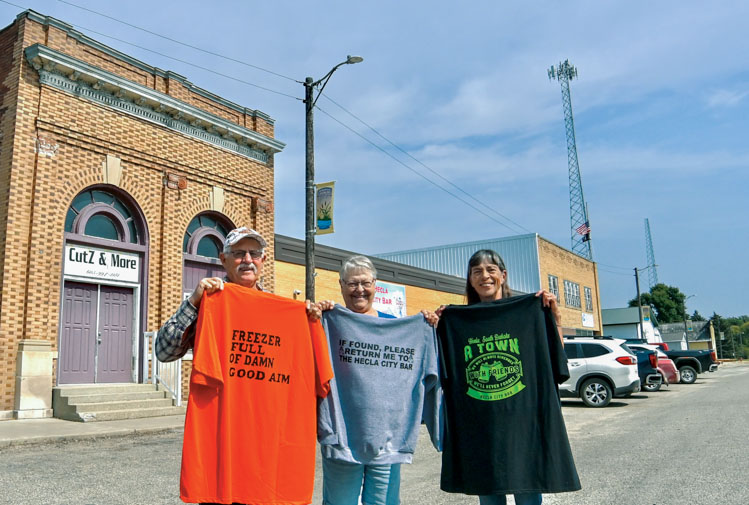
The Hecla City Bar offers a variety of apparel to visitors, as modeled by (from left) Terry and Diana Ulmer and Mary Freudenthal.

Outside influences shape the little town of Hecla, a tradition that dates to the last ice age. These days, a million winged and feathered guests migrate through the lakes and marshes south of town in the spring and fall. Humans follow the ducks and geese, and often find their way to the Hecla City Bar, where they traditionally pin dollar bills to the tiled ceiling and post photos of big fish on a”brag wall” near the door.

Hang around the bar and you eventually get a history lesson of the town. Its name comes from Hekla, Iceland, home to a stratovolcano. January Jones, a Hollywood actress who gained fame as Betty Draper in Mad Men, grew up here in the 1980s. A young couple, the Pioskes, operate an award-winning butcher shop across the street; sometimes on Friday nights they bring over a grill and cook ribs for everyone.

“It’s a pretty friendly town,” says Jess Monsen, who once ran the bar and now serves as the town’s deputy clerk.

Monsen says North Dakota is just 4 miles to the north, which explains the North Dakota State University Bison flags in some yards.”We’re pretty split between the Bison and the SDSU Jackrabbits.”

What about the Coyotes?

“I don’t even know what that is,” she quips. This is north country.

Trailers, tractors and other antique keepsakes decorate the yards of Hecla residents.

Hecla does feel like a town with a culture all its own. Jim Bauer, a woodworker who arrived from North Dakota as a youth in the 1960s, says the town has persevered even as many of its institutions have gone.

“There were 46 in my high school class in 1969,” he says. Today a memorial marker and bell are the only reminders that there was a school, which closed in 2002. Most of the downtown stores have been shuttered (though the butcher shop occupies three connecting buildings) and even some churches have left.

“Our Catholic church has closed,” Bauer says.”If I was rich, I would have bought the building and put up a big screen TV and broadcast the Sunday Mass, but I suppose the bishop wouldn’t have liked that.”

Bauer planned to parlay his woodworking skills into another enterprise for Hecla, but big business blocked him.”I was hoping to become a millionaire making caskets, and I started to build them, but the funeral home industry said I didn’t have enough liability insurance, so I never really got started.”

Weather is also not always friendly. As one of South Dakota’s northernmost communities, Hecla is among our coldest places in winter. Average January lows are barely above zero.

One asset that bishops, business tycoons and even Jack Frost cannot take from Hecla is the 21,498-acre Sand Lake Refuge that stretches for miles south of town. Fed by the James River, which flows down from North Dakota, the marshes and lakes — created when Ice Age glaciers melted 11,000 years ago — are a paradise for migratory birds and wildlife.

Hecla woodworker Jim Bauer keeps a collection of vintage lanterns in his shop at Fourth and Oak, including relics from trains, buckboards, police wagons and military vehicles.

Hunters and anglers, including many from North Dakota and Minnesota, make annual treks to the refuge. Most of the sportsmen stay at local lodges like Ruenz’s Roost or the Flatland Flyways, but others have bought homes and converted them to hunter’s cabins.

Monsen, the deputy clerk, says absentee ownership isn’t as controversial in Hecla as in mountain towns of the Black Hills.”Housing goes in cycles here,” she explains.”At times there isn’t a house to be found, and then a few years later there’ll be lots of homes for sale and not a buyer in sight.”

Refuge officials estimate that more than 75,000 people arrive every year to enjoy the outdoor paradise. They include birdwatchers, hunters and anglers.”There are three or four bridges near town that are the easiest places to fish from,” says Monsen,”and in spring and summer they might all be busy.” Northern and walleye are the prime catches.

Hecla culture today is a blend of farming, fishing and waterfowl. Antique farm machinery and duck/goose signage are common yard dÈcor, along with the Bison signs from that university in nearby North Dakota.

Editor’s Note: This story is revised from the January/February 2025 issue of South Dakota Magazine. To order a copy or to subscribe, call (800) 456-5117.

Posted on — Leave a comment

Highway 18 Color

Leaves may look the same wherever you go in autumn — red, gold and yellow — but every country road has its own personality.

Travelers on Highway 18, which dips and ducks above South Dakota’s shared border with Nebraska, probably don’t choose the route for fall colors. But the highway’s rural charm of cowboy culture, small towns and Indian reservations makes it an always-interesting drive that takes on a special aura in late autumn.

The terrain and the flora are especially scenic as you come and go from the spacious Missouri River valley in Bon Homme, Charles Mix and Gregory counties. Going from east to west, the farms grow into ranches. Trees, towns and people all become fewer, though no less colorful.

The river itself is a good place to stop and stretch. A beautifully manicured pioneer cemetery with 158 graves lies just west of the Fort Randall Dam, near the old yellow chalkstone chapel. A marker by the front gate lists not only the usual names and dates of the deceased, but also the causes of their deaths: pneumonia, lightning, scurvy, horse accident, drowned and — in the case of Herman A. Greening in March of 1886 –“found dead on prairie.”

What a beautiful place to spend eternity, or better yet to just explore on an autumn afternoon.

Editor’s Note: This story is revised from the November/December 2024 issue of South Dakota Magazine. To order a copy or to subscribe, call (800) 456-5117.

Posted on — Leave a comment

Pedestrian Politics

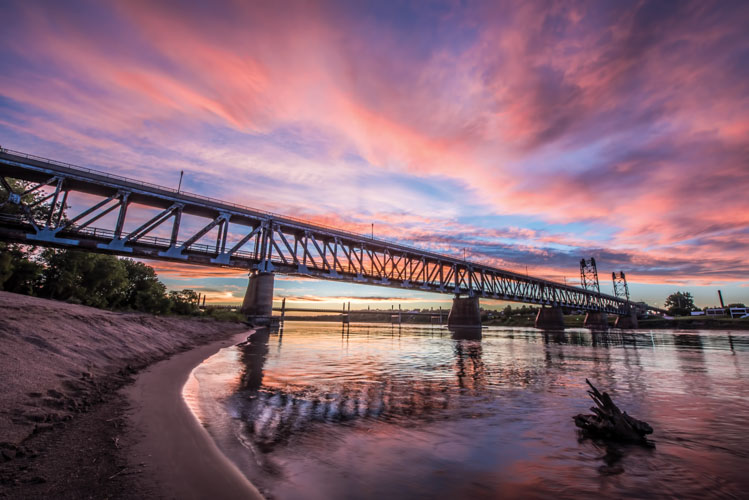
Yankton’s Meridian Bridge carried traffic across the Missouri River between South Dakota and Nebraska from 1924 until its closure in 2008, which ushered its new life as a pedestrian walkway. Photo by Pat Hansen

Bridges are famously controversial. Yankton’s double-deck Meridian Bridge, which turns 100 years old this year, is a classic example.

In the 1920s, Yankton booster D.B. Gurney and his supporters sought to circumvent the political process by raising private funds, but they still had to navigate approval from both Washington and Pierre before they could drop the first barrel of concrete into the Missouri River channel in 1922.

They also confronted politics within the Yankton community as they cajoled friends and neighbors to make major investments in the bridge. Gurney once donned boxing gloves for a meeting and suggested that the fundraising could require fisticuffs. Though Gurney’s friends thought he was joking, they quickly offered more money.

When the $1.1 million Meridian Bridge opened on Oct. 11, 1924, it became the first highway bridge constructed across the Missouri River in South Dakota. The double-decker design was chosen in anticipation of a railroad line that never materialized, so motorists driving south into Nebraska used the lower deck and northbound traffic took the upper. Drivers paid tolls until the cost was recouped in December of 1953. Gurney’s wife Henrietta paid the final toll.

Seven decades after the first cars rolled across, Meridian Bridge politics re-emerged as local and state leaders debated where to build its replacement. Then, even after the Discovery Bridge was completed, the Meridian was not free of politics. In fact, some of the old bridge’s most highly charged moments came in 2008 and 2009, after it was closed and slated for demolition.

The new Discovery Bridge was opened to traffic on Oct. 11, 2008 — the same date as the Meridian’s official opening 84 years earlier — with a gala ribbon cutting. Dan Specht, then the mayor of Yankton, remarked that the bridge shows the river does not divide South Dakota and Nebraska, but truly brings people closer together.

On that exciting afternoon, busloads of school children were diverted over the Meridian; the very next day, it was deemed unsafe for any use. Entrances were fenced and a sign declared it off-limits to the public.

The late Father John Garvey, then a feisty and good-natured Catholic chaplain at Mount Marty University and Sacred Heart Monastery, was the first to demonstrate the bridge’s future potential.

Garvey was known for challenging authority. He once was arrested for trespassing at Offutt Air Force Base in Omaha to protest nuclear weapons. He found it hilarious that the old bridge was strong enough for 18-wheelers and school buses on one day, and then unsafe for pedestrians the next. True to character, he climbed over the temporary orange fence and strode out over the river in the autumn of 2008. He did it with a twinkle in his eyes, and the Yankton police, with equally good cheer, led the grinning, white-haired priest back to Walnut Street.

Other Yanktonians were resigned to the idea that the old bridge would come down. Fortunately, a few local citizens — particularly Jim Means, a longtime businessman and civic leader who has been involved in nearly all of Yankton’s successful historic preservation projects over the last 50 years — patiently lobbied city commissioners, lawmakers and other officials to explore its potential as a pedestrian bridge.

“I always thought it was Yankton’s signature piece of architecture,” Means says.”I felt it would be short-sighted to let it fall into the river. Ever since it was built, it has set us apart from every other town. You could meet people from all over the country, and if they knew anything about Yankton it was that they’d traveled over the double-decker bridge.”

Opponents to preserving the Meridian included several of Means’ friends.”People thought it would be a waste of money. One of my neighbors said he didn’t think anyone would even want to walk on it.”

The Meridian Bridge was built with a lift span that rose 25 feet to allow steamboat traffic on the Missouri River to pass underneath. Raising and lowering the 220-foot span took about 8 minutes in each direction. It was deactivated in 1984, and the lifting mechanism was removed. Photo courtesy of the Yankton County Historical Association

But Means and others kept alive the notion of preserving the bridge, and eventually they gained support from two strangers south of the border: Bob Puschendorf, a native of nearby Norfolk, Nebraska, was then the state historic preservation officer in Lincoln, Nebraska, and John Kingsbury, a banker in Ponca, Nebraska, was chairman of the Nebraska State Highway Commission.

Puschendorf hoped to preserve the bridge for its historical and recreational possibilities. Kingsbury remembers that he was just looking for the finish line.

“The new Yankton bridge was one of the most controversial and environmentally complicated projects of my time on the commission,” he says.”As people in Yankton will remember, there were two factions. One wanted the bridge downtown as it is today and another group preferred a bypass bridge to the east. Nebraska was neutral, but at the time was generally preferring a bypass around communities.”

As the lead state for planning and construction of the new bridge, Nebraska was responsible for public hearings. Kingsbury felt the primary hearing should be in Yankton because the city had so much at stake.

“After discussion between the two states, it was agreed Nebraska could hold a public hearing in South Dakota,” Kingsbury remembers.”I am sure I was the first state commissioner to hold a large public hearing in another state. I believe [South Dakota transportation officials] felt a neutral Nebraskan would be a good choice to lead a controversial public hearing. There was a huge crowd with signs and buttons supporting their cause. The room was packed along with three television stations. The meeting went unexpectedly well. The speakers remained reasonably calm. In the end, both states agreed to the downtown location based on dozens of factors.”

Left in limbo, however, was the fate of the old bridge. A federal Environmental Impact Study favored preservation over demolition.

“Yankton was also asking Nebraska to make the new bridge more attractive than a flat, basic concrete bridge,” Kingsbury recalls.”Nebraska was opposed to the added cost because the many delays had greatly increased the cost projections. As negotiations continued, I recommended Nebraska beautify the new bridge with the pillars and lighting in exchange for Yankton or South Dakota taking ownership of the old, historical bridge.”

South Dakota authorities liked Kingsbury’s compromise, though they didn’t yet know if Yankton would accept responsibility for the Meridian. For nearly a year after car and truck traffic ceased on the old double-decker bridge, conversations and meetings continued in city hall and other locations.

Kingsbury’s proposal created an opening for Puschendorf and Jay Vogt, his counterpart in Pierre. Vogt was director of South Dakota’s historic preservation office; he was also well-acquainted with the Meridian Bridge. His grandparents had lived in Yankton, and one of his favorite childhood memories was of driving over the Missouri River on the double-deck bridge.

Yankton had yet another important connection: longtime local trucker Ralph Marquardt was then serving on the South Dakota Transportation Commission.

Puschendorf, Vogt and transportation officials from both states offered to work with the City of Yankton if its leaders wished to accept responsibility for the historic bridge.

Yankton attorney Nick Moser was a newly elected state representative in 2009.”It was one of the first things I worked on as a legislator,” he says.”All of the lawmakers from Yankton were in favor of preserving it but there were a number of people who were opposed for a variety of reasons: they thought no one would use it, they thought it might not be safe, some even thought it would be an eyesore.”

Moser and Yankton’s other lawmakers met on several occasions with Department of Transportation officials during the 2009 session, and they also organized meetings with Marquardt and city commissioners back home — often gathering at the publishing offices of South Dakota Magazine.

Demolition of the bridge would have involved liabilities, environmental issues such as lead paint and other unknowns, so preservation of the bridge appealed to some state officials who felt it was the safest decision.

Most city commissioners eventually embraced the view that the historic bridge still had something to offer but they were concerned that the city wouldn’t be able to afford restoration costs in the short-term, and that local taxpayers could be stuck with demolition costs sometime in the future.

Those financial worries were alleviated when state transportation officials agreed to devote $1.8 million from South Dakota’s share of the American Recovery and Reinvestment Act, which had been passed by the U.S. Congress to stimulate the economy after the Great Recession of 2008.

Kingsbury and his Nebraska associates, anxious to close the chapter on the Yankton bridge, offered the remainder of the restoration costs, which totaled $5 million. The two states also agreed to deposit their respective shares of the estimated demolition cost into a trust fund so that monies are available for that purpose if needed. The fund was started at $2.8 million but it has nearly doubled.

Two years later — after rehabilitation and the installation of a railing and lighting — the Meridian Bridge was opened to pedestrians and bicyclists in November of 2011. It’s difficult to find any detractors today, and the officials who were involved see it as a success.

“Every time I drive across the new bridge, I smile at the beautification,” says Kingsbury, who is still a banker in Ponca.

“Today I can walk out the front door of my office and I have a full view of the bridge,” says Moser.”I see people walking it at all times of the day, and all times of the year. On weekends from spring to summer and fall it’s packed.”

Means walks the bridge regularly and enjoys seeing the various ways it’s used by the community — from weddings to fundraisers, lovers’ padlocks, family gatherings and, of course, the constant stream of people who simply want to stroll at treetop-level above the grand Missouri River.

Editor’s Note: This story is revised from the September/October 2024 issue of South Dakota Magazine. To order a copy or to subscribe, call (800) 456-5117.

Posted on — Leave a comment

What’s in the Water at Wallace?

Wallace artists Adam and Madison Grimm are both federal duck stamp champions. Adam has won the Federal Duck Stamp Contest three times. Madison has three wins in the junior contest.

THERE AREN’T MANY ducks in Elyria, Ohio. It’s only 6 miles south of Lake Erie, but the second smallest of the five Great Lakes is hardly a South Dakota prairie pothole.

When Adam Grimm began hunting waterfowl, he and his dad drove an hour from their home in that far-western suburb of Cleveland to a public hunting area where the birds were often few and far between. It was no place to live for an outdoorsman, hunter and burgeoning wildlife artist.

Several years later, when he was married and had a daughter named Madison, he suggested moving to South Dakota, a place he’d visited as a child and had never forgotten. He spoke so glowingly of the state that his wife Janet, who’d never stepped foot within its borders, agreed to come check it out. Though it rained for five days straight, the young family was smitten and made the move.

They are now a family of six and firmly settled in Wallace, a town of 91 people in northwestern Codington County famous for being the birthplace of Hubert H. Humphrey, Minneapolis mayor, U.S. Senator and the nation’s vice president from 1965 to 1969. But the town could also rightly claim both Grimm and 17-year-old Madison among its favorite sons and daughters. They are both federal duck stamp champions, achieving success that the national art competition has never seen.

*****

Drawing was Adam Grimm’s first passion. He drew his favorite cartoons and other things he saw on television until one day Bob Ross appeared on the screen. His long-running PBS show The Joy of Painting captivated artists and non-artists alike, and Grimm began imagining life as an artist.”That Christmas I asked for oil paints,” he says.”I ended up not painting the way Bob Ross does, with the putty knife and three-inch brush, but I started to develop my own way. I achieved the look I was trying to get, and it just started to snowball.”

He sold his first drawing at age 11. His grandfather realized Grimm’s potential and Insisted on paying $20 for it.”He always had that confidence that I was going to be able to do this as a living. I remember him telling my sisters, ‘Your brother will probably never have to have a real job.’ He just had such belief in me, and I think that had a lot to do with my own thought process and thinking that I could actually do this. If I won something, he would call everyone he knew and tell them.”

Adam grew up in Ohio, where he worked at the dining room table on his early wildlife paintings.

The next year he was invited to exhibit his work at a local craft show. He sold every item he brought and went home with nearly 40 orders for drawings. He started following other artists and became encouraged that he could make a living drawing and painting.

At the same time, his passion for the outdoors blossomed after a trip to South Dakota. Grimm first became acquainted with the state through his grandfather, an avid collector of Native American artifacts. Then his father began making annual hunting trips, and when Grimm was old enough, he came along. The country was unlike anything he’d ever seen.”I didn’t know anywhere like this even existed. I think people in South Dakota take South Dakota for granted. They don’t realize that it’s not like this everywhere else. The people, the nature, it’s not this way.”

His Interests In wildlife and art finally married when he saw his first federal duck stamp, a pair of canvasbacks by Minnesota artist Bruce Miller that appeared on the 1993-94 stamp. Still a teenager, he began submitting artwork to the junior duck stamp contest, open to students in kindergarten through 12th grade. He never won, but he gained valuable experience.

Grimm enrolled at the Columbus College of Art and Design in Columbus, Ohio, though he struggled to fit in. His professors urged him to experiment in a variety of art genres, but he had a plan.”I was doing realism and wildlife art, and I told them that I would like to win the federal duck stamp one day,” he says.”No one at the college had ever really heard of it. It was like, ‘Who cares if you get a painting on some stamp?’ I remember telling them, ‘Well, it’s kind of a big deal if you win.'”

He began entering the contest as soon as he was eligible. In his first year, he submitted a painting of a mottled duck that took 16th place. The next year, his green-winged teal won eighth place. In 1999, the two species eligible for submissions were the black scoter, an ocean bird typically found in Alaska and along the Atlantic coast, and the mottled duck. He chose the mottled duck and pushed his own creative limits.

He thought back to a scene on a marsh near Timber Lake.”I had snuck up on this little water area and there were blue-winged teal out there,” he says.”The hen is pretty drab in color, but so is a mottled duck. She raised up and flapped her wings on the water, and the sunlight was shining through her feathers. That was so beautiful. If I could paint that, but with this other duck, that could win, because it would be more about the lighting on the bird than the bird itself. But I needed the reference. I was painting this in Ohio.”

Adam’s painting of a mottled duck stretching its wings won the 1999 Federal Duck Stamp Contest. He was 21, making him the youngest winner in the contest’s history.

Grimm contacted a biologist in Texas who was doing a banding project on mottled ducks and requested photos. Then, a friend sent him a mottled duck that he had shot (again, there aren’t many ducks in northern Ohio).”I would thaw the bird out the night before because I wanted that early morning lighting,” he recalls.”First thing in the morning I would run outside with this dead duck and hold it up and stretch the wings out. Then I would run back in and try to capture the colors I had just seen.

“I wonder how many of my parents’ neighbors were watching this crazy kid with a dead duck,” he laughs.”You do what you have to do in life, and there was no other way to do what I was planning on doing.”

Say what you will about his methods, his painting of a mottled duck stretching its wings in the soft sunlight of early morning finished first. At 21, Grimm became the youngest person to ever win the federal duck stamp contest.

What followed were several months of travel and delivering speeches about his artwork, which now appeared on a stamp that would be in hunters’ wallets and collections worldwide.”It’s almost like if you won American Idol,” he says.”You can go from being a nobody to being launched into the limelight. Everyone knows who you are. It’s a crazy thing.”

*****

Such a life-changing competition had humble beginnings that can be traced to legislation that another South Dakotan shepherded through Congress nearly 100 years ago. Waterfowl depletion on the Upper Plains was beginning to be a serious issue in the early 20th century. The federal government issued numerous protections, but it became clear that sustained recovery hinged on habitat protection.

South Dakota Sen. Peter Norbeck, who had already worked to establish wildlife preserves in western South Dakota and was the major force behind creating Custer State Park, became a champion of the Migratory Bird Conservation Act, a piece of legislation that had advanced in fits and starts during the 1920s. By 1929, he had a version that successfully passed through Congress. It created the Migratory Bird Conservation Commission, which approved the purchase or rental of wetlands upon the recommendation of the Secretary of the Interior. The only thing it lacked was a permanent funding source.

That came in 1934 with passage of the Migratory Bird Hunting Stamp Act, which required hunters to purchase a $1 stamp before hunting waterfowl. Ninety-eight percent of the proceeds from their sale go the Migratory Bird Conservation Fund for wetlands preservation.

President Franklin Roosevelt asked Jay”Ding” Darling to design the first stamp, which featured two mallards landing on a pond. Darling was an American cartoonist and two-time Pulitzer Prize winner who was serving as director of the Bureau of Biological Survey, the forerunner to today’s U.S. Fish and Wildlife Service. He had grown up in Sioux City, Iowa, where he developed an appreciation for the outdoors. After a year at Yankton College, he transferred to Beloit College in Wisconsin and had a successful career as an editorial cartoonist. He also founded the National Wildlife Federation in 1936.

Other artists were invited to contribute until 1949, when a contest was opened to the public. Rules, including that year’s eligible species, are released in the spring. Entries are taken from June 1 through August 15 and the winner is announced in September. A panel of five art, waterfowl and stamp experts judge the entries based on their anatomical accuracy, artistic composition and ability to be reproduced on a stamp. The winning design is featured on stamps that are valid from the following July 1 through June 30. Winners receive no compensation, but can sell prints of their work, which are highly collectible.

Today, federal duck stamps sell for $25. They are required for waterfowl hunters, and philatelists around the world are always eager to add them to their collection. The program raises about $40 million annually to conserve waterfowl habitat and, since its inception in 1934, has raised more than $1.2 billion to purchase more than 6 million acres of wetlands.

*****

With the big win under his belt, Grimm left school and became a full-time artist. Other accolades and milestones followed. In 2005, his painting of a wood duck won the competition to illustrate the Ohio Wetland Habitat stamp. Later that year, he and Janet were married.

Not long after the nuptials, the conversation turned to South Dakota.”I didn’t know if she would even want to move someplace like South Dakota,” Grimm says.”For people who enjoy nature, hunting and fishing, this area is so great. And for raising a family, this area offers so much more of the kind of life I want my kids to have. The place where I grew up just isn’t the same as it once was.”

Madison was a little girl when Adam began bringing her into the field to gather reference photographs for future paintings.

The couple and their new daughter Madison found a farm near Burbank in southeastern South Dakota and moved in 2006. Grimm quickly began taking advantage of his new surroundings. Searching for reference material in Ohio had always been a burden, but now he was surrounded by waterfowl aplenty. Donning a full ghillie suit, he began sitting in marshes and sloughs with his camera, spending hours photographing ducks in the early morning light.

They also began to notice Madison’s interest in art. Grimm recalls a particularly realistic drawing she did on a chalkboard at 2 years old.”Is that normal for 2?” he wondered.”She was our first child, and we weren’t around other kids her age, so I didn’t know what was normal for a 2-year-old. My sister is a speech pathologist and works with kids on certain benchmarks, and she said kids don’t normally do what Madison had done until much later.”

When Madison was 5, she asked if she could try to do a painting like Daddy. She found a photo of a canvasback from Grimm’s collection and began working in his studio.”She could enter the junior duck stamp contest,” Grimm said.”It’s a great contest for kids and there are a lot of prizes. I thought that would be a fun thing for her to try.”

The junior duck stamp program was launched in 1989, and the first national contest was held in 1993. Students from kindergarten through 12th grade are divided into four groups. States choose a best of show each year, and the winner is then entered into the national contest.

As Madison spent hours working on the painting, her parents worried she might not make the submission deadline. She was not dawdling. After years of watching her father, she was struggling to achieve the same realism.”I remember her crying, not because we were making her do this painting, but she was striving to reach the level where I was, and she couldn’t get there because she didn’t have the experience. She knew she wasn’t getting there, and it was upsetting her.”

Madison remembers the struggle, too.”I remember being really frustrated that it wasn’t going faster. I wanted it to be done,” she says.”I remember working on it for hours and losing total track of time. I would just get totally absorbed in the painting. Mom would come get me for supper and I’d realize that I had been in the studio the whole day.”

Adam and Madison each painted canvasbacks for their national duck stamp wins in 2013.

With her father’s encouragement, Madison finished the painting. She entered the state contest and won Best in Show.”She’s only 6,” Grimm says, his voice still reflecting the astonishment he felt 11 years ago.”I thought she did a nice job, but she’s only 6. I kept trying to rationalize it in my mind.”

Figuring Madison’s chances were slim in the national contest, the family went about their farm work on the day of judging.”It was being livestreamed, but we weren’t even watching it. I was working out in the garden,” Grimm says.”Then I got a phone call from a friend of ours and she said, ‘Madison’s doing really well. She’s at least fourth place.” So I ran in, and we had dial-up internet, so it was slow. By the time we pulled it up, she said, ‘I think Madison won.'”

With her victory, Madison became the youngest person to ever win the junior duck stamp contest, echoing her father’s achievement 14 years earlier and making them the first parent/child duo to win their respective contests. 2013 got even better for the family when Adam’s painting of a pair of canvasbacks standing on a shoreline that he entitled King’s Realm, won the federal duck stamp contest, giving him his second national win.

Madison won the junior contest again in 2020 as a 13-year-old, with a painting of a wood duck. The rules require junior winners to sit out a year after a victory, so her next entry came in 2022. She won for the third time with a painting of a green-winged teal.

*****

The Grimm family ó which has grown to include Hannah, Jonas and James ó relocated to Wallace six years ago. Adam and Madison’s shared art studio occupies the top floor of a guest house across the street from their home. The first floor accommodates hunters who come from out of state. It’s decorated with Grimm originals, including a painting that appeared on the cover of Ducks Unlimited magazine (he has twice been named the Ducks Unlimited Artist of the Year).

Madison goes photographing with her father to the sloughs and marshes around Wallace, though many of her photos are taken in the aviary that they built after her second junior duck stamp win. It houses 17 species of ducks, some bobwhite quail and a red golden pheasant that spends most of its time trying to impress the hens. In fact, the drake pintail that both of them painted for their most recent duck stamp entries lives in the aviary. Adam and Madison both finished second nationally.”You know what this means,” Grimm joked.”We’re going to have to eat that bird. Clearly, he’s not a first-place bird.”

Grimm says the wonderful people of the tiny town on the Coteau des Prairie welcomed them with open arms. Not long after they arrived, he was helping coach youth baseball and had joined the volunteer fire department. The kids have friends in town that they can see daily. And they are surrounded by ducks.”I used to drive 45 minutes to an hour away just to get to a marsh where I could try to photograph birds,” Grimm says.”Now, I can walk down the street. Even our yard has wood ducks and hooded mergansers flying through and trying to nest in our trees. Sometimes I think maybe it would have been easier to just get a regular job. But I really love what I do, painting these beautiful creatures in their natural habitat and having the inspiration right out our back door. It’s everything I want.”

Editor’s Note: This story is revised from the July/August 2024 issue of South Dakota Magazine. To order a copy or to subscribe, call (800) 456-5117.

Posted on — Leave a comment

Beautiful Delusions of Autumn

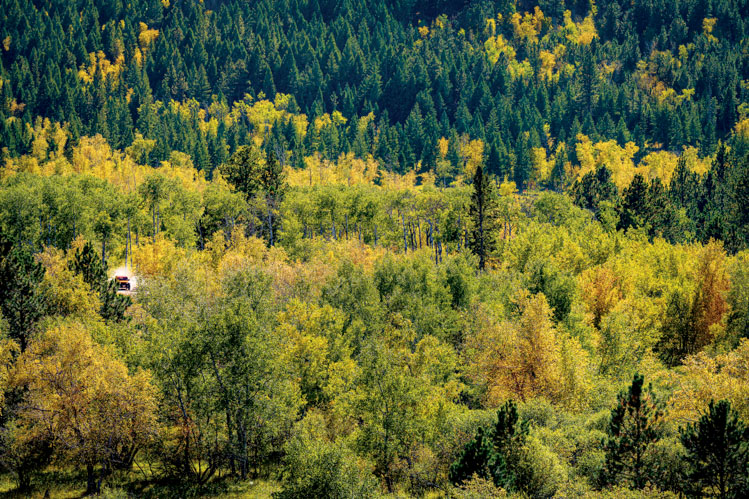
Drivers experience an autumn smorgasbord along Palmer Creek Road, which winds through thick aspen forests and broad meadows.

A SOLITARY COTTONWOOD tree on the lonesome prairie, when bejeweled with golden yellow leaves, emanates as much beauty as the human eye can absorb — especially when the sun slips southward, leaving the September sky bluer than blue.

Yet, who looks for a single tree in autumn? We tell ourselves we must see mountains and hillsides and river valleys with their forests full of leaves, each one hanging precariously by a stem, fluttering unworriedly as if winter was a thousand years away.

So yes, of course, go forth this autumn and fool yourself into believing that this glittering season is not just a cruel trick of chlorophyll. Life will always be so good. Calamity can never follow such serenity. South Dakota is paradise eternal.

Certain places in our big state are especially guilty of contributing to the delusions of autumn, beautiful though they may be. Traffic jams can occur on Highway 14 in Spearfish Canyon during peak leaf-peeking days. Sica Hollow’s oaks are almost as beguiling for people who live in the northeast. Our urban forests are resplendent in different ways because city parks and boulevards feature a gloriously unnatural mix of planned and planted trees. The McKennan Park neighborhood in Sioux Falls is an exceptional example.

We asked our chief photographer, Chad Coppess, if he knew of some lesser-known fall foliage tours. He suggested the three that follow. Interestingly, one that he chose is at South Dakota’s very lowest elevation while another is near the highest. Chad’s diplomatic third choice lies in between, along the Missouri River.

These routes won’t have bumper-to-bumper traffic in September and October when our leaves change color, but that is part of their allure. Autumn is even more striking when you escape the crowds.


PALMER CREEK

Pennington County

The graveled Palmer Creek Road is less than 4 miles long yet offers more than its weight in gold leaves between two spectacularly located campground resorts. Horse Thief Campground and Resort lies on the southwest end of the road and the Mount Rushmore KOA at Palmer Gulch Resort on the northeast. Both campgrounds have funky little stores that offer snacks and refreshments.

Midway along the road, an engineer had some fun by designing a double crisscrossing section with an over-under bridge and a cut through a rock that delivers a jaw-dropping view of Black Elk Peak no matter which way you are traveling. The road winds through beautiful aspen groves and, at times, offers a panoramic view of the entire gulch.

Little-known fact: Along the road is a parking area for Palmer Creek Trailhead, where you can trek to the top of Black Elk Peak (South Dakota’s highest point) and beyond.


PLATTE-WINNER BRIDGE

Gregory and Charles Mix counties

Those who prefer to venture off the interstates know that Highway 44, a main artery across the southern third of South Dakota, crosses the Missouri River via the Platte-Winner Bridge.

The stretch between Platte and Winner is 53 miles. The most scenic area features bluffs that drop into the river valley where you’ll discover two state recreation areas — Snake Creek on the east side and Buryanek on the west.

Lewis and Clark traveled here in 1804 and 1806, at one point losing a member of their party for several days. The Shannon Hiking Trail in Snake Creek Recreation Area commemorates the lost explorer and gives expansive views of the river and autumn colors.

Little-known fact: Unless you live in the neighborhood, you may not have heard that the mile-long Platte-Winner Bridge is about to be replaced. Construction on a new bridge may begin in 2025.


BIG STONE LAKE

Grant and Roberts counties

State Highway 109 runs up the South Dakota side of Big Stone Lake in the northeast corner of the state with a view across the lake into Minnesota. We recommend the 15-mile stretch from Big Stone City to Hartford Beach State Park with frequent stops at access points to the water. The route offers a variety of vegetation and colors for leaf peepers. Hartford Beach is one of the oldest South Dakota state parks and is popular with campers, boaters and fishermen. The log cabin trading post of Solomon Robar, along with Native American burial mounds and pioneer graves, are found along the hiking trails in the park.

Little-known fact: The shoreline of Big Stone Lake (elevation 965 feet) is the lowest spot in South Dakota.

Editor’s Note: This story is revised from the September/October 2023 issue of South Dakota Magazine. To order a copy or to subscribe, call (800) 456-5117.

Posted on — Leave a comment

David Wolff’s Black Hills

David Wolff spent 17 years teaching history at Black Hills State University in Spearfish. His new “Black Hills History Tours” book series blends travel with the region’s most colorful historical stories.

Every mountain range needs a few curious historians. They help the rest of us appreciate the peaks and valleys.

David Wolff of Spearfish fills that role in the Black Hills, and now the former professor is embarking on a six-book project that will not only recount the region’s colorful history but also serve as a guidebook for those who share the author’s itch to explore.

Mountain towns also need pharmacists — and that’s where Wolff got his start. Forty years ago the Denver native who was raised in Wyoming was working the pharmacy counter at a Pamida store in Sturgis. He wrote a history paper as an amateur and took it to a conference organized by university historians.”Pharmacists wear ties and that’s what I wore to the conference, and the history professors moved toward me when I arrived, assuming I was one of them,” Wolff recalls. He sensed they were less enthusiastic in greeting an amateur when they learned his identity.

The pharmacist eventually left the Black Hills, off to greener medicinal pastures, people in Sturgis surmised. In fact, he left to study history, first at the University of Wyoming where he earned bachelor’s and master’s degrees, and then at Arizona State University where he gained a Ph.D. In 1998 he returned to South Dakota to teach at Black Hills State University. He became Dr. David Wolff not as a matter of pursuing a personal goal or for job security (no one will tell you a historian’s position is more secure than a pharmacist’s). Rather, Wolff became a historian because he considers the field vital, especially the multi-layered history of the Black Hills and its mining culture — a significant component to American history overall. And yes, the snub he sensed at that long-ago conference was a motivator in reinventing himself. He didn’t want the lack of academic credentials to limit his ability to reach the public through university offerings, writings and at local history society talks that are free and open to all.

“He comes across as an everyday person,” says photographer and author Paul Horsted, creator of books with photos that compare and contrast historic and modern images.”But he’s got such a depth and command of knowledge at his fingertips, especially gold rush history and what happened afterward. As I was feeling my way in learning that history, David was so kind in being a sounding board.”

When Horsted mentions Wolff’s depth, he could include his friend’s recognition of romance in even the gritty business of mining. Wolff remembers the soft glow of light emanating from windows in Deadwood and Lead’s mining mills, reduction plants and slime plant at night as his family vacationed there –“evidence of workers’ massive efforts, round the clock, in grinding out wealth from the earth,” he says. The Wolffs lived in Cheyenne, Wyoming, when he grew up. His dad was a traveling salesman, mostly supplying drug stores. David sometimes tagged along and that was his introduction to pharmacists — nice people and important members of their communities. Wolff’s parents encouraged him to pursue pharmacy himself. Sure, they knew David’s interest in history and his love for Wyoming’s past as documented throughout the capital city and at nearby Fort Laramie.

“But nobody in the world I grew up in thought you could make a living in history,” Wolff says. Still, the idea briefly crossed his mind in college after reading Watson Parker’s classic Gold in the Black Hills. Wolff wrote to Parker, a history professor at the University of Wisconsin-Oshkosh, and Parker replied. He thought Wolff might be better off using money that would cover tuition for building a personal library of good books delving into history.

If Wolff got a delayed start as a historian, he more than made up for it — and continues to do so with an agreement with the South Dakota Historical Society Press to author six books in the coming years that will combine Black Hills driving with learning history. He taught 17 years at Black Hills State, a period that overlapped 18 years as a member of the South Dakota State Historical Society board of trustees. Still, the term he feels best describes him is simply”a history buff.”

Which is exactly how he comes across sitting in downtown Custer’s Way Park talking to a couple friends about historic cabins. Specifically he mentions this park’s Daniel Flick cabin, long proclaimed as the first built in the Black Hills. And that may be, Wolff says, although it’s unlikely the structure would pass a test by modern historians for such designation. Judge Henry Way pretty much declared the Flick cabin as first while developing the park across the street from the county courthouse in the 1920s.”That was fifty years after the presence of gold in the Black Hills was first confirmed in Custer,” Wolff says,”and the men and women who were here soon after gold discovery were aging and wanted credit for what they built. Almost every town in the Black Hills had its cabin.”

Wolff met with author Paul Higbee (right) in Custer’s Way Park. Despite his long academic career, Wolff says the title that best describes him is “history buff.”

Wolff believes the demand for credit by pioneers is more interesting than whose cabin came first. And while the Black Hills claimed structures more impressive than those humble dwellings — especially its great mines — there was something uniquely American about log cabins. They seemed to assert the Black Hills had become part of America rather than uncharted territory.

“There are a lot of myths and mistakes in history,” Wolff says.”I started out thinking I could correct those things. But misinformation hangs on so tenaciously.” People tend to believe what their families told them as kids, whether they lived in the Black Hills or visited as tourists. Embellished tales survive because they incorporate good storytelling techniques. Deadwood, most South Dakotans understand, has spawned myths since its founding in 1875 and 1876, and the HBO series Deadwood, which ran from 2004 to 2006, took that mythology to new heights. Wolff, frequently asked to comment on the series during its run, understood it as historical fiction and not a history lesson.”Something I looked for in the show, though, was whether or not it remained true to the personal qualities of the historical characters it portrayed,” Wolff says.”And I think it mostly did.”

For example, take Deadwood’s first sheriff, Seth Bullock. The series’ writers and actor Timothy Olyphant created a lawman who was mostly hands-off when it came to little things.”That was authentic to Bullock,” Wolff says.”He didn’t go after the drunk and disorderly and thought that celebrating by shooting into the air was okay.”

Wolff accepted an invitation to discuss Bullock on the Discovery Network’s Gunslingers series. It turned out well although he had to tell producers there’s no evidence that Bullock slung his guns or engaged in shootouts. And the program prompted this question: What does a professional historian facing TV cameras look like? It seems there’s a school of thought that says anybody living in the West and writing its history must be so enmeshed in the culture that they dress in character.”The Discovery Network asked me to show up with my look,” Wolff recalls.”I don’t have a look,” and he didn’t invent one for the appearance.

Wolff accepted another invitation related to Bullock, this one from the state Historical Society Press to write a biography, Seth Bullock — Black Hills Lawman. The book came out in 2009 and addressed aspects of the subject’s life that were not fodder for a TV shoot-em-up: personal friend of Teddy Roosevelt, government official who worked to establish Yellowstone National Park, federal Black Hills Forest Reserve (today’s Forest Service) superintendent, ranching innovator and Belle Fourche founder.

Wolff’s next book for the Historical Society Press profiled a remarkable Deadwood man, James K.P. Miller, strangely forgotten by history. Even Watson Parker told Wolff he never heard of him, although when Miller died at age 45 in 1891 a local paper predicted”his name will always be coupled with the prosperity of Deadwood and the Black Hills.” But it wasn’t, and no one was more instrumental in retrieving it than Wolff 130 years later. Among tools Wolff worked with in exploring Miller’s life and times was newspapers.com, technology that didn’t exist when he wrote the Bullock book. Miller was a native New Yorker, frontier grocery proprietor, builder of Deadwood’s Syndicate Block, and a wheeler-dealer who brought two railroads into Deadwood by setting up something of a competition between the Fremont, Elkhorn and Missouri Valley Railroad and the Burlington and Missouri River Railroad.”Sometimes we forget,” Wolff says,”how competitive railroads were back then. They hated each other.” Miller apparently understood that industrial hatred and made it work for Deadwood, which became one of a select number of South Dakota towns served by two railroads. Very likely that saved Deadwood from deteriorating into something unrecognizable and beyond rehabilitation in the years after the gold rush.

Without Miller, would there have been Days of ’76 celebrations, today’s gaming industry or the Deadwood TV series? Maybe not. The Miller biography, The Savior of Deadwood, James K.P. Miller and the Gold Frontier, was published in 2021.

The Gold Rush and The Gateway to the Hills are the first two installments of Wolff’s “Black Hills History Tours” series.

Wolff’s new book, The Gold Rush, is far from a biography. It resembles the Works Progress Administration’s state guidebooks of the 1930s, with more detail yet retaining a thumbnail listing format. The book identifies driving routes from Custer northward (later volumes in the series will take travelers elsewhere through the Black Hills and surrounding plains), identifying historic locations along the way.”It is a travel book,” Wolff says,”but I don’t recommend places to stay or eat. It’s all history.”

It’s history that is found along roads accessible by regular cars — no ATVs required. Among the author’s favorite sites, most retaining an air of historical mystery, are the Flick cabin and the so-called China walls at Galena (on Galena Road off U.S. Highway 385 south of Deadwood). Galena was best known for its silver mines in the 19th century but in 1909 it was announced that the area held great quantities of copper. Construction began on a copper mill but only stone walls, impressively crafted, were completed.”It has become commonplace,” Wolff says,”to look at old rock work and mistakenly assume Chinese did it.” Indeed, Chinese laborers contributed to much construction during the Black Hills gold rush early on, but by 1909 few remained. Was there really a copper fortune to be mined at Galena? No, says Wolff.

There was no shortage of nefarious mine developers who attracted naÔve investors to sink money into operations that would never yield profits. Three-and-a-half miles below today’s Pactola Dam, about 10 miles west of Rapid City on Highway 44, the Fort Meade Hydraulic Gold Mining Company (perhaps named for Fort Meade army officers who invested) began blasting a tunnel to move water for a sluice box that would work supposedly gold-rich gravel. The company’s very real tunneling, done from 1879 to 1882, probably kept investors engaged, but it closed. Soon, another company picked up the work, also relying on investors, but disappeared in 1889. Not much gold was recovered. What remained was a tunnel moving swiftly flowing water and an underground falls, later illuminated with electricity and named Thunderhead Falls for tourists. The attraction is permanently closed now, but the inspiring natural setting of cliffs and rushing waters makes it easy to see how investors thought something good was bound to take root.

Another site Wolff introduces is one the Forest Service calls the”only gold mining site on the BHNF (Black Hills National Forest) with a standing mill frame.” That’s the Gold Mountain Mine, northwest of Hill City down Burnt Fork Road. Lots of infrastructure work was done there in the 1920s and ’30s.”There is, however, no record of production,” Wolff says. That didn’t stop the Black Hills Historic Preservation and Trust Society from deciding to preserve the mill, rock work and exterior boilers a few years back, with volunteers and students from the Boxelder Job Corps Work Center, joining the effort.

This is a travel book, yes, but it will undoubtedly reach armchair travelers around the world and find use as a well-organized reference. A glance reveals the remarkable range of historic personalities connected to the Black Hills across the years, from giant American industrialist George Hearst (who developed Homestake, the western hemisphere’s biggest gold mine at Lead) to Lakota traditionalists committed to retaining a modern presence. Wolff is certainly describing more authentic Indigenous historical views than the WPA writers and in part credits landing on the faculty of Black Hills State, a university committed to Native course offerings and its Center for American Indian Studies. In particular he appreciated his late colleague Jace DeCory, a widely respected Lakota elder and teacher.”She was invaluable in helping me understand Lakota perspectives, and was always balanced and thoughtful,” Wolff says.

The book was released this summer, and surely readers will want to collect the entire series of six. They won’t wait long. There’s a chance the second will come out later this year, and Wolff and his editor and designers are working at a pace that could see two more published in 2025 and the remaining two in 2026. Upcoming books will address the Lawrence County triumvirate of Deadwood, Lead and Spearfish, Rapid City and the central Hills, the southern Hills, the Belle Fourche River and Wyoming Black Hills, and what Wolff calls”unknown, under-told or under-appreciated stories.”

The Black Hills delight people who sometimes declare they’ve found a pristine natural environment. But travel with David Wolff and you’ll see it’s a rare patch of the Hills that hasn’t been touched profoundly by humans — Lakota defenders, the U.S. Army, railway builders, miners, loggers, engineers who transformed land and water, town builders and, after devastating fires, town rebuilders.

Editor’s Note: This story is revised from the September/October 2024 issue of South Dakota Magazine. To order a copy or to subscribe, call (800) 456-5117.

Posted on — Leave a comment

Grandmother Power

Native American leaders from across the state, including (from left) Cecilia Fire Thunder, Arvol Looking Horse and Belinda Joe, attended a Women Take Back Honor event at the Dignity of Earth and Sky statue near Chamberlain.

FORT THOMPSON IS A complicated place with a tragic history, but the tribal community’s residents are finding hope in grandmothers like Belinda Rencountre Joe, a scholar and dancer with a vision for action.

Joe is among the organizers of Women Take Back Honor, a four-year initiative to restore the leadership role of the woman in Native American culture. The effort began a year ago with a day-long event at the Dignity of Earth and Sky statue near Chamberlain.

Grandmothers empowering girls is an intriguing concept, so we telephoned Joe to ask if we could come to Fort Thompson to learn more about her efforts.

“Can you hear me?” she answered.”I am standing outside on my porch looking at the full moon.”

Yes, we heard her loud and clear.

When told that the success of the Women Take Back Honor event prompted our call, she laughed and said it was a coincidence that she was looking at the moon.

“The full moon symbolizes the woman,” she explained.”It symbolizes the woman’s gift to meditate and pray and then get things done. The full moon is when we are at our strongest.”

She said her own activism took hold in 1999 when she and her aunt, the late Stella Pretty Sounding Flute, represented Crow Creek at World Peace Day in San Juan, Costa Rica.”A message was given to me there, a seed was planted, that the grandmothers — Native and non-Native — have a role that must be renewed. It felt like a message from our Creator, Him or Her? I don’t know.”

She says the participants prayed on a mountain for four days, and on the last day several Indigenous grandmothers called her over to them, gave her gifts, and then asked her to”keep the light going within our women in North America, and they would do the same in South America.”

She admitted that she felt unsure that a Dakota girl from Buffalo County could bring that Indigenous message to fruition.

*****

A FEW DAYS LATER, we drove to Fort Thompson on a hot summer day to meet Belinda Joe and learn more about her mission to empower women.

We exited Interstate 90, South Dakota’s principal east-west highway, at Chamberlain. The road from there to Fort Thompson parallels the Missouri River and winds past prairie foothills covered with wild grasses and occasional herds of cows and horses.

Belinda Joe walks along the Missouri River at a park known as The Old Fort with Hillary Hyde, a local youth.

Fort Thompson, with a population of more than 1,200, is the largest community in Buffalo County and the Crow Creek Reservation. The name Thompson is a constant reminder of its tragic history. Clark W. Thompson of Minnesota was serving as Superintendent of Indian Affairs in Abraham Lincoln’s administration when bloody battles and skirmishes broke out that are now referred to as the U.S./Dakota War of 1862. The hostilities between the Dakota and pioneer families were sparked by broken treaties, poor administration of government programs and the brutal winter of 1861 that led to starvation and frustration.

More than 400 settlers and soldiers were killed in the war. Historians didn’t document how many Dakota died, but 303 Dakota warriors were sentenced to death by a military court. Episcopalian Bishop Henry Whipple asked Lincoln to intercede, arguing that they were prisoners of war. Even though the president was overwhelmed with the Civil War, he took time to review each case and cut the number to 38, who were hanged in Mankato, Minnesota, on Dec. 26, 1862. It still stands as the largest mass execution in American history, and probably always will.

In the spring, Congress abolished the Dakotas’ Minnesota reservation, nullified the treaties, crowded 1,300 men, women and children onto steamboats and exiled them to live on the eastern shore of the Missouri River in Dakota Territory. A federal order mandated that the Dakota race,”be annihilated or forever pushed from the boundaries of Minnesota.” A $200 bounty was placed on every Dakota Indian, causing many of them to be hunted for years. Others died of disease, malnutrition and despair.

The story of the war and the infamous date of the hanging is well-known to all residents of Crow Creek today, many of whom are descended from the executed or of the hundreds of Dakota who were incarcerated as prisoners of war.

The descendants created communities in the forested bottomlands of the Missouri River by building homes, churches, stores and schools. And despite federal efforts of forced assimilation, some of their culture was preserved in the shade of the cottonwood trees.

Then in 1963 the federal government finished Big Bend Dam and flooded 56,000 acres, including many small communities of the Dakota. Families moved to higher ground, and that is when many came to live at Fort Thompson.

Ironically, the 3-mile earthen dam was completed exactly 100 years after the beleaguered Dakota arrived on the river. Hardships at Crow Creek remain today, but Belinda Joe and others like her promise that there is reason for hope, and their hopefulness lies in the cultural strengths that their Dakota ancestors brought with them on steamboats from Minnesota and somehow kept alive in that cottonwood forest.

*****

BELINDA JOE MET US at the Lode Star Casino, a windowless coliseum of glitz in an otherwise humble town that has few private businesses other than three convenience stores. There are four churches and myriad tribal government buildings. The casino has the town’s only restaurant, so it often hums with a lively mix of ranchers, local families and visiting gamblers, including many who come to fish for walleye on the nearby river.

Joe is 69 years old with striking white hair. She is tall, gracious and articulate, though she was easier to interview that moonlit night on the telephone because at the casino she had a 5-year-old grandson, Oaklynd, in tow. Altogether, she has three children, 14 grandchildren and four great-grandchildren. While at the casino, she was also trying to arrange a trip to Chamberlain to gather some clothing and bedding for a family in need. In fact, everyone she met at the restaurant had a question or a request.

We ordered sandwiches, but she soon asked for a to-go box because she hardly took a bite between phone calls, table visits and telling her story to us. Life was simpler when she was Oaklynd’s age, she laughed.

“We lived off the land,” she recalled of her childhood in the 1960s.”We ate wild game, which our dad and male relatives brought home. We fished and picked wild fruits. We grew our own potatoes. In the summer we walked down to the river and swam all day and then walked home.”

She says the family home, on the east side of Fort Thompson, was a hub for young relatives.”They would help us bag potatoes, and we would play a neighborhood game of softball, tag and make-believe.”

Her father, Whitney Rencountre, was a paratrooper in the Korean War who later worked as a tribal policeman and road worker. He hunted and cured mink pelts to buy groceries.”We grew up poor, but we didn’t see it as poor because we had everything we needed and the mainstay of that was our family. We were very close.”

She remembers her father as a good man who was always present. He and other relatives sang around a drum during warm evenings, and it was there that Belinda learned the songs and dances of the Dakota. The drum group, the Hunkpati Singers, still performs today.

Her mother, Thelma Black Tongue Rencountre, was the backbone of the family.”She was a petite woman who could do whatever it took to survive. She grew up as a Lakota girl in Promise, South Dakota, and was sent to the Pierre Indian Learning Center and the Stephan Mission when it was a harsh boarding school.” She spoke Lakota, English and Dakota.

Her father ran away from boarding school as a sixth grader, and her mom’s education was hampered by cruelties and illnesses. However, Belinda found refuge in books and became a voracious reader of stories that took her around the world. When she was a sophomore at Gann Valley High School, an encouraging teacher told her she had the talent to go anywhere she wished, and she taught Belinda to speed read.

“But I was scared to leave the reservation,” she recalls. A few years later, a young man on leave from the Vietnam War went to her father and asked if he could marry her — without asking her.

Her father’s answer was,”No, she’s going to college.”

Belinda remembers feeling relieved that he said no, but also thinking that she didn’t want to go to college because she wanted to see the world and she believed the only options for women were to be a nurse or teacher. Instead, she went to Denver and studied to become a court reporter. After working for the Navajo Tribe and the Bureau of Indian Affairs, she eventually gravitated home to Crow Creek. There was no work for a court reporter so she went back to school and earned degrees in education, determined that she would not discourage her students from learning about their own heritage.

Combining her mother’s fortitude and her relatives’ cultural teachings, Joe soon became an instrument of change at Crow Creek. She incorporated Dakota and Lakota songs, stories, dances and identity into her elementary curriculum and encouraged the students to use their voices to empower other youth.

She brought her young dancers to the dedication of Dale Lamphere’s Dignity statue in 2016. Lamphere’s 50-foot stainless steel sculpture of a Native woman wrapped in a star quilt immediately became an inspiring symbol of feminine empowerment. Jane Murphy, the sculptor’s wife, says several dozen Native and non-Native people are working on a vision that fits the art and the times.

Dignity, by artist Dale Lamphere, honors the cultures of the Lakota and Dakota people.

“Belinda did a blessing of the ground at Dignity before the ground was broken,” Murphy says,”and she is so connected to the Native culture and the people of her community, so she needs to be a part of this.”

Joe says she wasn’t really looking for another role, but the opportunity to build an initiative around Dignity seemed like a path to the calling she felt in Costa Rica.

Three years after the Dignity dedication, Joe accompanied Native Korean War veterans to Seoul, South Korea, where she represented her father and other veterans. At a banquet, she sang the Lakota Brother Song to honor the warriors.

While in Seoul, she learned of the”Comfort Women” who were taken from their homes in Korea during World War II and forced into sexual slavery by the Japanese military. Some of the victims are still alive, and they recently received apologies from Japanese grandmothers as well as the Japanese government after decades of official denials.

Joe says their story reinforced her commitment to honor the women of all nations.”Perhaps someday we Native and non-Native women will receive apologies for the harm we have endured and recovered from,” she says.”A legacy of love and honor is what I pray for in my lifetime, for we are the life-givers of our families, communities and nations.

“Our language and our culture are our lifelines to the past, to today and to the future,” she says.”Too many of our youth are struggling with addictions, drugs and alcohol. I believe we are targeted because we are vulnerable. We are targets because of our poverty, targeted by the dealers and even by some of our own people. It’s an easy way to make money. They groom you and pull you in because there aren’t many jobs here for young people.”

Along with her teaching career and community activism, Joe also serves as the prison liaison for the Crow Creek Sioux Tribe, visiting young men and women in the state prisons at Pierre and Sioux Falls during their spiritual conferences. Some of the young inmates are former students. Some are relatives.

“Most of our young males and females are in there for crimes involving meth — ingesting, using, selling, transporting,” she says.”A young grandson went in two weeks ago. In our Indian ways, they are all our grandsons and granddaughters, and we have an obligation to guide them and correct them and help them.”

Prior to one of her first prison visits, inmates warned her that her life was in danger. A threat was made by an inmate who was enraged that she’d reported a case of child abuse. Because Joe is a teacher, she is a mandatory reporter.

“At this point in my life, I wasn’t going to stop the visits,” she says.”My legs were shaking but I went anyway.”

When she arrived, the grateful inmates welcomed her warmly and promised they would see to her safety.”Come in and light up the darkness,” said one man. They presented her with a star quilt and beaded medicine wheel crafted by an inmate who worked all night to have it ready.

*****

THE TRIBAL HEADQUARTERS at Fort Thompson, a modest, metal gymnasium-style building, is a beehive of activity. People are constantly coming and going, asking about utility problems, stray dogs, vandalism and all the things that are talked about at city halls across the United States. Meanwhile, a half-dozen youth are shooting baskets while others visit on the bleachers.

At the center of it all is Peter Lengkeek, the 48-year-old tribal chairman who stands as straight and tall as he did when he served in the Marine Corps despite some service-related back injuries that cause him to work today from a stand-up desk.

He lowered the desk to normal height and sat down to visit with us about Joe’s work to empower the women.

“I think it’s beautiful,” he said.”It has to happen. The woman thinks from the heart,” he said, holding his hand to his heart,”while us men, we are from here” (pointing to his head).”Our culture was traditionally more matriarchal, but we were forced into a patriarchal society. It is unnatural for us, and it is not working for us.”

Though Lengkeek says the Marines were his only”college,” he speaks like a studied philosopher and historian when he reflects on his Dakota culture. He maintains that the rightful place of the women of the Dakota and other Native American tribes was diminished in the 19th century because”the government would only recognize men as leaders.” Wars, diseases, poverty and forced assimilation further reduced the traditional role of the woman in Dakota society.

Lengkeek says restoration of women’s rightful role will strengthen the entire culture, both at Crow Creek and other tribes.”We need healthy relationships, healthy communications and healthy boundary settings. Our young people must learn how to regulate your emotions, how to control your anger. That is something our language and culture teaches us. It teaches us how we address the physical, the spiritual, the mental and the emotional on a daily basis. Today, too often, we seem to care only about the physical. Our patriarchal society teaches us to put the emotions down and to not show weakness, compassion, tenderness, and love.”

Lengkeek says young people must have a good concept of healthy masculinity and healthy femininity.”The work of Belinda and others like her give me hope. Our aunties have a special obligation to teach. I’ve seen our women teaching our culture and traditions, teaching us how to pray. They are giving us hope.”

The tribal chair says he experienced the lack of culture in his own childhood at Crow Creek.”Many of my generation were not raised with the language and the culture, but when we hear it, we connect with it, and we want to learn more. My mother was raised in a boarding school. She could talk Dakota, but she never spoke it around us.

“On her deathbed, she was talking in her native language, and I was listening to her without her knowing I was there. Then she realized I was holding her hand and she stopped.

“Mom,” I said,”why did you not teach us this beautiful language?”

Lengkeek says his mother began to cry, and then she said,”I didn’t want you to go through what I had to go through.” She’d been so traumatized at boarding school by assimilation-minded teachers that she couldn’t bring herself to speak Dakota to her children.

Yet, Lengkeek says the language still has a powerful impact on Dakota youth.”A lot of study has been done on cellular memory, and it is recognized today as something real. Our people suffered historic trauma, but they also have a cultural or cellular memory that goes back to the early days of time. They did their best to take our culture and our language from us, but it is still here. They did their best to dehumanize us, but we are still here. All it did was make us stronger, make us more resilient. Yes, we are one of the poorest counties in the United States — but we are also one of the richest because we still have our culture.”

As the tribal chairman talked to us, Belinda was mingling with youth in the gymnasium. She wanted us to meet them, beginning with Keith Heth III, a 16-year-old who loves to skateboard, play the guitar and learn his native Lakota language.”My people went through 100 years of depression,” he says.”I love staying true to the culture and tradition.”

Jayton Pease, 19, is studying business management at Presentation College in Aberdeen. He hopes to return to the reservation to start some businesses, perhaps a barber shop and an arcade.”The younger guys look up to us older guys. It’s pretty cool but it brings a responsibility to set a good example,” he says.”I have a cousin who ended up in a dark place, but his young daughter helped him come back in the light.”

Hillary Hyde, 20, was shooting baskets. She says she worries about many of her friends.”Whenever I see police cars on the road, lights flashing, I pray for them. I wish I could change the world. They just need help, somebody to talk to. A family member or a friend. I saved a little cousin from drowning in a pool in Rapid City. Now I want to save him from drugs the same way, protect them all.”

Perhaps Joe took us to the gymnasium to show us there are others like her working for change. Or maybe she just wanted to occupy us while she returned phone calls to arrange for the clothing assistance.

As we talked with Hillary, Joe dialed a number and said,”I was supposed to be there at 3 to pick up the clothes. Will you still be there if I get there at 3:30?”

She handed her uneaten sandwich to one of the youth who hadn’t had lunch, then she rushed for her car, which she calls her”white pony.”

“Call me later,” she said.”I’ve got to go.”

Editor’s Note: This story is revised from the September/October 2022 issue of South Dakota Magazine. To order a copy or to subscribe, call (800) 456-5117.

Posted on — Leave a comment

A University Town

Burbank is a town along the old Dakota Southern Railroad about 6 miles from Vermillion and the University of South Dakota. It was named for John Burbank, the governor of Dakota Territory and a railroad director, when the line came through in 1872.

Burbank doesn’t look like a college town when you first arrive. The little village is surrounded by corn that grows 7 feet high in the lush bottomlands of the Missouri River.

Burbank has dirt streets. Chickens outnumber people two to one, and its most prominent architectural features are a railroad track and an old grain elevator.

But nearly every Burbanker has a connection to the University of South Dakota in Vermillion, just 6 miles away.

Jim Slattery runs Whimp’s, Burbank’s only eatery — and its only business — along with his brothers Nick and Tom. He learned to cook at the Silver Dollar in Vermillion while studying political science at USD.

He acknowledges that the town looks more like a traditional farm town. Some of the locals wear Coyote red with their seed corn caps, and they frequent Whimp’s along with professors and students.”The farmers know I’m a city boy,” Slattery grins.”I haven’t been asked to drive a tractor, but I can do that.”

Whimp’s was started in 1967 by Leonard”Whimpy” Girard and it has been a staple ever since, thanks to the Taggarts and Radigans who also spent stints as owners. Now it’s the Slatterys’ turn. All four families are”old names,” both in Clay County and on the USD campus.

The Slattery brothers haven’t changed the menu or decor since buying Whimp’s as well as Toby’s, a popular chicken shack in nearby Meckling — which is like a sister city to Burbank on the west side of Vermillion.

Whimp’s’ menu has six signature burgers (Burbank, Keg, Cornhusker, Mushroom & Swiss, BBQ Bacon Cheddar and the Dark Lord).”We’re one of the few places you can still get liver and onions,” Slattery says.

Popular specials include the $5 cheeseburgers on Tuesdays, chicken wings on Wednesdays and all-you-can-eat spaghetti on Thursdays, with mouth-watering meatballs made from tenderloin trimmings.

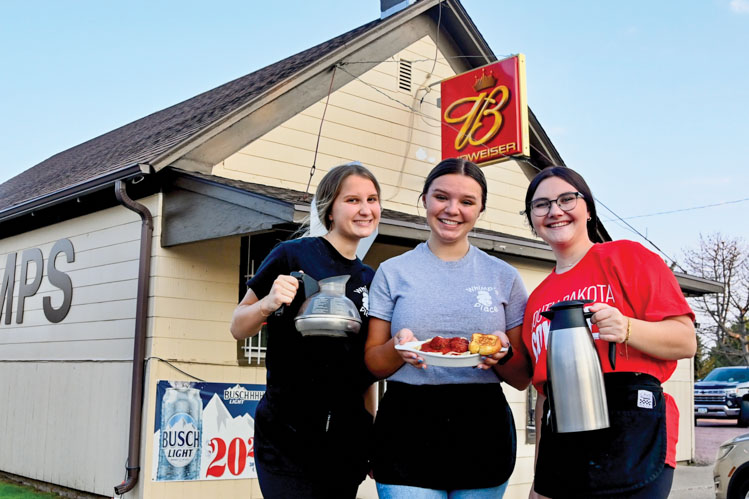
Carley Johnson, Grace Reynolds and Taryn Taggart are students at USD and waitresses at Whimp’s, a popular eatery in Burbank.

“If we can make it, we do it,” Slattery says.

Ted and Karen Muenster — namesakes of USD’s Muenster University Center — were at the bar for a recent spaghetti night.”We drive out here one or two nights a week,” says Ted, who’s now retired from a distinguished career in business, politics and academia. Karen served as a state senator from Sioux Falls and was a leader in historic restoration of downtown Vermillion for many years.

“Whimp’s has always been run by these old families who have been well-connected to the university,” Ted says.”Some people say it’s wicked,” he grins, gazing at the lawyers, teachers and retirees seated at simple tables.

Despite Burbank’s tiny population, Muenster notes that hundreds of thousands of people live within a 40-mile radius encompassing Yankton, Sioux City, Sioux Falls and Vermillion, so Whimp’s is actually a dirt-street oasis in a well-populated region.

The tiny town has a history of attracting outsiders. Frank Verzani, an Italian immigrant, ran a ferry on the Missouri River, just a few miles away. His crossing was called Victors, and then Green Point. When the Dakota Southern Railroad extended into Dakota Territory in 1872, the community was renamed in honor of John Burbank, the fourth governor of the territory and a director of the railroad.

Bob Hudelson is one of the few Burbankers without a connection to the nearby university, but he knows history and his own life story sounds like a Charles Dickens novel.”I was raised on the streets of Sioux Falls,” he says. He escaped from an orphanage and made his own way as a child, thanks to the benevolence of kindly policemen, store owners and others who helped him find a place to sleep and a meal. On some cold nights, he remembers being locked inside stores so he would be safe and warm.”I wish I knew how to say thank you to the people of Sioux Falls who helped me survive as a boy,” he says.

Ted Muenster (left), a longtime champion of USD, is a regular at Whimp’s, now run by Jim Slattery (right) and his brothers.

For 23 years, he and his wife Barbara have lived in Burbank, where he has soaked in the wicked past that Muenster referred to. Hudelson says Burbank was a wild cow town because ranchers brought stock here to be shipped on the railroad. He points to a house that was once a brothel and tells a story of when the notorious outlaw Jesse James nearly got involved in a shootout on main street.

Jerry and Colleen Johnson live across the street from the Hudelsons, along with a dozen ducks, 10 dogs and more than 200 chickens. Colleen takes the eggs with her to Vermillion every day, where she works as a custodian at the university.

“I like it here because at 6 o’clock at night it’s so quiet you could hear a pin dropping,” Johnson says. Or a rooster crowing.

Like any university town, Burbank has an ongoing fundraising project. It involves a historic school building that closed in 1972. Every September, the town holds a barbecue to raise money for repairs to the school, which is now used as a community center.

Nick Slattery, a local contractor and part-owner of Whimp’s, helps with the project. His brother, Jim, assists with the food.

“We’re here to help, whether it’s the schoolhouse or whatever,” Jim says.”This will not be a ghost town. There will always be people here.”

Editor’s Note: This story is revised from the November/December 2024 issue of South Dakota Magazine. To order a copy or to subscribe, call (800) 456-5117.